

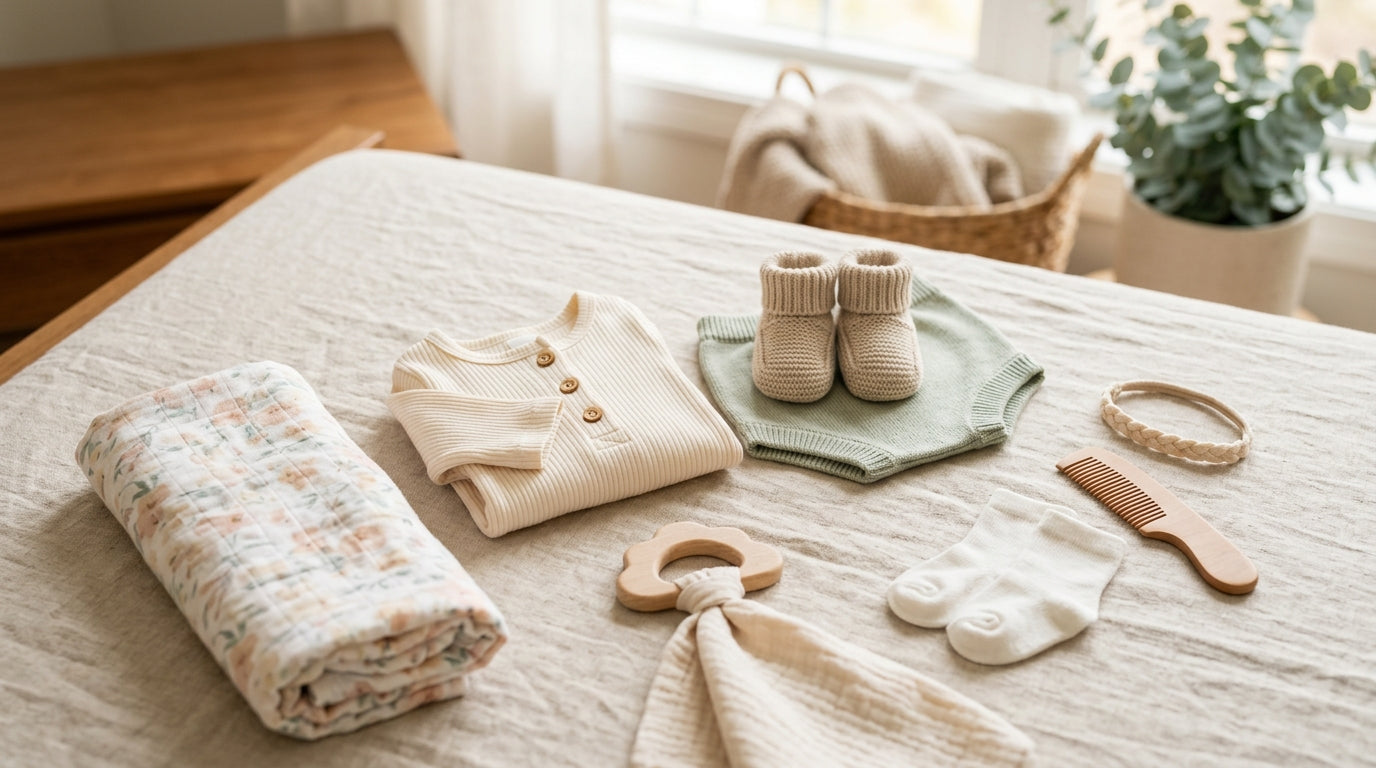
I'm currently standing in the disabled toilet of a Costa Coffee in Wandsworth, staring in abject horror at my daughter’s back. She is wearing a gift from a well-meaning great-aunt—a vintage-style, sage green dress featuring no fewer than fourteen microscopic buttons running down the spine. My other twin is attempting to lick a discarded sugar packet off the linoleum floor. I've exactly three minutes before a code-red nappy situation breaches the elastic leg cuff, and I can't, for the life of me, undo button number four. This is the dark, hidden underbelly of what society politely calls dressing your infant.
Before having twin daughters, my understanding of baby gear was largely theoretical. I assumed you just bought small, soft things, put them on the small, soft human, and went about your day. I was completely unprepared for the sheer architectural complexity of modern infant fashion, or the alarming speed at which a perfectly pristine outfit can be ruined by an entirely unexpected bodily fluid.
The structural integrity of tulle and other disasters
Let’s talk about the absolute madness of rigid materials on newborns. When you're frantically searching for cute baby girl clothes online at 2am, the algorithm will inevitably serve you images of infants wearing miniature, stiff denim jeans and multi-layered tulle skirts that look like they could filter microplastics out of the ocean. Don't fall for this. You haven't known true despair until you've tried to shove a squirming, furious, wildly kicking leg into a pair of tiny rigid jeans while heavily sleep-deprived (a task roughly equivalent to trying to dress an angry octopus in a telephone box).
Babies spend ninety percent of their early lives lying on their backs, digesting milk, and attempting to figure out how their own hands work. Putting them in a restrictive, scratchy tutu is borderline cruel, mostly to the parents who have to listen to the resulting screams. The glitter alone from one of these dresses has permanently bonded with our living room rug, creating a sparkly reminder of my own naive purchasing decisions.
Meanwhile, baby shoes are a complete psychological grift and anyone who buys them is participating in a mass delusion.
What our health visitor muttered about all those massive bows
Around day ten of our parenting journey, our NHS health visitor came round to the flat. We were drinking cold tea and staring blankly at the wall. She took one look at the massive, elaborate floral headbands we’d put on the girls for a photo (because social media demands proof of life, apparently) and muttered something about suffocation risks that thoroughly terrified me.

I vaguely understood her to be saying that anything with loose strings, giant bows, or complex necklines in a cot is basically a strangulation hazard waiting to happen, though the exact science of it eludes my perpetually exhausted brain. My doctor later echoed this, a very tired man who has long since stopped sugar-coating things, suggesting we stick to zip-up sleep sacks and completely bin the accessories the moment they lose consciousness, which frankly just saves me the hassle of looking for matching socks in the dark.
This is why, with daytime wear, I've entirely abandoned complex outfits for things that actually stretch. Right now, my absolute saving grace are the Baby Shorts Organic Cotton Ribbed Retro Style Comfort. They make the girls look like tiny 1970s marathon runners who have had a few too many pints, but my god, they actually function. We went through a dark phase where Twin A refused to bend her legs while being dressed, remaining as rigid as a plank of wood, and these shorts just slid right over the resistance. They stretch beautifully, they don't dig into their little milk-bellies, and they somehow survive the industrial, boiling-hot washing cycles required when one of them inevitably discovers mud in the park.
If you're exhausted by garments that require an engineering degree to operate, you might want to quietly browse through Kianao's collection of actually sensible baby girl clothes and save yourself a meltdown in a coffee shop toilet.
Decoding the sheer fiction of age-based sizing
I read somewhere on a terrifying parenting forum that synthetic dyes are terrible for a baby's highly permeable skin, which sounded mildly apocalyptic but probably explains why Twin B looked like a boiled lobster after wearing a cheap neon onesie from a high street bin. So we try to stick to organic cotton now, mostly because I don't have the emotional bandwidth to deal with mysterious rashes on top of everything else.

But even when you find the right fabric, buying clothes for a baby girl involves navigating a sizing system that's entirely fictional. A "six-to-nine months" label means absolutely nothing. It's a lie agreed upon by the garment industry. Our doctor pointed out that babies are essentially just different lengths of angry dough, and we should probably be buying clothes based on their actual length rather than whatever arbitrary age is stitched into the collar.
At four months old, Twin A was wearing nine-month clothing because she's essentially a small, dense boulder, while Twin B was still swimming in three-month sizes. If you try to blindly follow the tags, you'll end up with a child who looks like they're either wearing a Victorian corset or a very sad, sagging parachute, so maybe just hold the outfit up to the light, guess how long your child is, and hope for the best.
Building a wardrobe that survives actual bodily fluids
Because of the aforementioned unpredictability of babies, I've learned that true cuteness lies in wipeability. Why is every bib for a girl covered in passive-aggressive flamingos or delicate, stain-magnet white lace? We use the Waterproof Space Baby Bib because, frankly, I want my daughters to know about orbital mechanics, or at least have something interesting to look at while they smear mashed sweet potato directly into their own eyebrows. It catches the debris, and I can just rinse it in the sink rather than adding to the Mount Everest of laundry currently threatening to consume our bedroom.
There are, occasionally, moments where I cave to the pressure of traditional aesthetics. We have the Flutter Sleeve Organic Cotton Baby Bodysuit, which is fine. It does the job. The little ruffled bits on the shoulders are genuinely quite sweet, and I mostly deploy these outfits when the grandparents visit to prove I haven't entirely given up on maintaining a respectable standard of living. But crucially, it snaps at the bottom, which is literally the only design feature I genuinely care about at this point in my life.
Some authoritative-sounding cleaning institute claims that air-drying baby clothes extends the garment’s life by thirty percent, which is lovely in theory until you live in a damp London flat in November and your living room turns into a humid swamp of drying tiny socks. So we just wash things on whatever setting seems least likely to shrink them into doll clothes, avoid the aggressively scented fabric softeners that make them sneeze, and accept that some stains are just permanent historical records of a really good spaghetti bolognese.
Before diving into the terrifying, pastel-drenched world of baby fashion, remember that your child’s primary objective is to create mess, and your primary objective is to contain it while retaining a shred of your own sanity. If you can manage to dress them in something that doesn't cause a rash, doesn't require a tutorial video to remove, and occasionally looks charming in a photograph, you're doing spectacularly well.
Ready to burn the tulle and reclaim your mornings? Explore Kianao's full range of functional, beautiful, and highly washable baby essentials before the next growth spurt ruins everything you currently own.
Desperate questions from the laundry pile (FAQ)
Do I really need to iron my baby's clothes?
Absolutely not. Who are these people with the time to iron a garment that's going to be covered in highly acidic spit-up within fourteen seconds of being worn? Shake it out when it’s wet, lay it flat if you're feeling fancy, and let the child’s body heat smooth out the wrinkles. You have better things to do, like staring blankly out a window.
Are expensive organic clothes seriously worth it or is it a scam?
I used to think it was a massive middle-class tax until my daughter broke out in a furious red eczema patch from a cheap polyester jumper we bought at a boot sale. Organic cotton just means they haven't drenched the fabric in harsh chemicals before putting it on your kid's incredibly sensitive skin, so yeah, it generally stops the mystery rashes that ruin your weekends.
How many outfits does a baby honestly need in a day?
The books will tell you two. The books are written by liars. On a good day, you might get away with one. On a bad day—like the time we tried introducing beetroot—you'll go through four outfits before lunch. Buy multiples of the things that are easy to pull over their massive, wobbly heads.
What's the safest thing for them to sleep in?
According to every medical professional who has scolded me, the answer is a simple, well-fitted sleep sack over a cotton onesie. No hats indoors, no cute little headbands that slip down and become blindfolds, and definitely no loose blankets that they can kick over their own faces while you stare at the baby monitor in a cold sweat at 3am.
Why do newborn sizes never fit newborns?
Because a "newborn" can weigh anywhere from five pounds to ten pounds, and clothing manufacturers just threw a dart at a board when designing the patterns. Roll up the sleeves, fold down the waistbands, and accept that for the first three months, your baby will look slightly like they're wearing a hand-me-down potato sack.




Share:
Stop Buying Tiny Suits: The Truth About Dressing Baby Boys
The Sweaty, Stressful Reality of Baby Car Travel and Seat Safety