

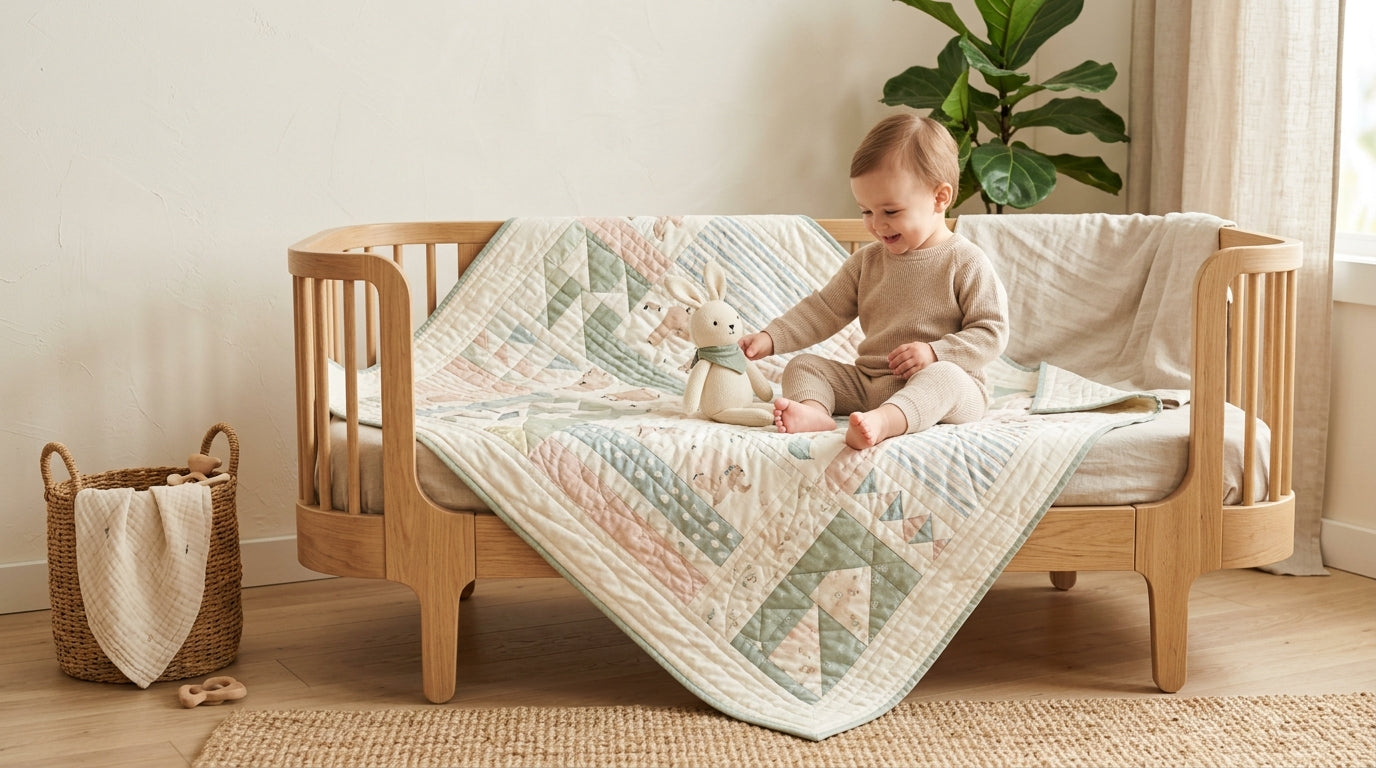
I'm sitting on the hardwood floor of our Portland apartment with a Stanley tape measure, surrounded by six different square-ish blankets, trying to categorize them by surface area. It's exactly three weeks after the baby shower. My wife, Maya, is standing in the doorway drinking decaf coffee, watching me build a spreadsheet on my laptop.
"Are you mapping the thermal conductivity of the textiles?" she asked.
I wasn't, though that's a fair assumption. I was just trying to understand the system architecture of infant bedding. We had been gifted half a dozen blankets, and none of them were the same dimensions. Some were tiny squares. Some were massive rectangles. One looked like a decorative rug. As a software engineer, I assume variations in size correlate to specific use cases, but the baby industry doesn't give you documentation. You just get handed a pile of pastel fabrics and are expected to know what a baby quilt is actually for.
Because apparently, as I was about to learn, you can't even use them for sleeping.
The safe sleep paradox
Before the baby arrived, I thought infants just slept under blankets like tiny, unemployed adults. Then we had our 36-week prenatal visit with our pediatrician, Dr. Lin. She looked me in the eye and explained the firmware rules of infant sleep, which basically state that a crib needs to look like a minimalist prison cell. No bumpers. No stuffed animals. No pillows. And absolutely zero loose fabric.
From what my sleep-deprived brain gathered, babies under twelve months old have terrible spatial awareness and buggy internal thermostats. If a blanket gets over their face, they don't know how to pull it off. Dr. Lin mentioned that overheating is a variable in SIDS, though I don't entirely understand the biological mechanism behind it. I just logged it in my head as a critical error to avoid at all costs.
So I was looking at this spreadsheet of blanket dimensions, deeply confused. If the number one rule of having a baby is "don't put a quilt in the crib," why did we receive six of them? Were older relatives just operating on legacy firmware where babies slept under heavy layers of synthetic batting? Or was there some secondary function I was missing?
Reverse-engineering the dimensions
I spent an unreasonable amount of a Tuesday night researching what exactly a parent is supposed to do with all this fabric. Apparently, "baby quilt" is just an umbrella term for a random geometric shape you'll use to solve unexpected parenting glitches over the next two years.

The tiny 12x12 inch ones aren't even meant for warmth. They're called lovies, which sounds made up, but it's basically a sensory object. It's essentially a napkin with a stuffed animal head attached. I tried giving one to our daughter when she was around five months old to comfort her, and she immediately tried to swallow it whole. I realized then that she didn't need fabric in her mouth, she needed hardware designed for chewing.
We picked up the Panda Teether around that time. Honestly, it's just okay. We have like four teethers in rotation right now. She seems to like the texture of this one because the bamboo design has ridges that probably feel good on her swollen gums, and I like that it's silicone so I can just throw it in the dishwasher. But half the time she ignores it anyway because she'd rather aggressively gnaw on my MacBook charger or my knuckles.
The tummy time floor failure
Then you get to the mid-sized blankets. The 36x36 or 40x40 inch squares. Every forum I read told me these were "tummy time" quilts. You just throw the baby quilt on the floor, put the baby on it, and let them develop their neck muscles. Simple, right?
Here's where I need to vent, because putting a soft cotton quilt on a slick hardwood floor is a catastrophic failure of physics. It slips. It bunches up. Our dog, a golden retriever mix, sheds constantly, and the cotton batting of these quilts acts like a magnet for dog hair. So every time I put her down on the floor, the quilt would slide away from her little arms when she tried to push up, leaving her face-planting into the wood. Then she'd be screaming, and I'd be trying to flatten out a crumpled, dog-hair-covered blanket with one hand while holding a crying infant in the other.
I hated it. I spent hours repositioning those stupid squares. Washing them didn't help either, because the natural batting shrinks weirdly and suddenly your perfect 36-inch square looks like a crumpled tortilla.
We completely abandoned quilts for floor time by month four. Maya eventually overrode my complaints about baby gear taking up too much space and ordered the Round Baby Play Mat. It completely patched the floor-time bug. It's made of vegan leather, which I initially thought sounded incredibly pretentious for someone who can't even hold up her own head. But then she projectile spat-up an entire bottle of formula directly onto it. I wiped it completely clean in three seconds with a damp paper towel. No washing machine required.
The 120cm diameter is exactly enough surface area for her to practice her weird, asymmetrical army crawl without immediately hitting the cold Portland floorboards. It stays put, the dog hair wipes right off, and she actually started making progress on her motor skills once she had a stable surface. It's probably the most functional piece of hardware in our apartment right now.
If you're looking for things that actually work and won't just collect dust in a nursery corner, I'd suggest taking a look through Kianao's baby gear collections for pieces that handle the messy reality of parenthood.
The sweet spot for strollers
So if the little ones are for chewing and the square ones are terrible for floors, what's a baby quilt honestly good for? Strollers.

The 30x40 inch rectangle is the exact dimension required to tuck around a baby in a UPPAbaby Vista seat without the corners dragging on the wet pavement or getting caught in the rear wheels. I track the weather obsessively, and when it drops below 55 degrees here, she needs an external layer. The rectangle size is basically a modular thermal patch.
But the fabric composition matters way more than I anticipated. I didn't realize babies sweat so much until we layered a heavy, polyester-filled quilt over her during a brisk walk. She woke up from her nap looking like she had just run a marathon in a sauna. I guess synthetic fibers just trap the heat against their bodies.
Now we mostly dress her in a breathable Organic Cotton Baby Bodysuit under a lightweight, natural-fiber quilt. The organic cotton seriously lets the heat escape while the blanket blocks the wind. It's a much better configuration, and she stops waking up damp and furious.
What happens to the giant ones
Which brings us back to the giant 40x60 inch crib quilts. The ones that look like they belong on a twin bed.
I finally learned that these aren't for babies at all. They're for toddlers. You're supposed to just fold them over a rocking chair for eighteen months until the kid is old enough to not accidentally suffocate themselves in their sleep. Maya ended up hanging one of the handmade ones on the nursery wall. I still think it's a little strange to nail a blanket to drywall, but I've learned to stop questioning the user experience of nursery aesthetics. It looks nice, and it dampens the acoustic echo when she cries at 3 AM.
Now that our daughter is 11 months old, the great baby quilt size mystery has mostly resolved itself. We keep a 30x40 in the car as an emergency tarp for park grass. We use a 36x36 to block the sun in the backseat. We don't use any of them in the crib.
You don't need a spreadsheet to figure it out. You just need to survive long enough to realize that a baby blanket is never just a blanket. It's a towel, a changing pad, a sunshade, and occasionally, wall art.
If you're still trying to figure out what to put on your registry or what to buy a highly anxious first-time parent, explore Kianao's collection of sustainable, non-toxic baby essentials that seriously solve daily parenting glitches.
Questions I frantically googled at 2 AM
When can my baby really sleep with a quilt?
Dr. Lin told us we had to wait until she was at least a year old, sometimes longer depending on her mobility. Apparently before that, their risk of getting tangled or overheating is too high. We just use wearable sleep sacks instead, which look like tiny sleeping bags and prevent her from kicking the blankets off anyway.
Why are there so many different sizes?
Because the baby industry is chaos. But practically, 12x12 is for sensory comfort, 30x40 is for stroller walks because it won't hit the wheels, 36x36 is traditionally for laying on the floor (though I hate it for that), and anything bigger is basically a toddler bed blanket that you'll have to store in a closet for a year and a half.
Are handmade quilts safe for babies?
It really depends on the construction. My pediatrician warned us to watch out for loose threads, heavy synthetic batting that traps heat, or little attached beads and ribbons that a baby could rip off and swallow. We only use the heavy handmade ones for laying out on the grass at the park, never for covering her up.
What fabric is honestly best?
I thought this was just marketing, but natural fibers really do make a difference. We stick to 100% cotton, linen, or bamboo. If the tag says polyester fill, it usually makes our daughter sweat profusely because her little body can't keep stable temperature well yet. You want stuff that breathes.




Share:
Raising a Baby Queen: The Brutal Truth About Royal Parenting
Finding a Nest in the Garden: A Warning About Infant Rabbits