

Dear Priya from six months ago. You're standing in aisle fourteen of the Target in River North, staring at a plastic contraption that plays the alphabet in three different languages. Your coffee is ice cold. Your baby is nine months old and has just started pulling himself up on the coffee table. You think you need to buy this thing right now to teach him to walk because the kid in our music class took a step yesterday. Just put the box down and walk away, yaar.
I know the anxiety is creeping in. You're mentally cataloging every milestone, wondering if you're behind. You aren't. And that plastic light-up walker isn't going to fix anything. Before you swipe your card on something that will just take up half the living room and annoy the dog, there are a few things we need to get straight about how this walking business actually works.
The mobile trauma units
Let's talk about the sit-in walkers first. You know the ones. The UFO-looking saucers where the kid dangles in the middle with a crotch harness and pushes themselves backward around the kitchen. I worked the pediatric ER triage desk enough times to know these things are basically just injury delivery systems. I've seen a thousand of these cases. We'd get babies coming in with concussions because they launched themselves down a flight of stairs in one, or because they suddenly had an extra two feet of height and managed to pull a hot cup of tea off the counter.
My doctor told me they banned them entirely in Canada. That honestly tracks. You give a baby the speed of a rolling chair with zero hazard awareness and it's just a code yellow waiting to happen. But even putting the ER visits aside, they're a mess for physical development. You suspend a baby p in a harness and they just push off the floor with their toes. Then they show up at the clinic at age two walking on their tiptoes like little ballerinas. The physical therapists have to spend months trying to loosen their tight Achilles tendons and fix their gait. I guess it bypasses the core muscles entirely or something. Just skip the sit-in saucer.
Standing behind the wagon
What you're actually looking for is a stand-behind walker. The kind where the baby has to stand on their own two feet, hold a handlebar, and push the thing forward. It forces a more natural heel-to-toe stride and actually requires them to use their own balance. But even these aren't some magical fast-track to independent walking.
Listen, the timeline is completely wild and unpredictable. Somewhere between nine and eighteen months, they might start walking. That's a massive window. You don't need to physically place the baby at the walker and force their hands onto the bar. Just leave it in the corner of the room like a piece of furniture and let them figure it out when they're ready to pull up on it.
When my kid first started pulling up on his wooden wagon, I panicked about his feet. At home, I try to keep him barefoot because the occupational therapists say they need to grip the hardwood to develop their arches. But the second we take that walker out to the sidewalk or the park, I use the Baby Sneakers Non-Slip Soft Sole First Shoes. They're easily my favorite thing we own right now.
When he first started attempting steps outside, I made the mistake of putting him in these stiff, expensive miniature boots from a department store. He immediately face-planted on the concrete. It was like he was trying to walk in cinder blocks. I switched to these soft-sole Kianao sneakers because they honestly bend. The inner lining is cozy, they don't slip off his heels every time he squats down, and they just look like classic boat shoes. They give him traction on the pavement without stealing his ankle mobility. It's a rare win.
Loading up the cart
A baby with a wheeled toy on a slick hardwood floor is a physics problem. The wheels are going to move faster than their little legs can keep up, the walker shoots out from under them, and they eat the floor. You need speed control.

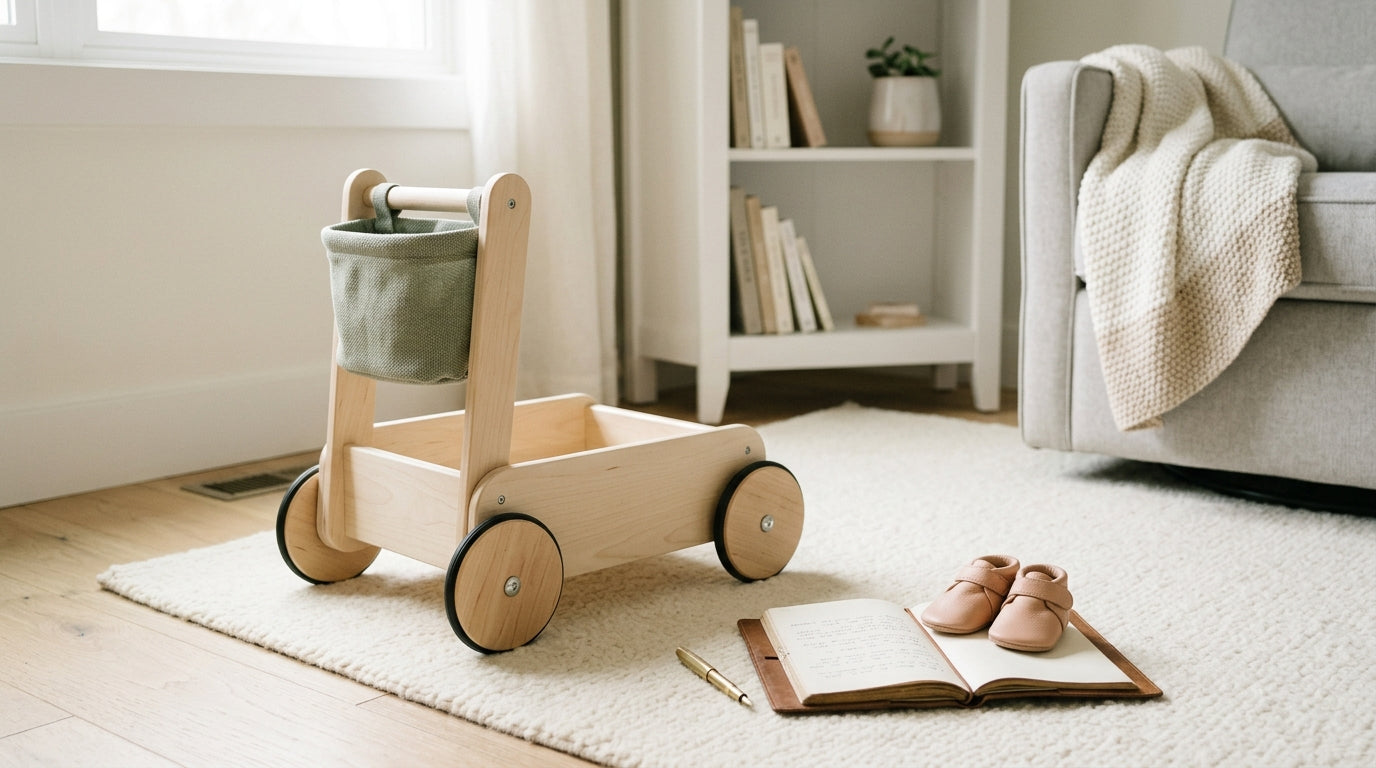
Some of the fancy plastic ones have adjustable tension dials on the wheels. But my doctor said the easiest hack is just to buy a wooden wagon style and weigh it down. I threw three massive medical textbooks and a bag of flour into the basket of ours. It adds so much resistance that he has to honestly engage his core to push it forward. It turns it from a runaway train into a heavy workout.
The therapists love this kind of heavy work.
- It builds actual functional strength rather than just momentum.
- It forces them to do squats. They drop a toy, squat down to get it, and stand back up while holding the bar.
- It gives them a fake sense of security. They think the wagon is holding them up, but they're doing all the balancing.
- It saves your lower back from doing that hunched-over hand-holding walk around the coffee table for three hours a day.
Chewing on the furniture
They're going to chew on the handle of the walker. It's inevitable. To save the paint job and keep him from ingesting wood finish, I usually just hand him the Sushi Roll Teether before he starts his laps around the living room. It's a solid teether. I'm not going to write a sonnet about it, but the varied textures on the silicone rice parts seem to distract him from the fact that his molars are trying to break through his jaw. It's food-grade silicone, whatever that really means in the manufacturing world, and it survives the heavy cycle in my dishwasher.
We also have the Baby Teething Toy Cactus. It's fine. The little arms reach the back gums well enough. But honestly, it gets dropped under the couch constantly because it doesn't have a good strap attachment point, and I spend half my day washing dog hair off of it. It works in a pinch, but it's not my holy grail. Stick to the sushi one.
If you're trying to build out a play space that doesn't look like a neon plastic factory exploded in your living room, you might want to look at Kianao's wooden play gyms and accessories. They blend in a bit better with the adult furniture.
Taking the safety net away
Here's the weird part that nobody warns you about. He got too good at using the push walker. He would literally jog across the room with the wagon, turning corners like a professional driver. But if I asked him to walk to me empty-handed, he would drop to his knees and crawl. He refused to take a single independent step without his wheels.

My doctor said sometimes they get addicted to the safety net. The walker becomes a crutch. So I just put the wagon in the hall closet for four days. I hid it completely. He was furious. Beta, it was a rough weekend of whining and pointing at the closet door. But by Monday morning, he realized he could just balance on his own. He took three steps across the rug to get to the dog. Sometimes you've to force the issue and remove the crutch.
So past Priya, just breathe. Leave the plastic alphabet walker on the shelf. Get something heavy, weigh it down, and let him take his time. The walking will happen eventually, and then you'll spend the next ten years chasing him trying to get him to sit still.
Before we get into the messy reality of milestone panic in the FAQ, check out Kianao's first walkers collection to protect those tiny toes when they inevitably ram the wooden wagon into a doorframe.
The messy realities of walking practice
Are they really going to walk sooner if I buy a walker
No. Probably not. My doctor was pretty clear that gross motor milestones happen on their own biological clock. You can't drill a baby into walking before their nervous system and muscles are ready. The push toy just gives them a fun way to practice once they're already pulling up. It might give them a bit of confidence, but it's not a magic accelerator pedal. Some kids never use one and walk at ten months. Mine used one every day and still didn't walk independently until he was fifteen months old.
How long should they use it each day
I treat it like any other toy. I don't set a timer or anything rigid. But if I notice he's been pushing it back and forth for twenty minutes, I usually try to transition him to floor play. They need to spend time crawling, rolling, and sitting to build out all those other core muscles. If they spend all day upright holding onto a bar, they miss out on the cross-body coordination that crawling builds. Just mix it up.
What if they only walk on their toes while pushing it
I've seen this a lot in the clinic. If they're constantly on their tiptoes while using a stand-behind toy, the handle might be too high for them, or the wagon might be moving too fast, forcing them to lean forward aggressively to keep up. Try adding more weight to the base so it slows down. If they're still doing it, maybe put the toy away for a few weeks until they grow an inch. You want their feet flat on the floor.
Can I prop them up on the walker if they can't stand yet
Listen, please don't do this. If they can't pull themselves up to a standing position on their own, they've no business being propped up behind a wheeled object. Their hips and core just aren't ready to handle that kind of load. Let them do the work. If they can't get up to the bar, leave them on the floor to practice crawling. The walker will still be there when they're strong enough.
How do I stop them from running over the dog
You don't. The dog is just going to have to learn to establish a perimeter. My golden retriever used to sleep in the middle of the hallway until the wagon rolled over his tail exactly one time. Now he sleeps on the sofa where the wheels can't reach him. It's a self-correcting problem.




Share:
The Unfiltered Reality of Raising a Baby and a Puppy at the Same Time
Why Every Mom is Obsessed With the Baby Pygmy Hippo