

It's 2:43 AM. I'm holding my iPhone between my teeth like a tactical flashlight because I need both hands to manage a diaper blowout of catastrophic proportions. I take one step backward, my heel finds a rogue wooden block, and I gasp. The phone drops from my mouth, flips mid-air, and lands face-up on the mattress, activating the high-beam camera LED directly into my 11-month-old's retinas.
Immediate system reboot. The tiny arms flail. The maximum-volume crying sequence initiates. My wife, Sarah, appears in the doorway a moment later, blinking through the glare, and sighs the kind of heavy, resigned sigh that means I'm currently failing at basic dad operations. Apparently, blinding your infant with an Apple device is not the good way to handle a midnight feeding.
That night broke me. The next morning, I poured a concerning amount of coffee and started aggressively Googling nursery illumination strategies. I assumed I needed to buy something marketed specifically for infants—something glowing, soothing, and probably shaped like a woodland creature. What I found out completely broke my mental model of how babies process their environment.
My doctor ruined my night vision theories
I brought a printed Excel spreadsheet of our recent sleep latency data to Dr. Chen, our doctor, fully expecting her to think a specific color temperature for our nighttime setup. Instead, she looked at my charts, looked at my highly caffeinated face, and laughed. She told me that from a purely biological standpoint, infants don't need to see anything at night.
Think about it like this: the womb was basically a warm, pitch-black server room. They spent nine months in absolute darkness. My understanding of developmental psychology is mostly just pieced together from panicked 4 AM Reddit deep dives, but apparently, the concept of being "scared of the dark" is a software update that doesn't even install until they're around two years old. Right now, at eleven months, my son doesn't fear the shadows in his room. He fears empty bottles and cold wipes.
The realization hit me hard: the light isn't for him. It's entirely for me.
It exists solely so I don't break my toes while trying to cross the room. Once I understood that I was designing a lighting system for a sleep-deprived adult rather than a fearful infant, the entire troubleshooting process changed. I stopped looking for things that would "soothe" him and started looking for things that wouldn't accidentally trigger his wake-up cycle.
The great star projector disaster of October
Before I had this breakthrough, I made the ultimate rookie mistake. I bought one of those incredibly popular devices that projects a slowly rotating galaxy of stars across the ceiling while playing a tinny, synthesized version of "Twinkle Twinkle Little Star." The packaging promised deep, restorative sleep. The packaging was a liar.
The sheer audacity of this machine can't be overstated. It essentially turned my son's peaceful room into a miniature rave simulator. The little green laser stars swept across the drywall at a speed that was just fast enough to be alarming, accompanied by a blue LED nebula that looked like a portal to another dimension. I turned it on during a 3 AM wake-up, expecting him to gently drift off while gazing at the cosmos.
Instead, I watched his eyes lock onto a green star tracking across the ceiling. His little head swiveled. His arms started reaching for it. His internal CPU was suddenly maxing out, processing all this new visual data. He wasn't getting sleepy; he was getting hyped. He stared at that ceiling for forty-five minutes, completely mesmerized, while I sat in the glider chair questioning every decision that led me to this moment. When I finally unplugged it, the sudden absence of the rave made him furious. We threw the projector in the hallway closet the next morning and never spoke of it again.
Filtering the melatonin science through my exhaustion
Dr. Chen had casually mentioned melatonin suppression, which sent me down a massive rabbit hole about circadian rhythms. From what I can gather, human brains are hardwired to react to blue and cool white light by halting melatonin production—which is the hormone that actually makes you sleepy. If you blast a baby with blue light (like, say, an iPhone flashlight or a cool-toned LED bulb), their brain immediately thinks the sun is rising and it's time to start the day's operations.

Red light, on the other hand, sits at a wavelength that apparently bypasses this wake-up trigger. It doesn't disrupt the melatonin factory. So I went to the hardware store and bought a single, incredibly dim amber bulb.
Installing a dimmer switch on the main ceiling fixture is totally useless by the way, because the overhead angle alone simulates the midday sun and will wake them up immediately.
Instead, I put this tiny amber bulb in a small lamp and shoved it entirely behind the changing table. The light bounces off the wall, creating just enough ambient glow that I can see the outline of the diaper pail without actually illuminating the room. I don't trip over the dog anymore, and my son barely registers that I've entered the room.
Testing the darkness with my actual hand
If you want to know if your room is dark enough, there's a physical test you can run. You don't need a light meter app (though I definitely downloaded one, which Sarah politely informed me was "deeply unnecessary"). You just use your hand.
- Step 1: Turn off all the main lights in the nursery and pull the blackout curtains.
- Step 2: Stand next to the crib and let your eyes adjust for about two minutes.
- Step 3: Hold your hand about twelve inches in front of your face.
If you can clearly see the distinct outline of your fingers, the room is too bright. Sarah walked in on me doing this at 10 PM. I was just standing alone in the pitch black, waving my hand in front of my nose like a broken animatronic. I had to explain that I was running diagnostics on the ambient street light leaking through the window edges.
If you're currently trying to optimize your own nursery setup and realizing you've the wrong gear, you might want to take a break and browse through the baby essentials collection at Kianao to see what functional, sleep-friendly materials actually look like.
Draping the problem away
Sometimes you can't control the light sources in your room. We have a heavy-duty air purifier that we need to run during allergy season, and for some incomprehensible reason, the manufacturer decided to install a glowing blue ring on the top that shines with the intensity of a thousand suns. You can't turn it off. It's hardwired.

My initial engineering solution was black electrical tape, but it looked terrible and left a sticky residue. My eventual, highly successful solution was the Bamboo Baby Blanket in Colorful Leaves. This is, without exaggeration, our favorite piece of fabric in the house. We bought it primarily because Sarah cares about sustainable organic materials, but I love it because it serves multiple functions simultaneously.
I realized I could drape this incredibly soft, lightweight bamboo blanket over the top of the air purifier. Because bamboo breathes so well, it didn't trap heat or overheat the machine's motor. But the weave is just dense enough to diffuse that aggressive blue LED into a dull, harmless glow. Beyond its use as a light-dampener, it's honestly just an amazing blanket. The fabric controls temperature like a high-end PC cooling system, preventing the baby from waking up sweaty. It's frictionless, meaning it doesn't irritate his cheeks when he rolls around on it. I'm mildly obsessed with this thing.
The blanket that didn't solve my problems
On the flip side, sometimes my logic completely fails. We also picked up the Autumn Hedgehog Organic Cotton Baby Blanket. I had this theory that if I bought a blanket with high-contrast imagery—like little dark hedgehogs on a warm mustard background—it would give his eyes something specific to focus on when the room was dim, stopping him from searching the shadows for the door frame.
Look, it's a perfectly fine blanket. The organic cotton is solid, it holds up in the wash, and the hedgehog print is undeniably cute. But my theory was garbage. He didn't care about looking at hedgehogs at 3 AM. Instead of peacefully staring at the pattern, he just grabbed the corner of the blanket, tried to shove the entire thing into his mouth, and then got frustrated when he couldn't chew on it properly. It's a great blanket for tummy time on the living room floor during the day, but it absolutely didn't hack his nighttime visual processing the way I hoped it would.
Distracting the processing core in the dark
The hardest part about minimizing light is that when you're working in near-total darkness, you've to find other ways to keep the baby calm during a diaper change. If they can't see the room, they start wiggling to figure out what's going on. Their tactile sensors go into overdrive.
If you just keep the room dark, tape a red bulb behind the dresser, and hand them something highly textured to hold, you can usually get them back into the crib before their brain fully boots up.
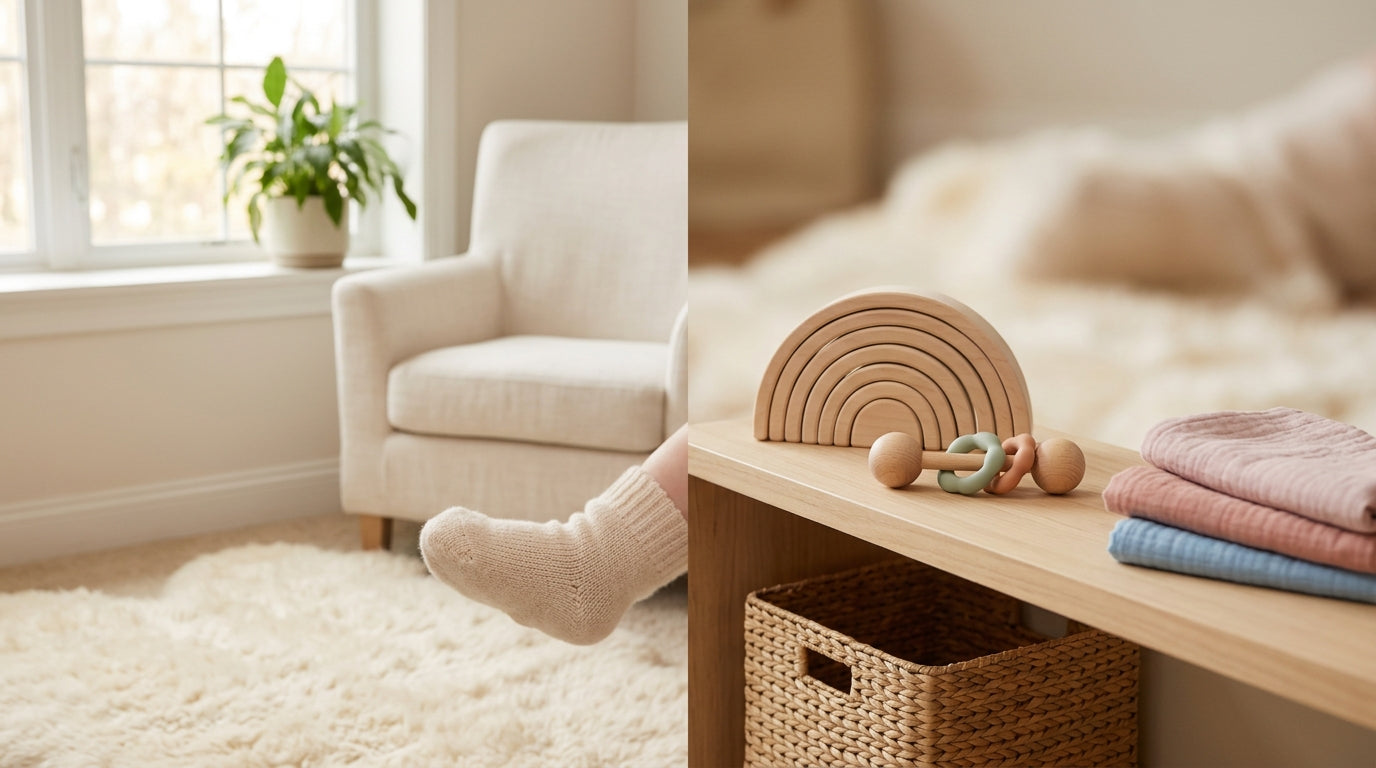
For us, that tactical distraction is the Crochet Bunny Rattle Teething Toy. I keep this sitting on the very edge of the changing table, right where I can grab it blindly. When I'm fumbling around in the amber glow trying to align the tabs on a fresh diaper, I just drop the wooden ring into his hands. The 100% organic cotton crochet texture on the bunny gives his fingers something complex to explore, and the untreated beechwood ring is heavy enough that he focuses his energy on trying to chew it instead of trying to roll off the table. It has no electronic lights. It has no batteries. It just quietly occupies his hardware until I'm done.
Parenting is mostly just running A/B tests on your own sanity. I thought I needed a high-tech glowing nursery to make my son comfortable, but it turns out he just needed a dark room, a soft bamboo blanket, and a dad who wasn't shining a smartphone directly into his face. Before you spend another night stepping on sharp wooden blocks in the dark, you might want to rethink your sensory environment and check out Kianao's sustainable nursery collection for essentials that genuinely respect a baby's biology.
My messy troubleshooting FAQ
Do babies really get scared of the dark?
According to my doctor and my frantic midnight internet searches, no. They literally don't have the cognitive capacity for imaginative fear yet. That firmware update doesn't happen until they hit the toddler stage. If they're crying in the dark, they're hungry, wet, or teething. They aren't worried about ghosts.
What wattage should the bulb be if I've to use one?
As low as humanly possible. I bought a 4-watt equivalent LED amber bulb. You want just enough photons bouncing off the drywall so you don't trip over the diaper pail. If you can read a book by the glow, it's way too bright and you're going to ruin their sleep cycle.
Can I just use my phone flashlight pointing at the floor?
I strongly advise against this. Phones are slippery, and the second you drop it, it'll somehow land facing exactly upward, blasting your kid with pure blue light. Plus, phone screens emit blue light anyway, so even just checking the time while you hold them can trigger their wake-up response.
Why red light specifically?
Apparently, melatonin (the sleepy hormone) is incredibly fragile. Blue, green, and white lights completely destroy it. Red and warm amber wavelengths are at the opposite end of the spectrum and sneak past the brain's light receptors without hitting the "wake up" button. It feels a little like developing photos in a darkroom, but it works.
Where should I really put the lamp?
Never next to the crib. Hide it. I literally shoved a small lamp behind the heaviest dresser in the room so the bulb is completely obscured. You want the light to bounce off the wall indirectly. If your kid can stare directly at the bulb, they'll just fixate on it until their brain is running at full capacity.




Share:
The Brutal Reality Of Trying To Find A Safe Baby Life Jacket
Put That Tupperware Down: The Reality Of Backyard Reptiles