

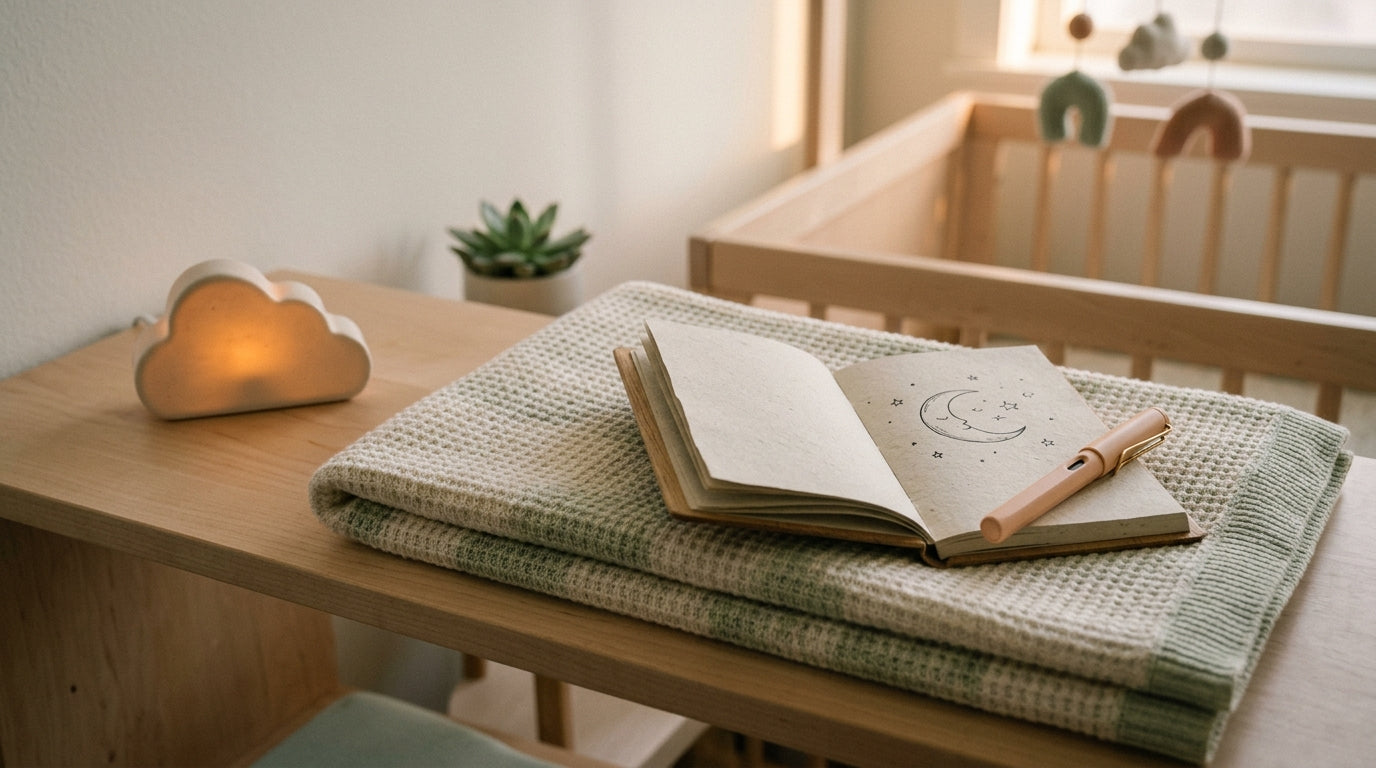
It's exactly 3:14 AM. The rain in Portland is doing that aggressive, sideways thing against the nursery window, and my son is currently running his four-month firmware update, which apparently means his system has completely forgotten how to execute a basic sleep protocol. I'm doing the heavy, tactical parent-bounce down the hallway, desperately cycling through my limited mental database of baby lyrics. My brain is fried, so I hit the default script: rockabye baby.
I start out just humming the melody to get a baseline rhythm going, but eventually the actual words start spilling out of my mouth into the dark hallway. Rock-a-bye baby, on the tree top... I pause mid-bounce. Wait a second. When the bough breaks, the cradle will fall. I look down at this tiny, fragile, eleven-pound human I've spent the last hundred and twenty days trying to keep alive. I track his nursery temperature to the decimal point and log every single diaper output in a shared cloud database with my wife, Sarah. And yet, to soothe him, I'm singing a song about a catastrophic structural failure leading to an infant plummeting from a tree.
The dark syntax of our default lullaby
I honestly can't figure out why this is the cultural standard we all just blindly accept. I spent an embarrassing portion of my paycheck on a high-tech baby monitor that measures breathing micro-movements and alerts my phone if he so much as sighs weirdly, but the primary auditory tool I use to calm him down is basically the plot of a horror movie. My wife walked out of our bedroom to get water, looked at me swaying frantically in the dark while muttering about broken tree branches, and whispered that I was going to give him complex trauma before he could even walk. I tried to argue that his language processing modules hadn't compiled enough English yet to understand what a "bough" was, but we were both way too exhausted to finish the debate.
It really makes you question the people who invented these nursery rhymes. Who looks at a crying infant and thinks that a story about falling from a dangerous height is the right patch for this particular bug? I guess I just assumed all baby songs were about fuzzy animals or sleeping in clouds, but no, the most famous one is a literal safety violation.
A 4 AM deep dive into nursery rhyme history
Because my primary coping mechanism for parenting anxiety is aggressive, unfiltered internet research, I ended up sitting in the rocking chair with my phone brightness turned all the way down, holding my finally-sleeping kid, looking up the historical origins of these bizarre lyrics. Apparently, the song first showed up in print in London somewhere around 1760 to 1765 in a book called Mother Goose's Melody, though the original first line was actually "Hush-a-bye baby" before it mutated into what we sing today. But the theories about where it actually came from are wild.
- The Mayflower settler theory: According to some historical dictionaries, the most widely accepted origin is that an English settler on the Mayflower observed Indigenous Native American mothers carefully suspending birch-bark cradles from low tree branches. The idea was to let the wind naturally rock the baby to sleep, which honestly sounds like a brilliant, passive-energy soothing mechanism if you know what you're doing.
- The political bug report: Another group of historians thinks the whole song was just a piece of political satire aimed at King James II of England. The "bough" breaking was supposedly a warning that his royal lineage was unstable and going to snap. Why we repurposed 17th-century political trash talk to put modern infants to sleep is beyond me.
- The morality patch: The weirdest one I found was that early printed versions actually included a footnote stating the song was a warning to the "proud and ambitious, who climb so high that they generally fall at last." So it's a cautionary tale about corporate ladder-climbing disguised as a lullaby.
The hardware side of soothing
The ironic part of all this tree-top nonsense is that it goes entirely against every piece of modern safe sleep documentation we've. During our two-month checkup, I jokingly asked our doctor, Dr. Lin, about hanging cradles or those angled sleep rockers you see in vintage photos. She looked at me over her glasses and made it very clear that babies need to sleep on a firm, flat mattress in a designated crib, with absolutely zero loose blankets or pillows, and definitely nothing that suspends them in mid-air. The American Academy of Pediatrics basically has an anti-tree policy.

So instead of relying on the wind, we recreate the rocking motion with a glider chair, keeping the environment tightly controlled before placing him flat on his back. This is genuinely how I survived the great blowout of 3:45 AM that same night. Right as I was finishing the historical deep dive, he exploded out of his diaper. I had to strip him in the dark and throw him into the Organic Cotton Baby Bodysuit Sleeveless Infant Onesie. I'm not exaggerating when I say this specific piece of clothing saved my sanity. It has these overlapping envelope shoulders that let you pull the entire garment down over their body instead of trying to drag something covered in baby waste over their giant, fragile head. Plus, the organic cotton is so soft it practically feels like butter, and since it stretches with elastane, I didn't have to fight his rigid little arms to get it on. Sarah says the undyed natural fibers are better for his skin micro-biome, but my main metric for success is that the snaps closed on the first try while I was operating on two hours of sleep.
If you find yourself frantically trying to outfit a baby in the middle of the night while questioning the logic of 18th-century poetry, you might want to browse our sustainable baby wear collections to find gear that seriously works with you instead of against you.
Why this repetitive loop honestly works
If the lyrics are a literal nightmare, why does singing them seriously make a screaming child shut down and reboot into sleep mode? Apparently, it has very little to do with the story and everything to do with the data structure of the sound. I read a paper from a literacy trust that pointed out the AABB rhyming scheme is incredibly good at helping babies grasp phonetic patterns. Even though he has no idea what I'm saying, he's mapping out the language architecture.
Dr. Lin also mentioned that the slow, rhythmic tempo of a lullaby mimics the resting maternal heartbeat they heard internally for nine months. Even my deep, raspy, tone-deaf dad voice vibrating in my chest helps lower his cortisol levels and kicks his parasympathetic nervous system online. And weirdly enough, the song is laying down foundational vocabulary variables. He might be an e baby who will probably know how to swipe an iPad before he can tie his shoes, but his brain is still pulling data from words like "wind" and "tree" and spatial concepts like "top" and "down."
Troubleshooting the twenty minute transfer
Of course, getting them to sleep in your arms is only half the battle. The transfer from the chair to the crib is basically a high-stakes bomb defusal. I used to just stop singing the second his eyes closed, gently lower him to the mattress, and tiptoe away, only to have him immediately snap awake and scream.

It turns out there's a twenty-minute sleep rule you've to follow. According to whatever sleep portals Sarah reads, you've to keep humming or singing for twenty to thirty minutes after their eyes shut to get them past active REM sleep and into deep, restorative sleep. It's incredibly tedious. I get so tired of whispering bye baby over and over while staring at a dark wall that I usually start substituting my own lyrics about whatever I did that day or complaining about my code compiling errors, just to keep the rhythm going without losing my mind.
Daytime data to fix nighttime bugs
The only real way I've found to make the nighttime rocking sessions shorter is to thoroughly drain his battery during the day. We set up the Wooden Baby Gym | Rainbow Play Gym Set with Animal Toys on the living room rug, and it's a lifesaver. It’s just a beautifully simple wooden A-frame with a little hanging elephant and some tactile geometric shapes, but it completely captivates him. There are no terrible plastic flashing lights or electronic songs, just gravity and natural wood. I can lay him under there and he will spend a solid thirty minutes furiously batting at the rings, trying to figure out hand-eye coordination. Tiring out his gross motor skills under that gym directly translates to less time I've to spend singing about falling branches at night.
I wish I could say the same for teething, which completely wrecks his sleep data. We got the Panda Teether Silicone Baby Bamboo Chew Toy when he started drooling on everything. It's totally fine, and I love that it’s food-grade silicone so I can just chuck it in the dishwasher to sanitize it, but my kid chewed on the panda for about three minutes before deciding he’d rather gnaw on the remote control or my own knuckles. Babies are weird, and you just have to test different inputs until something works.
A patch for the lyrics
If you're like me and you really can't stomach the idea of ending your nightly routine with a theoretical baby plunging to the ground, there's genuinely an extended, modernized version of the lyrics that fixes the narrative bug. I stumbled across it during my late-night research, and I’ve slowly started trying to overwrite my default memory with it.
Instead of the bough breaking, you transition into this:
Baby is drowsing, cozy and fair,
Mother sits near in her rocking chair,
Forward and back, the cradle she swings,
And though baby sleeps, he hears what she sings.
It feels a lot less like a threat and a lot more like actual parenting. You just sit there, forward and back, cycling through the loops, trying to keep the little system running smoothly until morning. It’s exhausting, repetitive, and completely overwhelming, but apparently, it’s exactly what they need.
Before you dive back into the dark nursery to try and troubleshoot your own tiny overlord's sleep cycle, explore our full line of sustainable baby clothing and gear at Kianao to help you survive the night shifts.
FAQ
Is it bad to sing the traditional rockabye baby lyrics to my newborn?
I was genuinely worried I was whispering terrifying concepts into my kid's ear, but apparently babies don't process the meaning of the words at all. They only care about the slow rhythm of your voice, the AABB rhyming structure, and the vibration of your chest. The dark lyrics are mostly just a psychological burden for the parents who seriously listen to what they're saying.
Do I really have to sing for 20 minutes after they fall asleep?
In my messy, sleep-deprived experience, yes. If I try to put him down three minutes after his eyes close, his internal gyroscope senses the movement and he wakes up screaming because he's still in light REM sleep. Humming or singing for a solid 20 to 30 minutes seems to act like a buffer zone that gets him into that deep, floppy-arm sleep stage where the crib transfer seriously works.
What if I'm terrible at singing?
I've the musical talent of a dial-up modem, and my baby literally doesn't care. My doctor told me that the familiarity of your specific voice is what lowers their cortisol levels, not your pitch accuracy. You can just hum a monotone drone or rhythmically read a software manual to them, and as long as the cadence mimics a resting heartbeat, it'll probably knock them out.
How can I safely recreate the rocking motion without a hanging cradle?
Since hanging your kid from a tree branch is obviously a terrible idea and AAP guidelines strictly say flat mattresses only, we just use a sturdy nursery glider chair. You hold them, you do the rocking work yourself using your own leg power, and then once they're fully rebooted in deep sleep, you place them flat on their back in a stationary, boring crib.




Share:
What You Actually Need to Know About the Safe Haven Baby Box
Why we sing about dropping infants from trees at 3 AM