

Maya is currently doing an impressive impression of an oiled piglet at a country fair, streaking across the scorched grass of Clapham Common while I trail a few paces behind her with a handful of thick, chalky white zinc cream. Chloe, her twin sister, is sitting quietly in the sparse shade of a dying oak tree, methodically trying to eat a dry pinecone while glaring at the sky. I'm sweating through a dark t-shirt that now has ghostly white handprints across the stomach, trying to remember why I thought leaving the house in July was a sensible parenting decision. This is what it means to keep a baby safe in the sun.
Before the twins arrived, my entire understanding of infant sun exposure was based almost exclusively on morning television. Specifically, I believed in the great lie of the Teletubbies sun baby. You remember her—that beaming, disembodied infant face giggling down at Tinky Winky from a perfectly clear blue sky. She looked so happy up there, bathing the world in golden light. What a catastrophic deception that was. Real babies don't giggle in the sun. Real babies despise the sun, and the sun, with its terrifying invisible radiation, actively hates them back.
I used to believe that summer with kids meant idyllic picnics, light cotton dresses, and perhaps a casual spritz of factor 50 from Boots before heading out for a stroll. I thought you just bought a bottle of whatever smelled faintly of coconuts, sprayed them down like you were polishing a kitchen counter, and got on with your day. The reality is a terrifying, messy battle against the elements that leaves everyone crying and smelling vaguely of minerals.
What my GP actually said about the six-month rule
Dr. Evans, our endlessly patient GP at the local NHS clinic, gave me the absolute fear of God during the girls' four-month checkup when I innocently asked what kind of sun cream I should buy for our upcoming holiday to Cornwall. She stopped typing, looked over her glasses at me, and casually shattered my worldview.
She explained that babies under six months shouldn't have chemical sunscreen anywhere near them, mumbling something about their tiny little livers not being able to process the ingredients yet, which I immediately translated in my anxious brain to mean that if I put SPF on them, they would spontaneously break. Apparently, their fresh, paper-thin skin doesn't have enough melanin yet either, leaving them completely defenceless against the big fiery ball in the sky. So, for the first six months of their lives, we treated them like a pair of temperamental, milk-drunk vampires, rushing frantically from shadow to shadow and aggressively defending our violently claimed patch of shade under the one decent tree at the park.
Once they finally crossed that magical six-month threshold, Dr. Evans said we were allowed to use sunscreen, but only the physical mineral kind made with zinc oxide or titanium dioxide. From my very shaky understanding of the science, chemical sunscreens absorb into the skin to work, while mineral sunscreens just sit on top of it like a suit of armour, physically blocking the rays. The major downside to this protective armour is that it has the exact consistency and spreadability of wet cement, meaning you've to violently rub it into your screaming child's skin until they look like a tiny Victorian ghost.
A very heavy bag of summer survival gear
Because you can't just rely on smearing chalk paste on a thrashing toddler, you end up carrying an absurd amount of equipment just to survive a trip to the local playground. My canvas tote bag currently contains:

- Two legionnaire-style hats with massive neck flaps that make the girls look like they're off to fight in a desert campaign (which they'll immediately pull off and throw into a puddle).
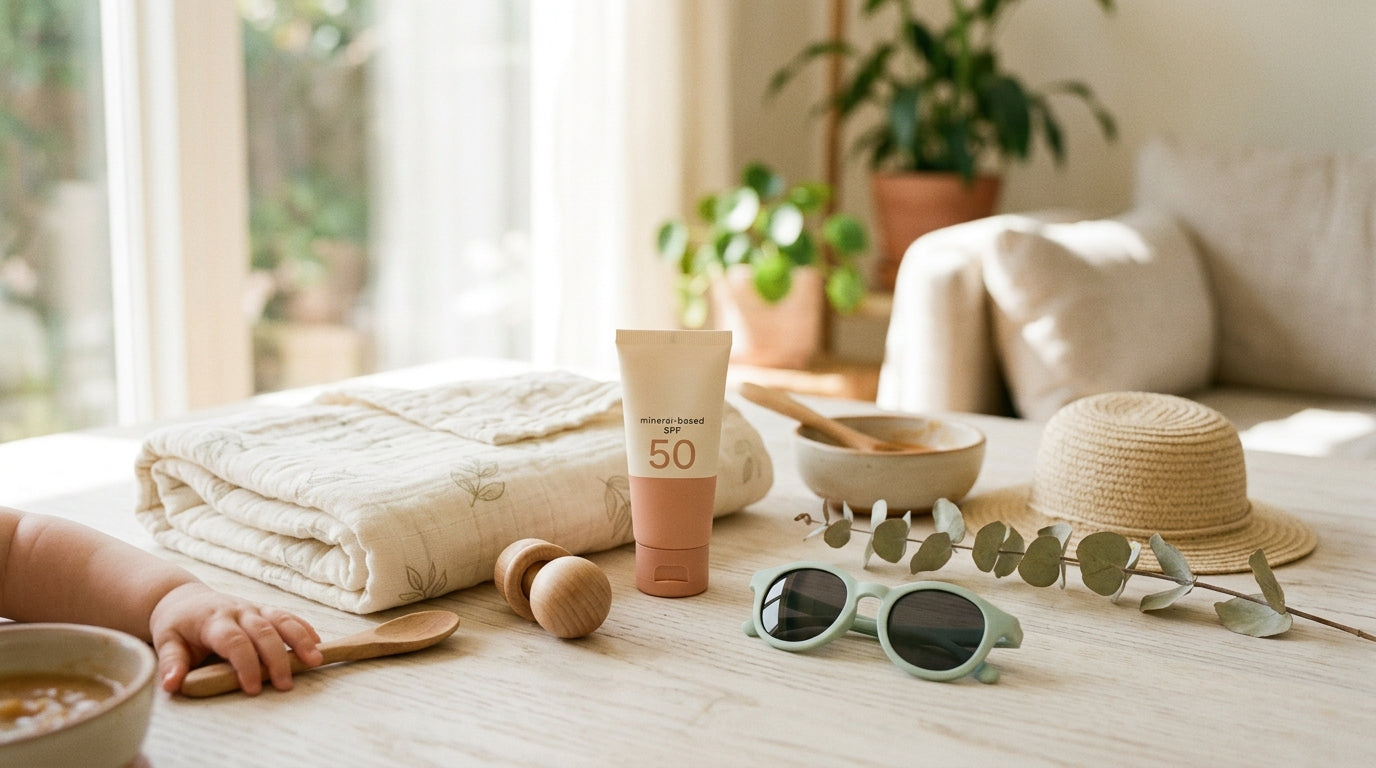
- A tube of mineral sun cream so thick you need a trowel to apply it, which guarantees my hands will remain sticky for the next three to five business days.
- An alarming volume of water, because the sheer terror of infant dehydration keeps me awake at night more than the prospect of another sleep regression.
- At least four different emergency distraction snacks so I can attempt to pin them down long enough to reapply the cream to their shoulders.
I did briefly buy them those little UV-blocking baby sunglasses because the internet told me the lens of a child's eye is clear and lets in massive amounts of radiation, but both girls immediately pulled them off and tried to snap the arms off in their teeth, so I gave up on eye protection entirely and just hope they remember to blink.
If you're also attempting to build a summer wardrobe that won't cause your child to spontaneously combust from the heat while still protecting them from the elements, you might want to dig through our organic baby clothes collection before you lose your mind entirely.
Clothes that actually do the heavy lifting
When you realise that sunscreen alone is a fool's errand, clothing becomes your absolute best friend. But then you run face-first into the secondary terror of summer parenting: overheating. It's a cruel joke that covering them up protects them from the UV rays but traps the heat against their skin, leading to heat rash.
Maya gets heat rash if you so much as look at her warmly. Her chest turns into a bumpy, red disaster zone at the slightest hint of humidity. In a moment of desperation last June, I bought the Organic Baby Romper Short Sleeve Summer Suit, and it has genuinely saved my sanity. The organic cotton is so ridiculously thin and breathable that it feels like they're wearing nothing, but it covers their shoulders and the tops of their arms, which are the prime real estate for accidental sunburns. I don't have to wrestle them into it because the neck has enough stretch to accommodate their massive, stubborn heads, and it has somehow survived being covered in mashed strawberries, mud, and industrial-strength zinc cream without permanently staining. It actually breathes, which means Maya can run around the garden without turning into a boiled lobster.
Add the absolute misery of teething to a London heatwave, and you've a recipe for a total paternal breakdown. The hot, acidic drool mixed with summer sweat is basically a biohazard. When the heat makes their gums throb, I rely heavily on the Panda Teether Silicone Chew Toy. I keep it in the fridge next to the milk, and when Chloe starts stress-gnawing on the pram straps in the midday heat, I hand her the freezing cold panda. It buys me exactly fourteen minutes of blissful, whining-free silence, which is just enough time to apply another layer of sun cream to her sister's face before the sweating washes it away.
The great pram overheating panic
I'd be remiss if I didn't mention the sheer, heart-stopping panic of pram temperature management. Every summer, you see well-meaning parents draping a blanket over their pram to keep the sun off their sleeping baby. I used to think this was a genius move until Dr. Evans casually mentioned that doing so turns the inside of the pram into a literal oven, trapping the stagnant air and causing the temperature to spike dangerously in minutes.

So, what about the Bamboo Baby Blanket? Look, it’s a perfectly nice blanket. The universe pattern is aesthetically pleasing, and the bamboo is definitely softer than the cheap scratchy things I used to buy at the supermarket. But as a sun defence mechanism? It’s completely useless, because I'm far too terrified of accidentally slow-cooking my daughters to ever drape it over the buggy. Mostly, it just lives crumpled at the bottom of my bag, getting used as an emergency picnic mat when the park grass is inexplicably damp, or as a giant mop for when Maya inevitably upends her entire sippy cup over her own lap.
Cloud cover is a massive scam
The cruelest joke of all is that we live in Britain. We get maybe six days of actual, blazing, squint-inducing sunshine a year. The rest of the time, the sky is a flat, grey, humid soup that looks entirely harmless.
But apparently, UV rays don't care about British weather. I read somewhere—probably during a 3 AM doom-scroll while Maya used my ribs as a trampoline—that up to 80% of UV rays punch straight through the clouds. This feels like a personal attack. You can genuinely get a sunburn while standing in a light drizzle in Croydon. It makes no sense, but it means the chalky mineral paste has to come out even when the sky looks like a wet pavement. Just one blistering sunburn in childhood can double their lifetime risk of melanoma, which is the kind of terrifying statistic that ensures I'll be chasing my children with a tube of factor 50 until they leave for university.
Instead of calmly applying lotion and placing a wide-brimmed hat on their head before a peaceful morning walk, try smearing a bit of that thick mineral goop on their wrist 24 hours before you plan to go out to make sure their skin doesn't break out in hives, and then resign yourself to keeping them entirely indoors between 10 AM and 4 PM while pouring tepid water down their throats so they don't melt onto the carpet.
If you need gear that seriously works without making your life harder than it already is, explore our full range of organic baby essentials before the next heatwave hits.
Messy questions about the sun
How do you get mineral sun cream out of clothes?
With tears and aggressive scrubbing, mostly. Mineral sunscreen leaves a greasy white stain on dark fabrics that mocks you from the laundry basket. I've found that rubbing neat dish soap directly into the stain before throwing it in a hot wash sort of works, but honestly, I've just accepted that all my navy t-shirts now feature permanent white smudges at waist height.
What if they eat the sunscreen?
They will absolutely try to eat the sunscreen. Chloe actively licks her own arm immediately after I've applied it. Because we use mineral sunscreens made of zinc oxide—which is the same stuff they put in nappy rash cream—a tiny lick isn't going to require a trip to A&E, though it tastes like chalk and regret. If they somehow manage to unscrew the cap and down the whole tube, that's a different story, but a passing lick is just part of the chaotic dining experience of toddlerhood.
Can they just stay in the shade all day instead of wearing cream?
If you can somehow convince a two-year-old to sit perfectly still under a tree for four hours, please write a book and take my money. Babies are magnetically drawn to the brightest, hottest, most dangerous parts of the playground. Plus, UV rays bounce off concrete, sand, and water, so even if they're in the shade, they're still getting hit by scattered radiation. You still have to do the cream wrestling match.
Is heat rash seriously dangerous?
It looks terrifying—like a sprawling constellation of tiny angry red bumps across their chest and neck—but my GP assured me it's mostly just incredibly irritating for them rather than actively dangerous. It means their sweat glands are blocked because you've either over-dressed them or slathered them in too much thick cream. Get them inside, strip them down to their nappy, let them air dry, and rethink your layering strategy for tomorrow.
Do I really have to reapply every two hours?
Yes, and even more frequently if they've been splashing in a paddling pool or sweating profusely. The two-hour rule feels like a punishment designed specifically to ruin whatever brief moment of relaxation you managed to find on a park bench, but the mineral barrier physically rubs off onto car seats, buggy straps, and your own clothes, leaving their shoulders entirely exposed.




Share:
The Real Meaning Behind Sugar Babies For Tired Moms
The Myth of the Perfect Infant: Debugging Your First Months