

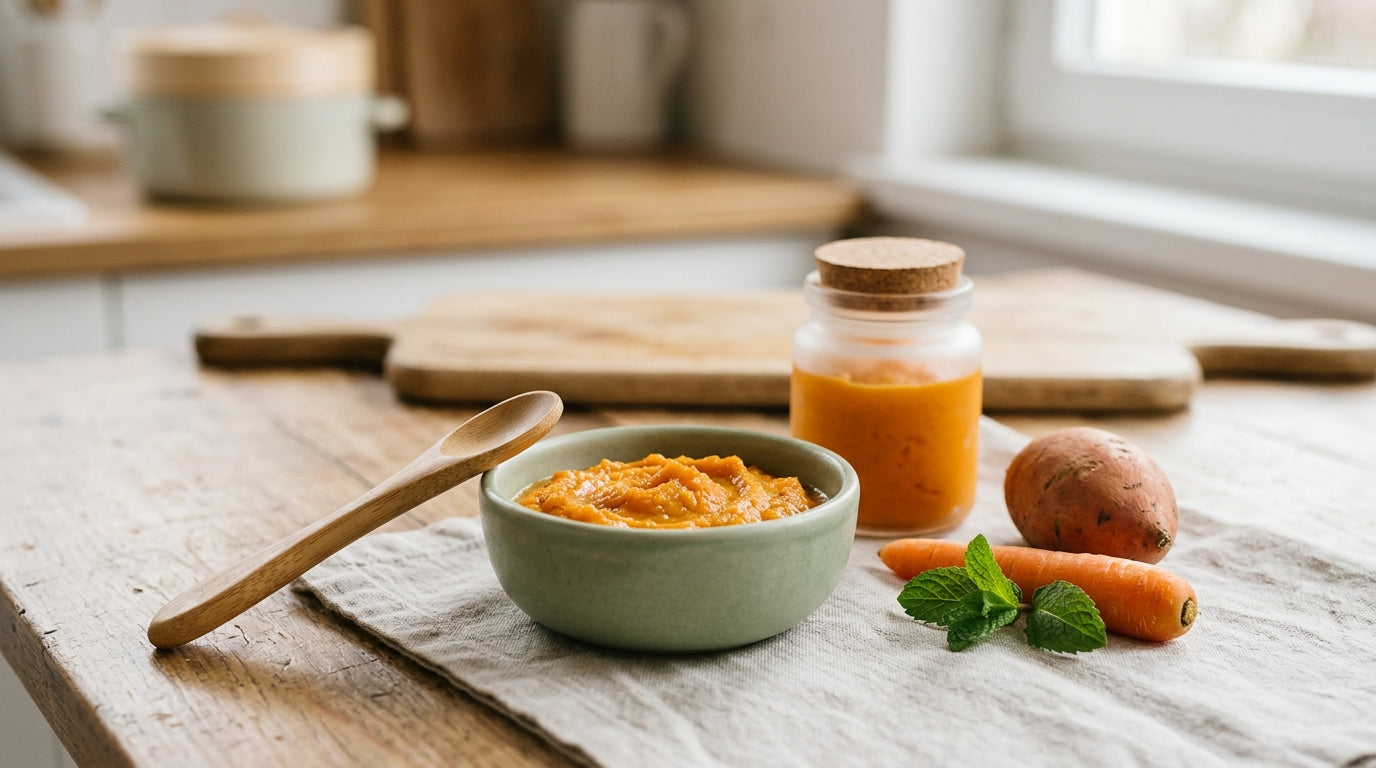
My mother-in-law cornered me in the kitchen and said I had to boil dal water for three straight hours or my son's intestines would simply shut down. My coworker from the pediatric ward texted me to skip purees entirely, advising me to just hand him a whole cooked rib bone and walk away. Then I opened Instagram and saw a woman in a matching linen set blending organic dragonfruit into a literal foam, claiming anything else was poisoning his gut microbiome.
Listen, figuring out what to feed an infant is like walking into a trauma bay where every single monitor is alarming for a different reason. You just have to tune out the noise, look at the actual patient in front of you, and do the next logical thing.
When I first thought about whipping up meals from scratch for my kid, I assumed my nursing background would make it a breeze. I've seen a thousand gastrointestinal issues. I understand the basic mechanics of the human gut. But standing at my kitchen counter staring at a single organic sweet potato, I completely froze. The pressure to get this right feels suffocating.
The reality of preparing your own infant meals is much duller and much messier than the internet makes it look. It's mostly just mashing things with a fork, watching them spit it onto their bib, and hoping they swallow ten percent of it.
When to actually put food in their mouth
You'll hear the six-month rule thrown around like it's a federal law. My pediatrician told me to look at my kid, not the calendar on the wall.
She said to watch for three specific things before I even bothered buying carrots. First, he needed to sit up like a somewhat stable human being, not a sack of flour. Head control is completely non-negotiable. If their head is still bobbing around like a dashboard ornament, they're a choking hazard waiting to happen.
Second, they've to actually stare at your food like they want to steal it from you. When my son started tracking my fork from my plate to my mouth with intense, unblinking focus, I knew we were getting close.
Third, the tongue-thrust reflex has to be gone.
That reflex is just a built-in safety mechanism to push foreign objects out of their airway. If you put a spoon in their mouth and they immediately push it back out with their tongue, they aren't being defiant. They just aren't ready. Give it another week or two.
I see so many parents in the clinic rushing this stage. We all want our kids to hit milestones yesterday so we can brag on some e baby forum. But their tiny digestive systems are just barely getting the hang of processing milk. There's no prize for being the first parent in the playgroup to serve a mashed banana. Take a breath, yaar.
The single ingredient rule
I'm going to talk about the three-day rule for a minute because it's one of the few things I actually care about.

Just steam a green bean, mash it, feed it, and wait three days to see what happens instead of playing Russian roulette with a tropical superfood blend. You don't add cinnamon, you don't mix it with applesauce to make it palatable, and you don't let them lick the seasoning off your avocado toast. You give them a spoonful of plain, unadulterated mush.
If they break out in hives, or their diaper suddenly looks like a crime scene, or they start screaming in unprecedented pain, you'll know exactly what caused it.
I've been in the ER with sobbing parents who fed their kid a twelve-ingredient smoothie for their very first meal. The baby is covered in a raised red rash, and the medical staff has to guess if it was the mango, the coconut water, the chia seeds, or the passionfruit. It's incredibly boring to do one food at a time, but boring is exactly what you want in medicine.
As for how to make the stuff, I refuse to buy a dedicated baby appliance. They're glorified food processors with tiny parts that get lost in the dishwasher. Hard things get steamed until they fall apart, soft things get smashed with a fork. You can thin it out with breastmilk, formula, or the steaming water. My pediatrician basically begged me to use spices once we cleared the initial allergy window so he wouldn't end up as a toddler who only eats beige carbohydrates. A tiny pinch of mild curry powder in lentils goes a long way.
Products that buy me four minutes of peace
Before we get into the nightmare of food safety, we've to talk about the chewing obsession. Right around the time they show interest in solids, their gums start bothering them constantly. They want to put everything in their mouth. It's partly teething and partly them just trying to map out where their mouth even is.
I lean heavily on teething distractions to keep my kid occupied while I'm trying to prep these tiny, frustrating meals. My absolute lifeline has been the Handmade Wood & Silicone Teether Ring.
I'll be perfectly honest, I bought it mostly because it looked nice and wasn't made of neon plastic that would clash with my rug. But it ended up being the only thing that genuinely worked. The contrast between the hard beechwood ring and the softer silicone beads gave him options when his gums were throbbing. I wipe it down, hand it to him while he's strapped in the high chair, and get exactly four minutes of peace to smash an avocado.
Sometimes I also throw him under the Fishs Play Gym Set. It's fine for what it's. It's minimal and made of wood, which I prefer over electronic plastic things that play the same aggressive song on a loop. He swats at the little wooden rings for a bit. It doesn't hold his attention for hours, but it buys me enough time to wash out a blender without a screaming audience.
If we're dealing with serious, inconsolable teething drama, the Panda Teether is another solid option I keep in the rotation. It's all food-grade silicone, which is great because I can just toss it in the fridge for ten minutes. The cold pressure helps numb the sore spots before we try to attempt a meal.
If you're in the thick of the chewing phase and need something to preserve your sanity while you cook, browse our teething collection to buy yourself some quiet time.
The hospital triage approach to food safety
This is where the exhausted pediatric nurse in me completely takes over. The immune system of an infant is basically a polite suggestion. It doesn't seriously do much of anything yet. So food safety isn't just a best practice, it's the entire job.

Honey is the big one. Never, under any circumstances, give honey to a kid under one year old. Not raw honey, not baked in a muffin, not a tiny drop on a pacifier to get them to stop crying. Infant botulism is rare, but it's catastrophic. The spores in honey paralyze a baby's muscles, starting from the head and working their way down. Just thinking about a floppy baby in the ICU makes my chest physically tight. Cross honey off your grocery list entirely.
Meat and eggs need to be cooked to death. If you're giving them an egg yolk, it shouldn't be runny and aesthetically pleasing. It should be chalky.
Then there's the double-dipping issue, which most parents don't even think about. When you feed a baby, bacteria from their mouth transfers directly to the spoon. If you put that spoon back into the main jar of puree, you've just introduced mouth bacteria into a warm, nutrient-rich environment where it'll multiply rapidly. You're basically creating a petri dish.
Scoop a small amount into a separate bowl. Feed them from that bowl. If there are leftovers in that bowl, scrape them into the trash. Never save food that a used spoon has touched. I don't care how expensive the organic peas were.
If perishable food has been sitting at room temperature for two hours, throw it away. Make it one hour if it's summer in Chicago. Treating a baby for foodborne illness is a miserable experience you want to avoid at all costs.
Why I gave up on the freezer stash
I tried the whole meal prep lifestyle exactly once. I spent three hours on a Sunday steaming various gourds, pureed them into different textures, froze them into perfect little silicone ice cube trays, and transferred them to labeled freezer bags.
My son refused to eat a single bite of it. I ended up throwing out forty frozen cubes of butternut squash six months later when they were covered in freezer burn.
If you're honestly going to batch cook, purees last a day or two in the fridge. In the freezer, they're supposedly good for a month or three. To thaw them, you're supposed to leave them in the fridge overnight. If you're desperate and need to use the microwave, you've to stir the absolute life out of it before you serve it. Microwaves create invisible hot pockets that will severely burn the roof of a baby's mouth. I always test it on my own wrist first, like a milk bottle.
Honestly, after the first month of making specialized purees, I mostly gave up. I just started smashing whatever we were having for dinner, minus the salt. It's cheaper, it's drastically easier, and it requires zero dedicated storage trays taking up space in my kitchen.
honestly, feeding your kid shouldn't feel like a high-stakes chemistry exam. You mash some things up. You watch them spit it out onto their lap. You wipe down the high chair and try again tomorrow. They all end up eating stale crackers off the floor eventually anyway.
Get your kitchen prepped and your baby occupied before you start smashing peas. Shop our collection of natural baby essentials to make mealtime slightly less chaotic.
Answers to your messy food questions
What if they gag on literally everything?
Listen, gagging is going to happen, and it's terrifying the first ten times. But gagging is just their body figuring out how to move food around their mouth. Their gag reflex is super far forward on their tongue compared to an adult's. Choking is silent, gagging is loud. If they're coughing, turning red, and making noise, they're fine. Just sit on your hands and let them work it out. If they're completely silent and turning blue, that's when you intervene.
Do I honestly have to buy everything organic?
My pediatrician said something that stuck with me. She said she'd rather a kid eat conventional broccoli than organic fruit snacks. If you've the budget to buy organic apples and berries, great. Do it. If you don't, just wash the regular produce really thoroughly and move on with your life. The stress of paying double for a sweet potato that they're just going to throw at the wall isn't worth it.
How much are they supposed to honestly consume?
Barely anything. At six months, food is just for fun. It's entirely about sensory exploration and motor skills. They're still getting all their actual calories and nutrition from breastmilk or formula. If they swallow half a teaspoon of mashed avocado, consider it a massive victory. Most of it's going to end up in their hair, in your hair, and wedged into the crevices of the high chair.
What if they aggressively hate all vegetables?
Then they hate vegetables right now. It takes something like fifteen exposures to a new flavor before a kid seriously decides if they like it or not. My son treated green beans like they were toxic waste for two straight weeks. I just kept putting a tiny dab on his tray every day. Eventually, he got bored enough to lick it. Now he tolerates them. Don't make a big deal out of it, and definitely don't force it.
Can I start giving them water to wash it down?
You can offer a tiny bit of water in an open cup or a straw cup when they start solids, mostly just to help them practice the physical skill of drinking. But we're talking about an ounce or two a day, tops. Their immature kidneys can't handle large volumes of free water, and you don't want them filling their tiny stomach with water instead of nutrient-dense milk. Just a few sips with their meal is plenty.




Share:
Why We Are Obsessed With The Homeless Billionaire Baby Daddy
Let's Talk About How Do Babies Get Thrush (And How To Fix It)