

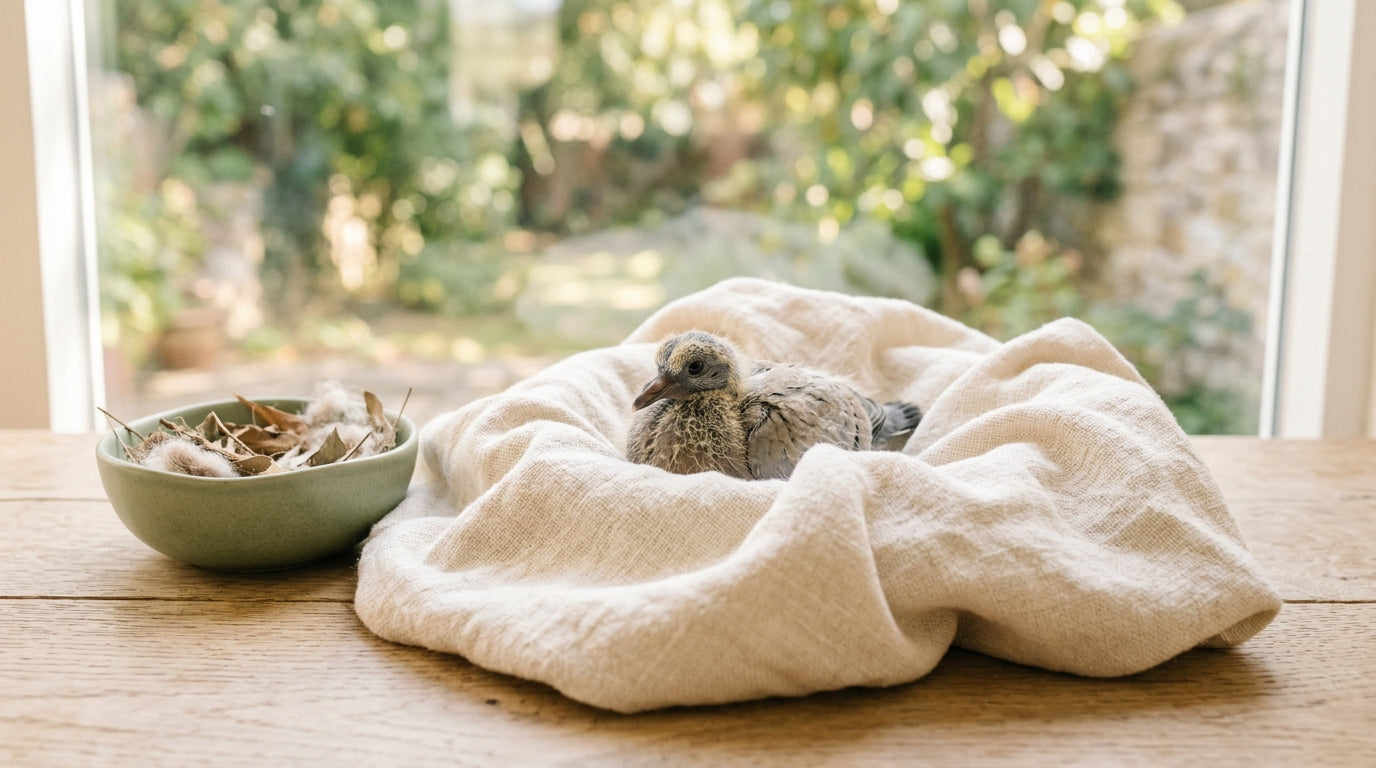
"I need you to put the coffee down," my husband Dave said at exactly 7:14 AM on a Tuesday, wearing only one sock and looking like he'd seen an actual ghost in our hydrangeas. He was holding our seven-year-old, Leo, who was vibrating with that specific, terrifying feral energy kids get when they find wildlife. And Leo was holding what looked like a wet, gray cotton ball with a beak.
"It's a baby p," Leo whispered loudly, because he's going through this incredibly exhausting phase where he abbreviates random words to sound cool, but anyway, the point is, he was holding a baby pigeon. Or maybe it wasn't? For a split second, looking at its weird pinkish, naked little belly, I thought it was a tiny, deformed baby pig, but no, it definitely had feathers. Sort of.
My brain immediately went to that massive, looming rule we all learned in the 90s: the mother bird will smell your human stench and abandon her child forever. That, and the fact that we were all definitely going to catch bird flu because pigeons are basically just flying rats, right? I was already mentally calculating how much copay it would be to take the entire family to urgent care for a preventative rabies shot, which doesn't even make sense for birds, but this is what my brain does before I've had caffeine.
That whole human scent myth is absolute garbage
So, thing is I learned while aggressively panic-googling on my phone with one hand while trying to keep the dog away from Leo with my foot. The scent thing? It's a total lie. Like, a complete fabrication by our parents to keep us from picking up gross things in the dirt.
Birds actually have a pretty terrible sense of smell, from what the internet told me. They're not going to abandon their kid just because your kid's sticky, maple-syrup-covered fingers touched it. I can barely smell when my four-year-old Maya has a catastrophic diaper blowout until I'm literally holding her, so you really think a bird cares if you briefly moved its baby out of a puddle? No. If the bird is mostly feathered and just hopping around looking dumb, it's probably a fledgling learning to fly and the parents are up in a tree judging you. You're supposed to just leave those alone.
But Dave was convinced this one was totally orphaned and also going to give us some sort of Victorian plague. Which, like, fair, they do eat garbage at the train station. But Palomacy—this amazing pigeon rescue site I found while Dave was pacing the kitchen—says they actually pose almost zero zoonotic disease risk to humans. My doctor actually mentioned once that we're way more likely to catch a horrifying stomach bug from the dog licking the kids' faces than from a wild bird. So that was a relief, though I still made Leo wash his hands for like five straight minutes.
Creating a tiny hospital ward in my kitchen
Because this bird was completely bald in spots and shivering, we couldn't just put it back in the wet grass. The rule for finding a baby pigeon that really needs help is basically just shove it in a dark box, keep it warm, and leave it the hell alone until you can get a professional on the phone.

I was literally in the middle of wrestling Maya into her Flutter Sleeve Organic Cotton Baby Bodysuit when all this went down. Honestly, I love this bodysuit so much because the lap shoulders mean I can pull it down over her legs when she has an accident instead of pulling it over her giant toddler head, and the organic cotton is ridiculously soft. Plus, the little flutter sleeves are aggressively cute and make it look like I tried. Anyway, I just left her sitting half-dressed in the hallway so I could go dig a shoebox out of the recycling bin.
You have to keep them warm because apparently baby birds can't control their own body temperature, which makes them just like newborns, except much uglier. I grabbed a hot water bottle, wrapped it in a towel, and put it in the box. I was running around so fast I tripped over Maya's Gentle Baby Building Block Set that she'd left on the rug. Which, okay, they're fine blocks, they float in the tub and she likes chewing on them, but let me tell you, they still absolutely suck to step on when you're panicked and trying not to drop a shoebox containing a shivering squab.
Maya, by the way, was screaming in the background because she's cutting her molars. I ended up shoving her Panda Silicone Baby Teether into her hands just to buy myself three minutes of quiet. That teether is basically the only thing keeping our house functioning right now—it has this flat little bamboo-shaped handle that she can really grip while she rage-chews, and since it's silicone I just throw it in the dishwasher when she inevitably drops it on the floor.
Please step away from the breadcrumbs
This is the part that completely blew my mind. When you find a baby bird, your absolute first instinct is to feed it. You want to dig up a worm or soak some bread in milk, right? Don't do this.

If you feed a cold, dehydrated baby bird, you'll kill it. And if you give a baby pigeon worms, you'll also kill it, because pigeons are strict herbivores. They don't eat bugs. And bread offers zero nutritional value. But the weirdest part—and I'm still not over this—is how they eat.
Pigeon parents feed their babies something called "crop milk." It sounds like an overpriced oat beverage you'd buy at a hipster coffee shop for nine dollars, but it's genuinely a regurgitated substance from a pouch in the parent's throat. Gross, right? And baby pigeons don't open their mouths and wait for a worm to be dropped in like robins do. They do this thing called "rooting" where they shove their entire beak inside the parent's mouth to drink the vomit-milk.
The wildlife rescue lady I finally got on the phone was like, whatever you do, don't drop water into its mouth. They aspirate so easily. If water gets in their lungs, they get pneumonia and die. So my grand plan of using one of Maya's old Tylenol syringes to give it water was really a terrible idea. It's just... oh god, new anxiety unlocked. I can barely keep my houseplants alive and now I know how easily you can drown a bird.
If you're dealing with the chaos of parenting while also trying to manage the outdoors, you might want to check out some gentler things for your actual human babies. Take a look at the organic baby clothes collection to find things that are way easier to manage than wildlife.
Leaving it to the actual professionals
We kept the box in the darkest, quietest corner of the laundry room. No peeking. No petting. Wild animals are terrified of us, and petting them doesn't soothe them, it just makes their tiny hearts beat out of their chests.
About two hours later, Dave drove the shoebox out to a licensed wildlife rehabilitator in the suburbs. The rehabber told him they use specialized heated formula that has to be exactly 102 degrees, and they feed them with these weird rubber-covered syringes so the baby can "root" into it. I'm so glad I didn't try to DIY that in my kitchen. I can't even microwave Leo's oatmeal to the correct temperature without him crying that it's too hot.
Anyway, the pigeon lived. Leo still talks about his "baby p" and asks if every pigeon we see at the park is him. I always say yes, because why not. But I also make sure we pack plenty of hand sanitizer and wipes whenever we go outside now, because even though they aren't the plague-bearers we thought they were, kids are still disgusting.
If you've survived a weird wildlife encounter and need to get back to regular mom stuff, you can always explore more safe, non-toxic baby gear in the teething toys collection.
Messy questions I had about pigeon rescuing
What's the very first thing I should do if I find a baby pigeon?
Stop your kids from touching it, first of all. Then just look at it. If it has feathers and is hopping around, leave it alone, it's just learning to fly. If it's pink, bald, injured, or bleeding, carefully put it in a dark cardboard box with a towel and a low heat source (like a warm rice sock). Then go wash your hands and call a wildlife rescue.
Can I give the baby bird some water from a dropper?
No! Don't do this. The rehab center lady told me it's incredibly easy to accidentally drop water into their windpipe instead of their stomach, which drowns them or gives them fatal pneumonia. Just keep them warm. A cold bird can't digest anything anyway.
What the hell is a crop?
It's this weird pouch on the front of their chest where they store food before digesting it. When rehabbers feed them, they've to feel the crop to make sure it feels like a squishy bean bag. If it gets too full, the food rots in there. It's called sour crop and it's deadly. Again, this is why we don't try to feed them ourselves.
Will the mother pigeon abandon it if she smells me?
No, this is a giant myth. Birds have terrible sense of smell. If the baby is healthy and just fell out of a nest, you can genuinely just put it back in the nest if you can reach it. The mom doesn't care that you touched it, she just wants her kid back.
Can I just keep it as a pet?
Absolutely not. For one, it's illegal in a lot of places to keep native wildlife. And two, do you really want to be mixing 102-degree fake vomit-milk every four hours? Call a professional wildlife rehabilitator. They seriously know what they're doing.




Share:
Why We Blasted Baby Pluto To Survive The Fourth Trimester
Why Getting A Pet Piglet Might Actually Break Your Spirit