

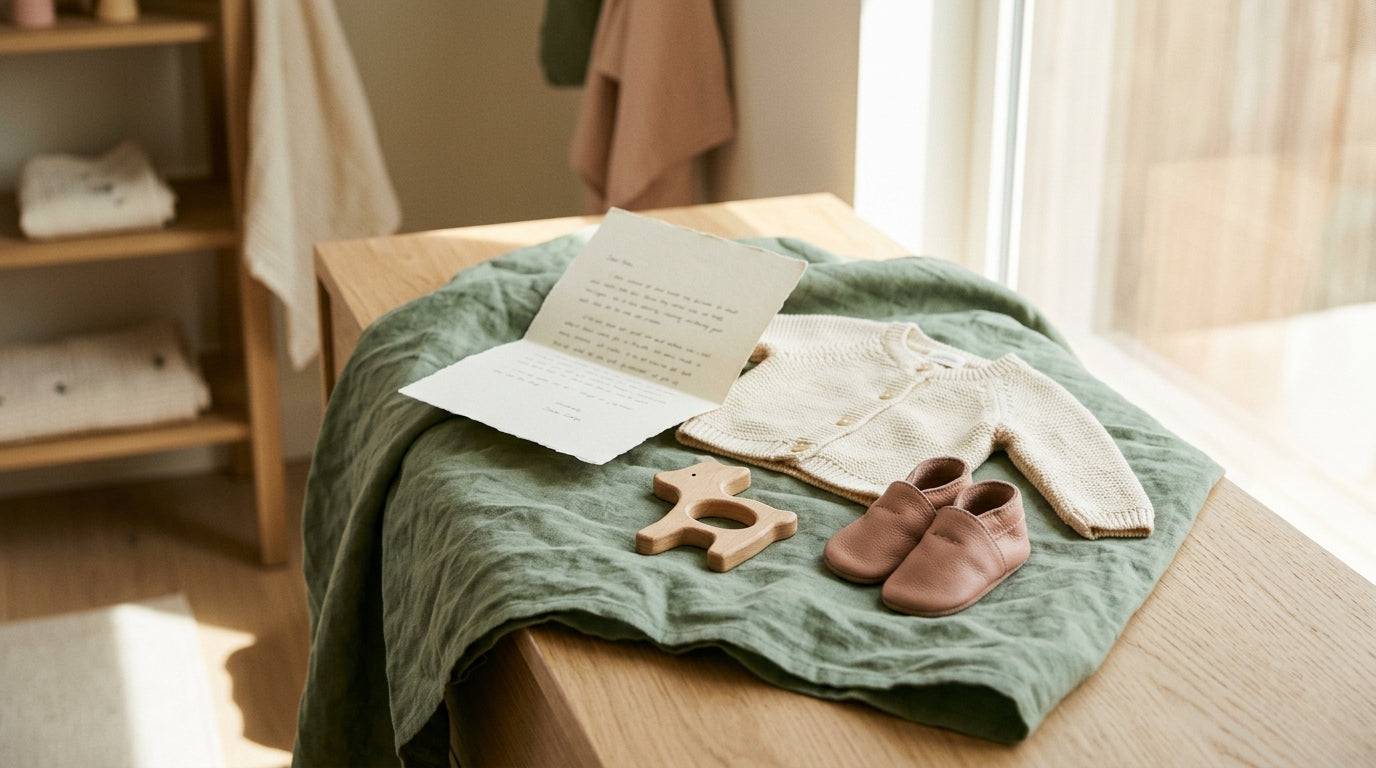
Hey Marcus from six months ago. It's 2:14 AM and you're sitting on the edge of the incredibly lumpy gray sofa, bouncing a 5-month-old who absolutely refuses to power down. He's currently undergoing some sort of major firmware update, which apparently means he wakes up angry every two hours. While scrolling through your phone to keep your eyes open, you just stumbled across a screenshot in your camera roll from back when Sarah was pregnant. It's that ai baby generator you paid five bucks for.
I'm writing to you from exactly six months in the future. Our son is eleven months old now, and I'm going to save you a lot of late-night mental spiraling. Looking at that AI-generated JPEG while holding the actual, physical baby g in your arms is a bizarre experience, mostly because it highlights just how completely clueless we were about human biology.
Your basic misunderstanding of human source code
I get why you used that app during the third trimester. You're a software engineer. Your brain wants to approach parenthood like a software deployment. You fed your brown eyes and Sarah's green eyes into a neural network, and you fully expected the baby generator to output a predictable, blended hex code of your features. You wanted a roadmap.
That isn't how genetics works. Our pediatrician gently roasted me at one of the early checkups when I asked why his hair was coming in strawberry blonde when neither of us has red hair. She explained that human traits are polygenic, which apparently means it's less like mixing paint and more like a chaotic, multi-variable slot machine. A diffusion model or a GAN just overlays our facial pixels. It doesn't know that my great-grandfather had red hair, or that recessive genes just hang out in the background for generations like deprecated code waiting to randomly execute.
The AI gave you a picture of a baby with a perfectly proportioned nose and my exact jawline. Real baby g has a nose that currently resembles a small button mushroom and he basically has no jawline. He's just a series of soft, rolling chins that constantly smell slightly of sour milk.
We really need to talk about where those photos went
I'm going to go off on a tangent here for a second because it still keeps me up at night. You uploaded high-resolution, front-facing biometric data to a site called something like "MakeMyFutureBaby.net." Think about that for a minute. You wouldn't push unencrypted user data to a public repository, but you just handed over our literal face maps to a third-party app with a privacy policy that was probably copy-pasted from a generic template in 2012.
These free or cheap platforms aren't running computationally expensive AI models out of the goodness of their hearts. Server time costs money. They're farming data. They're taking your face, Sarah's face, and aggregating millions of data points to train other commercial models or selling the data sets to third-party ad brokers. You've spent weeks reading Reddit threads about internet safety and protecting his future digital footprint, but you're out here treating our own biometric security like it's a casual party trick.
You have to stop giving away our facial recognition data to random servers in eastern Europe just to soothe your anxiety about the future.
That five-dollar add-on feature that predicted his Myers-Briggs personality based on his fake digital star sign is literally just a random string generator, by the way.
The hardware is way messier than the simulation
The AI-generated photo showed a kid with flawless, poreless, perfectly glowing skin. It didn't predict the baby acne that hit him like a freight train at week three. It didn't warn you about the mysterious, bumpy rash that would cover his chest every time we tried a new brand of laundry detergent. When you're dealing with the actual physical reality of an infant, you quickly realize their skin is incredibly buggy.

I spent hours troubleshooting his rashes before realizing synthetic fabrics were practically acting like a heat trap. What actually helped—and what I really wish you'd bought instead of wasting money on that app—was swapping his wardrobe over to the Organic Cotton Baby Bodysuit. I don't fully understand the textile manufacturing process, but standard cotton is apparently blasted with chemicals, and synthetic stuff just causes his skin to freak out. This organic bodysuit became our daily uniform. It's 95% cotton with a tiny bit of stretch, acting like a breathable heat-sink for his skin. It's tagless (tags are a major design flaw in baby clothes), and the envelope shoulders mean when he has a catastrophic diaper blowout, you can pull the whole thing down over his legs instead of dragging it over his head.
If you want to feel like you're actually preparing for his future, stop looking at fake photos and check out Kianao's organic nursery gear, because you're going to need way more bodysuits than you currently think is humanly possible.
Development doesn't follow a loading bar
Right now, at five months old, you're holding a kid who's just starting to realize he has hands. His gums are swollen, he's drooling so much you could mop the floor with his bibs, and he's completely miserable. You're trying to figure out if his face matches the AI prediction, but he just wants to chew on your collarbone.
We bought the Panda Teether Silicone Baby Bamboo Chew Toy and it's basically the only reason I've survived the last month. When teething strikes, he essentially turns into a tiny, inconsolable werewolf. This panda thing is made of food-grade silicone and has these weird little textured bumps on the back that apparently massage his gums. He can actually hold it himself because of the circular cutout, which gives you about five minutes of peace to drink lukewarm coffee. Plus, you can throw it in the fridge so it gets cold, which seems to numb his mouth a bit. It's a lifesaver.
We also grabbed the Rainbow Play Gym Set with Animal Toys because I read somewhere that wooden toys promote better focus. I'll be honest with you—it's beautifully made. The wood is smooth, the little hanging elephant is great, and it doesn't play those horrific electronic songs that make me want to throw my smart speaker out the window. But right now? Half the time he just ignores the carefully crafted geometric shapes to stare at the ceiling fan or try to eat the carpet. It's a solid piece of gear, and it definitely helps him practice grabbing things, but babies are weird and their attention spans are basically non-existent. Don't expect it to magically entertain him for an hour.
Letting go of the beta version
I'm telling you all of this because I know exactly why you used that generator. You were terrified. You were trying to put a face to this massive, abstract life change that was rapidly approaching. You thought that if you could just get a visual of him, you could run some sort of predictive model and prepare for the reality of being a dad.

But the reality of him is so much louder, stickier, and better than a composite image. He's going to have Sarah's weird habit of sleeping with one arm straight up in the air. He's going to have your exact scowl when he's trying to figure out how a zipper works. No algorithm could have ever predicted that.
You should probably just close your phone, stop staring at that screenshot, and try to get him back to sleep. You've got to debug this stuff live in production anyway.
Before you completely log off for the night, you might want to redirect that nervous energy into something useful. Head over to Kianao and start building a physical survival kit of organic essentials for when the next growth spurt hits.
Answering your late-night panic searches
I know your brain won't shut off, so here are the answers to the questions you're probably about to type into the search bar at 3 AM.
Are AI baby apps seriously accurate at all?
Not really. They just take two flat photos and blend them together using basic facial mapping algorithms. They can't sequence your DNA, so they can't account for recessive genes, hereditary quirks, or the simple fact that a baby's face completely changes shape over the first year. It's a highly advanced parlor trick and nothing more.
Is it safe to upload my face to these generator sites?
I wouldn't trust them with a burner phone, let alone my actual biometric data. Most of these free sites have incredibly vague privacy policies. You're handing over high-resolution face maps, and they usually reserve the right to store it, use it to train other AI models, or sell it off. If you absolutely have to try one, use a secondary email and read the terms of service carefully.
Can AI predict my baby's eye color?
Our pediatrician basically laughed me out of the room when I asked about this. Eye color is determined by multiple genes interacting in ways science doesn't even fully map out predictably yet. Even if you and Sarah both have brown eyes, you could carry a blue-eye gene that randomly compiles in your kid. The AI is literally just guessing based on the dominant pixel colors in your selfies.
What should I genuinely be doing instead of using baby generators?
Honestly, try to sleep. But if you can't, start researching breathable, non-toxic fabrics for his clothes or baby-proofing the living room. We spent so much time worrying about what he'd look like and completely neglected figuring out how to handle his incredibly sensitive skin. Focus your energy on making the physical environment safe rather than stressing over digital predictions.
When will we really know what he looks like?
Even when he's born, he's going to look like a swollen, grumpy potato for the first few weeks. It took about three months for his actual features to de-puff and settle in, and even now at eleven months, his face seems to completely change every time he learns a new expression. Just be patient with the process.




Share:
Why I Swapped Helicopter Parenting for the Achtung Baby Method
The Brutal, Beautiful Truth About the Always Be My Baby Phase