

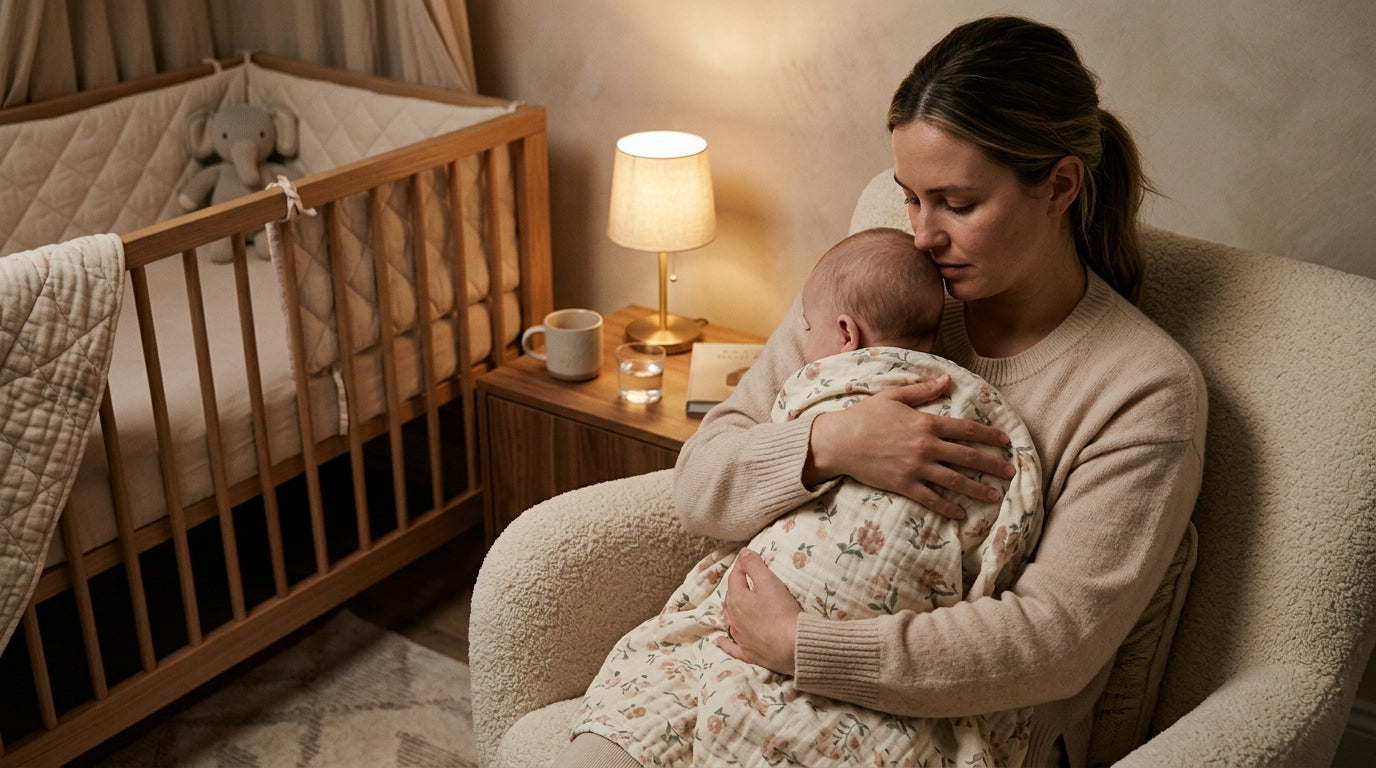
It was 3:14 on a Tuesday morning in November, and the rain was lashing against the single-glazed window of our flat in London, but I couldn’t hear it over the sound of my own teeth grinding. I was standing in the narrow hallway holding Maya, who was executing a noise that sounded less like a human infant and more like a dial-up modem being fed into a woodchipper. Her twin sister, Chloe, was asleep in the other room, meaning I was entirely consumed by the singular, terrifying mission of keeping this screaming potato from waking her sibling. My shoulders were somewhere up near my ears, my lower back was screaming, and my brain felt like it was wrapped in wet wool.
That's the exact moment you understand it. Not intellectually, but physically. You understand how the unthinkable happens.
The pamphlets the NHS hands you about shaking baby syndrome always feature a sad-looking shadow person or a clinical diagram, which completely fails to capture the visceral, acid-in-the-veins reality of severe sleep deprivation colliding with a baby who won't stop shrieking. Before you've kids, you assume that abusive head trauma is something committed by absolute monsters in dark alleyways. At 3:14 AM on day forty-two of no sleep, covered in sour milk and yesterday’s tears, you suddenly realize that the line between a functioning adult and a total biological meltdown is about paper-thin.
What our doctor actually said about the danger zone
I ended up mentioning this dark, creeping panic to our local GP during the girls' vaccinations. I fully expected him to call social services and have me dragged away for admitting that my daughter’s crying made me want to punch a hole through our drywall. Instead, Dr. Evans—a man who always looks like he needs a long holiday and a stiff drink—just nodded wearily.
He explained that a baby's head is essentially a massive, heavy bowling ball balanced on a cooked piece of spaghetti. Their neck muscles are basically non-existent. He muttered something about shearing forces and blood vessels, which made me think of aggressive gardening, but his main point was that a baby's brain is incredibly fragile and quite literally sloshes around if subjected to violent force. The sheer mechanics of it mean that just a few seconds of losing your temper and shaking them out of pure, blinded frustration can cause catastrophic, irreversible damage.
But the most reassuring thing he told me was what doesn't cause it. You can't accidentally shake a baby into this kind of trauma by jogging with a pram over London cobblestones, or by bouncing them a bit too enthusiastically on your knee while trying to dislodge a burp. I had spent three weeks terrified that tripping over the rug with Maya in my arms had scrambled her neurology. Dr. Evans made it very clear that it requires deliberate, violent force—the kind of force that only happens when a parent’s brain entirely short-circuits.
The absolute tyranny of the tiny ruler
There's a psychological concept called king baby syndrome, which sounds like an obscure indie band but actually refers to an adult who acts like a selfish infant demanding the world cater to them. But when you've an actual baby, the literal version of king baby syndrome takes over your entire household. You're no longer an independent human being; you're the exhausted, terrified staff of a non-verbal dictator who uses auditory warfare to get their way.

My mate Dave calls his youngest lad a G baby, mostly because the kid essentially runs a tiny, milk-based cartel from his highchair. You laugh about it, but the power dynamic is genuinely staggering. They dictate when you sleep, when you eat, when you can use the loo, and whether you're allowed to sit down. When that absolute loss of autonomy is paired with hours of inconsolable crying, the psychological pressure cooker is immense.
The medical establishment calls this the Period of PURPLE Crying.
I hate this acronym with a burning passion. It makes it sound like a cheerful loyalty program at a high street coffee shop, not a grueling test of human endurance. It stands for Peak of crying, Unpredictable, Resistant to soothing, Pain-like face, Long lasting, and Evening. Which is just a very sanitized way of saying: "Your baby is going to scream in your face for five hours every night for absolutely no medical reason, they'll look like they're being tortured, nothing you do will fix it, and you'll just have to endure it."
When Maya hit this phase, we checked everything. Clean nappy? Yes. Fed? Yes. Winded? Yes. Fever? No. She just needed to yell into the void, and I was the void.
We tried a straightjacket-style swaddle once and Chloe looked at me like I’d just insulted her ancestors, so we binned that immediately.
We eventually realized that minimizing sensory annoyances helped a tiny bit. The rigid clothing with a thousand snaps was making us all furious during midnight changes. We switched to the Organic Cotton Baby Bodysuit purely out of self-preservation. It's sleeveless, ridiculously stretchy, and means I don’t have to wrestle a thrashing infant into rigid armholes in the dark. It's soft, doesn't have those scratchy tags that seem to enrage babies for sport, and simply gets out of the way. It didn't stop the crying, but it stopped me from crying while trying to dress her.
Sometimes you wonder if it's teeth. We handed Maya the Panda Silicone Baby Teether hoping for a miracle cure to the evening meltdowns. I'll be perfectly honest with you: it's a cute piece of food-grade silicone, and she definitely enjoyed gnawing on its little bamboo stalk, but it didn't magically turn our chaotic evening into a peaceful yoga retreat. It's a solid, safe thing for them to chew on instead of your knuckles, which is a win, but it's not a mute button.
If you're in the thick of the crying phase and looking for ways to keep your sanity intact, you might want to explore the Kianao collection. They can't fix the crying, but having soft, organic basics at least removes a few friction points from your day.
Explore Kianao's organic baby essentials collection
Leaving the room doesn't make you a monster
The single most important piece of advice I received—and the one that feels the most unnatural—is the walk-away rule.

Every fiber of your evolutionary biology tells you that putting down a crying baby is an act of supreme negligence (page 47 of the main parenting book we bought strongly implies that a failure to instantly soothe your child will result in them becoming a sociopath, which I found deeply unhelpful). But when you feel that hot spike of rage in your chest, when your teeth are grinding so hard your jaw pops, the only safe thing to do is walk away.
You put them down. Safely. On their back.
For us, the designated safe drop zone became the floor underneath the Wooden Rainbow Play Gym. If I felt myself cracking, I'd lay Maya down right there. I didn't care if she batted at the little wooden elephant or just screamed at it. It was sturdy, it was safe, and she couldn't roll off it. I'd put her there, walk into the kitchen, shut the door, and stare blankly at the kettle while taking deep, shuddering breaths for exactly five minutes.
The baby will keep crying. The noise will seep under the door. But a baby crying alone in a safe space for ten minutes has never died from crying. Babies have, however, died because a parent tried to push through the red zone and snapped.
You have to forgive yourself for those moments. Parenting is largely about surviving your own emotional wreckage while trying to keep a tiny human alive. You tag your partner in if they're around. You text a mate. You put on noise-canceling headphones (an absolute godsend, by the way) and just hold the baby while listening to a podcast about brutalist architecture or literally anything that isn't the screaming.
The twin girls are two years old now. The evening witching hours have been replaced by negotiations over whether a blue plastic spoon is 'spicy' or not. The sheer, terrifying vulnerability of their infant brains has hardened into toddler resilience. Looking back, I don't remember the details of the sleepless nights, but I vividly remember the physical weight of the desperation.
If you're standing in a dark hallway right now, holding a screaming baby and feeling like you're about to shatter into a million pieces, just put them down. Go to the kitchen. Breathe. You're not failing. You're just exhausted.
When you're ready to face the music again, make sure you're equipped with things that make the hard parts just a little bit easier.
Shop Kianao's full range of safe, sustainable baby gear
The messy realities of the crying phase (FAQs)
Is it normal to feel angry when my baby cries?
Absolutely, and anyone who tells you otherwise is either lying or has a full-time night nanny. The sound of your own baby crying is biologically engineered to spike your cortisol and cause severe distress. Combine that with massive sleep deprivation, and anger is a completely standard neurological response. The feeling isn't the problem; it's how you act on it. Step away, scream into a pillow, and give yourself grace.
Can bouncing my baby on my knee cause brain trauma?
According to our endlessly patient GP, no. The panic you feel after you accidentally trip on the stairs or bounce them a bit vigorously during a game of horsey is entirely misplaced. Abusive head trauma requires violent, whiplash-inducing force that's intentional and extreme. Normal play, bumpy car rides, or clumsy dad maneuvers don't cause this.
How long does this terrifying PURPLE crying thing last?
It generally peaks around the two to three-month mark and then slowly tapers off, which feels like a lifetime when you're living it. For us, it felt like an eternity, but by month four, the five-hour scream-fests abruptly turned into normal, decipherable complaints about wet nappies or hunger. It really does end, even if your current reality suggests otherwise.
Does putting them down to cry cause attachment issues?
I spent weeks agonizing over this, convinced that leaving Maya under her play gym for ten minutes while I hyperventilated in the kitchen was going to ruin her for life. It doesn't. Ten or fifteen minutes of crying in a safe crib or on a mat while you keep stable your own nervous system is infinitely better for their long-term health and safety than being held by a caregiver who's on the absolute brink of losing control.
How do I explain this to my parents who are babysitting?
Just be blunt. The older generation sometimes operates on outdated mechanics ("just give them a bit of whiskey on the gums" etc.). I told my mum flat out: "If she won't stop crying and you feel overwhelmed, put her in the cot and go make a cup of tea." Give them explicit permission to walk away, because secondary caregivers often feel intense pressure to 'fix' the crying and can panic when they can't.




Share:
Why the she gon call me baby boo meme is stressing moms out
Why I Finally Started Buying Serenity Kids Baby Food for Maya