

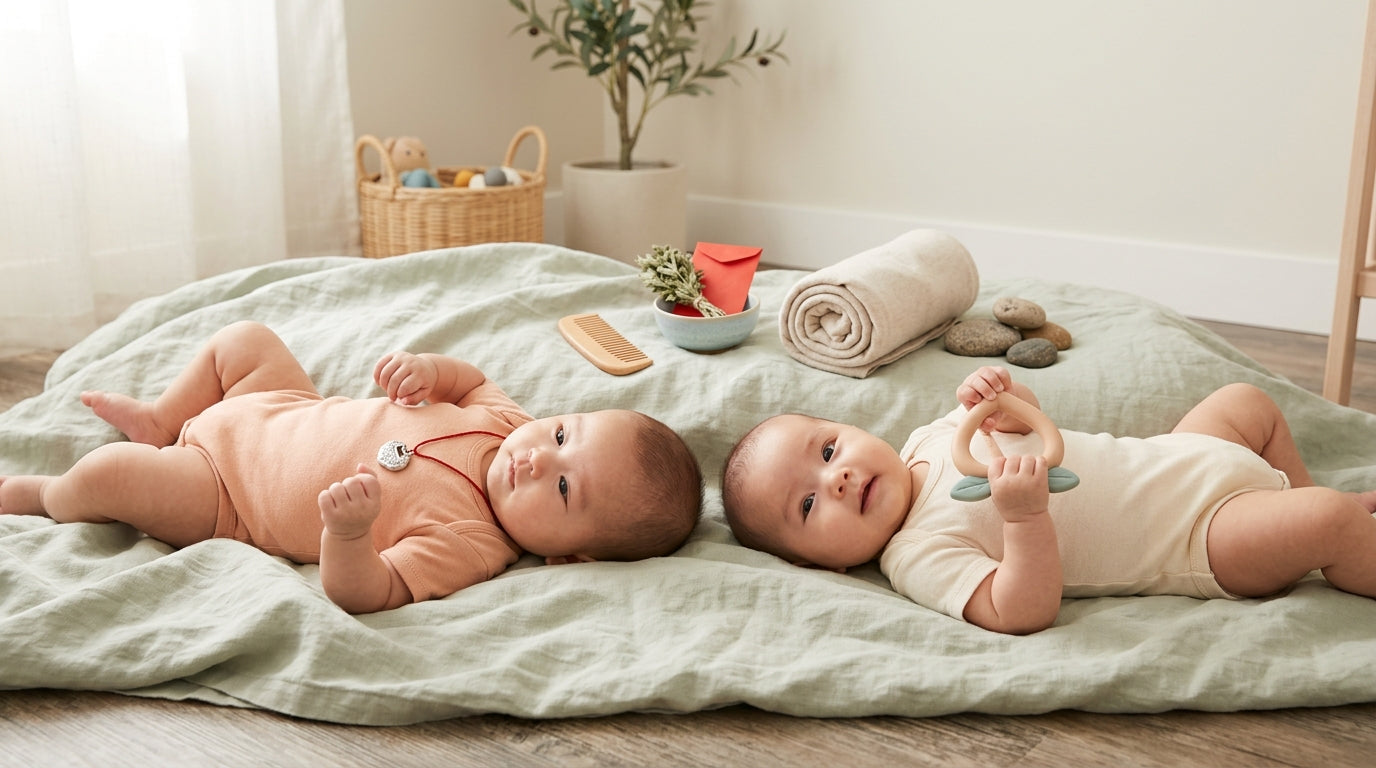
It was 9:47 PM on a Tuesday, roughly four months before our lives permanently imploded, when my wife—who was at that point roughly the size and shape of a medium family car—aggressively tapped her phone screen and demanded I calculate her exact age on the lunar calendar. She was sweating through a maternity shirt, eating a jar of pickled onions with a fork, and desperately trying to reverse-engineer a chinese baby gender predictor she had found buried deep in an ancient parenting forum.
I tried to explain that since we were having twins, the ancient lunar magic was probably going to struggle with the logistics. But when a pregnant woman demands you convert her Gregorian birthdate into lunar phases to cross-reference with the exact month of conception, you don't argue. You just open a spreadsheet and start doing the maths while quietly hoping she doesn't notice you've eaten the last of the chocolate digestives.
That time a piece of paper tried to guess my twins' genders
The entire premise of the chinese baby calendar is wonderfully absurd if you spend more than three seconds thinking about it. Legend has it that a scroll was found in a royal tomb hundreds of years ago, containing a grid that cross-references the mother's lunar age with the lunar month of conception to definitively tell you if you need to paint the nursery blue or pink. (Side note: page 47 of the modern parenting manual suggests you remain completely neutral about gender, which I found deeply unhelpful when trying to buy appropriately sized cardigans at 3am).
My wife spent three solid days convinced we were having two boys because the chart said so. She completely ignored the fact that fraternal twins could literally be one of each, assuming the ancient royal tomb scroll simply overrode basic biology. The medical consensus, as relayed to us by a junior sonographer at St Thomas' Hospital who looked like she hadn't slept since 2018, is that these charts are exactly 50 percent accurate. You would literally get the same statistical reliability by flipping a coin into a fountain and wishing really hard.
We had two girls.
Yet, the chokehold this thing has on expectant parents is terrifying. Just last week, a desperately pregnant acquaintance cornered me near the swings at our local park, aggressively refreshing a chinese baby calendar 2025 site on her phone as if a better 5G signal might magically alter the gender of her fetus. I just nodded and handed her a wet wipe, because there's no reasoning with someone in the third trimester.
The obsession with rolls (and why the health visitor strongly disagreed)
Once the twins actually arrived, my internet search history took a massive left turn into global childcare philosophies, mostly because British childcare advice essentially boils down to "give them some Calpol and try not to drop them." This is how I stumbled into the long-standing cultural reverence for the fat chinese baby.
In traditional Chinese culture, a baby with deep, aggressive rolls—the kind that makes them look like the Michelin Man's tiny, angry offspring—is celebrated. It's historically seen as a sign of wealth, exceptional health, and a family's sheer competence at keeping a human alive. I found myself obsessing over this aesthetic because, honestly, the NHS growth charts were giving me palpitations.
Our girls were born tiny, and every visit from the health visitor involved a lot of serious frowning at a little red book. I wanted those glorious, culturally celebrated rolls just to prove I wasn't entirely failing at fatherhood. I started trying to cram extra ounces of formula into them at every feed, hoping to magically inflate them.
Our paediatrician, a woman who perpetually smelled of stale coffee and clinical-grade hand sanitizer, eventually told me to stop it. From what I could gather through my fog of chronic sleep deprivation, the science suggests that trying to force-feed babies to hit a specific visual aesthetic completely destroys their natural ability to know when they're full. She suggested I try paying attention to the babies instead of the clock, letting them eat when they were fussy and stopping when they aggressively batted the bottle away, which basically sounds like guessing but apparently has a fancy medical name like responsive feeding.
Dressing the glorious, sticky reality
Whether your baby has rolls or resembles a small, angry string bean, clothing them is an absolute nightmare of logistics and bodily fluids. When they're constantly leaking milk, drool, and substances I still refuse to identify, you go through outfits at an alarming rate.

Because of my brief obsession with perfect infant health, I bought a lot of organic things. Most of them were rubbish and shrank into doll clothes the second they looked at a washing machine. But the Sleeveless Organic Cotton Baby Bodysuit from Kianao actually survived our household. It's my absolute favorite purely because it has these envelope shoulders that let you pull the entire garment *down* over their body instead of up over their head when a nappy explosion occurs, which is a design feature that quite frankly deserves a Nobel Peace Prize. It stretches over whatever body type your kid currently has without looking like a sad, deflated balloon by the end of the day.
Where was my month of sitting?
Perhaps the most devastating thing I learned about traditional eastern baby care was the concept of *Zuo Yuezi*, or "sitting the month." It's a strict, deeply respected postpartum tradition where the mother does absolutely nothing for 30 days except rest in bed, bond with the baby, and eat highly nutritious, warming broths brought to her by a dedicated support system of grandparents or hired maternity nurses.
I read this aloud to my wife while she was sitting on a plastic donut cushion in our freezing London flat, eating a slightly stale digestive biscuit. We looked at each other and nearly cried. Instead of a carefully orchestrated month of healing broths and generational support, our postpartum "village" consisted of:
- Dave from Deliveroo, who regularly judged our 11am orders of greasy chips.
- An automated text message from the GP surgery reminding us to book a smear test.
- My mother-in-law popping round for forty minutes, complaining about the traffic on the M25, and leaving before anyone needed a nappy change.
- The Amazon delivery driver who started leaving parcels in the recycling bin out of sheer pity because it took me so long to limp to the front door.
The western medical establishment expects women to essentially bounce back, strap the baby to their chest, and march off to the supermarket three days after major abdominal surgery. Adopting even a fraction of the *Zuo Yuezi* mindset—ignoring the laundry, banning unhelpful visitors, and demanding people bring you hot meals instead of useless soft toys—is probably the most medically sound thing you can do for maternal mental health, though good luck explaining to your British relatives that they aren't allowed to hold the baby unless they've brought a casserole.
Check out Kianao's curated collection of sustainable baby essentials to make your own messy postpartum survival slightly more comfortable.
Holding a 6-month-old over a toilet while hissing
By month four, we were going through roughly sixteen nappies a day. I was financially ruined and environmentally crippled with guilt. This led to my desperate foray into Elimination Communication (EC), a practice widely used with Chinese babies who traditionally wear *kaidangku* (split-crotch trousers) instead of nappies.

The theory is that babies signal when they need to go, and if you're observant enough, you can just hold them over a receptacle, make a cue sound, and skip the nappy entirely. I decided I was going to master this. I was going to be an eco-warrior dad attuned to my children's deepest bodily rhythms.
Our attempt at part-time EC went exactly like this:
- Observe Twin A making a slightly strained face that looks either like deep philosophical contemplation or impending bowel movement.
- Sprint across the living room, aggressively stripping off her tights while she screams in sheer confusion.
- Hold her over a small plastic potty while making a prolonged "ssssss" hissing sound like a defective radiator.
- Watch her stare at me, completely dry, for four solid minutes until my arms shake from the strain.
- Put her nappy back on, at which point she immediately and violently soils it while maintaining unbroken, victorious eye contact.
We abandoned it after three days. If you can make EC work, you're a better, more spiritually grounded parent than I'm. We just bought a bigger bin.
Distractions, drool, and wooden rings
When you aren't obsessing over their bodily functions, you've to find ways to stop them crying. Teething in our house felt less like a developmental milestone and more like a hostile hostage situation. We acquired the Panda Teether from Kianao during a particularly dark week. Look, it's fine. It's a piece of silicone shaped like a bear. It goes in their mouth, it gets immediately dropped on the floor, it becomes entirely coated in golden retriever hair, and you've to wash it. But they do gnaw on it aggressively, and it occasionally bought me three minutes of silence to drink lukewarm coffee, which is the highest praise I can give any object.
What actually saved my sanity was setting up the Wooden Rainbow Play Gym in the center of the rug. Unlike the plastic, battery-operated monstrosities that flash primary colors and scream tinny electronic songs at you until you want to throw them into the Thames, this thing just sits there. It's wood. It has little hanging animals. The babies would lie under it and bat at the wooden rings for ages, completely fascinated by basic physics, leaving me free to stare blankly at the wall and question my life choices.
Praising the struggle
Now that the twins are two, they're absolute feral menaces who communicate mostly in high-pitched demands and strategic property damage. But the one piece of eastern parenting philosophy I've genuinely managed to stick to revolves around how we talk to them.
Western parents have this deeply ingrained habit of praising innate talent. "You're so smart!" "You're a natural!" Decades of psychological research suggest this is genuinely a terrible idea, making kids terrified of failure because they think struggling means they've lost their special gift. The traditional Chinese approach leans heavily the other way, focusing almost entirely on the effort expended rather than the natural ability.
I try to do this, though my execution is definitely lacking. When Twin B finally figures out how to open the childproof cabinet to steal the dog biscuits, I don't tell her she's a genius. I tell her I'm incredibly impressed by the sheer, relentless perseverance she showed in dismantling the plastic lock with a plastic spoon. It's a small shift, acknowledging the grind rather than the outcome, but apparently, it builds resilience. Or it just creates highly determined burglars. Time will tell.
Parenting is basically just borrowing traditions from cultures older and wiser than yours, completely messing them up in execution, and hoping your kids survive the experiment. Just throw away the lunar calendars, buy clothes that stretch over the nappy explosions, and if someone offers to bring you a casserole, never, ever turn them down.
Ready to upgrade your baby's wardrobe and play space with things that really survive the chaos? Shop Kianao's full collection of sustainable, organic baby essentials today.
Frequently Asked Questions (Because You're Definitely Overthinking This)
Is the lunar gender calendar genuinely based on real science?
No. Absolutely not. My paediatrician literally rolled her eyes when I asked about it. It's an ancient parlor trick that has a 50/50 shot of being right, which are the exact same odds you get by guessing randomly. Use it at a baby shower for a laugh, but don't paint your nursery based on what a grid from the 13th century tells you. If you really need to know, wait for your 20-week scan or get the genetic blood test.
Should I be worried if my baby doesn't have those chubby Michelin rolls?
Unless your actual, medically qualified doctor is worried, please stop stressing about this. Our twins were basically string beans for the first year. The cultural pressure to have a delightfully fat baby is huge, but trying to force a baby to overeat just to look a certain way messes up their natural hunger cues. Just follow their lead, feed them when they scream, and accept whatever shape they happen to be.
Can I realistically do Elimination Communication in a modern western home?
You can, but you need the patience of a saint and an excellent carpet cleaner. Part-time EC is probably the most realistic approach for the average exhausted parent—just offering the potty right after they wake up or after a big feed. We failed spectacularly at it because trying to read the subtle facial expressions of two babies simultaneously while sleep-deprived usually just resulted in puddles on the sofa.
How do I create a 'village' for postpartum recovery if I don't have family nearby?
You have to brutally manufacture one. You can't do the traditional month of rest without help, so lower your standards for pride and start begging. Set up a meal train link and text it to everyone you know. Hire a postpartum doula if you can scrape together the budget. And explicitly tell visitors that the price of admission to see the baby is doing a load of laundry or bringing a hot meal. If they just want to hold the baby while you make them tea, lock the door.
Does praising effort instead of talent really make a difference?
From everything I've read and poorly understood, yes. When you tell a kid "you're so smart" every time they do something right, the second they fail at something, they assume they're suddenly stupid. If you say "I love how hard you tried to figure that out," they learn that the struggle is the point. It's exhausting to remember to say it in the moment, especially when they're just aggressively stacking blocks, but it supposedly stops them from becoming anxious perfectionists later on.




Share:
Navigating The CD Baby Login Confusion And Infant Auditory Rules
My 3 AM breakdown over a 700-year-old pregnancy prediction chart