

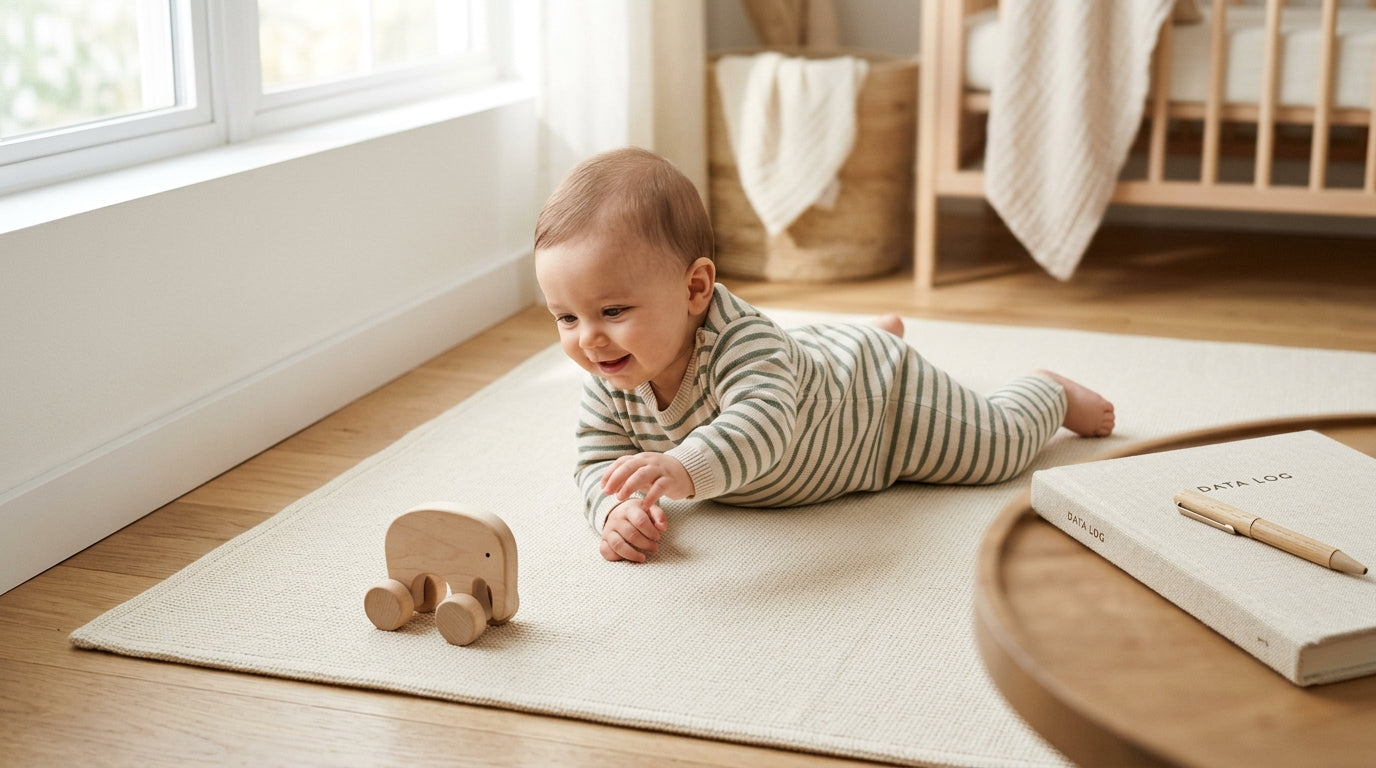
It was 2:14 AM on a random Tuesday when the firmware update clearly hit. I rubbed my eyes, squinted at the grainy night-vision feed on the baby monitor, and froze. My previously stationary, log-like child was suddenly facedown in his crib, looking like a tiny, extremely confused skydiver. My heart rate spiked to about 160 BPM. I nudged my wife, Chloe. She cracked one eye open, mumbled that he was fine, and went back to sleep while I spent the next four hours anxiously watching a pixelated blob breathe.
Before I became a dad, I treated infant development like a software release schedule. I literally had a Gantt chart. Month three: visual tracking deployed. Month four: structural neck stability confirmed. Month five: the roll function goes live. But apparently, when do babies start to roll over isn't a fixed date you can circle on a calendar, and babies absolutely don't read the documentation.
If you look at my frantic, sleep-deprived search history from that month, it’s just a descending spiral of panic: when do babies start to roll, how to flip babi back without waking, and eventually, at 4 AM, is my babie broken.
Pre-baby Gantt charts versus reality
My initial assumption was that rolling over was a linear progression. You put the baby on the floor, they do some reps, they gain a level, and then they execute a flawless barrel roll. What I know now, eleven months into this wild experiment, is that developmental milestones are chaotic flailing until one day the physics just sort of happen by accident.
My pediatrician looked at my meticulously color-coded milestone spreadsheet at his four-month checkup, laughed out loud, and told me to delete it. She said the window for when do babies begin the transition is aggressively vague, hovering anywhere between three and seven months. Three to seven months! That's a massive variance. If I told my project manager a feature would be delivered anywhere between Q1 and Q3, I’d be fired. But apparently, in the pediatric world, this is completely normal.
From what I gather—and my understanding of infant physiology is basically just a patchwork of frantic Googling and half-remembered doctor visits—the first roll is usually tummy-to-back. It usually happens around four or five months because they basically just throw their disproportionately heavy heads to the side and let gravity handle the rest.
The great swaddle depression
I can't overstate the absolute terror of the swaddle transition. For the first few months, our swaddle was our lifeline. We wrapped him up tight like a little burrito, and it was the only way any of us got more than forty-five minutes of consecutive sleep. It was a perfect system. Then he started showing signs of rolling.
The medical advice here's ruthless. My pediatrician casually mentioned that the second a baby shows any sign of attempting to pivot or roll, the swaddle has to go in the trash immediately to prevent them from getting trapped face-down. So we had to quit cold turkey. I spent an entire weekend mourning our predictable sleep schedule.
The first night with his arms free, he looked like a miniature orchestra conductor having a seizure. He kept punching himself in the face. Every time he drifted off, a rogue arm would fly up and smack his own nose, waking him up furious. It was a localized disaster. My wife firmly reminded me that we had to endure it and transition to a safe sleep sack while I spent my nights staring unblinking at the monitor, just waiting for the inevitable moment he would flip himself over and get stuck.
Hardware requirements for the flip
The actual mechanics of rolling are surprisingly complicated for a tiny human with zero core strength. My doctor told me it has something to do with a newborn feature called the Asymmetrical Tonic Neck Reflex, which sounds exactly like a corrupted hardware driver but is actually the "fencing reflex" that makes newborns stick one arm out when they turn their heads. They physically can't roll until this reflex fades away, which apparently happens whenever their tiny brains decide to uninstall it.

To encourage the process, we were told to prioritize tummy time. Tummy time in our house was basically a daily hostage negotiation. I'd place him on the floor, and he would immediately start screaming as if I had dropped him onto hot lava. He hated it. I hated watching him hate it.
But floor time is critical. We spent probably four hundred hours on the floor, mostly on this Bamboo Baby Blanket with the Universe Pattern. It’s actually my favorite piece of baby gear we own. I used an infrared thermometer to track his skin temperature once because I'm that kind of nerd, and the bamboo actually kept him from overheating while he redlined his tiny CPU trying to lift his heavy head. It’s ridiculously soft, it survived approximately eighty distinct spit-up incidents without staining, and it gave him a clean, firm surface to practice his push-ups.
Toys as developmental bait
You can't force a kid to roll. You just have to trick them into it. My wife, who's significantly better at this parenting thing than I'm, started using visual bait. She’d place high-contrast objects just barely out of his reach while he was on his back, forcing him to shift his weight to try and grab them.
We used the Autumn Hedgehog Organic Cotton Baby Blanket for this specific purpose. She would fold it up and place the mustard yellow fabric with the blue hedgehogs just to his left. Apparently, high-contrast patterns trigger some kind of targeting system in their developing optical sensors. He would lock onto a hedgehog, reach across his body, arch his back, and try to pivot. It was fascinating to watch the underlying code execute, even if he usually just ended up frustrated and stuck on his side.
Once he genuinely mastered the roll, everything else became exponentially harder. Diaper changes turned into a wrestling match with a baby alligator. As soon as I'd lay him down, he'd flip over and try to crawl away. I bought these Wood & Silicone Pacifier Clips thinking they would solve the issue of him launching his pacifier across the room during these maneuvers. They're totally fine, honestly. The wood looks nice and they don't break. But let me be perfectly clear: trying to attach a small metal clip to the collar of a shrieking infant who's actively barrel-rolling away from you is like trying to put a seatbelt on a crocodile. If you can genuinely catch him to clip it on, it works great.
If you're currently in the thick of the rolling phase and need gear that honestly holds up to a highly mobile, drooling infant, you can explore Kianao’s organic baby essentials collection right here.
Nighttime pancake logistics
The biggest source of anxiety for me was the sleep logistics. Back to sleep is the golden rule, right? Put them on their back. Always. But once they learn to roll, they'll immediately flip onto their stomach the second you leave the room.

I asked our pediatrician if I needed to go into his room and flip him back over every time he rolled onto his stomach at night. I was fully prepared to set a recurring alarm for every twenty minutes. She looked at me with deep pity and said no. Her logic was that if a baby has the muscle strength to roll themselves onto their stomach, they generally have the hardware required to turn their head and protect their airway, provided the crib is completely empty of loose blankets or bumpers.
I still checked the monitor obsessively, but I did stop sneaking into his room like a ninja to flip him. Mostly because the one time I did try to flip him back onto his back, he woke up, stared at me with pure betrayal, and refused to sleep for the next three hours.
The final analysis
Now that we’re at eleven months, rolling is old news. He’s pulling up on furniture and trying to override the baby gates. But looking back at those early months, the rolling milestone was my first real lesson in parental surrender. You can track the data, you can buy the perfect playmats, you can optimize the tummy time routine, but honestly, babies run on their own mysterious operating systems.
You just have to provide a safe environment, step back, and let them figure out the physics. And maybe buy a better baby monitor for your own sanity.
Ready to upgrade your floor time setup before your kid starts barrel-rolling under the sofa? Shop Kianao’s collection of sustainable, organic cotton baby blankets and play essentials today.
The logs
Is it normal if my kid only rolls in one direction?
Apparently, yes. For about a month, my son could only roll to his left. He was like Zoolander; he simply couldn't turn right. My pediatrician told me they usually favor one side because of muscle asymmetry and eventually figure out the other side. Unless they seem incredibly stiff or floppy, it’s just a weird baby quirk you've to wait out.
Do I seriously have to throw away the swaddle if they haven't rolled yet?
If they're trying to roll, pivoting, or getting up on their side, my doctor made it very clear that the swaddle must be retired. Yes, your sleep will suffer terribly for about a week. It's awful. But a swaddled baby stuck on their tummy is a massive safety hazard, so you basically just have to rip the band-aid off and buy an arms-free sleep sack.
What if my baby hates tummy time and screams instantly?
We dealt with this daily. It felt like torture. My wife eventually figured out that lying on the floor with him, face-to-face, made it slightly less miserable. You can also try laying them on your own chest while you lie back. As long as they're working those neck and shoulder muscles against gravity, it counts as tummy time.
My baby rolled once at 3 months and then never did it again. Did they forget?
I logged a successful roll at 14 weeks and then he didn't do it again for another month. My doctor said early rolls are sometimes just accidental physics—they lean too far and gravity takes over. True, intentional rolling requires them to actively engage their core, which takes longer to every time master. They didn't forget, they just got lucky the first time.
Do I need to flip them back over if they roll during the night?
Every medical professional I asked told me that as long as you put them to sleep on their back initially, and the crib is completely free of pillows, bumpers, and loose blankets, you don't need to flip them back if they roll over on their own. If they're strong enough to get there, they're usually strong enough to keep their airway clear. Save yourself the stress and go back to sleep.




Share:
Debugging The Drool Firmware: When Do Babies Teeth Come In?
When Do Babies Start Seeing Color? A Letter to Past Me