

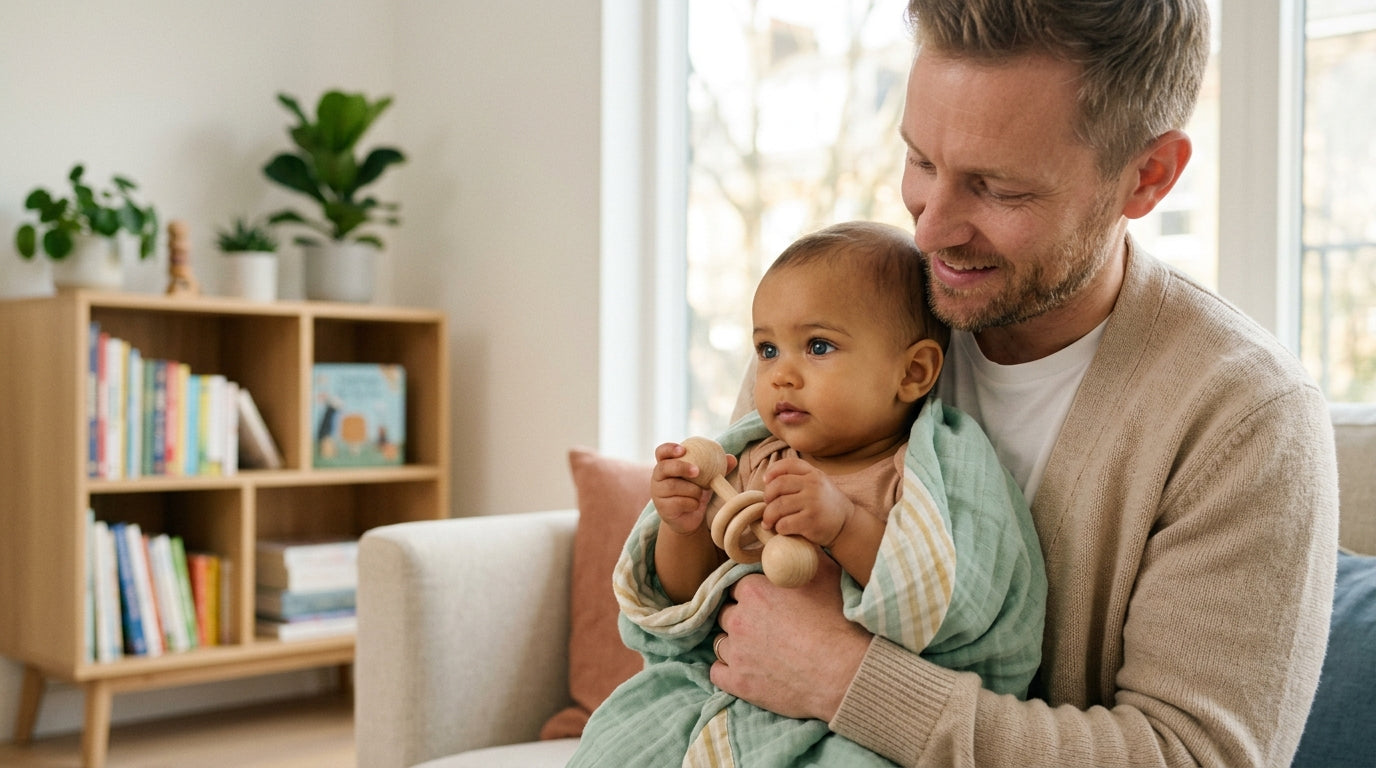
My mother-in-law leaned over the Moses basket on day three and declared with absolute certainty that Twin B's eyes were definitely turning brown because she spotted some microscopic muddy flecks near the pupil. The NHS health visitor popped round on day seven, checked their umbilical stumps, and casually remarked that both girls' eyes were absolutely staying blue because they had that permanent, watery slate look. Then my mate Dave, who possesses absolutely no medical qualifications but did once correctly guess the weight of a marrow at a village fete, squinted at my newborn twin girls and confidently predicted they'd be hazel by Tuesday.
It's profoundly maddening to have three different adults project entirely different futures onto the irises of two infants who, at this stage, mostly just resemble angry, milk-drunk potatoes. You find yourself obsessively staring into these tiny, unfocused faces, desperate for a sign. You're constantly wondering when babies' eyes might change colour just so you can stop arguing with your relatives about it. I spent an embarrassing amount of time during that first month holding them up to the living room window like Rafiki presenting Simba, trying to catch the afternoon light just right to see if the blue was giving way to green. Page 47 of the main parenting manuals suggests you simply wait and observe without obsessing, which I found deeply unhelpful at 3am when I was covered in sick-up and questioning my own reality.
The great melanin lottery and why everyone gets it wrong
Our GP tried to explain it to me at their six-week check, and honestly, the science of it's as murky as the actual hue of their irises. As far as I can gather through my sleep-deprived haze, it's all about melanin, which is the same pigment that gives you a tan when you accidentally fall asleep in the garden without a shirt on. In the womb, it's pitch black, which makes total sense. Once a baby is evicted into the harsh fluorescent lighting of the maternity ward, the light somehow kickstarts these special cells in the eye called melanocytes to start pumping out melanin.
The paediatrician basically said that babies with darker skin tones—Asian, Black, Hispanic—are overwhelmingly born with brown eyes that stay brown, which sounds incredibly efficient and saves a lot of pointless speculation. But if your babi (as my phone relentlessly autocorrects it when I'm typing with one hand) emerges looking pale and confused with those cloudy blue-grey discs, you're essentially entering a waiting game. The blue isn't even real blue pigment, by the way. It's just light scattering around the collagen fibres because the melanin hasn't turned up to work yet, acting like an elaborate optical illusion that tricks you into buying clothes that match eyes that will inevitably change in six months.
Mendel's punnett squares from year nine biology are largely useless here so just throw them in the recycling bin with the mountain of empty formula boxes.
Why nobody warned me about the blinding sun
Now, thing is that absolutely no one tells you about having infants with light-coloured eyes. I'm going to rant about this for a solid three paragraphs because it completely blindsided me and caused several public meltdowns.
If your baby has those watery blue or grey eyes, they lack melanin. Melanin is nature's built-in sunblock. Therefore, those adorable pale blue eyes are incredibly sensitive to bright light. I learned this the hard way when I took the twins for their first walk around the local park on a mildly overcast Tuesday in London. They spent the entire journey screaming as if I were forcing them to stare directly into a halogen bulb. We spend so much time slathering our kids in Factor 50 and arguing with our partners over whether they're too hot or too cold, but nobody stops to tell you that a babie with light eyes needs proper, militant shade right from the start.
It became an absolute obsession. I bought absurdly expensive pram parasols, I angled the buggy like I was calculating a lunar landing trajectory, and I started paying excessive attention to how wide the brims on their sun hats were. You'd think the hospital would hand you a leaflet about UV protection when you're discharged, but instead, you just figure it out when your kid is weeping in the dairy aisle because the supermarket fluorescents are too aggressive. If you could just stop shining your iPhone torch into their corneas to check their pigment and perhaps buy a decent sun hat instead, we'd all be significantly better off.
Actually, one of the few things that kept me relatively sane during the "are they blue or are they green" phase was dressing them in the Short Sleeve Organic Cotton Baby Bodysuit. I'm not exaggerating when I say this ribbed little number in earth tones became my absolute crutch, mostly because it's ridiculously soft and stopped Twin A from getting that weird heat rash she develops when she's stressed. But also, the contrast trim magically complemented whatever muddy-blue colour her eyes were deciding to be that particular week. It's just a solid, incredibly well-made basic that you don't have to overthink, which is a rare commodity when you're spending four hours a day overthinking eye pigment. Plus, it survives a 40-degree wash after a catastrophic nappy leak without losing its shape, elevating it instantly to god-tier status in my sleep-deprived household.
The timeline that means absolutely nothing in practice
If you look it up online, the internet will confidently tell you that the most dramatic shift happens between three and nine months. This is a massive, entirely unhelpful window. Three to nine months is an eternity in parent time. During that period, your infant goes from being a stationary, burping lump to a crawling menace that actively tries to eat the skirting boards and lick the dog.

For us, around the six-month mark, Twin B's eyes suddenly deepened into this striking, unmistakable brown over the course of about a fortnight. It was like someone flipped a switch behind her retinas. Twin A, however, decided to drag the whole process out, hovering in a bizarre hazel-green purgatory until well past her first birthday. Our GP chuckled and said that while most kids settle down by twelve months, the sneaky ones can keep subtly changing their hue until they're three years old. So if you're holding your breath wondering when do babies eyes change definitively, you might as well exhale now because you're in for a very long wait.
While you're waiting for this glacial transformation to occur, you'll inevitably buy things to distract them so you can sit down for five minutes. We ended up with the Panda Play Gym Set, which is perfectly fine. It's aesthetically pleasing, the wooden frame doesn't scream at you in obnoxious primary colours, and the little crocheted panda gave them something to stare at while I stared at them. I wouldn't say it's life-changing—it's a play gym, it sits on the rug and gives you roughly eleven minutes to drink a tepid coffee—but it blends nicely into the living room, which is honestly more than I can say for the massive piles of neon plastic currently dominating the sofa.
The exact moment you should ring the doctor
You'll inevitably panic at some point. I know this because I'm a parent, and panicking over minor physiological details is roughly 80% of the job description. I've diagnosed my kids with at least fifteen rare diseases based entirely on blurry Google image searches at midnight.
But unless your baby suddenly wakes up looking like David Bowie with one brown eye and one violently blue eye, you can probably stand down. The paediatrician casually mentioned this is called heterochromia, and while it's usually harmless, it's occasionally linked to hearing issues or genetic quirks like Waardenburg syndrome. It's worth a quick check-up if it happens. If their eyes suddenly shift dramatically after their third birthday, you might want to call the doctor just to rule out trauma or illness, but otherwise, the shifting sands of infant eye colour are just another messy, unpredictable part of keeping a small human alive.
Before you descend entirely into madness trying to photograph their retinas in different lighting conditions, perhaps take a breather and browse some Kianao baby accessories that actually stay the exact colour you bought them in.
You might also notice that the eye colour anxiety usually peaks right around the time teething starts, which is a truly cruel biological overlap. Just as you're holding them up to the light to inspect their irises, they'll enthusiastically bite your nose with their rock-hard gums. We survived this horrific phase largely thanks to the Handmade Wood & Silicone Teether Ring. It's made of naturally antibacterial beechwood, the silicone beads give them different textures to gnaw on, and it somehow managed to avoid getting permanently lost under the car seat like every other toy we've ever owned.
How I survived the unpredictable pigment
In the end, my mother-in-law was right about Twin B, Dave was spectacularly wrong about everything as usual, and Twin A ended up with this weird, shifting hazel that changes depending on whether she's wearing a green jumper or crying because I gave her the wrong coloured plastic cup.

You can't control the melanin, you can't rush the genetics, and you certainly can't trust a relative's prediction on day three. All you can do is keep the blinding sun out of their sensitive little eyes, dress them in fabrics that don't make them scream, and accept that whoever they're turning into, they're going to look at you with those exact eyes and demand snacks for the next eighteen years.
Ready to embrace the chaotic unpredictability of your baby's development without compromising on their comfort? Explore Kianao's full range of sustainable, sanity-saving essentials before you scroll down to read the answers to the questions you're inevitably googling at 2am.
The desperate late night search answers
Is it true that what they wear alters their eye colour?
No, despite what my sleep-deprived brain thought when I put Twin A in a green jumper and audibly gasped. It's just light reflecting off the clothing and tricking your exhausted mind. The melanin isn't taking fashion cues from their wardrobe, unfortunately.
Why are my baby's blue eyes so incredibly watery in the sun?
Because they lack the natural sun-blocking melanin that brown eyes have. The paediatrician made me feel like an absolute fool for not realising this sooner. If they've light eyes, you need to be intensely militant about wide-brimmed hats and pram shades.
Can a bad cold permanently shift their eye colour?
Normally, no. A nasty virus might make their eyes look glassy or slightly red around the rims, giving the illusion of a colour shift, but the actual iris pigment isn't changing because of the Calpol. If there's a dramatic, permanent colour change after age three, get the GP on the phone to rule out trauma.
Did my baby get their eye colour from me or my partner?
Genetics are a messy, unpredictable soup, not a straight line. You can both have dark brown eyes and produce a blue-eyed baby if there's a recessive gene hiding somewhere in your family tree. Stop trying to use this to win arguments about who the baby looks like because you'll definitely lose.
Will staring at screens mess with their developing eye colour?
The health visitor actively laughed at me when I asked this. Screen time might ruin their sleep schedule and turn them into tiny, uncooperative zombies, but iPads don't possess the magical ability to alter cellular melanin production.




Share:
When Do Babies Get Measles Vaccine? A Portland Dad's Guide
The 3 AM Monitor Panic: Surviving The Stomach Sleeping Phase