

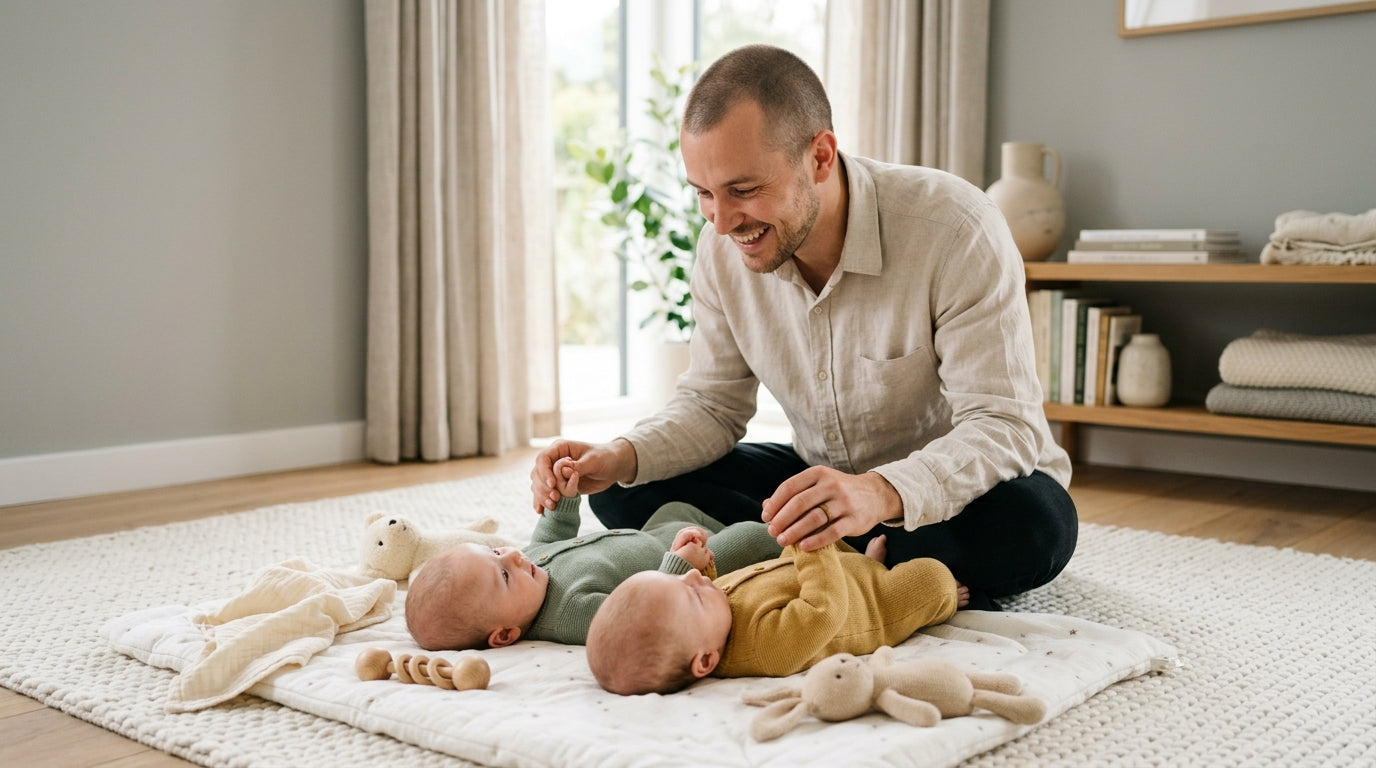
I was standing in our galley kitchen on a miserable Tuesday afternoon, holding a plastic cup of my wife’s morning urine in one hand and a slightly expired box of baking soda in the other. The internet—that infinite void of terrible advice—had confidently informed me that if you mix the two together and it fizzes like a cheap science fair volcano, you’re having a boy. If it does absolutely nothing, it’s a girl. My wife, Sarah, was glaring at me from the sofa with the specific type of exhaustion reserved for women in their first trimester of a twin pregnancy. This, I can now confidently tell you, is what absolutely not to do when you're desperately trying to figure out who's currently using your partner’s bladder as a makeshift bouncy castle.
The urgency to know is entirely understandable, mostly because buying tiny socks provides a false sense of control over the terrifying reality that your entire life is about to change. But the timeline of discovering the biological sex of your child is less of a straight line and more of a bizarre obstacle course involving wives' tales, highly sensitive DNA tests, and ultrasound machines that look like they run on Windows 95.
The folklore that completely ruined my dignity
Before medical science stepped in to ruin the fun, humanity had to rely on folklore, which is a polite word for guessing wildly based on a pregnant woman’s eating habits. My mum swore blind that we were having boys because of the fetal heart rates at our early viability scan. Someone at her office had told her that if the heart rate is over 140 beats per minute, it’s a girl, and if it’s under, it’s a boy. Baby A was clocking in at 145 and Baby B was chugging along at 138. I immediately assumed we were having one of each and went out to buy a tiny pair of denim dungarees that neither child has ever worn.
Then there were the food cravings. Sarah couldn't stop eating salt and vinegar crisps, violently sour pickled onions, and basically anything that tasted like a pub floor. According to the older women at our local Waitrose who felt entirely too comfortable commenting on our shopping basket, this overwhelming desire for salt definitively meant a boy was in there. Don't trust a condiment to predict human biology. It turns out she just wanted salt because growing two skeletons from scratch makes you crave weird things.
Everyone also told us she was carrying high, which is mathematically impossible to avoid when two human beings are expanding inside a five-foot-three torso at roughly the speed of sound.
The early at-home blood test paranoia
Around week six, I plummeted down a late-night Reddit rabbit hole and discovered that there are at-home blood tests you can buy. You essentially prick your finger, bleed into a tiny plastic tube, and post it off to a laboratory that allegedly checks for male chromosomes. It sounded brilliant until I read the fine print.
Because the test is looking for tiny fragments of male DNA, the testing environment has to be completely sterile. If a male partner (me) or a male pet (our permanently shedding pug, Colin) drops so much as a microscopic skin flake near the kitchen table while the test is happening, the lab might pick up our DNA and give you a false "boy" result. I spent three days mentally planning how I'd bleach the entire kitchen while wearing a hazmat suit, locking Colin in the garden, and forcing Sarah to bleed into a vial while I barked instructions from behind a glass door. We ultimately skipped it, mostly because my understanding of genetics is entirely based on watching Jurassic Park and I knew I'd somehow contaminate the sample with my own idiot DNA.
The clinical route that actually worked for us
When Sarah hit about ten weeks, our NHS midwife casually brought up something called NIPT. As I vaguely understand it, it’s a simple blood draw from the mother’s arm, primarily meant to check for serious chromosomal stuff—which is terrifying enough to think about—but because fetal DNA is just floating around in the maternal bloodstream like microscopic space debris, they can also spot the Y chromosome.

We had to wait a nerve-wracking two weeks for the results. During this torturous waiting phase, the nesting instinct hit me like a freight train, but I refused to buy anything excessively pink or blue just in case the universe decided to mock me. I ended up panic-buying the Mono Rainbow Bamboo Baby Blanket, and it turned out to be the smartest purchase I made that entire year. It has these minimalist terracotta arches that look incredibly stylish in a way that I, a man wearing stained jogging bottoms, am not. But more importantly, the organic bamboo fabric is outrageously soft. Two years later, the twins still physically fight over this specific blanket, dragging it around the house until it smells like dried milk and dog hair. It controls temperature brilliantly, which was a godsend because babies are essentially tiny, unpredictable radiators.
The dreaded twenty week anatomy scan
If you don’t do the fancy blood tests, you usually have to wait for the mid-pregnancy anatomy scan, which happens somewhere between 18 and 22 weeks. This is the big one. This is when they slather freezing cold jelly onto the bump and press a wand into it hard enough to bruise, while you stare at a grainy monitor trying to pretend you know what you’re looking at.
Our sonographer, a woman with the bedside manner of a tired parking warden, told us right away that ultrasounds are not an exact science with the plumbing. Babies are famously uncooperative. They cross their legs, they put their hands over themselves, or they position themselves in a way that makes their genitals look like an ambiguous blur. We were lucky. Both of ours decided to star-fish across Sarah’s uterus, allowing the sonographer to confirm what the blood test had already told us: twin girls.
Once we officially knew, my brain broke a little bit and I started ordering things just to feel prepared. I grabbed the Bunny Teething Rattle Wooden Ring Sensory Toy because I thought the little blue bow tie on the crochet bunny would balance out the sheer volume of floral dresses our relatives were threatening to post to us. Honestly, it’s just okay. It’s wonderfully made and looks lovely on a shelf, but when teething actually hit, the girls would gnaw on the wooden ring for about three seconds before aggressively trying to chew on a dirty shoe or the television remote instead. Babies are feral.
What did actually save our sanity were the Wood & Silicone Pacifier Clips. When you've two babies, the sheer volume of dummies being casually spat onto the pavement is mathematically staggering. We got them in cream and sapphire, and clipping them to their tops meant I stopped having to wipe dog spit off pacifiers at the park. If you buy nothing else before the birth, buy something to tether the dummy to the child.
A quick note on sex versus gender at 3am
There's, of course, a medical distinction between biological sex and gender identity that our GP tried to explain to me while I was distracted by a poster about whooping cough. The blood tests and the scans tell you the chromosomal makeup and the physical anatomy. They tell you the biological sex. They don't tell you your child's gender, which is a whole complex societal thing they’ll figure out as they grow into actual people.

Knowing they were girls didn’t tell me that at age two, Baby A would refuse to wear anything except a dinosaur costume, or that Baby B would develop a passionate, terrifying obsession with carrying a plastic screwdriver everywhere we go. (Page 47 of the parenting manual suggests you calmly validate their choices, which I found deeply unhelpful when trying to wrestle a toddler into a sensible jumper at the school gates).
If you're currently trapped in that endless waiting period before the big ultrasound, trying to prepare a nursery without committing to a color palette that might be entirely wrong, just browse Kianao’s organic baby essentials collection for things that are beautifully neutral, because frankly, they’re going to cover whatever you buy in pureed carrots anyway.
The final verdict on when you honestly know
If you go through IVF, like some of our friends did, they can genuinely test the embryos in a lab before anyone is even pregnant, which sounds like glorious science fiction. If you’re brave enough to keep the dog out of the kitchen, you can try an at-home blood kit at six weeks. If your midwife offers it, you can do the clinical blood draw around ten weeks. Or you can just wait for the twenty-week scan and pray the baby uncrosses its legs.
We also received a Blue Fox in Forest Bamboo Baby Blanket from a friend who boldly ignored the "girls must have pink" memo. It’s got this gorgeous Scandinavian woodland pattern on it. I initially thought it was a bit too nice to let near a newborn, but the bamboo cotton blend is basically indestructible. It survived the great Calpol spill of 2023 and genuinely gets softer every time I throw it in the washing machine.
Ultimately, whenever you find out, it’s just one tiny piece of data in the absolute chaos of bringing a human into the world. You’ll spend weeks agonizing over the reveal, only to realize six months later that you haven't slept a full night in half a year and you couldn't care less if they're wearing blue, pink, or a burlap sack as long as they stop crying.
Before sleep deprivation permanently ruins your ability to make rational purchasing decisions, grab some genuinely useful, sustainable gear from Kianao. Whether you're expecting a boy, a girl, or an ambiguous blur on a monitor, they're going to need soft things to sleep on.
Messy questions I googled at 2am
Are those early at-home blood tests honestly accurate?
The science behind them is supposedly quite solid, but the execution is where it all goes wrong. If you live with a male partner, a male cat, or a male dog, the chances of their stray DNA floating onto your testing kit and giving you a false "boy" reading are aggressively high. Unless you've an operating theatre in your house, take the results with a massive pinch of salt until a doctor confirms it.
Can the twenty-week anatomy scan be wrong?
Absolutely. The sonographer at our hospital told us they're only about 90 to 95 percent certain because babies are terrible at taking direction. If the baby is crossing their legs, or the umbilical cord is wedged between their legs, it’s basically just a highly educated guess. Don't paint the entire nursery navy blue based solely on a shadowy fourteen-week ultrasound.
What's the NIPT test and should I ask my GP for it?
It stands for Non-Invasive Prenatal Testing, which is just a fancy way of saying they take blood from your arm rather than jabbing a needle near the baby. Our midwife offered it because it screens for chromosomal things like Down syndrome, but it also checks for the Y chromosome with scary accuracy. Ask your GP or midwife if you qualify for it on the NHS, or if you need to look into a private clinic.
Why shouldn't I just trust the old wives' tales?
Because pregnant women craving salt or carrying their bump a bit higher has absolutely zero scientific correlation to the genitals of the child inside them. If we had listened to the fetal heart rate myth, we would have been expecting a boy and a girl, and I'd be dealing with a very confused son right now.
Is it okay to start buying baby things before I know the sex?
Yeah, please do, because the sheer volume of stuff you need is overwhelming and spreading out the cost is the only way to survive. Stick to gender-neutral tones—creams, sage greens, terracotta—which honestly look much chicer in a modern house anyway. They will spit up on a beige swaddle exactly the same way they'll spit up on a aggressively gendered blue one.




Share:
The Great Melanin Firmware Update: A Dad's Guide to Eye Color
The brutal, messy truth about when your baby will finally sit up