

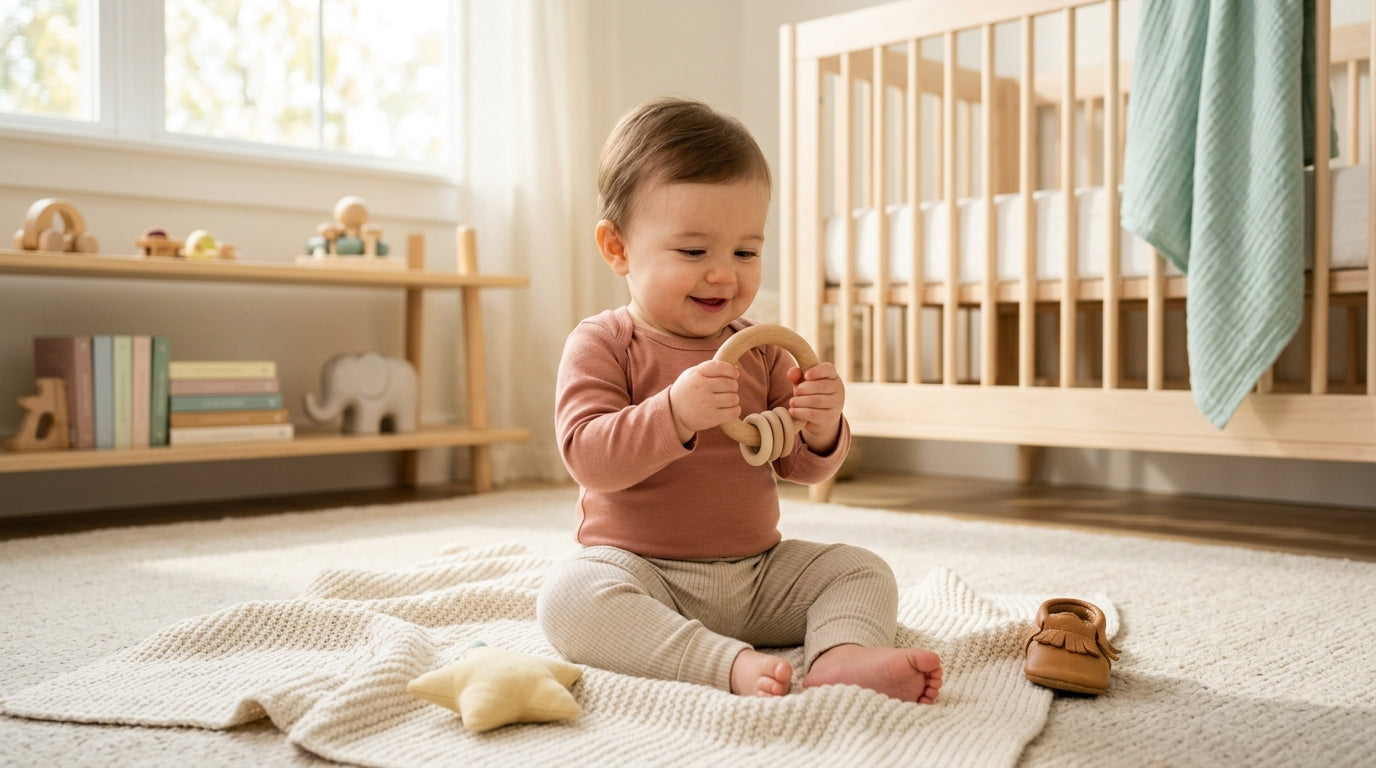
I'm currently staring at a beige, violently stained sleepsuit that was, until approximately four minutes ago, perfectly pristine and white. It's 6:15 AM on a Tuesday, and one of the twins—let’s call her the Loud One, though honestly they alternate schedules depending on who feels most vindictive—has just vividly demonstrated why the concept of a flawlessly clean infant is perhaps the greatest lie ever sold to modern parents.
If you spend more than five minutes on social media, you might be led to believe that a truly healthy baby is a serene, lavender-scented cherub who sleeps in neutral tones and never leaks biological fluids onto your only decent jumper. The reality of raising an actually robust, thriving infant looks much more like running a severely underfunded hazardous waste containment facility while hallucinating from sleep deprivation. My understanding of paediatric health has evolved drastically since we brought the girls home from the hospital, shifting from a textbook desire for perfection to a desperate, sweaty baseline of just keeping them breathing and relatively un-sticky.
The great hygiene illusion
Let's talk about the sheer, mind-bending volume of waste a tiny human can produce. The glossy brochures from the NHS cheerfully suggested we would be changing about ten nappies a day per child, which mathematically works out to roughly 140 changes a week for twins. You spend those first few months operating as an assembly line worker, developing a hyper-specific, obsessive criteria for healthy baby diapers because you quickly realise that anything less than structurally flawless will result in absolute disaster. You're desperately searching for a brand breathable enough to prevent their backsides from resembling an angry baboon, yet heavily engineered enough to contain what can only be described as liquid shrapnel.
This endless cycle of wiping is where the real panic sets in. You want to protect their incredibly fragile immune systems and completely nonexistent skin barriers, which means entering the absurd world of trying to find genuinely healthy baby wipes. Most of the options on the high street either smell like an industrial floor cleaner or are so flimsy you end up with more mess on your hands than on the baby. I eventually learned that you basically just have to wipe them endlessly from front to back using whatever water-based concoction doesn't cause immediate angry red spots, slather on whatever barrier cream you've managed to scrape out of the jar with one hand, and aggressively pray the whole setup stays dry until the next inevitable explosion.
I'm reliably informed by our GP that babies only actually need a bath two or three times a week anyway to avoid drying out their skin, which is a massive relief considering trying to hold onto a wet, furious newborn is essentially like wrestling a greased eel.
Sleep environments and temperature wars
Safe sleep is a terrifying subject entirely wrapped in layers of maternal guilt and deeply contradictory advice. Our paediatrician mumbled something about needing to keep the nursery strictly between 68 and 72 degrees Fahrenheit—which translates to about 20 to 22 degrees Celsius for those of us trying to decode the British thermostat—to reduce the risk of overheating and SIDS. This medical guidance is delivered as if the average London flat has a climate control system calibrated by NASA, rather than a draughty sash window and a radiator that only decides to function on alternate Thursdays. Finding that exact thermal sweet spot usually involves me aggressively toggling the heating dial in the dark at 2am while trying to gauge if the back of my daughter's neck feels a bit sweaty.

The basic medical consensus I've managed to string together between panic attacks is that infants should sleep completely alone, squarely on their backs, in a desperately empty cot devoid of pillows, bumpers, or anything that looks remotely comfortable. Since you can't put any actual bedding in the cot with them, what you wrap them in before they hit the mattress becomes a matter of supreme strategic importance.
I've developed an aggressively strong emotional attachment to the Organic Cotton Baby Blanket Calming Gray Whale Pattern. When the girls were tiny and we were attempting highly supervised tummy time on the living room rug, this double-layered cotton barrier was the only thing standing between their faces and whatever microscopic crumbs the hoover had missed. It's GOTS-certified, which I'm led to believe means nobody sprayed it with horrible toxic chemicals during manufacturing, and the fabric actually feels robust enough to survive being dragged through the house. The Loud One (Matilda) eventually designated it as her absolute favourite thing in the universe, mostly because it grips perfectly when wrapped around her shoulders. We also picked up the Blue Fox in Forest Bamboo Baby Blanket for her sister, Florence, which is perfectly fine and admittedly incredibly soft, but the bamboo blend just slips directly off my shoulder when I’m trying to burp her in the dark.
If you find yourself frantically staring at textile weaves at midnight trying to decode what won't suffocate your child, you might want to peruse our baby blankets collection before you accidentally order something made of highly flammable synthetic nightmare fluff.
Nutrition or something resembling it
Feeding an infant is essentially a hostage negotiation where the demands mysteriously change every two hours. The health visitor strongly implied that exclusive breastfeeding for the first six months provides a magical, bespoke shield of custom antibodies against ear infections and respiratory doom. This is a brilliant biological theory, but when you've twins and a wife who's visibly hallucinating from exhaustion, formula aggressively enters the chat.
Whether you use breast milk or formula, you quickly discover that feeding on demand means nobody ever seriously stops feeding. We found ourselves constantly propping up bottles in semi-upright positions to allegedly prevent choking and ear issues, calculating milk ounces with the manic intensity of an accountant facing an audit. Then, right around the six-month mark, you're supposed to establish predictable solid food routines to grow a lifetime of healthy eating habits, a clinical directive that totally ignores the reality of me scraping pureed sweet potato off the ceiling while one twin tries to feed her spoon directly to the dog.
Developmental milestones and other terrors
If the bodily fluids don't break you, the developmental milestones will certainly try. Take tummy time, for instance. The medical literature insists you must place them face-down on the floor for a few minutes a day starting almost immediately after birth to strengthen their weak little neck muscles so they don't grow up floppy. Page 47 of every parenting manual implies you should do this happily and playfully, entirely brushing past the fact that placing a baby on their stomach generally results in them screaming into the carpet as if you've just asked them to complete a tax return.

Then comes the teething phase, a protracted period of misery where your previously cheerful offspring suddenly decide to aggressively chew on the coffee table, your chin, and the TV remote. You start noticing bright red cheeks and a volume of drool that could legitimately fill a pint glass, accompanied by a pathetic, heartbroken whimpering that completely shatters your soul.
In a desperate bid for silence, we tried the Squirrel Teether Silicone Baby Gum Soother with Acorn Design, mostly because I thought the mint green colour looked slightly less offensive scattered across the rug than the garish neon plastic alternatives. It's absolutely decent—made of food-grade silicone that doesn't harbour strange bacteria, easy enough to lob into the dishwasher when it inevitably gets dropped in a puddle of god-knows-what, and the ring shape means Florence can honestly grip it without immediately dropping it and crying. Honestly, any firm silicone object that stops them from gnawing my index finger to the bone is a massive win. We also had the Llama Teether Silicone Soothing Gum Soother lying around, which is virtually the identical experience but shaped like a llama, so just pick whichever animal matches your current level of spiritual exhaustion.
Alongside the chewing comes the mental development stuff. The experts strictly advise absolute zero screen time for anyone under eighteen months, which means my entire life is spent trying to hide my phone while they attempt to aggressively poke the FaceTime screen whenever my mother-in-law calls to decipher if she's looking at a grandchild or an extreme close-up of my nostril. I'm fairly sure bonding and kangaroo care supposedly involve regulated skin-to-skin contact, though half the time in this house I think it just means letting them violently cling to my chest while I dramatically fail to reach my cold cup of tea.
Medical anxiety in the dark
My entire understanding of infant pathology is largely based on staring at them in the pitch black to make sure their tiny chests are still rising and falling. You do eventually learn to watch out for the actual, terrifying red flags amid the daily noise of grunts and sneezes.
Any random temperature spike in a newborn under three months old means you completely bypass the Calpol, grab the changing bag, and speed straight to A&E without passing go. If they start turning an alarming shade of yellow, or if they decide to scream for three uninterrupted hours without stopping for a single breath—ushering in the dark psychological warfare known as colic—you probably need a medical professional rather than a stronger coffee. I basically just blindly follow the NHS vaccination schedule so they don't catch Victorian diseases, handle their wobbly little necks with extreme paranoia because shaking them is a catastrophic medical emergency, and generally try to keep them breathing until the next chaotic morning.
Raising an infant requires a frankly ridiculous amount of guesswork and a massive, humbling tolerance for being covered in someone else's biological matter. If you're still awake and functioning enough to read this, you can explore our teething toys collection to at least preserve what's left of your soft furnishings.
Frequently Asked Questions (From the Trenches)
How do I really know if my baby is too hot at night?
The books will tell you to check the ambient room temperature, but unless you sleep with a thermometer strapped to your face, that's useless at 3am. Just gently feel the back of their neck or their tummy. If they feel sweaty or unusually hot to the touch, they're too warm and you need to strip a layer off. If their hands and feet are a bit cold, ignore it—baby circulation is terrible and their extremities always feel like tiny icicles.
When do I legitimately need to ring the doctor?
In the first three months, any fever (above 38°C or 100.4°F) is an absolute, non-negotiable emergency room situation. Later on, you look for changes in behaviour. If they're completely lethargic, won't drink anything, have fewer wet nappies than normal, or are doing that terrifying high-pitched cry that sounds fundamentally different from their "I'm annoyed" cry, you ring the GP. When in doubt, call. doctors entirely expect new parents to be unhinged.
Are expensive organic cotton blankets really worth the hassle?
I used to think organic cotton was just a marketing scam to extract money from anxious millennials, until I touched a cheap synthetic blanket that sparked like a static electricity experiment and made Matilda break out in a rash. GOTS-certified organic cotton really breathes, which means they don't wake up in a puddle of their own sweat. It's less about the fancy label and more about preventing their hypersensitive skin from freaking out.
What if my baby absolutely completely hates tummy time?
Welcome to the club; population: everyone. My twins acted like the living room rug was made of hot lava. You don't have to just leave them on the floor to scream. Tummy time counts if they're lying chest-to-chest on you while you're reclined on the sofa scrolling through your phone. It's just about getting them to lift their heavy little heads against gravity. Two minutes of them glaring at you from your own chest is better than zero minutes.
Why is teething essentially ruining my entire life?
Because baby teeth have to literally break through gum tissue to enter the world, which sounds like something from a medieval torture manual. It hurts them, which means they're going to make sure it hurts you emotionally. Keep shoving safe silicone objects into their mouths, wipe away the oceans of drool before they get a chin rash, and remind yourself that eventually, they'll have a full set of teeth and this particular nightmare will end. Probably just in time for potty training.




Share:
That Time My Winter Layering Mistake Caused a Heat Rash on Baby
So Your Sweet Kid Brought Home A Horrific Joke From Preschool