

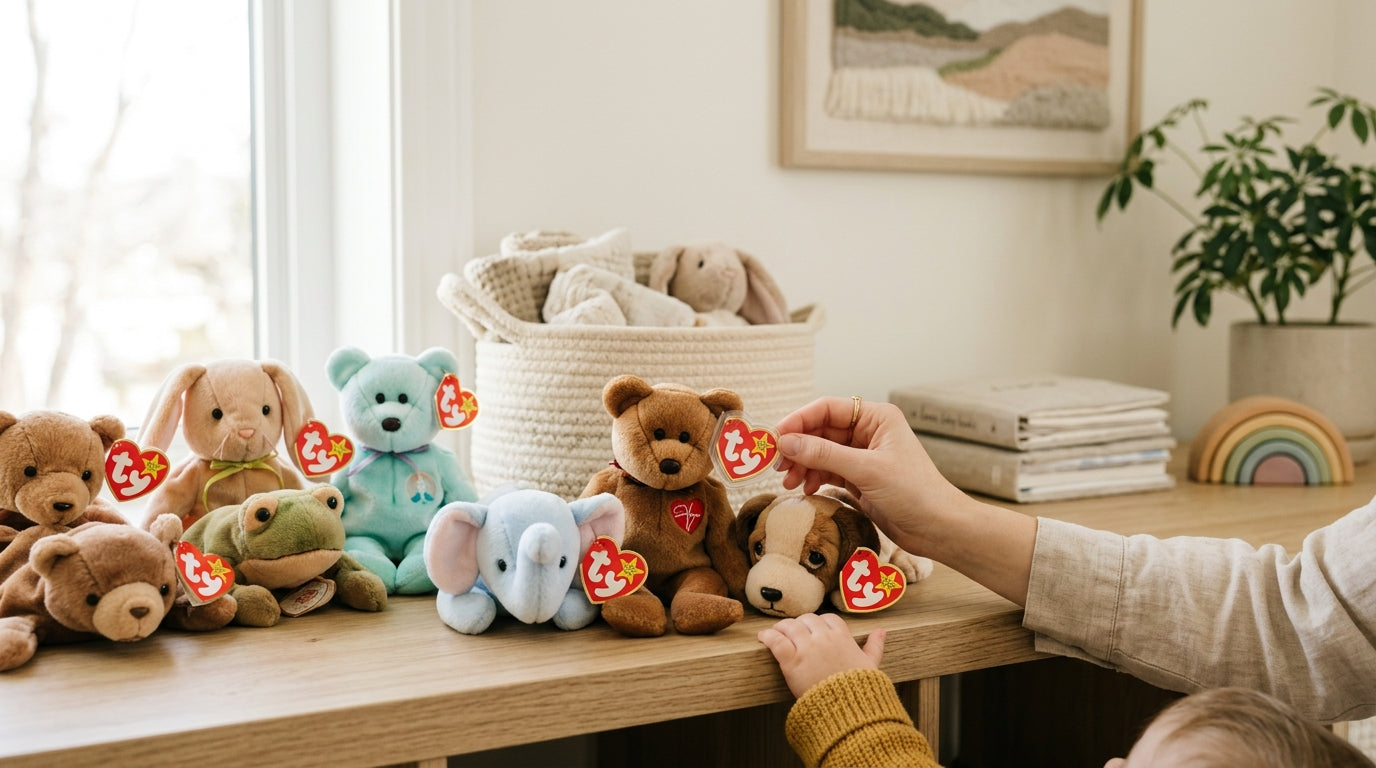
I was sitting cross-legged on the nursery floor at 10 AM on a Saturday, entirely surrounded by a 30-gallon plastic storage bin of my childhood. My mom had just dropped off the "archives," grinning like she had just unburdened herself of a terrible curse. My 11-month-old son was sitting opposite me, wearing his favorite little baby t—well, technically it's the Organic Cotton Baby Bodysuit, but we call it his baby t because the sleeveless cut makes him look like a tiny, extremely unemployed roommate. He lunged forward, his chubby hand locking onto "Pinchers the Lobster" with terrifying speed.
Immediately, his hand went straight for the iconic red heart dangling from the lobster's antenna. As he tried to yank it into his mouth, my wife walked by the nursery door, paused, and said, "You need to cut all those tags off right now."
My brain basically blue-screened. "But the beanie baby tag is the whole point!" I yelled back, wrestling the crustacean away from my son. "If you take off the swing tag, the market value drops by like seventy-five percent!"
She just stared at me. "Marcus. It's a twenty-five-year-old stuffed animal, not a 401k. He is going to choke on the plastic loopy thing."
She was right, of course. She usually is. But the realization that I was going to have to manually alter my pristine, 1996-era investment portfolio just so my kid wouldn't aspirate a piece of cardboard sent me down a massive internet rabbit hole. I was panic-searching my phone with one sweaty thumb, trying to look up eBay auction histories, but my autocorrect kept splitting the words so I was searching for an "e baby" value index, which just gave me weird forums about early 2000s virtual pets. It was a mess. Here's how I eventually debugged the situation.
Running a threat assessment on the hardware
If you treat a vintage soft toy like a piece of legacy hardware, the red heart tag is a massive design flaw for the end user (the baby). There are actually two tags on these things. You've got the "hang tag" or swing tag, which is the cardboard heart attached to the ear or limb via a tiny plastic loop. Then you've got the "tush tag," which is the fabric label sewn directly into the bottom seam.
At our 9-month checkup, our doctor vaguely mentioned that we needed to start looking out for small objects now that the kid was crawling and using his pincer grasp. She was mostly talking about dropped grapes and rogue cheerios, but as I looked at that plastic attacher loop, I realized it was exactly the kind of fatal error my son would exploit. If a baby pulls that loop off, both the plastic string and the cardboard heart become immediate, high-priority choking hazards. Apparently, babies don't care about the poem printed inside the tag; they just want to dissolve the cardboard with their saliva.
What's incredibly ironic about all of this is the manufacturer's original patch notes. When these things first launched in the early 90s, the company actually explicitly told parents to remove all tags before giving them to small children. The whole "keep the tag pristine in a plastic protector" thing was a user-generated bug that the collector market invented. The fact that I was agonizing over destroying the value of "Pugsly the Dog" when the creator himself said to cut the tag off is just shows how deeply the 90s nostalgia boom warped our brains.
The great PVC pellet firmware update of 1998
Once I accepted that the cardboard had to go, I thought the debugging process was over. I was wrong. The deeper I dug into the forums, the more I learned about the actual stuffing inside these animals. This is where my anxiety really spiked.

If you look at the fabric tush tag on the older toys, it tells you what kind of plastic pellets are inside. Before 1998, they were stuffed with PVC (polyvinyl chloride) pellets. Now, I'm not a chemist, and reading Wikipedia articles at 2 AM doesn't make me an expert on polymer degradation, but apparently, PVC is basically on the naughty list of modern sustainable baby products. From my messy understanding, older PVC formulations can sometimes contain phthalates or leach weird chemicals over time. Given that my son's primary method of exploring the world is aggressive mastication, handing him a 25-year-old sack of PVC felt like a massive parenting fail.
Sometime around February 1998, the manufacturer pushed a major update and switched to PE (polyethylene) pellets. PE is generally considered much safer and more stable. You can verify this just by looking at the sewn-in label. If it says PE, it's the newer, slightly less terrifying stuffing. If it says PVC, you might want to reconsider letting it become your kid's new favorite chew toy.
This completely changed my sorting algorithm. I wasn't just checking for rare spelling errors on the cardboard tags anymore; I was running quality assurance on the internal components. I ended up creating a rigid binary system: PVC toys went back into the plastic bin for "display only" (which means they live in the garage until the end of time), and PE toys were cleared for the next phase of the security check.
Checking for structural degradation
Even if the toy has the safer PE pellets and you've severed the red tag, you still have to deal with the fact that the fabric is old enough to rent a car. I started pulling at the seams of a few of the cleared toys, treating them like a stress test on a new server.
To my horror, the thread on "Stripes the Tiger" just gave way with a sickening little pop, and a cascade of plastic beans spilled out onto the rug. If my son had been chewing on that seam, he would have bypassed the cardboard choking hazard entirely and gone straight for the plastic bean buffet. It turns out that thread from 1995 doesn't always hold up to three decades of attic temperature fluctuations. You really have to pull on the limbs and check the back seam where they were originally stitched closed. If it looks even slightly compromised, it fails the test.
Upgrading to safer peripherals
While I was having this existential crisis over my childhood collection, my son was happily confined in his Wooden Baby Gym, swatting at the wooden elephant. Watching him interact with something that was actually designed for a baby—made of non-toxic wood and safe fabrics—made me realize how ridiculous I was being. I was trying to force a vintage collectible into the role of a modern soothing toy just for the sake of my own nostalgia.

If your kid is in the heavy teething phase, they don't want a dusty plush toy anyway. They want resistance. When my son's gums are really bothering him, I swap out the plushies entirely and hand him the Panda Teether. Honestly, this thing is a lifesaver. It's made of 100% food-grade silicone, which means I don't have to worry about vintage chemical leaching. But the best part, from a lazy dad perspective, is that it's dishwasher safe. When it inevitably gets dropped on the dog's bed, I just toss it in the top rack. It has these great little bamboo-shaped textures that he just goes to town on, and it perfectly fits in his grip.
We also tried the Bear Teething Rattle, which has a nice smooth wooden ring that he likes gnawing on. It's totally fine, and the crochet bear is cute, but the cotton yarn gets instantly waterlogged with his drool. It requires an annoying amount of air-drying latency before I can give it back to him, so it usually stays in the diaper bag as a backup option.
If you're dealing with the teething phase right now, do yourself a favor and explore some modern options. Check out Kianao's collection of organic and sustainable teething toys instead of relying on your old attic stash.
Executing the final protocol
At the end of the afternoon, my sorting project was complete. The execution phase was brutal but necessary. I took a pair of kitchen scissors and systematically decapitated the plastic loops off every red heart tag on the toys that passed the seam and PE-pellet tests. I just tossed the tags in the recycling bin, effectively destroying thousands of imaginary 1990s dollars in about three minutes.
It hurt a little bit, but watching my kid tackle a safely-vetted, tagless green frog without me having to hover over him like a nervous helicopter made it entirely worth it. You just have to accept the loss of your childhood investment portfolio, grab some scissors, and sever those plastic ties before your kid turns a nostalgic collectible into an emergency room visit.
The rest of the bin—the PVC ones, the split-seam ones, and the ones with the really rare tags that I couldn't bring myself to cut—went back into the garage. Maybe in another twenty-five years, my son can inherit them and have this exact same dilemma. Until then, we're living a tag-free, highly debugged lifestyle.
Ready to upgrade your baby's playtime with toys that don't require a vintage safety audit? Explore our wooden play gyms and organic accessories for a stress-free nursery.
Frequently Asked Troubleshooting Questions
Do I really have to cut the beanie baby tag off if I'm watching my kid play with it?
Look, I thought I could just supervise my kid too, but babies have the reaction time of a striking cobra with things they shouldn't eat. It only takes one second for them to snap that plastic loop and get the cardboard wet enough to tear. If the toy is in their hands, the tag needs to be off. No exceptions.
What's the difference between PVC and PE pellets?
Apparently, earlier toys (pre-1998) used PVC pellets, which modern safety standards generally frown upon for baby products due to potential chemical leaching over time. Ty switched to PE pellets later, which are considered a safer plastic. Always check the fabric tush tag to see what you're dealing with before letting it near a baby's mouth.
Can I wash my old 90s plush toys before giving them to my baby?
You can try, but it's a risky deployment. The washing machine can totally destroy the 25-year-old fabric and cause the seams to blow out, leaking plastic pellets everywhere. If you absolutely have to clean one, I highly suggest spot-cleaning with a damp cloth or putting it inside a pillowcase on the gentlest, coldest cycle possible.
How much value am I seriously losing by removing the swing tag?
The collector market is wildly unpredictable, but generally, a missing hang tag drops the "mint" value by about 75%. That said, unless you've a Princess Diana bear or an incredibly rare first-generation toy, most of these things are only worth a few bucks anyway. Your baby's airway is worth infinitely more than a $5 plush walrus.
Are there any vintage soft toys that are completely safe for infants?
Honestly, nothing vintage is "completely" safe because safety standards have radically evolved since we were kids. Plus, materials degrade over decades. If your kid is in the chewing and teething phase, stick to modern, tested products made from food-grade silicone or organic cotton. Keep the vintage stuff on a high shelf until they're way past the toddler years.




Share:
Why Skipper Babysitters Inc Dolls Terrify Me As A Parent
The Beanie Baby Ty Debate: Why My 90s Toys Stay In The Attic