

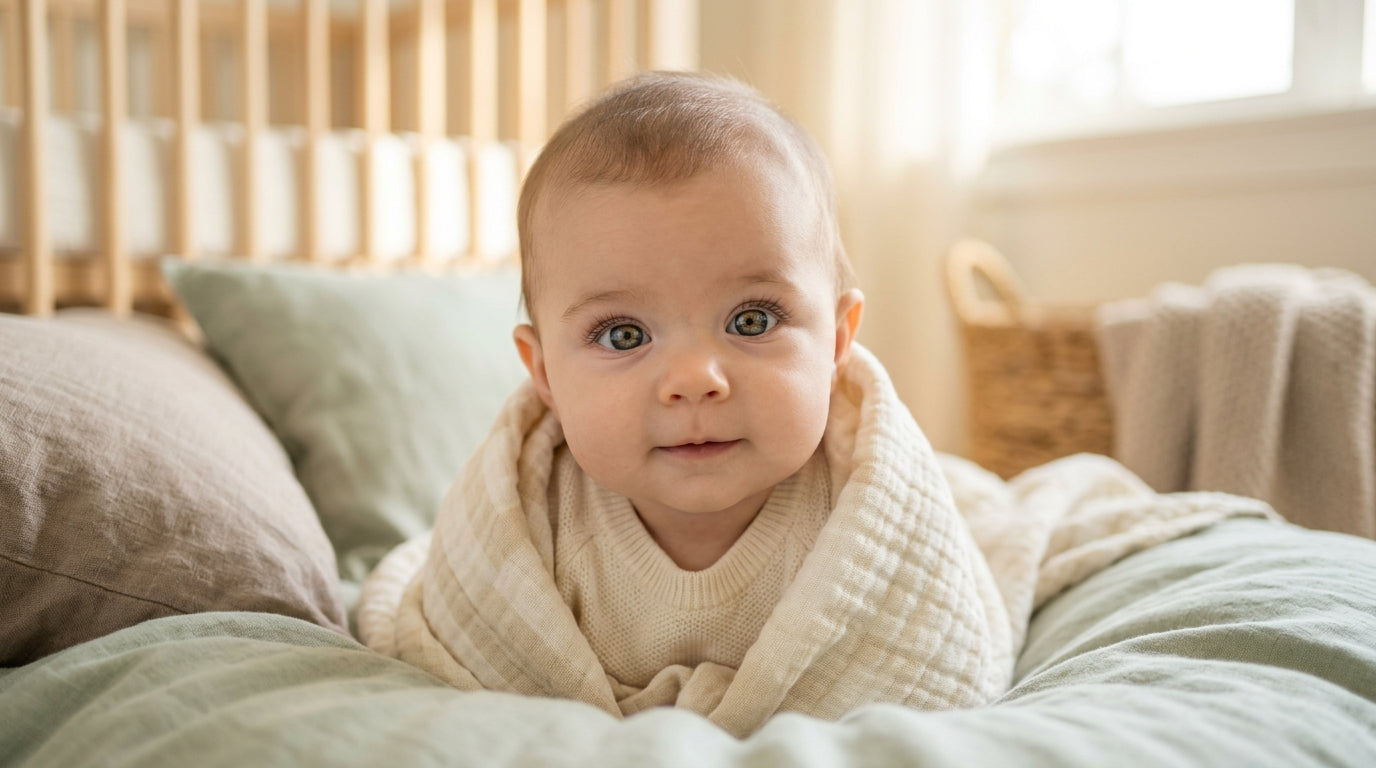
Dear Tom from eighteen months ago. You're currently sitting on the floor of the nursery at three in the morning, holding an iPhone torch uncomfortably close to Maya's face to see if her irises have developed any gold flecks, while her twin sister Zoe screams from the cot next door in solidarity. Put the phone down, step away from the WebMD tab you’ve left open on your laptop, and accept the maddening reality that you won't know their permanent eye shade until they're at least walking, talking, and actively trying to destroy your home.
I know why you're doing it. When you're drowning in nappies, Calpol syringes, and the sheer relentless grind of early parenthood, you latch onto these tiny biological mysteries as a form of entertainment. You stare into those oversized, glassy alien orbs and try to find some trace of yourself, or your partner, or maybe the postman if you're feeling particularly paranoid. But the truth about when babies decide on their final eye colour is far messier and much slower than the parenting books let on (page 47 of our favourite manual suggests you 'calmly observe the subtle shifts in pigment,' which I found deeply unhelpful when I was so tired I was literally typing 'when do babi get eye colour' into Google with numb thumbs).
The massive lie about newborn peepers
Let's address the most pervasive piece of absolute rubbish floating around the millennial parenting circuit, which is the idea that every single infant is born with bright blue eyes. I remember sitting in our freezing local community centre for an NCT group meeting when a very confident man named Tristan announced that all babies start with blue eyes because "it's an evolutionary mechanism to make us love them."
Tristan was an idiot. As far as my foggy brain can understand from what our paediatrician muttered while checking Zoe's reflexes, it's completely normal for a child to be born with dark eyes. In fact, a massive chunk of them—something like 60 percent—come out of the womb with brown eyes that will never change. My own two girls emerged with these slate-grey, terrifyingly blank eyes that looked like wet pebbles you'd find on a beach in Cornwall. They certainly weren't the Disney-princess blue that my mother-in-law had optimistically knitted a matching jumper for.
The whole thing comes down to a cellular lottery involving melanin, which is the exact same pigment that dictates whether you get a lovely tan on holiday or simply burst into flames like I do. Apparently, when they're tucked away in the womb, it's pitch black, so the little cells that produce melanin (melanocytes, if we're being technical) are fast asleep. Once they're thrust into the blinding fluorescent lights of the NHS maternity ward, the light hits the eye and triggers those cells to start pumping out pigment. If they pump out a little bit, the eyes look blue because of some optical illusion involving scattered light that's frankly too close to physics for me to understand. If they pump out a lot, you get brown. And because biology is a one-way street, the colour can only go from light to dark, meaning your brown-eyed newborn is not going to magically transform into a blue-eyed toddler, no matter how many times your relatives squint at them in the garden.
Your totally unscientific timeline of pigment
For the first three months of their lives, absolutely nothing happens, which is fine because you'll be too busy crying over the steriliser machine to notice anyway.

Then comes the three to six-month window, which is when the real drama occurs. This was the era when we bought the Panda Play Gym Set, mostly because I couldn't handle looking at any more garish plastic primary colours in my living room, and the monochrome aesthetic was genuinely soothing to my burning retinas. I'd lay the twins underneath that sweet crocheted panda, and because the natural wood and grey palette gave them high-contrast visual anchors, their eyes would track the little wooden teepee back and forth. It was during these quiet, desperately needed moments of independent play that I first noticed Maya's left eye was developing a muddy green rim around the pupil, while Zoe's were darkening into a solid, impenetrable espresso colour.
From six to twelve months, the changes slow down to a glacial pace, and by their first birthday, whatever colour is staring back at you across the smashed avocado on their highchair is probably the colour you're stuck with.
Except, of course, when it isn't. Because just when you think you've this parenting thing figured out, biology throws a spanner in the works. Up to fifteen percent of kids (mostly those with lighter eyes) will continue to have tiny, insidious pigment shifts until they're three years old. This explains why, at 18 months, I panicked when Maya's slightly hazel eyes suddenly went full brown over a bank holiday weekend.
If you're currently in the middle of this genetic waiting game and need a distraction, I highly think browsing through Kianao's organic baby essentials before you start obsessively analysing old photos.
Mutant powers and sunlight panic
Because I'm fundamentally incapable of receiving medical information without turning it into a crisis, our health visitor casually mentioned one afternoon that lighter-coloured eyes are more sensitive to harsh sunlight because they lack the protective melanin of darker eyes. She meant this as a gentle reminder to buy a sun hat. I took it to mean that my partially green-eyed daughter was essentially a vampire who would be blinded by the midday sun.
I immediately became unhinged about UV protection. I started hauling the Colored Universe Bamboo Baby Blanket absolutely everywhere we went. I'll be honest, this blanket is easily my favourite thing we own. It's ludicrously soft, genuinely looks like a piece of astronomical art with its deep cosmic pattern, and because it's bamboo, it breathes perfectly. I mostly used it to drape over the pram like a makeshift shield when we were walking through the park, though it was equally excellent for laying the girls down in the grass while I hovered over them, inspecting their irises like a deranged diamond appraiser. The fabric never irritated their skin, and it gave me a fleeting, false sense of control over their exposure to the elements.
That one terrifying Google search about mismatched eyes
There was a dark period right around the seven-month mark where I spent four hours on the internet because Zoe appeared to have two different coloured eyes. One looked distinctly brown, and the other had a weird grey shadow over it.
I plunged into the depths of medical forums and emerged convinced she had Waardenburg syndrome, a rare genetic condition that causes heterochromia (mismatched eyes) and is sometimes linked to hearing loss. I rehearsed a very serious speech for my partner about how we were going to learn sign language. I prepared myself for a life of medical advocacy. Then I wiped Zoe's face with a muslin cloth and realised the 'grey shadow' was a dried smear of pureed pear that had crusted onto her eyebrow and was casting a weird reflection on her cornea.
If your child actually does have two distinctly different coloured eyes, by all means, bring it up with your GP instead of asking the internet. But maybe check for dried fruit first.
As for toys that allegedly help them learn about colours while their own eyes are sorting themselves out, we've the Gentle Baby Building Block Set. They're fine. They're blocks. The main selling point for me is that they're made of a squishy silicone material, meaning when you inevitably step on one in your bare feet at midnight while carrying a screaming child, you'll merely wince instead of letting out a string of expletives that your toddler will later repeat at nursery.
The only advice that actually matters
Looking back from the lofty, exhausted height of having two-year-olds, the obsession over their eye colour seems incredibly quaint. When they're tiny, their bodies are entirely out of your jurisdiction. You can't control how much they sleep, you can't control their digestion, and you certainly can't control how their melanocytes react to the light in your living room.

So let it go. Stop trying to predict whether they'll look like your side of the family or your partner's. Embrace the weird, shifting, muddy phase where their eyes look like dishwater. Take too many macro photos of their face in natural lighting, buy a decent pair of baby sunglasses so you don't panic at the park, and trust that eventually, they'll settle into whatever shade they were always meant to be.
And if you find yourself awake at 3am wondering what else you should be worrying about, you can always go prepare for the next crisis.
Explore Kianao's full range of sustainable toys to give those developing eyes something beautiful to look at.
Your frantic midnight queries answered
Can breastmilk or formula change my baby's eye colour?
I literally read this on a forum once and nearly threw my phone out the window. No. Your baby's diet has absolutely nothing to do with their eye pigment. It's entirely down to genetics and melanin. Unless you're feeding them radioactive isotopes (please don't), their milk isn't changing their eyes.
Is it bad if I use flash photography on their developing eyes?
Our paediatrician laughed at me when I asked this, which stung, but he assured me that a normal camera flash isn't going to damage their eyes or alter their pigment. That said, shining a bright light directly into the face of a creature that already has a tenuous grasp on emotional regulation is just asking for a meltdown. Stick to natural light for those close-up eyeball portraits.
My mother says babie eyes always turn out like the father's. Is that true?
Your mother, much like my mother-in-law, is just making things up to pass the time. Eye colour genetics are absurdly complicated and involve multiple different genes interacting in ways that even scientists get headaches trying to map. It's entirely possible for two brown-eyed parents to have a blue-eyed child if the recessive genes line up right.
What if they suddenly change colour when they're older?
If you notice a dramatic, sudden shift in your child's eye colour after their first birthday—like, going from brown to blue overnight, or one eye suddenly looking cloudy—skip the frantic internet searching and just ring your GP. Sudden changes later in life are usually worth a proper look by someone who didn't get their medical degree from Google.




Share:
When Do Babies Finally Learn To Hold Their Own Bottle?
When Do Babies Get Measles Vaccine? A Portland Dad's Guide