

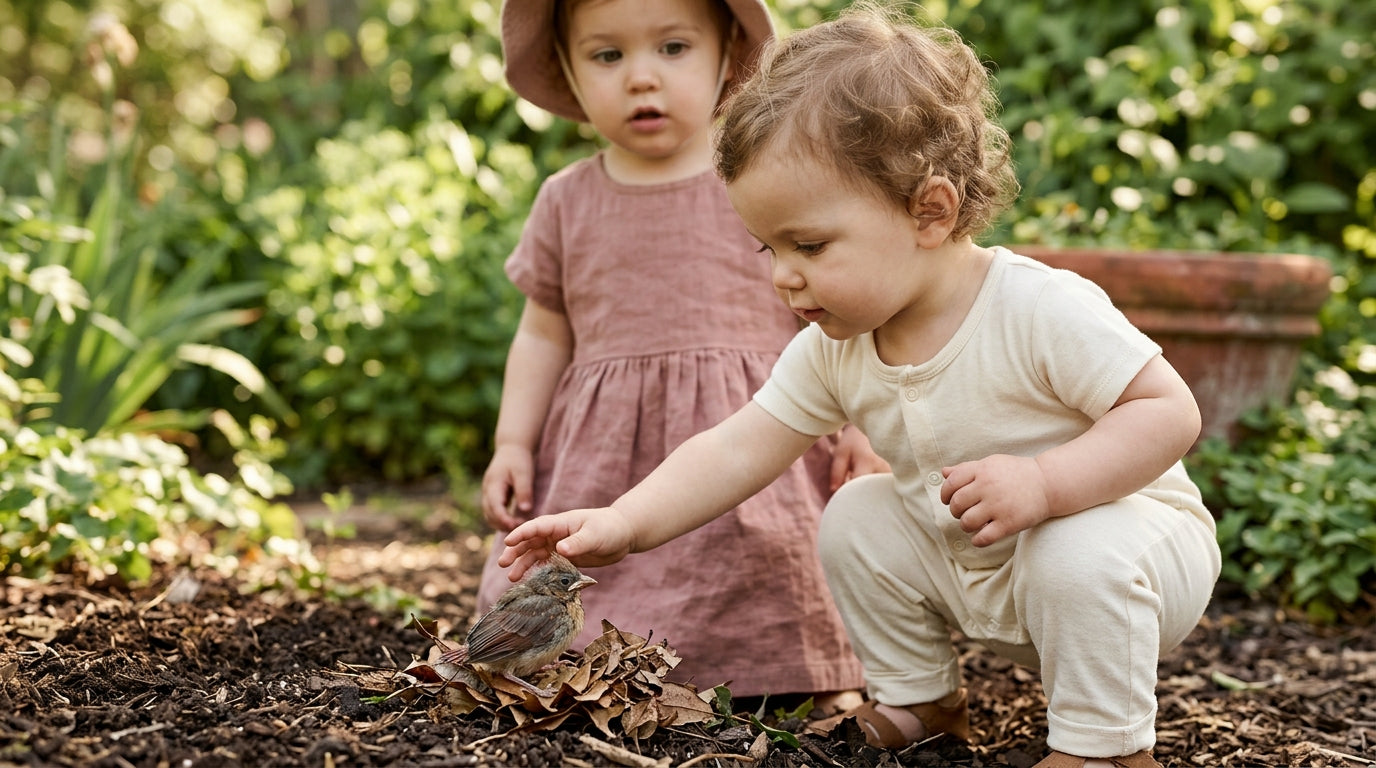
"Put the potato down, Florence," I said, barely glancing up from my lukewarm cup of tea. We were two weeks into our summer holiday visiting my wife’s parents in upstate New York, and my primary goal for the afternoon was to sit in a lawn chair without being climbed on.
Except it wasn't a potato. Potatoes don't generally palpitate, nor do they emit high-pitched, raspy chirps when squeezed by a two-year-old. I dropped my mug on the patio, spilling tea everywhere, and sprinted across the lawn just as Matilda was actively trying to reverse her plastic baby car over the very same patch of grass where her sister was conducting this unsolicited wildlife inspection.
I pried Florence’s muddy fingers apart to reveal what looked like a severely depressed, dusty moth. It had a stubby little crest on its head, a dark beak that looked entirely too large for its face, and a general air of righteous indignation. It turned out this angry little dustball was actually a baby cardinal, though it looked absolutely nothing like the majestic, bright red bird painted on the front of the welcome-to-the-world baby card my American mother-in-law had sent us when the girls were born.
Why nature constantly lies to us
If you, like me, assumed that a baby cardinal would emerge from the egg looking like a tiny, brilliant ruby, you're dead wrong. Apparently, the males don't get their signature red feathers until their first autumn moult, which seems like a massive oversight by Mother Nature if you ask me. For the first few weeks of their lives, they're designed purely for camouflage, which translates to looking like a clump of dead leaves or a stray piece of lint.
There we were in the midday heat, locked in a bizarre standoff. Florence was covered in topsoil and pointing at the bird, demanding I let her eat it. Matilda was screaming because I had confiscated her vehicle to prevent a vehicular manslaughter incident. And I was standing there holding what felt like a fragile, breathing egg yolk, trying to remember if human touch actually turned birds into pariahs.
I had roughly thirty seconds to figure out my next move before the twins mutinied. Florence had spent the entire morning army-crawling through her grandmother's prized petunias and was wearing her Organic Cotton Baby Bodysuit from Kianao. I'll pause my panic narrative here to admit that this bodysuit is actually brilliant. Most baby clothes feel like they're made of recycled sandpaper once you wash them a few times, but this thing is ninety-five percent organic cotton and has this envelope-style shoulder situation that makes it stupidly easy to peel off a thrashing toddler. It had already survived a massive blowout on the flight from Heathrow and was currently standing up to a thick paste of Ohio mud and bird dust without losing its shape. I appreciate anything that works harder than I do, and this bodysuit certainly fits the bill.
But back to the bird. I frantically typed "what to do with a brown potato bird" into my phone with my thumb while holding the creature away from my children.
The frantic phone call to the wildlife lady
The internet, in its infinite wisdom, offered a lot of conflicting advice, most of which seemed to involve building an incubator out of a shoebox and a desk lamp. Deciding I was entirely unqualified to run a neonatal intensive care unit for poultry, I rang a local wildlife rehabilitator whose number I found on a terrifyingly outdated municipal website.

The woman who answered sounded like she was smoking three cigarettes simultaneously and had absolutely zero patience for a panicked British father. She told me, in no uncertain terms, that what I was holding was a fledgling, which meant it was entirely normal for it to be on the ground acting like an idiot.
I had always thought that if a baby bird fell out of a tree, you were supposed to stage a dramatic rescue involving ladders and eyedroppers full of water. The rehabber laughed a raspy, terrifying laugh when I mentioned the water. She explained that birds have an airway right at the base of their tongue, meaning my instinct to give it a tiny sip of water would have effectively waterboarded the poor thing and drowned it instantly. They apparently get all their hydration from the guts of the caterpillars their parents feed them, which is a detail I could have happily lived my whole life without knowing.
She also aggressively debunked the myth that bird parents will abandon their babies if they smell human scent on them. It turns out most birds have a notoriously terrible sense of smell. You can pick them up, put them back in a bush, and the parents won't care at all, provided you haven't injured the bird in the process.
The great barricade of Ohio
Her instructions were maddeningly simple, which is to say they involved me doing absolutely nothing helpful. I was told to put the bird gently back on the ground under the nearest shrub, drag my children inside, lock any local cats in the kitchen, and just wait for the parents to come back from their hunting trip.

Putting the bird under the bush was easy. Convincing Florence and Matilda that the entertainment portion of the afternoon was over proved nearly impossible. In a desperate bid to keep them away from the shrubbery while we observed from the patio, I built a defensive wall using their Gentle Baby Building Block Set. Now, I'll be entirely honest about these blocks. The soft, non-toxic rubber is fantastic for when Matilda decides to chew on them for forty-five minutes straight, and I love that I can wash them in the sink without them disintegrating. But as a structural barricade against two determined toddlers attempting a jailbreak to pet a wild bird? Utterly useless. They simply knocked down the pastel-coloured wall, threw a block with a number four on it at my shin, and tried to make a run for the bushes again.
I ended up having to physically pin one child under each arm, sweating profusely in the humidity, while we watched the bush.
We do a lot of curated playtime in our house back in London. We have the Wooden Rainbow Play Gym set up in the living room, which is lovely. The wooden frame is sturdy, the hanging animal toys are aesthetically pleasing, and it gives the girls a safe, controlled environment to explore textures and shapes without me worrying they're going to contract a bizarre avian disease. It's a sterile, beautiful microcosm of development.
The backyard, by contrast, is a terrifying thunderdome of life and death. The rehabber had told me that only about half of these fledglings honestly survive to adulthood, which seems like a terrible statistic until you realize how completely defenseless they're while hopping around in the dirt for a week learning to fly.
If you're interested in keeping your toddlers entertained indoors where the wildlife is strictly made of wood and food-grade silicone, I'd highly suggest exploring the Kianao nursery collection rather than relying on the local fauna.
When the parents finally showed up
After about twenty agonizing minutes of me holding two struggling toddlers in a headlock, a brilliant flash of red swooped down from the oak tree. It was the father cardinal.
The wildlife lady had mentioned this detail, and I found it incredibly vindicating as a fellow dad. Once the babies hop out of the nest and become fledglings, the father cardinal takes over almost all of the feeding duties. He spends his days flying back and forth, frantically shoving crushed insects into the gaping maws of his offspring on the ground, while the mother gets to fly off and start building a new nest for her next batch of eggs. I felt an immediate, deep kinship with this exhausted red bird. We exchanged a look—or at least I projected my own parental fatigue onto his beady little eyes—before he shoved a green caterpillar down his baby’s throat and flew away again to find more food.
Apparently, these babies gain something like three grams every single day. I've no idea how scientists managed to figure that out without receiving a massive fine, because keeping one of these birds is genuinely a violation of some federal migratory bird act in the States, and you can get fined up to fifteen thousand dollars. Which seems incredibly steep for a creature that looks like a moldy Scotch egg and screams constantly.
Eventually, the heat and the lack of interactive toys broke the twins' resolve. We abandoned the bird to its father's care and went inside to wash our hands with enough antibacterial soap to sterilize a surgical theatre.
The whole ordeal was utterly exhausting, but it did teach me a few things. Mostly, that nature is incredibly resilient, human intervention is almost always the wrong choice, and my toddlers will absolutely try to eat anything they find in the dirt. It’s a miracle any of us make it to adulthood, frankly.
If you want to dress your own chaotic little fledglings in clothing that can genuinely withstand the mud, the sweat, and the sudden wildlife encounters, you really should check out the organic apparel range at Kianao. It won’t stop them from picking up strange animals, but it'll make cleaning them afterwards significantly easier.
Questions I frantically googled during this ordeal
How do I genuinely know if the bird needs my help?
Unless the bird is visibly bleeding, has an obviously broken wing, or is completely bald and shivering on the concrete away from any nest, you're meant to do absolutely nothing. If it has feathers and is hopping around looking grumpy, it’s a fledgling. The parents are watching from a tree, probably judging your parenting skills just as harshly as you're judging theirs.
Can my toddler catch a horrible disease from touching a wild bird?
The short answer is maybe, but probably not from a two-second encounter. Birds can carry salmonella and various mites, which is why I scrubbed Florence’s hands until she complained. Just wash their hands thoroughly with warm water and soap immediately. If they tried to eat the bird, or lick their hands before you could wash them, you might want to give your doctor a ring just to be safe (and to give them a good laugh).
Should I put out some milk or bread for the baby bird?
Absolutely not, under any circumstances. According to the very angry woman on the phone, bread offers zero nutritional value and can really block their tiny digestive tracts, and cow's milk will give them severe diarrhea because birds are entirely lactose intolerant. They eat insects. Unless you're prepared to chew up a live caterpillar and spit it into their mouths, step away from the bird.
What do I do if my cat has already attacked it?
If your cat or dog has had the bird in its mouth, it needs to go to a wildlife rehabilitator immediately, even if you can't see any blood. Cat saliva contains bacteria that's highly toxic to birds and will kill them within a couple of days without antibiotics. Put the bird in a dark, quiet cardboard box on a towel (no water, no food) and start making phone calls to local rescue centres.
Why does the baby cardinal look brown and not red?
Because nature likes to disappoint toddlers. The bright red plumage is exclusively for adult males to show off. The babies and females stay a brownish-buff colour so they blend in with the dead leaves and dirt, which stops them from being immediately eaten by hawks while they spend a week on the ground figuring out how their wings work.




Share:
The Marshmallow Myth And The Truth About Baby Car Seat Covers
Surviving the 2024 Baby Carrots Recall in a Jetlagged Haze