

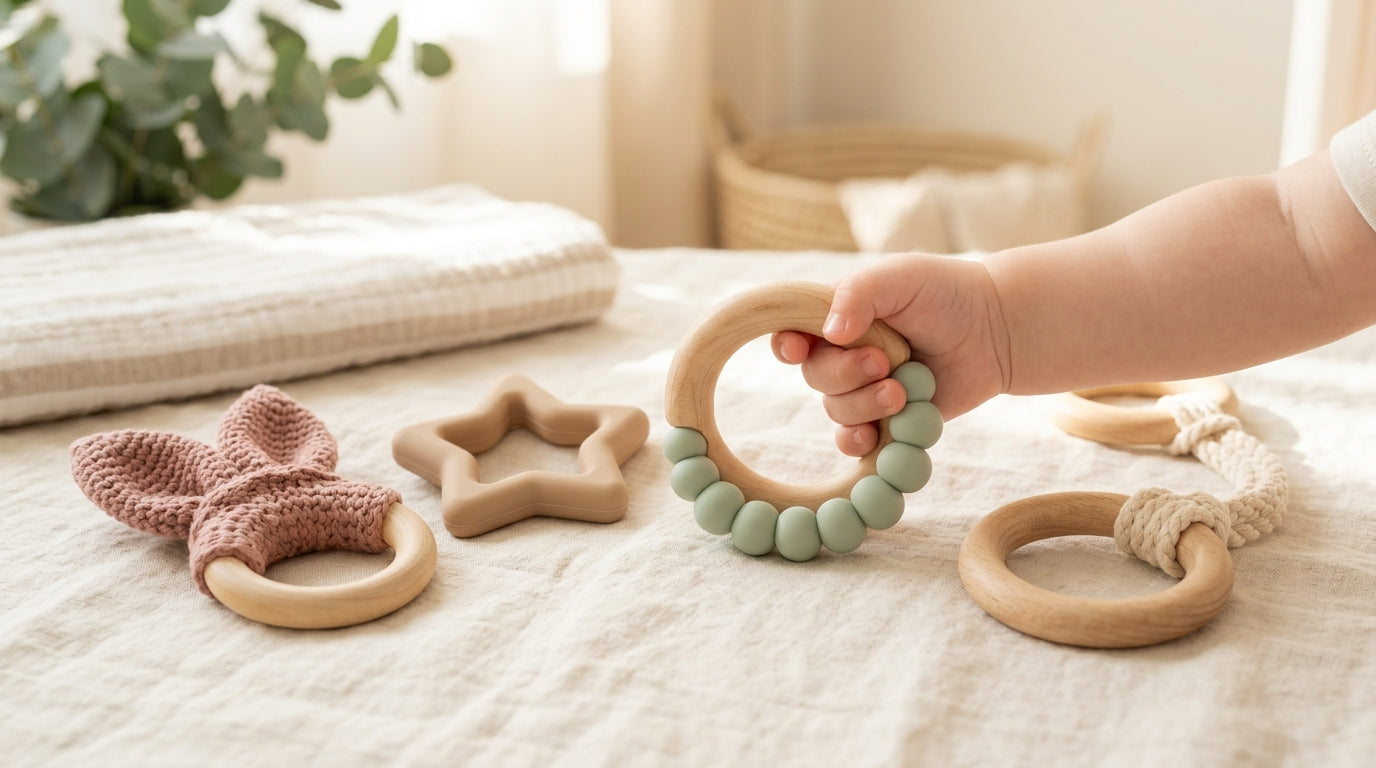
When my oldest started gnawing his own fists off at four months, the unsolicited advice came flying at me faster than I could dodge it. My mom told me to just rub a little whiskey on his gums, my sweet neighbor handed me a supposedly magic amber necklace that looked like a literal strangulation hazard bless her heart, and the moms in my local Facebook group swore I just needed to freeze a wet tube sock. I remember standing in my kitchen at two in the morning, holding a frozen, rock-hard Hanes sock in one hand and an angry, drooling baby in the other, thinking there absolutely had to be a better way to handle this than whatever archaic rituals I'd just been handed.
I'm just gonna be real with you. The whole newborn teething phase is wild. It usually starts way before you actually see a tooth, which is a cruel joke if you ask me. You're just getting out of the fourth-trimester fog, maybe your kid is finally sleeping for a solid four-hour stretch, and then suddenly they're fussy, their hands are shoved perpetually in their mouth, and everything they touch gets covered in a thick layer of slime. You start desperately searching for a newborn teething ring that won't cost as much as a tank of gas, only to find yourself staring at a wall of plastic junk at the big box store while your baby screams in the cart.
The great symptom mystery
Every time one of my kids so much as looked at me funny between the ages of three and eight months, my mother-in-law would confidently declare, "Oh, he's teething." Blowout diaper? Teething. Didn't nap? Teething. Refused to eat peas? Teething. It gets to the point where you start blaming everything on these invisible teeth that take months to actually show up.
I finally broke down and asked my doctor about it because my middle child had a fever of 101 degrees and I was convinced a molar was erupting. My doctor gave me this very patient, very tired smile and explained that while mild warmth is normal, actual high fevers mean your kid is just sick and you shouldn't blame the teeth. Near as I can figure out from what she said, the actual biological process of teeth moving up through the bone causes some localized soreness, but it isn't supposed to completely derail their immune system. So if your baby is burning up or has severe issues, you probably need to take them in rather than just shoving a teething ring in their mouth and hoping for the best.
Here's what the actual newborn teething signs looked like in my house, stripped of all the old wives' tales:
- The drool ratio: We're not talking a cute little bubble here. We're talking soaking through three shirts by noon, requiring constant wardrobe changes just to prevent their little chests from getting a rash.
- The gnawing reflex: They will try to chew on your chin, your keys, the edge of the crib, and the family dog's ear if you don't intervene.
- The cheek flush: Sometimes just one side of their face would get bright red and warm to the touch right where the tooth was trying to make an entrance.
- The night wakings: Just an annoying, low-level fussiness at 3 AM where they aren't fully awake but they definitely want you to be.
Why I've serious trust issues with plastic
Let me use my oldest kid as a cautionary tale because I made literally every mistake in the book with him. When he was about six months old, we were at a discount store and I grabbed one of those cheap, brightly colored plastic teething rings that are filled with liquid. It was three dollars, it had little fish floating inside it, and I figured it would do the job. I washed it, threw it in the freezer until it was a literal block of ice, and gave it to him.

Fast forward two weeks. We're sitting on the rug in the living room, I'm trying to fulfill Etsy orders on my laptop, and I hear this weird squelching noise. I look over, and my sweet, aggressive little angel has managed to puncture the thick plastic casing of the teething ring with his one razor-sharp bottom tooth. The mystery liquid was leaking all over his chin and he was happily sucking it down like it was a juice box.
I completely panicked. I grabbed the toy, wiped his mouth with my shirt, and frantically called Poison Control while sobbing. The very calm operator assured me that the liquid in most modern toys is just sterilized water or a mild saline, but she also told me they get those calls constantly because babies are basically tiny, destructive engineers. That was the day I realized I couldn't just buy any cheap plastic garbage off a shelf and trust it in my kid's mouth. Between the risk of them chewing through it and the anxiety over what weird endocrine-disrupting chemicals might be leaching into their system from cheap plastics, I swore off the liquid-filled stuff forever. I bought those homeopathic numbing tablets once too, read the ingredient list, and threw them straight in the kitchen trash without even opening the bottle.
My brutally honest take on what works
Because I run a small business out of my house, I don't have the time or the patience to sanitize complex toys with tiny crevices. I need things that I can either toss in the dishwasher or wash in the sink with dish soap in thirty seconds flat while I'm holding a baby on my hip. That's why solid silicone has become my absolute holy grail for teething.
If you want my actual favorite recommendation, look at the Panda Teether Silicone Baby Bamboo Chew Toy. I'm pretty budget-conscious, but this thing is worth every penny because it's practically indestructible. It's made of solid, food-grade silicone, which means there's no mystery liquid inside for your baby to drink when they inevitably try to destroy it. It has these little textured bumps on it that my youngest absolutely loved grinding her gums against. The best part is the shape. It's flat and has these little handles that are actually the perfect size for a younger baby who's just figuring out how to grab things. I'd buy two of these, keep one in the fridge, and swap them out when the fussing started.
Now, I'll also mention the Bear Teething Rattle Wooden Ring because I know people love the aesthetic. It's undeniably cute, it makes a great baby shower gift, and the natural wood is a fantastic, safe alternative to plastic. But I'm going to shoot straight with you: if you've a heavy drooler, this might not be your everyday workhorse. The little crochet bear head gets absolutely soaked with spit within five minutes of heavy chewing. You end up having to spot clean it and wait for it to air dry, which isn't ideal when you're in the trenches of a multi-day teething marathon. It's beautiful for church or when you're out to lunch and need them distracted, but for the heavy-duty 3 AM screaming fits, stick to the silicone.
The temperature rules nobody tells you about
You've got to stop throwing these rings in the deep freeze until they turn into weapons and then boiling them on the stove like pasta because the material just degrades and turns into a toxic mess in your kid's mouth.

I learned this the hard way after ruining several good teethers. My doctor explained that putting a newborn teething ring in the freezer is seriously a terrible idea because extreme cold can bruise or even cause minor frostbite to their extremely delicate, inflamed gum tissue. You just want it cool, not frozen solid. The refrigerator is your best friend here. Ten to fifteen minutes in the fridge provides enough of a chill to constrict the blood vessels and reduce the swelling without completely numbing their mouth to the point of pain.
Same goes for cleaning. Unless the manufacturer explicitly tells you it can be boiled, hot soapy water is fine. Our grandmothers sterilized everything to within an inch of its life, but honestly, if the toy hasn't left your house and hasn't been in the dog's mouth, a quick wash in the sink is perfectly adequate.
The reality of the constant drool
We can't talk about teething rings without talking about the sheer volume of saliva your child is going to produce during this phase. My second baby drooled so much I honestly thought he was dehydrated. The problem isn't just that it's gross; the problem is that the constant dampness against their neck and chest causes this nasty, bright red drool rash that's incredibly painful and just makes them even more miserable.
I got so tired of changing his entire outfit four times a day that I finally just invested in a stack of really good quality bases. The Organic Cotton Baby Bodysuit was a lifesaver for us. I'm usually pretty cheap about baby clothes because they ruin them so fast, but synthetic fabrics just trap that moisture against their skin and make the rash ten times worse. The organic cotton breathes, it absorbs the moisture better, and the flat seams don't rub against the irritated skin on their neck. Do yourself a favor and keep a rotation of these going, along with a stack of soft burp cloths to just gently dab their chin throughout the day.
honestly, you just have to survive this phase. It feels like it lasts forever when you're in the thick of it, trying to work and parent and keep a house somewhat functional while a tiny dictator screams at you because their mouth hurts. But then one morning, they smile at you, and you see that little white grain of rice poking through the bottom gum, and you realize you made it.
If you're currently in the trenches and need to stock up on things that won't make you crazy, take a look at the wooden play gyms we offer too, because sometimes you just need to lay them on their back and let them kick at some hanging toys while you drink a lukewarm cup of coffee in peace.
Questions I get asked all the time
When should I honestly introduce a teething ring?
Honestly, I start offering them around three or four months, way before the teeth honestly show up. Even if they aren't actively in pain yet, they're usually figuring out how to grab things and bring them to their mouth. Giving them a safe silicone ring early on saves your own fingers from being chewed on, and it really helps them practice the hand-eye coordination they're going to need later.
Can I put a silicone ring in the freezer?
My doctor was pretty firm on this one: fridge only. I know it's tempting to freeze them so they stay cold longer, especially in the middle of a brutal Texas summer, but the freezer makes them way too hard and dangerously cold for sensitive little gums. Just stick it in the fridge for about fifteen minutes. If it warms up too fast, that's why you buy two and rotate them.
How on earth do I clean the wooden ones without ruining them?
Untreated wood is pretty but you've to genuinely care for it, which means absolutely no tossing it in the dishwasher or letting it soak in a sink full of dirty water. I just use a damp cloth with a tiny drop of mild dish soap, wipe it down, wipe it again with a clean damp cloth to get the soap off, and let it air dry completely. If the wood starts looking a little dry after a few months, I just rub a tiny bit of coconut oil on it.
Are those amber necklaces seriously safe?
I'm just going to be blunt: no. I know half the crunchy moms on the internet swear by them, but my doctor looked at me like I had two heads when I asked about them. Putting a string of small, breakable beads around a baby's neck is a massive choking and strangulation hazard. I'm not risking my kid's life for a piece of jewelry that supposedly releases magic pain-relieving oils. Stick to things they can safely hold in their hands.
Why is my baby chewing their hands if they aren't teething yet?
My oldest did this constantly at two months old and I swore he was getting early teeth. Nope. Turns out, babies just discover they've hands and the only way they know how to explore them is by shoving them in their mouth. It's a totally normal developmental thing. It doesn't always mean a tooth is coming, it just means they found their knuckles and think they're delicious.




Share:
The great baby silicone migration: a dad's troubleshooting guide
The Truth About Baby Onesies and the 3 AM Blowout Survival Guide