

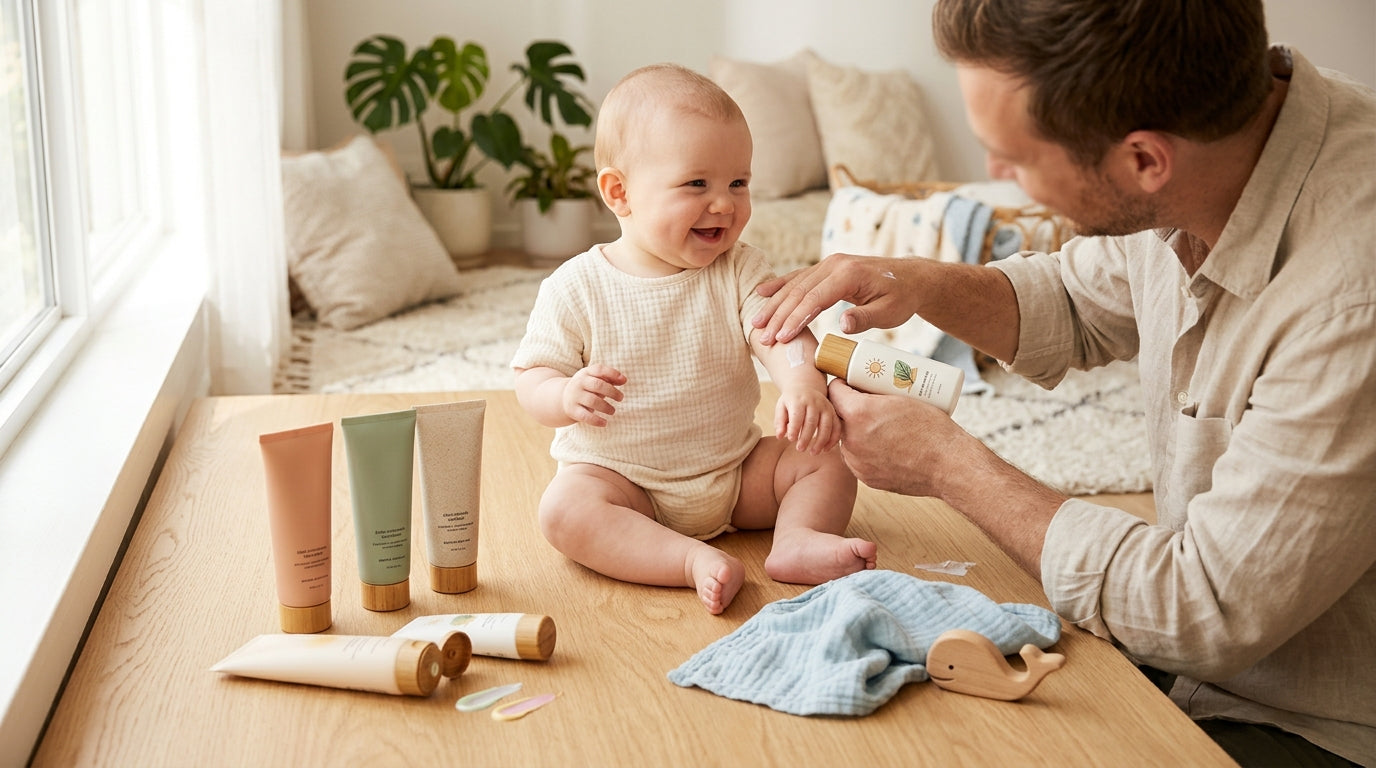
It's exactly 78.4 degrees at Laurelhurst Park, and I'm currently holding a pressurized aluminum can of SPF 50 like it's a live grenade. My eleven-month-old son, Leo, is squirming on the picnic blanket like I'm trying to install a malicious rootkit on his hardware. I press the nozzle, attempting a sweeping motion I saw a teenager execute flawlessly at the beach last week. The wind instantly shifts. Instead of laying down a protective UV firewall on my kid, I manage to coat the stroller handle, my prescription glasses, and a passing Golden Retriever in a sticky, coconut-scented cloud. Leo inhales, lets out a pathetic little cough, and immediately starts crying. My wife, Sarah, intercepts the can mid-spray, fixes me with a terrifyingly calm glare, and asks if I actually read the label. Apparently, you don't use aerosol sprays on infants. I'm literally an engineer who reads documentation for a living, and I somehow managed to gas my own child while trying to protect him from the sun.
That localized chemical weapon deployment was my rock bottom. Figuring out the best sunscreen for babies shouldn't require a degree in biochemistry, but here we're. After spending the last three nights falling down a Reddit rabbit hole and cross-referencing pediatric dermatology papers while Leo logged exactly 3.4 hours of continuous sleep, I've realized that infant sun protection is mostly about managing hardware limitations.
The six-month firmware limitation
When Leo was four months old, I asked our doctor, Dr. Chen, which SPF lotion we should buy for a trip to the coast. She looked at me like I'd just asked if I could feed him a double espresso. She told me that before a baby hits the six-month mark, their skin barrier is essentially still in closed beta. It's incredibly thin and prone to absorbing whatever you slather on it right into their system.
Plus, there's a thermal management issue. If you coat a tiny infant in thick mineral paste, it apparently acts like a physical seal. Babies already have buggy thermoregulation—they can't sweat efficiently—so blocking their pores with heavy creams just causes their internal CPU to overheat. Dr. Chen said to keep him entirely in the shade until his half-birthday, relying on physical barriers instead of lotions.
So, during those early months, I became a mobile shade architect. I'd constantly reposition the stroller to maintain an good shadow trajectory based on the earth's rotation. When the built-in canopy failed, I'd drape our Organic Cotton Baby Blanket with Squirrel Print over the stroller's legs. It's woven loosely enough that he didn't overheat inside the carriage, but the organic cotton was opaque enough to block direct rays. Plus, the little squirrel graphics gave him something to stare at while I nervously checked the local UV index every fifteen minutes.
The aerosol deployment disaster
Let's loop back to my spray can incident, because I've a lot of feelings about this. I genuinely don't understand why they even manufacture aerosol sunscreens for kids. The physics of application are entirely stacked against the user. You press the button, and the propellant blasts microscopic droplets into the atmosphere, creating a toxic vortex that your kid inevitably breathes in. My doctor confirmed that inhaling these microscopic particles can severely irritate their tiny, developing lungs.

Then there's the illusion of coverage. You see a wet sheen on their arm and assume the protective layer is active, but a light breeze can carry away half the active ingredients before they even make contact with the skin. You end up with a baby who has random, highly specific burn stripes, like a poorly rendered zebra. It's a UX nightmare.
Meanwhile, chemical UV filters like oxybenzone and octinoxate are basically just endocrine-disrupting reef-killers that we can entirely ignore in favor of mineral options.
Mineral vs chemical logic
Once your tiny human passes the six-month update, you're cleared for topical defense. But the market is divided into chemical and mineral sunscreens, and the distinction actually matters.
Chemical sunscreens work by absorbing into the skin and neutralizing UV rays like a sponge. I don't love the idea of Leo's skin soaking up synthetic compounds that take twenty minutes to boot up and activate. Dr. Chen heavily hinted that we should stick strictly to mineral formulas.
Mineral sunscreens—specifically those using non-nano Zinc Oxide or Titanium Dioxide—are physical firewalls. They sit on top of the skin and literally bounce the radiation away. It's brute-force protection, which appeals to my problem-solving brain. Because they sit on the surface, they're wildly less likely to trigger an eczema flare-up or cause allergic kernel panics in your baby's immune system.
My daily loadout
After testing entirely too many formulas, I've a clear winner and a massive disappointment.
My absolute holy grail is the Mustela mineral sunscreen stick. It looks like a chunky deodorant dispenser. The genius of the stick format is that it bypasses the messy hand-application entirely. Last Tuesday, Leo was aggressively teething on a silicone spatula, completely ignoring me. I just took the stick and blindly swiped it across his forehead, down his nose, and over his cheeks in three seconds flat. It didn't run into his eyes, my hands stayed totally clean, and I didn't have to pin him down like a wrestling referee. It's the only UI that makes sense for a moving target.
On the flip side, we've a generic organic mineral lotion that I grabbed at a drugstore in a moment of panic. It's just okay. And by "just okay," I mean it's structurally identical to drywall paste. It takes about four hundred frantic swipes to rub it in, and even then, Leo looks like a Victorian ghost child for the rest of the afternoon. It works, but the friction of application makes him furious.
If you're trying to build a solid physical firewall against the elements without relying solely on messy lotions, check out Kianao's organic baby clothes collection to upgrade your base layers.
Clothing as the primary firewall
Sunscreen is a fallback protocol. The absolute best way to prevent a sunburn is to cover the hardware so the radiation never reaches it in the first place. I've become intensely paranoid about what Leo wears outside.

For park days, my go-to base layer is the Short Sleeve Organic Cotton Baby Bodysuit. It covers his core and shoulders completely. The ribbed cotton is super breathable, so he isn't sweating through his clothes, but the tight weave provides decent mechanical protection from the sun. I just have to remember to grease up his exposed forearms and legs.
Sarah, however, recently bought the Flutter Sleeve Organic Cotton Baby Bodysuit. I'll admit, it's objectively adorable. When he crawls, the little shoulder ruffles flap around. But analytically speaking, flutter sleeves are a structural liability. They expose exactly 14% more shoulder skin than a standard sleeve when his arms are raised. I caught myself calculating the exact angle of the sun hitting those exposed shoulder joints and had to remind myself to calm down. It's a great piece, but it requires a much heavier sunscreen application on the upper arms.
I'm far less thrilled about the Organic Cotton Baby Bodysuit Sleeveless for outdoor excursions. Don't get me wrong, it's a phenomenal indoor garment. When our living room hits 75 degrees, it's his best outfit. But outside? It leaves his entire upper arm and shoulder architecture exposed to the UV index. That's a massive surface area where I've to perfectly execute a sunscreen application, and given my track record, I prefer the clothing to do the heavy lifting.
Application protocols that actually compile
So how do you genuinely get this stuff onto a squirmy babi without losing your mind? I tried looking up official medical advice, and dermatologists think the "teaspoon rule." They say to use exactly one teaspoon of lotion for the face and neck, one for each arm, and so on.
I literally took a metal measuring spoon out to the patio to try this. Leo immediately grabbed the spoon, tried to eat it, smeared zinc oxide into his eyebrows, and wiped his face on my jeans. So, forget the exact measurements. Here's my messy, reality-based protocol:
- The High-Chair Hack: I strap him into his high chair, hand him a frozen waffle to keep his hands occupied, and apply the sunscreen ten minutes before we even look at the front door. If you wait until you're at the park, they're too stimulated and will fight you.
- The Dot Matrix Method: Instead of rubbing a giant glob into my hands and slapping it on him, I tap tiny dots of lotion all over his exposed limbs. Then I quickly rub the dots together. It distributes way faster than pushing a huge puddle of paste up his arm.
- The Timer: A babie's sunscreen degrades. I set a recurring alarm on my smartwatch for 80 minutes. The moment it vibrates, I intercept him mid-stride and reapply the stick to his face. He hates it, but he's outputting four wet diapers a day, drinking his water, and hasn't had a single burn, so the system works.
Being a dad mostly feels like trying to debug a complex system where the documentation is missing and the user screams when you touch them. But figuring out the sunscreen puzzle has honestly made our afternoons outside way less stressful. I don't have to hover over him under the oak tree anymore; I can just let him eat handfuls of dirt in the broad daylight like nature intended.
Before you pack your diaper bag for the next blindingly sunny afternoon, make sure your physical protection is just as solid as your mineral lotion. Grab a few breathable, long-lasting layers from Kianao's organic essentials to keep their delicate hardware safe.
Troubleshooting FAQ
What do I do if my baby eats the sunscreen?
Panic for exactly two seconds, then wipe their tongue with a wet cloth. Leo managed to lick the sunscreen stick last month. I frantically googled the safety data sheet. Because we use a mineral formula (zinc oxide), it's totally non-toxic and just tastes terrible. If it was a chemical spray, I probably would have called poison control. Just get a drink of water into them to wash out the chalky taste.
How do I wash the mineral paste off at night?
This took me weeks to figure out. Mineral sunscreen is engineered to repel water, so standard baby body wash just slides right off it. You're left with a weird, tacky baby. Sarah taught me to use a tiny bit of baby oil or coconut oil on a washcloth first. The oil dissolves the zinc oxide instantly. Then you run the normal bath routine. It's a two-step authentication process for dirt.
Does a baby with a dark complexion still need sunscreen?
Absolutely. My friend's doctor was super clear about this when they asked. More melanin provides a slight baseline resistance, but infant skin is so universally thin and fragile that UV radiation will absolutely cause cellular damage regardless of skin tone. The hardware is equally vulnerable across all models.
Can I use my adult sunscreen on my baby?
I wouldn't risk it unless you're trapped in a desert with no alternatives. Adult formulas are loaded with synthetic fragrances, preservatives, and chemical filters that make our skin feel nice but will likely cause a massive eczema flare-up on a baby. I borrowed my sister's fancy adult SPF once when I forgot our bag, and Leo's arm broke out in tiny red bumps by dinner. Stick to the boring, unscented baby stuff.




Share:
The Search for the Best Humidifier for Baby (Without the Mold)
The search history nightmare and the offline baseline