

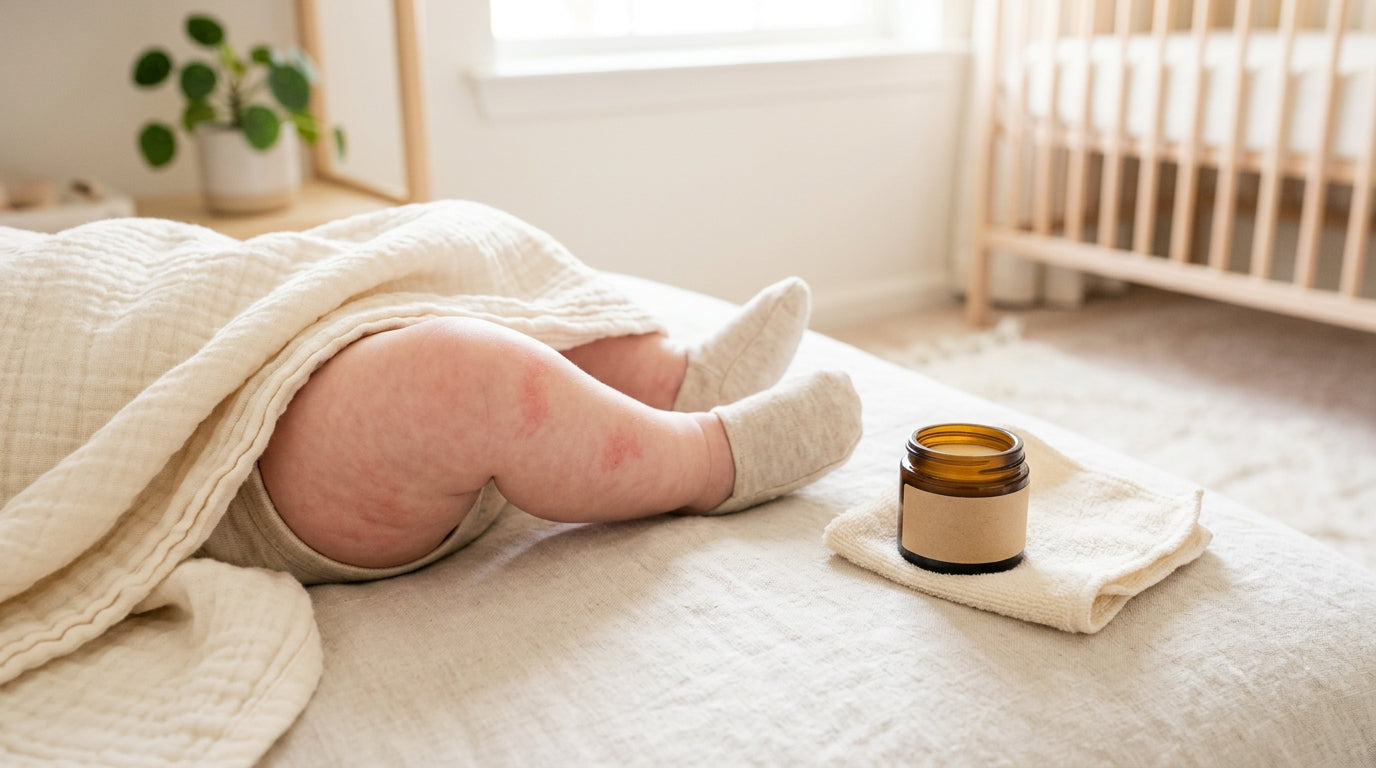
I was sitting on the edge of the bathtub in Dave’s grey Georgetown hoodie—the one that already had three distinct spit-up stains on the left shoulder—watching my four-month-old son try to rub his own face off. Seriously. Little Leo was grinding his violently red, sandpaper-textured cheeks into my collarbone so hard I thought he was going to draw blood. I was exhausted, nursing my second cup of lukewarm coffee, and crying. Like, full-on, ugly crying into his sparse baby hair.
Before having kids, I completely bought into the commercialized lie of "baby soft skin." I thought babies just emerged smelling like lavender and feeling like velvet. I didn't realize that a huge chunk of them come out with skin that acts like it’s highly allergic to the planet Earth. I remember sitting there with one hand holding Leo and the other frantically typing variations of "help red rash on my babie" and "what actually causes this sudden eczema in our babies" into Google at 3 AM. The internet, as usual, was a terrifying place that convinced me my house was toxic, my breastmilk was flawed, and I was failing.
I wasn't. And if you're reading this while staring at your own kid's angry, scaly elbows, you aren't either. It's just that nobody really warns you about how much of modern parenting is just playing amateur dermatologist.
The genetics thing and that protein I can barely pronounce
So our pediatrician, Dr. Evans, is this wonderfully blunt woman who talks a mile a minute. I dragged Leo into her office, convinced he was allergic to our golden retriever or the laundry detergent or maybe just me. She took one look at his poor little joints and cheeks, sighed, and started drawing on the paper examining table cover with a pen.
From what I understand from her scribbles, half of this is just completely out of our control. It comes down to a genetic mutation regarding this skin protein called filaggrin. God, I sound like a biology teacher right now, but basically, filaggrin is the glue that holds the skin's moisture barrier together. A ton of our kids are just born without enough of it. So their skin barrier is literally leaky. Water evaporates right out of it, and every little irritant—dust, dog hair, a slightly scratchy tag—marches right in and sets the whole system on fire.
She asked if Dave or I had asthma, hay fever, or sensitive skin. I sneezed just looking at a tree in spring, and Dave used to get crazy rashes as a kid. Boom. The atopic triad. She basically told us we had handed this down to our sweet little babi like a crappy genetic heirloom. Thanks, DNA.
This is when I realized that what we put *on* his body mattered just as much as what we put in it. We had been stuffing him into these adorable but cheap polyester-blend outfits that my mother-in-law bought on sale. Dr. Evans told us to burn them. Okay, she said "donate them," but her tone implied burning. She said he needed breathable, natural fibers only, or he was just going to marinate in his own sweat and trigger a massive flare-up.
I immediately overhauled his entire dresser. The absolute hero of my laundry basket became the Organic Cotton Baby Bodysuit Sleeveless Infant Onesie from Kianao. I'm intensely picky about bodysuits because Leo is built like a little linebacker and getting things over his head used to cause a total meltdown. But these are 95% organic cotton, undyed, and they've these flat seams. Do you know how rare a truly flat seam is? Regular seams on cheap clothes were leaving angry red welts under his armpits. This one didn't. Plus, because there are no harsh chemical dyes, it didn't agitate his leaky skin barrier. We bought six of them and he basically lived in them until he was walking. Just a baby in a sleeveless organic onesie, looking like a tiny, comfortable Bruce Willis in Die Hard.
The three minute timer of doom
If you take nothing else away from my rambling, take this: the bath time routine is the only thing standing between you and a peaceful night's sleep.

Dr. Evans instituted the "3-Minute Rule" in our house, which sounds like a game show challenge but is actually a logistical nightmare. Here's the premise: you bathe them in lukewarm water (hot water strips the skin and makes the itch worse) for no more than ten minutes. You pull them out, gently pat them dry—NO RUBBING, rubbing is a crime in this house—and you've exactly three minutes to slather them head to toe in a thick ointment to lock the remaining bathwater into their skin.
Have you ever tried to cover a thrashing, screaming, wet infant in a quarter-pound of petroleum jelly in under 180 seconds? It's sheer chaos. Dave and I'd treat it like a pit stop at the Indy 500. He held the towel, I did the scooping and smearing. You have to use downward strokes, too, because apparently rubbing it in circles just aggravates the hair follicles. Who knew? So we're just frantically slicking him down like a greased pig at a county fair, trying not to drop him onto the bathroom tile.
And lotions? Forget it. Lotions are mostly water. They evaporate and leave the skin drier than before. You need creams that you've to scoop out of a tub, or straight-up greasy ointments. If your baby doesn't look like a glazed donut before you put their pajamas on, you haven't used enough.
If you're currently overwhelmed by the sheer volume of things you need to change to accommodate your baby's skin, I highly think grabbing a coffee and just browsing through some safer, softer options. Kianao's organic baby essentials saved me a ton of late-night doomscrolling when I was trying to figure out what fabrics wouldn't make Leo scream.
Teething drool is basically battery acid
When Maya was a baby, she barely drooled. A delicate little trickle here and there. Leo? Leo was a St. Bernard. When he started teething around six months, he produced enough saliva to fill a wading pool.
The problem is that saliva is full of digestive enzymes. When it sits on a baby’s chin, neck, and chest, it literally starts breaking down the skin. Add a pacifier into the mix, and you get this horrifying, chapped, red "ring of fire" around their mouth. It looks so painful you just want to cry for them.
Dave thought we should just take the pacifier away entirely. Dave is an idiot sometimes. Taking a pacifier away from a teething six-month-old with an active itch is a recipe for nobody sleeping for a decade. Instead, our pediatrician had me start coating his chin and the skin under his pacifier with a thick layer of barrier ointment right before naps and bedtime. It acts like a raincoat. The drool literally slides right off the grease instead of eating away at his face.
During the day, we also had to rethink his bedding and blankets, because he would constantly rub his wet, rashy face into whatever he was lying on. Dave, in a rare moment of proactive online shopping, ordered the Bamboo Baby Blanket in the Universe Pattern. I'll be totally honest with you: the pattern is just okay for me. I’m a boring, neutral-aesthetic mom, and neon orange planets aren't exactly matching my nursery vibe. But I've to admit that Dave nailed the fabric choice. The bamboo is incredibly soft—like, way softer than standard cotton—and it's naturally moisture-wicking. So when Leo was sweating and drooling in his sleep, the blanket wasn't trapping the heat against his face. It genuinely helped bring the redness down.
Oh, and a quick side note because this happens to me constantly: No, this skin condition is not contagious. If one more mom at the park pulls her toddler away from Leo's elbow like he has the plague, I'm going to lose my mind. It's just dry skin and genetics, Brenda. Moving on.
When the crunchy moms judge you for using the cream
I spent way too long trying to heal Leo's skin with breastmilk baths, organic coconut oil, and positive vibes. I was terrified of steroids. I was in all these Facebook groups where moms would tell horror stories about topical steroid withdrawal, and I thought, oh god, I can't put steroids on my tiny fragile baby.

But the coconut oil was just sitting on top of his skin doing absolutely nothing, and he was scratching himself until he bled. Dr. Evans basically sat me down and told me to get off the internet. She prescribed a mild 1% hydrocortisone cream and told me to just use the damn medicine for seven days to break the itch-scratch cycle.
Here's the trick they don't tell you on the box: you've to apply the steroid cream to the red spots, wait a full hour, and THEN apply your thick moisturizer all over. If you mix them together, you dilute the medicine and spread it to healthy skin where it isn't needed. We followed the rules, and within three days, his skin was clear. Sometimes, you just have to trust the science and ignore the moms in the comments section.
Also, Dr. Evans warned us to watch out for a staph infection. Because their skin is broken and leaky, bacteria can get in so easily. She said if I ever saw a golden, honey-colored crust forming over the rashes, or if they started oozing pus or he spiked a fever, we needed to call her immediately because that means antibiotics. Terrifying? Yes. But I'm so glad I knew what to look for instead of just thinking it was a bad flare-up.
Doing laundry like a paranoid person
I used to love heavily scented laundry detergent. I wanted everything to smell like an Alpine meadow or a tropical breeze. Now? Our laundry room is a sad, fragrance-free zone.
Dr. Evans told me to toss the fabric softeners and dryer sheets entirely because they leave a chemical film on the clothes that's basically kryptonite for sensitive skin. Now we use a dye-free, fragrance-free liquid detergent, and I run all of Leo’s clothes through an extra rinse cycle just to make sure every single trace of soap is gone. It's extremely annoying and uses a ton of water, but it actually works.
I also stopped buying synthetic fabrics entirely. Even for gifts! Recently, my best friend had a baby who was showing early signs of skin sensitivity, and instead of taking a chance on random store-bought blankets, I bought her the Hypoallergenic Bamboo Baby Blanket with the Blue Floral Pattern. Honestly, this is the blanket I *wish* Dave had bought for us instead of the space one. The watercolor cornflowers are gorgeous, and because it’s that same 70% organic bamboo blend, it stays cool and frictionless against a newborn's delicate skin. My friend says her daughter sleeps with it every night and hasn't had a single heat rash since they switched.
Look, navigating this is exhausting. You’re going to buy a cream that someone swore by, and your kid will scream when you put it on. You’re going to have days where their skin looks perfect, and the very next morning they’ll wake up looking like a sunburned lizard for absolutely no reason. Give yourself some grace. You're doing the best you can with a puzzle that keeps changing its shape.
Before I get into the specific questions you guys are always messaging me about, do yourself a favor and double-check what your baby is sleeping in tonight. Swapping out just one scratchy sheet or synthetic onesie for Kianao's gentle organic clothing can honestly make a bigger difference than a hundred expensive creams. Okay, let's get into the messy details.
FAQ
How the hell do I tell the difference between this and regular baby acne?
I asked Dr. Evans this exact question because Leo had both. Baby acne really looks like teenage pimples—little raised bumps, sometimes with tiny whiteheads, mostly on the cheeks and nose. It doesn't seem to bother them at all. Eczema looks like angry, red, dry, scaly patches that feel rough to the touch, and your baby will actively try to rub or scratch them because they itch like crazy. By six months, the acne usually clears up, but the dry scaly patches move to their elbows and knees as they start crawling.
Will my kid have to deal with this forever?
Honestly, nobody knows for sure, which is the most frustrating answer ever. Dr. Evans told us that a huge percentage of kids outgrow the worst of it by the time they hit kindergarten. Their skin barrier just matures and gets better at holding in moisture. But some kids will just always have sensitive skin that flares up in the winter. I've accepted that Leo might just be a "needs unscented soap forever" kind of guy, and that's fine.
What's the actual best moisturizer to use?
I wasted so much money on expensive, fancy-smelling baby lotions before I learned they're garbage for leaky skin. You want an ointment. Petroleum jelly (Vaseline) or a thick, plant-based alternative ointment is the gold standard. It feels gross and greasy, and it'll get on your clothes and ruin your silk pillowcases, but it works better than any $40 boutique lotion. If it comes in a pump bottle, it's probably too thin.
Can I still use those cute scented baby washes for bath time?
Absolutely not. Put the lavender sleepy-time bubble bath down. I know it smells like heaven and makes for great Instagram bath photos, but those fragrances are brutal on a compromised skin barrier. We switched to a completely fragrance-free, oat-based creamy wash and only use it on the actual dirty parts—diaper area, armpits, and those gross little neck folds that trap milk. The rest of him just gets rinsed with water.




Share:
Why the Dust Baby Meme is Harmless but Your Floor is Toxic
What an elon musk baby mama taught me about dad anxiety