

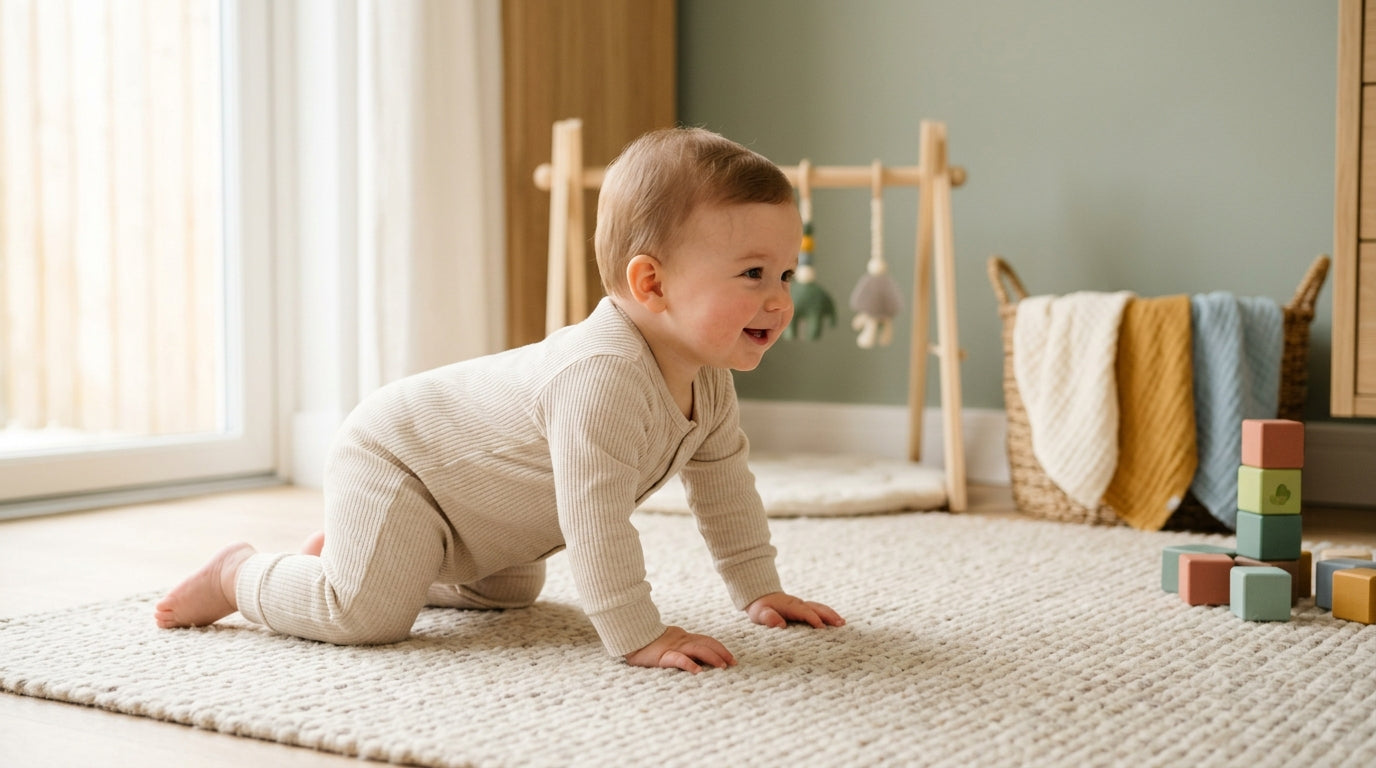
I was standing in line at a Portland coffee shop yesterday with my 11-month-old strapped to my chest like a very heavy, drooling backpack, when I got hit with three completely contradictory pieces of developmental advice in the span of ten minutes. First, the barista asked if he was mobile yet, casually mentioning her nephew was practically sprinting on all fours at five months. Then my mom texted me to ask if my son was "delayed" because I was apparently a speed-demon crawler at six months. Finally, a guy behind me in line with a labradoodle leaned over and said his daughter skipped crawling entirely and went straight to walking, like she had discovered some kind of speedrun exploit for human physics.
I just nodded, bought my overpriced pour-over, and went out to the car to quietly panic. Trying to figure out the exact timeline for independent mobility is enough to break your brain. If you spend more than five minutes on parenting forums looking for averages, you'll walk away convinced your kid's internal firmware is hopelessly corrupted. I spent weeks staring at my son on the rug, wondering if I needed to file a bug report with his pediatrician.
The great milestone firmware update
Here's a piece of data that actually made me breathe easier. I was aggressively logging my son's floor time in a spreadsheet—because I'm a software engineer and I process anxiety through data entry—when I stumbled on the fact that the CDC actually updated their official milestone checklists in 2022. They completely removed crawling from the list.
It blew my mind. It was like deprecating a legacy feature that everyone assumed was mandatory. Apparently, a totally healthy percentage of babies just skip this step entirely and go straight to pulling themselves up on coffee tables. My pediatrician confirmed this at our nine-month checkup, gently suggesting I could probably delete my tracking spreadsheet. She told me the expected window for a baby to figure out crawling is ridiculously wide, somewhere between seven and ten months, but even then, the definition of "crawling" is wildly subjective.
Backward bugs and other weird mobility hacks
For the longest time, my son only went in reverse. He would push up on his hands, lock his elbows, and somehow slide backward across the hardwood floor until he wedged himself under the sofa. I spent hours debugging why he was going the wrong way. I thought his internal gyroscope was installed upside down. My wife had to remind me that a baby has a much heavier head and upper body compared to their tiny little legs, so pushing backward is just the path of least resistance at first.
But the classic hands-and-knees movement you see in diaper commercials is just one option. Once I started paying attention at daycare drop-offs, I realized babies are basically just experimenting with different physics engines.
- The Commando: Dragging themselves entirely by their forearms while their legs drag dead weight behind them like a tiny, determined sniper.
- The Bottom Scoot: Sitting straight up and using a weird combination of heel-kicks and hand-pushes to shuffle forward.
- The Bear Crawl: Hands and feet on the floor, butt high in the air. It looks deeply uncomfortable and slightly terrifying in dim lighting.
- The Crab: Moving entirely sideways using one dominant arm to pull and one leg to push.
Don't bother buying those rigid little baby sneakers right now because they just weigh their feet down and look ridiculous anyway.
The brain science stuff I barely understand
Even though the strict timeline is kind of a myth, our pediatrician said physical therapists still really want babies to practice crawling if possible. Not because of their leg muscles, but because of their brains. She explained that the classic cross-lateral crawl—moving the right arm with the left leg—forces the two hemispheres of the brain to talk to each other.

She used a term called the corpus callosum, which sounds like a Harry Potter spell but is apparently the neural pathway connecting the left and right brain. Building that connection supposedly helps with reading and problem-solving later on. Wrap your head around that. My son awkwardly dragging himself toward the dog's water bowl is somehow compiling the code he'll need to pass middle school math. When he finally did his first proper cross-lateral crawl last week, my wife cheered like he was a little baby star performing at a halftime show.
Gear that actually helped (and the stuff that didn't)
If you want a baby to move, you've to put them on the floor, which means you spend a lot of time on the floor yourself. This is where I learned that traction and motivation are the only two things that honestly matter.
At first, we had him on this Autumn Hedgehog Organic Cotton Baby Blanket. Don't get me wrong, my wife loves this blanket. It's incredibly soft organic cotton, the mustard yellow color looks great in the nursery, and the little blue hedgehogs are undeniably cute. But it's entirely the wrong surface for learning to crawl. It's too soft. Every time he tried to push up, the fabric bunched up under his hands and he'd just faceplant in frustration. We still use it constantly for stroller walks in the Portland drizzle, but for floor time, you need something firm. Hardwood floors work, but you've to strip them down to bare legs and bare feet so they can really get some grip.
Once we had the traction sorted, we needed bait. Tummy time was a screaming nightmare in our house for months. He hated it. I hated it. We would just stare at each other while he cried into the rug. The only thing that got him to stop screaming and start reaching was the Silicone Sloth Teether Toy.
This thing is honestly my favorite piece of gear we own right now. Right around the time he was developing the upper body strength to crawl, his front teeth decided to brutally hack their way through his gums. The kid was miserable. I'd take this little mint-green silicone sloth, run it under cold water, and place it exactly three inches out of his reach during tummy time. The sheer desperate desire to chew on the sloth's textured little arms was stronger than his hatred of tummy time. It's 100% food-grade silicone, so I didn't care how much he gnawed on it, and the tree-branch design was perfectly shaped for him to grab with one hand while he tried to drag his body forward with the other.
If you're currently in the thick of setting up an obstacle course for your own QA testing, you can browse Kianao's wooden play gyms to make the floor setup a little less chaotic.
One side effect of mobility that nobody warned me about: the faceplants. Once they get up on their knees, they wobble, and gravity always wins. They invariably smash their mouth into the floor right when their gums are the most swollen. After one particularly nasty tumble, my wife bought the Baby Finger Toothbrush Set. I thought it was ridiculous at first—brushing a baby's gums?—but slipping that little silicone cap over my index finger and gently massaging his sore mouth genuinely calmed him down after he bumped his face trying to conquer the living room rug.
Stop trapping them in plastic buckets
I've to rant about baby containers for a second. Bouncers, swings, walkers, activity centers where they sit in a little suspended fabric seat—they're all traps. I get it. When you're desperately trying to answer a Slack message from your boss without a tiny human grabbing your laptop cord, the bouncer looks like salvation.

We abused the bouncer heavily between months four and six. But you can't learn to move if you're strapped into a five-point harness. The floor is the only place they can honestly figure out how their joints work. We basically had to cold-turkey the bouncer, baby-proof the entire living room by covering every sharp corner in foam, and just let him loose. It means you can't take your eyes off them, which is exhausting, but it's the only way they get the reps in.
When to honestly call tech support
Because I'm an anxious person, I still made my doctor give me specific parameters for when to worry. If your baby is taking their time, that's usually fine. But she told me to call her if we noticed a few specific hardware issues. If by 10 or 12 months he wasn't sitting up on his own at all, that would be a red flag. If he felt unusually floppy, or incredibly stiff and rigid, that was another reason to check in.
The biggest thing she warned me about was asymmetry. If he was only ever using his right arm and right leg, and completely ignoring the left side of his body for weeks at a time, we'd need to look into it to rule out muscle tightness. But as long as he was trying to move, rolling around, and putting weight on his limbs, she told me to stop googling percentiles and just let him figure it out.
If you want to upgrade your floor time setup with stuff that's really safe to chew on, shop our organic baby essentials before you dive into the FAQs below.
The messy FAQ section I wish I had
What happens if my baby skips crawling entirely?
Honestly, nothing bad. My pediatrician said a lot of babies just go from sitting to pulling up on furniture to walking. As long as they're figuring out how to coordinate both sides of their body in some way, skipping the hands-and-knees phase isn't the developmental disaster my mother thinks it's.
Why does my kid keep scooting backward instead of forward?
Because their arms are way stronger than their legs at first. Pushing up instinctively sends them into reverse. It's totally normal. Just fish them out from under the TV stand and turn them back around. They eventually realize the forward gear exists.
Are those rolling activity centers good for teaching them to walk?
Apparently not. Our doctor told us to avoid the traditional sit-in walkers entirely. They don't teach babies how to balance their own weight, and they let them move way too fast toward stairs and dog bowls. Stick to tummy time on a firm floor.
How much tummy time do they seriously need?
The medical advice I got was to aim for 30 minutes a day total, but you don't have to do it all at once. Doing it in 3-minute bursts before they start screaming counts. Use toys, use a mirror, use your own face. It's a grind, but it builds the neck and core strength they need for literally everything else.
Should I put socks or shoes on them when they try to crawl?
No, take them off. Slippery socks on hardwood floors just turn your baby into a cartoon character running in place. Bare feet and bare knees give them the grip they need to genuinely push off the floor.




Share:
Exactly When Does Baby Acne Go Away? A Tired Parent's Guide
When Should Babies Start Talking? A Real Mom's Messy Timeline