

It was exactly 4:13 AM on a random Tuesday in November, and I was wearing my husband Dave’s oversized college sweatshirt which had a highly questionable yogurt stain on the left shoulder. I was holding a lukewarm mug of yesterday's coffee, operating on maybe three hours of broken sleep because Maya, who was three at the time, had a nightmare about a giant talking banana, and Leo was a colicky six-month-old who believed sleep was for the weak.
I took exactly two steps into the dark living room and my foot came down hard on something plastic.
Immediately, a robotic, hyper-enthusiastic British voice screamed into the silent house: "THE COW SAYS MOOOO! LET'S FIND THE RED TRACTOR!" Followed by thirty seconds of aggressive electronic banjo music.
I spilled the coffee down my leg. I cursed. Leo woke up crying. The dog started barking at the plastic farm monstrosity. And right then and there, rubbing my bruised heel in the dark, I decided I was throwing all of it away. All the loud, flashing, overstimulating crap that we had been guilted into buying because some targeted Instagram ad told me it would make my kids geniuses. Oh god, the guilt is so real, isn't it? Because when you're exhausted and just trying to survive the week, you'll literally buy anything that promises to help your child hit their milestones faster.
But the joke was on me, because none of it was actually working.
Anyway, the point is, my living room looked like a plastic factory exploded, and my kids were still just chewing on my car keys.
Flashcards for babies are a complete scam and I refuse to ever talk about them again.
The great plastic purge of my living room
So the next morning, fueled by pure spite and a fresh pot of dark roast, I started bagging things up. Dave came downstairs, took one look at my manic energy, and wisely backed away into the kitchen.
I had read this article somewhere—or maybe I heard it on a podcast while I was doing dishes, my brain is basically a sieve these days—by this developmental psychologist named Alison Gopnik. I'm pretty sure she said that kids are basically tiny, uncoordinated scientists running chaotic experiments all day. And the thing that really stuck with me, or at least the version of it I vaguely remember, is that if a toy is doing all the work—like flashing lights, singing songs, moving on its own—then the kid is just sitting there passively. Like a zombie.
For kids to actually learn anything, the toy needs to be passive so the child can be active.
Which made so much sense it physically hurt. All those batteries I bought! All that money! I was buying toys for early learning thinking I was doing the right thing, but I was basically just buying them tiny personal televisions. So I kept the wooden blocks, the measuring cups from my kitchen, a few soft things, and tossed the rest in a donation box.
When they're just little milk blobs
When Leo was in that 0-to-12-month phase, everything was about sensory input. And by sensory input, I mean he just wanted to put every single object he encountered directly into his mouth to see if it was food.

After the purge, I felt weirdly naked. Like, what do you even give a baby if it doesn't sing the alphabet? I started looking into more minimalist, Montessori-inspired learning playthings that wouldn't make my eyes bleed when I looked at them in the living room.
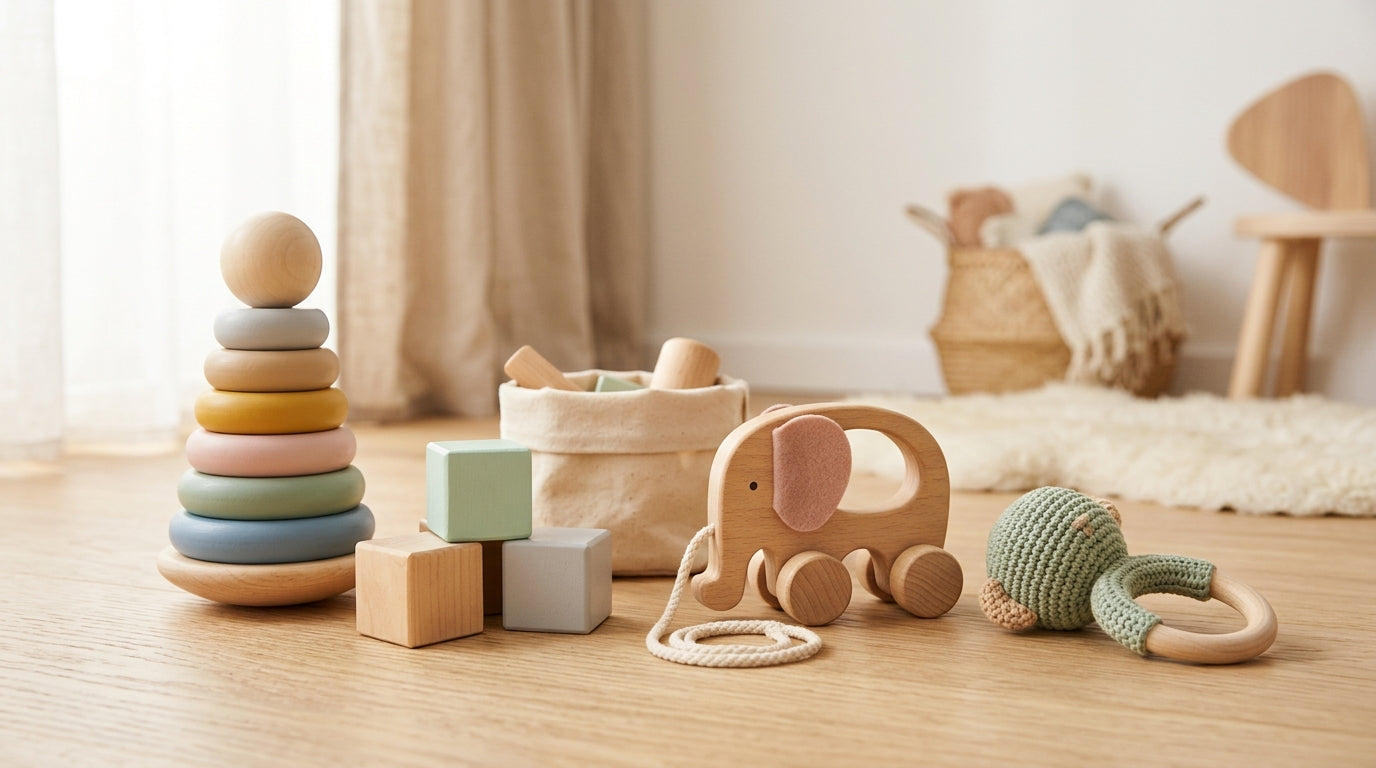
We ended up getting the Fishs Play Gym Set from Kianao, and honestly? It was the single best thing I kept in that house. I set it up on the rug next to Dave’s favorite armchair. It’s just this really simple, beautifully smooth wooden A-frame with these wooden ring toys hanging down. No lights. No robotic farm animals. Just wood.
And you know what? Leo was obsessed. He would lie there for like twenty solid minutes—which in baby time is basically a century—just staring at the wooden rings, trying to figure out how to command his tiny meat-hook hands to grab them. I could sit there, drink my coffee while it was actually still hot, and watch him figure out cause-and-effect. He’d swat a ring, it would swing, and you could see his little mind blowing. It’s a genuine heirloom-quality piece, totally sustainable, and the rings are perfectly sized for when they start aggressively grasping at things.
Now, to be totally transparent, we also got their Fox Rattle Tooth Ring. It’s incredibly cute, the crocheted cotton is beautiful, and it's super safe for teething. But as a developmental tool? Meh. It’s just okay for us. The rattle is very subtle, which I guess is nice for my sanity, but Leo basically ignored the rattle aspect and just used it to aggressively chew on the poor fox’s left ear for six months straight. He loved chewing it, but I wouldn't say it unlocked any deep cognitive milestones, you know? It's cute, it works as a teether, but it wasn't the star of our playroom.
The chaos of the toddler years
Right around the time Maya turned 18 months, things got wild. Finding learning toys meant for an 18-month-old is a highly specific kind of hell because they're smart enough to be bored easily but uncoordinated enough to get frustrated and throw things at your head.
This is the stage where they want to mimic everything you do. If I was sweeping, Maya wanted to sweep. If I was typing on my laptop, Maya wanted to aggressively mash my keyboard and delete a draft of my article.
I realized that the best toys for our kids to learn from at this stage were just... things they could manipulate. Stacking, sorting, destroying. I gave her empty cardboard boxes and she would spend an hour turning them into a "boat."
We did invest in some basic building items, like the Gentle Baby Building Block Set. What I loved about these is that they're soft rubber. Because let me tell you, when your toddler is having a meltdown because you gave her the blue sippy cup instead of the pink one, and she chucks a block across the room, you really want that block to be soft rubber. Dave took one to the forehead once and barely even noticed.
Plus, they've numbers and animals on them, so Maya could practice naming things, and when Leo got a little older, he just used them as bath toys because they float. Multitasking at its finest.
If you're currently staring at a mountain of noisy plastic and want to completely overhaul your playroom without losing your mind, you might want to browse through Kianao’s wooden baby gyms or their organic playmats. Just a suggestion from someone who has been in the trenches.
Preschoolers just want to argue and build stuff
By the time Maya hit four, she was basically a tiny teenager. The attitude was off the charts. This is the preschool age, and the developmental focus shifts heavily from "how do my hands work" to "how do I manipulate the emotions of the people around me to get more snacks."

We started focusing on social-emotional learning, which is a very fancy way of saying "teaching her how not to be a jerk to her little brother."
I remember Dave and I were lying in bed one night, both scrolling on our phones instead of talking to each other like a healthy couple, and I read this study—or maybe Dave read it to me? I don't know. But it was this brain scan study about how when kids play with dolls or action figures, it lights up the empathy centers in their brain. It literally forces them to practice mind-reading, like imagining what someone else is thinking or feeling.
So we leaned hard into open-ended imaginative play. Magna-Tiles, basic wooden dollhouses, simple board games where you've to roll a dice and count spaces. Just sitting on the floor with her, moving a tiny wooden dog around a board and practicing taking turns. It was exhausting sometimes, especially when she would openly cheat at Candy Land, but you could genuinely see the gears turning in her head as she figured out spatial reasoning and early math.
What my doctor seriously said about all this
At Leo’s 18-month checkup, I was a total mess. I confessed to our doctor, Dr. Aris, that I felt like a failure because I wasn't using any of those highly-rated STEM apps on my iPad to teach him phonics. All the other moms at the park were talking about screen-based learning algorithms, and I was just letting Leo bang two wooden spoons together in the kitchen while I stress-ate leftover mac and cheese.
Dr. Aris literally laughed at me. She has this very dry, comforting laugh.
She told me to stop looking at the app store. She said all that stuff about "serve and return"—which is when a baby coos at you, and you make a ridiculous face back at them, and it builds neurological pathways—doesn't require a single piece of plastic.
Her exact words, and I'll never forget this, were that I'm the ultimate toy. The engagement that happens when I get down on the floor and just narrate what Leo is doing with a cardboard box is infinitely more valuable than any battery-operated thing I could buy him.
It’s hard to remember that when you're tired. It’s so much easier to just buy something and hope it does the parenting for you. But letting go of the pressure to have the perfectly curated educational environment genuinely made playing with my kids fun again. Messy, loud, exhausting, but fun.
So grab a garbage bag, pour a very large coffee, and throw out the robotic farm animals. I promise you won't miss them. If you want to start replacing the junk with things that really matter, explore Kianao's full collection of mindful, sustainable playthings before you buy another plastic headache.
My messy answers to your questions
Do babies seriously need educational toys to develop normally?
Honestly? No. If you literally just gave your baby some safe household objects like a wooden spoon and a whisk, they would learn about gravity, sound, and texture. I spent way too much money trying to buy "development" before realizing that Leo learned the most just by watching Dave fold laundry and trying to eat the socks.
Are Montessori toys genuinely better or is it just a trendy aesthetic?
It's a bit of both, if I'm being real. Yes, the neutral wood aesthetic looks way better in my living room than neon plastic. But the core idea—giving them simple, passive objects that force them to use their imagination instead of just pushing a button to make a noise—seriously works. Maya played with plain wooden blocks for literal years, whereas light-up toys held her attention for maybe five minutes.
How many toys should my preschooler genuinely have out at once?
Fewer than you think. When we had baskets and baskets of stuff out, Maya would just dump them all on the floor, get overwhelmed, and then whine that she was bored. When I started hiding 80% of them in the closet and only leaving out three or four options at a time, she honestly started playing deeply with them. It’s called toy rotation, and it saved my sanity.
Is screen-based learning okay for toddlers?
Look, I'm not going to sit here and pretend my kids have never watched a tablet so I could take a shower in peace. But from everything my doctor told me, screens under the age of two or three really don't teach them much because they can't translate 2D concepts into the 3D world yet. So use the tablet for your own survival, sure, but don't stress about making it "educational."
What's the best toy for an 18-month-old who gets bored easily?
Anything they can safely destroy and rebuild. Block sets, soft stacking cups, or honestly just a safe, low drawer in your kitchen filled with Tupperware that they're allowed to pull out and bang together. At that age, they just want to cause a reaction in their environment. Let them be chaotic in a safe way.




Share:
The Truth About New Baby Gifts (And Why I Burned a Cardigan)
The Real Truth About Buying A Graphic Baby Tee Without The Rash