

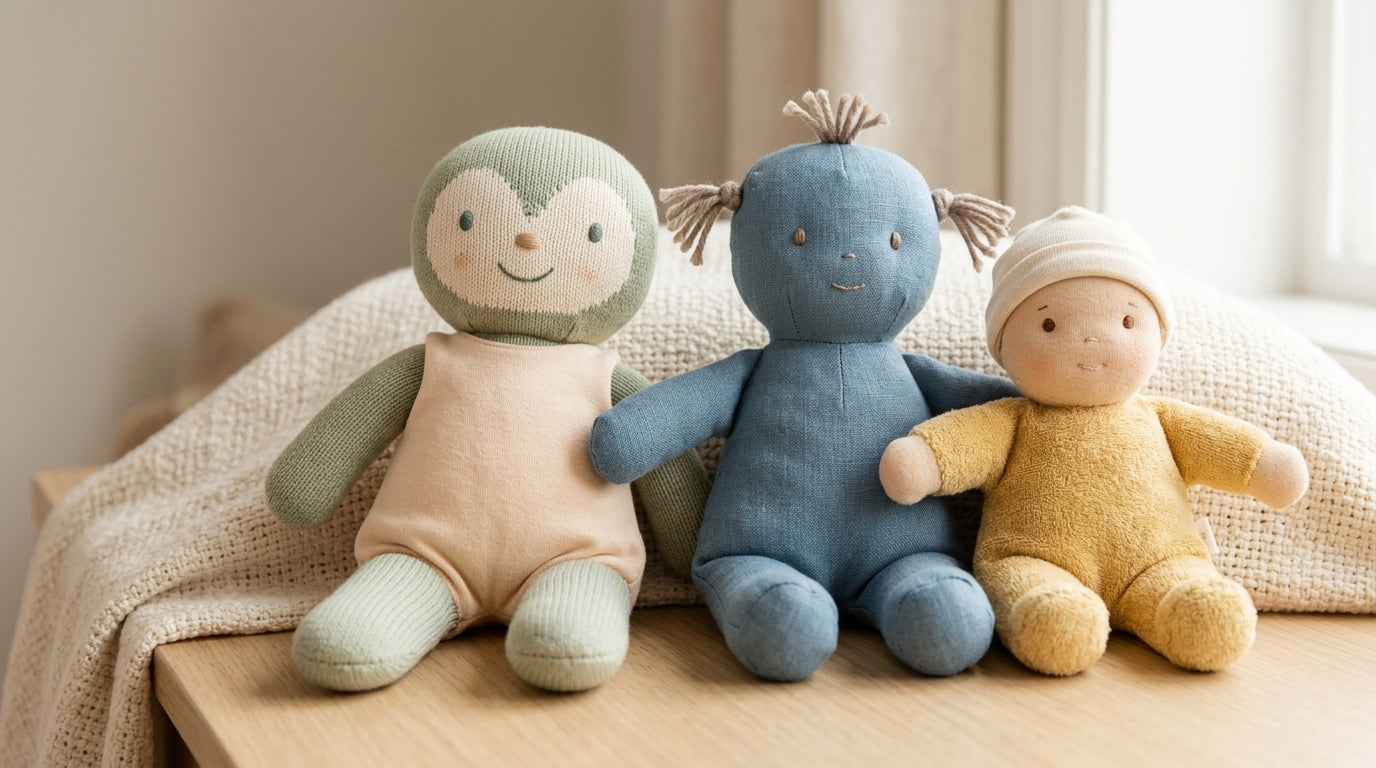
My mother-in-law handed me a beautifully wrapped box last Diwali. Inside was a rigid plastic nightmare with eyelashes you could cut steak with, wearing a tiny, removable pearl necklace. She smiled warmly, called it beta's new best friend, and told me it was the perfect baby's first doll. I smiled back while my brain immediately started triaging the choking hazards. As a former pediatric nurse, I look at toys a little differently than normal people do. Where an eager grandparent sees a precious nursery companion, I just see a foreign body airway extraction waiting to happen in room four.
The truth is that finding a safe toy for an infant is an exercise in extreme paranoia. You have to assume that every single part of whatever you hand them is going to end up covered in saliva and shoved down their throat. That's just the baseline physics of infancy. But at some point, they do actually need to interact with something other than your exhausted face, which means you've to figure out how to handle the doll aisle without having a slow-motion panic attack.
The absolute threat level of tiny accessories
Listen, if you aren't aggressively ripping at a doll's embroidered face to test for loose threads before throwing it into a hot wash cycle to see if it survives, you're just asking for an ER visit. The sheer volume of garbage that manufacturers attach to infant toys is staggering. I've seen dolls marketed to six-month-olds that come with removable magnetic pacifiers, as if a baby possesses the fine motor control to care about magnetic polarity rather than just swallowing the plastic nub.
Then there are the clothes. Some designer somewhere decided that soft toys need miniature wardrobes consisting of tiny socks, removable beanies, and decorative buttons. A baby doesn't care about fashion. They care about what fits in their mouth and what they can pull apart with their newly acquired pincer grasp. When a baby grabs a tiny doll shoe, their immediate instinct is to test its durability with their gums. If that shoe detaches, you suddenly have a very quiet, very blue child.
And we've to talk about the stuffing. Traditional teddy bears and vintage dolls are notorious for being filled with weird little microbeads or cheap synthetic fluff. The second a seam rips on one of those limbs, that stuffing becomes an inhalation risk. A baby's first doll needs to be a single, solid piece of firmly stitched fabric with absolutely zero detachable elements, sewn together with the kind of industrial strength usually reserved for military gear.
The crib rule
Keep it out of the crib until they're one, because I'm not dealing with SIDS risks just so your kid's nursery looks cute on social media.
Why their brains actually need these things
Despite my deep suspicion of the toy industry, there's a legitimate medical reason we introduce these things. My doctor tried to explain the neuroimaging to me at our twelve-month visit. Apparently there's a 2020 study showing that playing with dolls activates the posterior superior temporal sulcus. I definitely memorized that brain region for an anatomy final once, but all I retained is that it helps kids process social cues and empathy.

According to the child development experts, babies are naturally drawn to things with massive eyes and puffy cheeks because of human evolutionary biology. It triggers a primal nurturing instinct. They look at the weirdly proportioned face of a cloth doll and their brain tells them they need to take care of it. Filtered through my imperfect understanding of psychology, I guess giving them a doll just makes them slightly less likely to become a sociopath later in life. They use it to process the overwhelming sensory input of their world, mimicking the way we bounce and soothe them when they're losing their minds at three in the morning.
The chewing phase and fabric standards
Before they get to the sophisticated emotional nurturing phase, they're just going to bite it. Between three and six months, a doll is nothing more than a heavily abused chew toy. They grab it by whatever pointy hat or limb is available and drag it straight to their inflamed gums. This is usually when I intercept the situation. I've seen too many drool-soaked cloth dolls develop weird smells, so I usually just hand over the Panda Teether instead. It's genuinely my favorite defense mechanism in this house. The food-grade silicone takes the abuse, you can throw it in the dishwasher to sanitize the horror off it, and it stops my toddler from trying to chew the embroidered eyes off her plush toys. It's just a highly functional piece of silicone that saves me from washing a doll three times a week.
But when they do inevitably cuddle the doll, the fabric matters immensely. You spend half your life figuring out what goes against your kid's skin. We strictly use the Organic Cotton Baby Bodysuit for my daughter because synthetic fabrics give her a miserable, fiery red eczema patch on her shoulders. It stretches, it survives my aggressive laundry habits without falling apart, and it doesn't have scratchy tags. Your baby's doll needs to meet a similar standard. If you wouldn't wrap your kid in toxic polyester clothing, you shouldn't give them a cheap polyester doll to rub against their face while they sleep.
Explore our collection of safe, organic baby essentials that won't give you a panic attack.
The mandatory squish factor
The French call it a doudou. It's that specific snuggly squish factor that turns an object from a simple toy into an emotional support crutch. A first doll should basically feel like a security blanket that happens to have a face. We use the Squirrel Print Organic Cotton Blanket as our baseline for how soft things should be in this house. It has this buttery, double-layered breathability that keeps stable temperature. If a doll isn't as breathable and tightly woven as that blanket, it doesn't make the cut. You want something lightweight, preferably under twelve inches, that they can easily manipulate with weak, uncoordinated arms. Anything heavier just becomes a blunt force weapon when they inevitably drop it on their own forehead.
The architectural alternative
Sometimes people want to skip the soft toys entirely and just use architectural wooden structures. We have the Nature Play Gym Set with the botanical elements. It's fine. It looks gorgeous in the corner of the living room, and it kept her briefly distracted when she was four months old and I needed to drink a tepid cup of coffee. The natural wood is great for early reaching practice, and the non-toxic finish means I didn't care when she mouthed the wooden rings. But you can't shove a wooden A-frame into your diaper bag when you're at a loud restaurant and your kid is teetering on the edge of a sensory meltdown. A soft doll is portable, squishable triage.

Teaching a toddler not to crush the new baby
If you're having a second kid, a doll transitions from a chew toy to a critical piece of survival equipment. Toddlers are essentially tiny, unpredictable linebackers. They have no spatial awareness and a lot of chaotic energy. You have to use the doll to teach them the concept of gentle hands before you bring a fragile newborn into the house.
We spent weeks doing parallel play. When I pretended to change the doll's diaper, she would pat its head. When I rocked it, I forced my voice into this quiet, unnatural whisper to model how we behave around sleeping things. It's just behavioral conditioning. If they can learn not to launch the cloth doll across the room by its leg, there's a fighting chance they won't try to sit on their new sibling's head when you turn your back for five seconds to grab a wipe.
honestly, you're just looking for a small, aggressively stitched, chemical-free piece of fabric that can survive being dragged through mud, soaked in drool, and run through the heavy-duty wash cycle a hundred times. Keep your expectations low and your safety standards unreasonably high.
Browse our collection of safe, developmental toys that actually make sense for babies.
Things you're probably wondering
How do I know if a doll is really safe for a newborn?
If you can pull on any part of it and it moves, detaches, or feels loose, it belongs in the garbage. I run my thumb hard over the eyes to make sure they're flat embroidery, not plastic beads. I check the seams by pulling the fabric in opposite directions to see if the thread holds. If it has a removable hat, a bow, or tiny shoes, it's not a baby toy, no matter what the age grade on the cardboard box claims.
When do they seriously start playing with it instead of eating it?
Usually around twelve to fourteen months. That's when you'll see them randomly pat the doll's back or try to shove a bottle into its embroidered mouth. Before that, it's just a textured object they use to soothe their gums. Don't stress if your nine-month-old shows zero nurturing instincts and just drags it around by the neck while screaming. They're processing.
How often am I supposed to wash this thing?
More often than you think. Arrey yaar, the amount of bacteria that accumulates on a wet cloth toy is horrifying. I throw ours in the wash at least once a week, or immediately after it hits the floor of a doctor's waiting room or a grocery store. This is exactly why it has to be organic cotton and machine washable. If a toy says spot clean only, I don't buy it. I don't have time to gently dab at a mystery stain with a damp cloth.
Can I let them sleep with it if they're supervised?
No. I don't care how closely you think you're watching the baby monitor. Blankets, stuffed animals, and dolls don't go in the bassinet or crib until the kid is at least twelve months old. If they fall asleep on the floor during playtime with the doll next to them, just move the doll away from their face. It's a very simple boundary that prevents catastrophic outcomes.
Does it matter what the doll looks like?
Sort of. The child psychology people say it's good for them to have dolls that look like them, and dolls that look completely different from them, to build early empathy and representation. But practically speaking, just make sure the face is simple. Babies respond to high contrast and clear facial features. They don't need hyper-realistic details, they just need two eyes and a mouth to project their feelings onto.




Share:
The Honest Guide to Surviving Your Baby's Dedication Service
When Your Brother Asks You to Help Pick a Memorial Marker