

It was 3:14 AM on a dismal, rain-soaked London Tuesday, and I was pinned to the sofa beneath two howling six-month-olds, frantically jabbing at my phone with my nose. I was trying to skip a shockingly loud Spotify advert for car insurance so I could get back to blasting a cello sonata into the darkness. I'd read somewhere (likely on one of those terrifying midnight forums populated by people who casually lie about their infants sleeping through the night) that forcing your offspring to absorb classical masterpieces while they wept was the secret to raising tiny geniuses. If I could just get the volume right, the internet promised, I'd somehow rewire their brains and fast-track them to Oxford.
Spoiler alert: screaming twins don't care about cellos. They don't care about the delicate connection of strings, they don't care about 18th-century Austrian composers, and they certainly don't care about my desperate attempts to grow their cognitive development at three in the morning.
I had completely bought into the whole baby mozart fantasy, convinced that if I didn't pump symphonies into their developing ear canals, I was failing them as a father. It turns out, I was just making us all miserable while ruining perfectly good music.
The genius lie we all fell for
Once the sun came up and the girls finally passed out in a pile of drool and muslin cloths, my former-journalist brain took over. I started digging into where this massive, guilt-inducing cultural phenomenon actually came from. Why did an entire generation of 90s nostalgia-loving parents think that a cassette tape of piano music was the pedagogical equivalent of a superfood?
Here's the deeply irritating truth. The entire concept stems from a single study published in 1993. I looked it up, expecting to find a massive trial involving thousands of infants in a controlled setting. What I found was a study involving exactly thirty-six university students. Thirty-six young adults (who were probably just there for course credit or a free sandwich) listened to ten minutes of a sonata and then temporarily showed a tiny improvement in their ability to mentally fold a piece of paper. That's it.
There were no babies. There were no IQ tests. There was just a handful of undergrads folding paper in a lab. But the media grabbed it, ran a mile, and spawned a billion-dollar industry of DVDs and CDs designed to make anxious parents part with their cash. By the time the scientific community officially declared the intelligence-boosting phenomenon completely nonexistent a decade later, the damage was done. We were all completely brainwashed into thinking passive listening was the key to raising the next Einstein.
My health visitor's deeply unglamorous advice
During their nine-month check, I tentatively confessed my failure to our NHS health visitor. I explained that Baby M has a particular hatred for classical piano, usually expressing her displeasure by screeching at a pitch that makes the dog leave the room. I asked, quite sincerely, if I was ruining their cognitive potential because I'd given up on Bach and accidentally left a 2000s indie rock playlist running instead.
She just stared at me over her glasses for a painfully long time. From what I could decipher through her deeply unimpressed sigh, passive listening doesn't do much of anything for a baby's brain. You can't just download intelligence into an infant like a software update while they lie there like a lump. She explained that if I actually wanted to help their neural pathways (a phrase I'm fairly certain I'm misusing), I needed to stop acting like a DJ and start interacting with them.
Singing a terribly off-key version of Old MacDonald while pulling faces and letting them bang a wooden spoon against a saucepan does infinitely more for their auditory processing than piping in a professional orchestra while staring at my phone.
What actually happens when you give a toddler a block
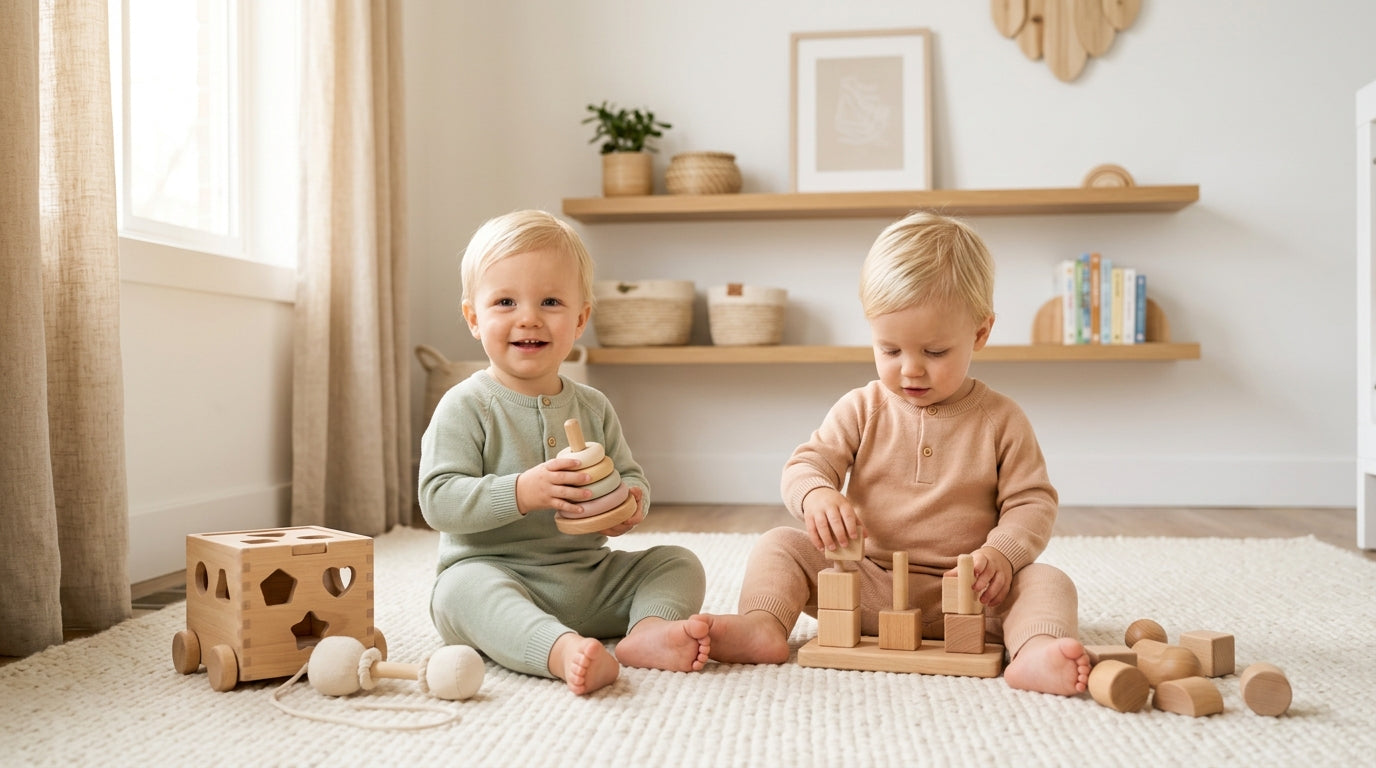
Once I let go of the idea that I needed to curate a highbrow auditory environment, I pivoted to giving them actual objects to interact with. I bought the Gentle Baby Building Block Set, harbouring a naive hope that we might sit peacefully on the rug and engage in quiet, spatial-reasoning activities.

They're just okay, if I'm being brutally honest. The macaron colours are undeniably lovely, and it's brilliant that they're free from all those horrific chemicals you constantly read about, but if you expect your children to build a structural masterpiece, you need to lower your expectations drastically. Baby M immediately claimed the number four block as her personal weapon of choice, while Baby E mostly just tries to chew the corners off the animal symbols. They're satisfyingly squishy, though, which means when one inevitably gets lobbed at my head while I'm drinking my tea, I don't end up with a concussion.
They definitely help with grasping and throwing, which I suppose counts as motor development, even if it feels more like dodgeball.
The wooden holy grail of my living room
What really saved my sanity, and completely replaced my frantic attempts at musical tutoring, was leaning into proper, independent sensory play. If there's one thing in our house that I'd rescue in a fire (after the children and my coffee machine), it's the Wooden Baby Gym | Rainbow Play Gym Set with Animal Toys.
When I finally stopped trying to force-feed them culture, I started sliding them under this wooden A-frame, and the change was miraculous. It doesn't play a garish electronic tune. It doesn't flash blinding lights. It just sits there, looking vaguely Scandinavian and deeply unbothered, while my girls absolutely go to town on the hanging fabric elephant.
Baby M figured out how to make the wooden rings clack together, and the look of sheer, unadulterated power on her face when she realised she was the one controlling the noise was incredible. That's actual, tangible brain development. It's cause and effect happening right in front of you. Plus, the colours are earthy and calm, so it doesn't look like a plastic explosion went off in my lounge, which does wonders for my own fragile mental state.
If you're currently staring at a mountain of chaotic plastic toys that sing the alphabet off-key and wondering where it all went wrong, you might want to browse Kianao's wooden play gym collection before you lose your mind entirely.
The teething noise exception
Of course, all this talk of gentle, self-directed play goes completely out the window the second a new tooth decides to cut through a gum. When that happens, the screaming returns, and no amount of wooden clacking or indie rock will save you.

I learned very quickly that when the teething fever hits, you don't need Mozart, and you don't need developmental milestones. You just need something they can gnaw on with the ferocity of a starving badger. We practically have a shrine built to the Panda Teether Silicone Baby Bamboo Chew Toy. It's flat enough for Baby E's remarkably clumsy little hands to grip properly, and the textured bits seem to hit exactly the right spot on her swollen gums. I throw it in the fridge for twenty minutes while the crying escalates, hand it over cold, and enjoy the blissful, stunned silence that follows.
It's easy to wash, doesn't collect weird carpet fluff like the fabric toys do, and most importantly, it buys me enough quiet time to seriously finish a thought.
Letting go of the playlist panic
The truth is, parenting twins (or just parenting in general) is loud, chaotic, and mostly involves making it up as you go along. The pressure we put on ourselves to optimise every waking second of a baby's life is utterly exhausting.
My girls aren't going to fail their A-levels because I didn't play them enough classical sonatas when they were six months old. They're going to learn about rhythm by violently banging a wooden spoon on my skirting boards, and they're going to learn about pitch by shrieking at each other over who gets to hold the green block.
Instead of agonising over curating the perfect developmental soundscape and worrying about your child's auditory input, just let them make their own noise while you sit on the floor and try to survive until bedtime. It's much cheaper, slightly less stressful, and it doesn't ruin Vivaldi for you forever.
If you're ready to ditch the plastic noise machines and let your baby orchestrate their own chaos, grab the Rainbow Wooden Play Gym and reclaim a tiny bit of peace in your living room.
Questions I frantically googled at 2 AM
Do I honestly need to play classical music to my newborn?
Absolutely not. Unless you personally find it soothing while you're trying to wipe sick off your shoulder, you can skip it entirely. Your baby isn't judging your Spotify wrapped. They're just trying to figure out how their own hands work.
What's the best music for a baby's brain development?
According to my deeply unscientific observations and the weary sigh of our GP, whatever music you'll seriously sing along to is best. Your voice, even if it's terribly out of tune, does more for their language development than any recording ever will. I currently sing Arctic Monkeys to mine, and they seem fine.
How do I start active musical play if I don't own any instruments?
You already own instruments; you just call it kitchenware. A wooden spoon and a plastic Tupperware tub is the greatest drum kit a ten-month-old could ever ask for. Just be prepared to hide it when your head starts throbbing.
Will electronic musical toys ruin my baby's hearing?
I don't know about their hearing, but those plastic monstrosities that play a compressed, tinny version of 'Wheels on the Bus' on an infinite loop will absolutely ruin your soul. Stick to wooden rattles and things they've to physically shake to make a sound.
Is it normal that my baby only wants to chew on their musical toys?
It would be weird if they didn't. Until they hit about a year old, a baby's mouth is basically their primary tool for scientific research. If they're gnawing on a wooden block instead of building with it, they're just aggressively studying its texture.




Share:
The Real Reason I Cried About My Baby's Name at the Hospital
The 3AM Kitchen Panic: Surviving the Baby Motrin Maths Test