

The wind coming off Lake Michigan was aggressive enough to make my eyes water, but I couldn't blink. My two-year-old was fifteen feet up a rope climbing pyramid at Maggie Daley Park. His left foot was wedged between two cables. His right hand was slipping. My pediatric ER nursing brain was already calculating the trajectory of his skull against the recycled rubber matting below. I was mentally prepping an IV line and sizing a cervical collar.
Every instinct in my body was screaming to sprint over, scale the ropes, and pull him down. The three moms on the adjacent bench had stopped pretending to drink their lattes and were just openly staring at me, waiting for me to do my job as a mother and rescue him.
Listen, standing still while your kid struggles is the hardest physical task on the planet. You just have to choke down the bile in your throat and dig your fingernails into your own palms while they whine about being stuck.
My pediatrician told me to act like a bear
I didn't start out like this. When he was born, I monitored his breathing with the intensity of an ICU nurse on a triple shift. If he coughed, I ran a differential diagnosis. Dr. Amin, my pediatrician who has known me since my own clinical days, finally pulled me aside at his eighteen-month checkup. I was asking her about foam corner guards for our coffee table.
She told me I was treating him like a fragile vase when he was actually built to bounce. She asked if I'd ever watched how an actual giant bear raises its cubs. You see those nature documentaries where the mother holds the newborn constantly, barely eating or sleeping to keep this tiny pink thing alive. Total devotion. But fast forward a year, and that same mother is just sitting there chewing bamboo while her cub literally plummets out of a twenty-foot pine tree and lands on his head. She barely looks up. She knows he has to figure out gravity on his own.
Dr. Amin called it panda parenting. High warmth in the beginning, extreme backing off later. It sounded like a fast track to a CPS visit, but she was right. My anxiety wasn't keeping him safe, it was just keeping him incompetent.
The science behind ignoring your child
There's a whole cottage industry built around this now. Esther Wojcicki wrote a book about it. Psychologists rebrand it every few years as autonomy-supportive parenting or whatever the current journal term is. The from what I've read that kids who are allowed to fail in low-stakes environments develop better emotional regulation and problem-solving skills.

I don't know about all the specific neural pathway stuff they claim it builds. From what I've seen in the hospital, kids who aren't allowed to take physical risks end up completely lacking in proprioception. They don't know where their bodies end and the world begins. They fall harder because they never learned how to fall softly.
There's an acronym for this method called TRICK, which stands for trust, respect, independence, collaboration, and kindness. I think acronyms are just a way for publishing houses to sell paperbacks, but the basic idea is solid. You set a hard boundary, and then you completely check out of whatever happens inside that boundary.
The cult of the hoverboard mothers
I need to talk about the park moms for a second. The ones with the organic quinoa puffs in the perfectly sanitized silicone bags. They follow their kids around the playground structures like secret service agents. Every time their kid steps on a slightly uneven woodchip, they gasp and hover their hands two inches from the kid's shoulders. They narrate the entire play experience with constant warnings to be careful, go slow, and hold on.
I've seen a thousand of these kids in the ER. They're the ones who break their arms falling off the bottom step because their mother was looking at her phone for three seconds and they hadn't been taught how to catch their own weight. The mothers are always devastated, always saying they looked away for just a minute. That's the problem, yaar. You can't be their external nervous system forever. Eventually, you've to go to the bathroom.
It makes me insane to watch women exhaust themselves trying to control physics. We're so terrified of being judged by other women for letting our kids get a scraped knee that we stunt their physical development just to look like attentive mothers in public. It's a terrible trade.
Then there are the parents who just sit in the car scrolling TikTok while their kid throws sand at other people. That's not what I'm talking about either. Neglect isn't a strategy.
Equipping them to survive the fall
If you're going to let them fail, you at least have to dress them for it. When we decided to stop hovering, we started paying a lot more attention to what he was wearing and playing with. You can't let a toddler climb a tree in stiff denim and a puffy coat.

We started putting him in the Sleeveless Organic Cotton Baby Bodysuit from Kianao. I like it because it actually breathes. When he's stress-sweating because he climbed too high on the jungle gym, the organic cotton doesn't trap the heat like the cheap synthetic stuff we used to buy. It has enough stretch that he can reach for the next rung without the fabric pulling him backward. It just quietly does its job.
When he was an infant, long before the playground stress, we used the Panda Play Gym Set. My husband started calling him Baby P around this time because he would just roll around under this wooden structure looking completely confused by his own limbs. I appreciated this gym because it was wood and grey. It didn't light up. It didn't play aggressive electronic music. It just sat there and let him figure out how to swat at the little crocheted bear. It was our first lesson in letting him entertain himself without us interfering.
We also had the Panda Teether Silicone Chew Toy. It's fine. It's a flat piece of silicone shaped like a bear. He chewed on it when his molars were coming in. It survived a hundred runs through our dishwasher without melting, which is really all I ask of any object that enters my house. It didn't change our lives, but it kept him from chewing on the television remote.
Explore our soft baby essentials collection if you need gear that actually holds up to a kid who plays hard.
Back to the rope pyramid
So there we were at Maggie Daley. The wind blowing. The moms judging. My kid stuck fifteen feet up.
He started to cry. Just a little at first, then the specific panicked wail that tells me he's seriously frightened, not just frustrated. I walked to the base of the ropes. I didn't climb up. I just stood there, put my hands in my pockets so I wouldn't reach for him, and looked up.
I asked him where his left foot was. He looked down through his tears. I told him to look at the blue rope next to his knee. I asked him what would happen if he moved his hand to that rope. It took him four minutes of heavy breathing and snot-dripping crying, but he shifted his weight. He untangled his foot. He climbed down.
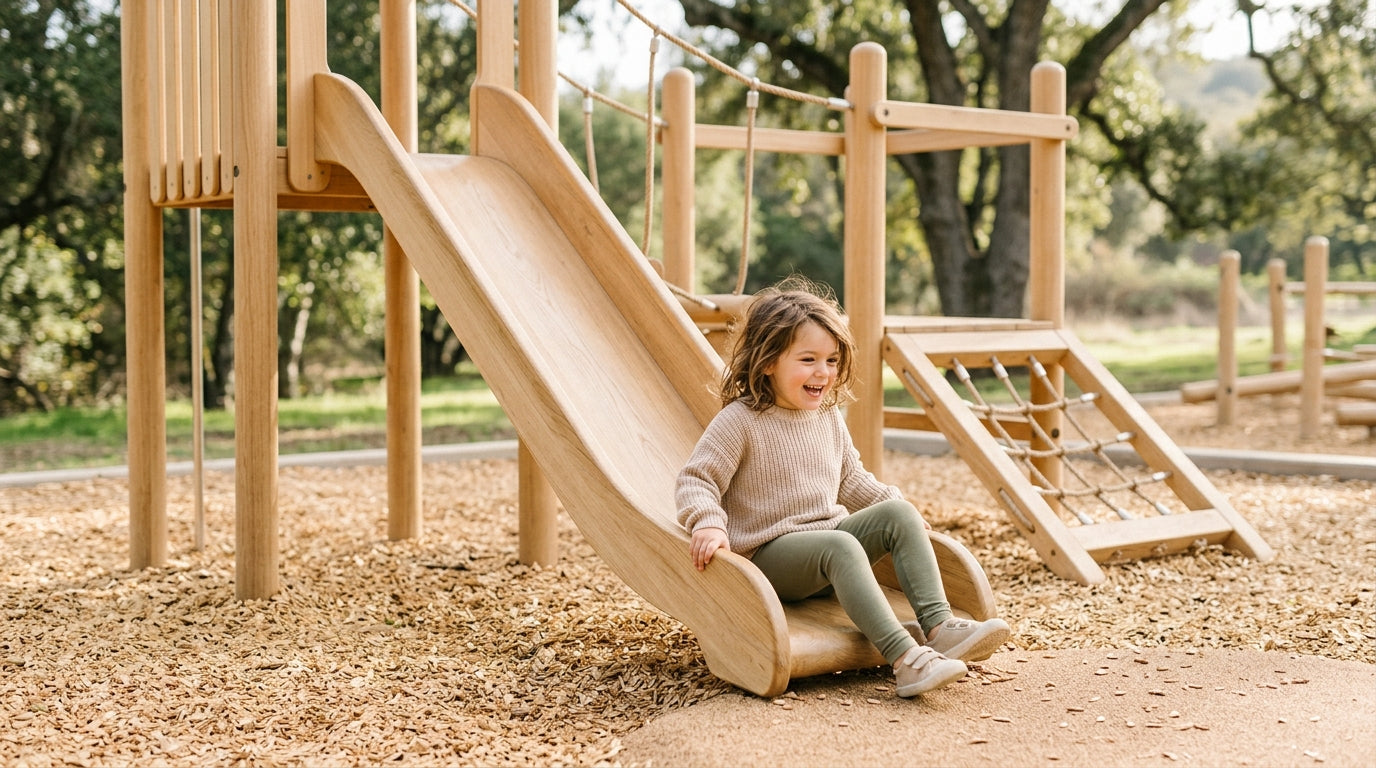
When he hit the rubber matting, he didn't run to me for a hug. He just wiped his nose on his sleeve and ran over to the slide. He was fine. I was the one who needed a beta-blocker.
Everybody loves watching a cute baby panda video on the internet, but nobody wants to do the actual work of raising one. It requires you to sit with your own extreme discomfort so your kid can build their own competence. It's the opposite of lazy parenting. It's the most active, exhausting mental work I've ever done.
Check out our complete line of sustainable clothing before you head out to the park to practice doing absolutely nothing.
Questions I usually get from other parents
How do you stop your own panic when they're climbing too high?
I don't. The panic is always there. I just hide it. If I gasp or show fear, he absorbs that fear and freezes, which makes him more likely to honestly fall. I usually bite the inside of my cheek or dig my fingernails into my hand. You just fake a calm voice and give them verbal cues instead of physical rescue. It feels terrible every single time.
What if they genuinely get hurt while you're stepping back?
They will. That's the whole point. He has come home with bruised shins, scraped elbows, and a bloody lip. From a medical standpoint, a scraped knee is a very cheap price to pay for learning physics. As long as the environment doesn't have fatal hazards like deep water or moving cars, a physical injury teaches them a boundary faster than my voice ever could.
Is this just an excuse to ignore your kids?
People love to say this. If you're doing it right, you're watching them like a hawk. You're constantly assessing the risk vs reward ratio in your head. Ignoring your kid is sitting on a bench looking at Instagram while they wander off. Panda parenting is standing at the bottom of the slide, hyper-vigilant, actively suppressing your urge to intervene.
Does this work for kids who are already super anxious?
Not always. If your kid has clinical anxiety or sensory processing issues, you can't just throw them to the wolves. They need more scaffolding. My friend's autistic son needs very specific, step-by-step physical guidance before he feels safe on a new structure. You have to read the kid in front of you. The goal is stretching their comfort zone, not breaking their spirit.
At what age do you start backing off?
The day they start crawling. Seriously. When they're trying to reach a toy across the rug, don't just hand it to them. Let them grunt and struggle and get mad about it. The stakes are literally zero on a carpeted floor. If you start the habit of not rescuing them from minor frustration at six months, it's a lot easier to not rescue them from a playground structure at three years.




Share:
The Myth That Ruined My Newborn Days (And The Baby Orangutan Fix)
Dear Past Me: Please Put Down That Baby Percentile Calculator