

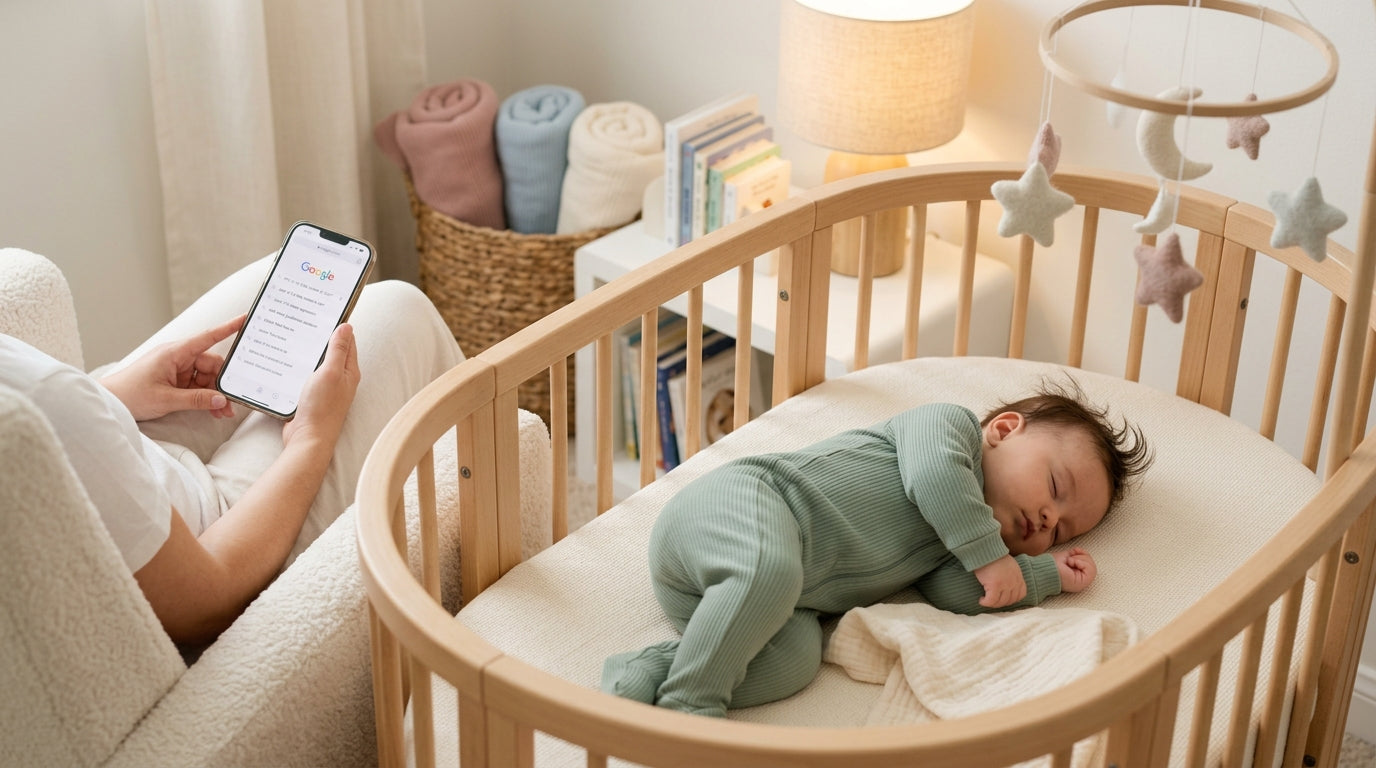
It was 3:14 AM on a Tuesday, and the nursery was exactly 69.4 degrees. I know this because I've a Bluetooth-enabled hygrometer strapped to the wall, which I refresh obsessively like I'm monitoring server uptime. My son, currently eleven months old but flashing back to a particularly brutal regression at eight months, was executing a continuous, high-decibel crying loop. My wife was completely tapped out, having taken the first two shifts, so it was just me, the glow of my smartphone, and a desperate need to troubleshoot this tiny human.
With my thumb hovering over the Safari browser, I started typing a frantic search. I got as far as the letters baby mel before Google’s autocomplete served up two entirely different, yet equally terrifying, rabbit holes. The first was a barrage of searches for infant sleep aids, specifically targeting the idea of a chemical system patch for my sleepless child. The second pulled up a pediatric feeding expert named Coach Mel, plunging me right back into my daytime anxiety about choking hazards. Sitting there in the dark, bouncing on a yoga ball until my lumbar spine threatened to unionize, I realized that modern parenthood is mostly just toggling between different genres of panic.
The great sleep aid delusion
Let's talk about the sleep deprivation data for a second. I log everything under a profile called Baby M in our tracking app—every ounce of milk, every diaper change, every agonizingly short nap. When you look at the raw data of an infant's sleep architecture, it looks less like a biological rhythm and more like a randomized error log. It makes you desperate. It makes you think, surely there's a firmware update for this. That’s exactly how I ended up searching for baby melatonin at 3 AM, convinced that if I could just use a mild, over-the-counter reboot, we might all survive the week.
Our doctor, Dr. Lin, looked at me with a mixture of deep pity and clinical alarm when I brought this up at his next wellness check. Apparently, melatonin isn't just some sleepy-time tea extract you can drop into a bottle; from my rudimentary understanding of her lecture, it’s an actual hormone that tells the brain the sun has gone down. Dr. Lin made it very clear that the AAP strongly advises against giving it to infants because their tiny circadian rhythms are basically uncompiled code, and introducing external hormones could seriously mess up their internal clocks unless a pediatric neurologist specifically prescribes it. My wife silently nodded along while kicking my ankle under the examination table, effectively closing the ticket on that particular "solution."
Instead of chemical shortcuts, we had to rely on hardware. Babies are basically little thermal reactors, and my son runs so hot he practically generates his own weather system. We realized half his wakeups were because he was sweating through his basic cotton swaddles and then freezing when the ambient air hit him. I eventually caved and bought the Colorful Universe Bamboo Baby Blanket, mostly because I liked the little planets on it, but it turned out to be a massive operational upgrade. The bamboo fabric apparently has these microscopic gaps that vent heat, meaning he stopped waking up covered in a thin layer of stress sweat. It’s hilariously soft, and wrapping him in tiny yellow and orange planets actually seems to down-control his nervous system enough to get us a solid four-hour block of sleep.
A complete breakdown over a grape
If the night shift is about sleep anxiety, the day shift is strictly feeding anxiety. That second search result—Coach Mel, also known as Melanie Potock—sent me into a tailspin about introducing solids. We were attempting baby-led weaning, which sounds incredibly progressive and natural until you actually watch a small, toothless creature attempt to process solid matter.

I'm now fundamentally terrified of grapes. If you look at the structural dimensions of a grape, it's essentially a biological cork engineered specifically to lodge perfectly within the exact diameter of an infant's trachea. You can't just slice them in half like some casual Sunday brunch prep because the dome shape still poses a critical airway threat, so you've to meticulously quarter them lengthwise like you're performing high-stakes micro-surgery while your baby screams at you for a snack. I spent an entire Saturday morning watching pediatric speech-language pathology videos on exactly how slippery textures bypass the gag reflex, and now I evaluate every single piece of produce based on its aerodynamic potential to cause a disaster.
I once brought home a sugar baby melon from the farmer's market, thinking it would be a cute, baby-sized fruit to introduce to him, only to realize that the moment it gets wet, melon turns into a frictionless projectile that his uncoordinated little hands couldn't grip safely. I ended up mashing it into a pulp while heavily sweating. Purees are basically just food compilers for cowards anyway.
The myth of the instant connection
All this tracking and panicking and Googling creates a weird psychological load. There's this pervasive cultural narrative that the moment your baby is born, you get hit with a tidal wave of explosive, cinematic love that instantly makes all the suffering worth it. But when you're operating on a sleep deficit that violates the Geneva Conventions, the reality is a lot darker.
My wife had an unplanned C-section after a harrowing labor, and the recovery was brutal. I remember driving to the pharmacy a few weeks postpartum, and she was just staring out the window with tears streaming down her face while blasting some cry baby melanie martinez track on the car stereo, completely overwhelmed by the sheer, relentless volume of motherhood. It turns out that instant, magical bonding is a total myth for a lot of parents who go through traumatic births or severe exhaustion, and the connection is actually something you build iteratively, line by line, over months of surviving the trenches together.
I read somewhere—I think it was a Mustela pediatric guide I found during one of my doom-scrolls—that babies cry an average of three to four hours a day, which is a frankly staggering metric. The guide said that if the baby is fed, has a dry diaper, and isn't running a fever, you're completely allowed to put them safely in their crib, walk into the hallway, shut the door, and just stare blankly at the wall for ten minutes to control your own spiking cortisol levels. Learning that stepping away wasn't a failure, but honestly a necessary safety protocol for parental mental health, was probably the most valuable piece of advice I've aggregated so far.
Hardware solutions for software problems
Because I can't fix the underlying biology of teething or sleep regressions, I try to throw accessories at the problem. Sometimes this works, and sometimes it’s just a waste of bandwidth.

Take teething, for example. When the drool factory opened at four months, I thought a dedicated chew-toy would solve the endless fussing. We got the Bear Teething Rattle. Don't get me wrong, it's beautifully made—the beechwood ring is untreated, and the little crochet bear is objectively adorable. But my son spent about four minutes chewing on the organic cotton ears before deciding that the most satisfying texture in the house was honestly the rubber casing of my MacBook charging cable. The bear is now mostly a decorative item that I wave frantically in his face during diaper changes to distract him from rolling off the table.
On the flip side, my wife is obsessed with dressing him in aesthetic outfits, which brings me to the Flutter Sleeve Organic Cotton Baby Bodysuit. She bought this for a family photo session. The organic cotton is admittedly incredibly soft and supposedly creates some kind of breathable microclimate that prevents heat rash, which is great. But from a purely operational standpoint, trying to align reinforced snap closures on a squirming, violently angry eleven-month-old requires a level of spatial reasoning I simply don't possess at 6 AM. She thinks the flutter sleeves are charming; I think they're just extra fabric getting in the way of my already compromised diapering efficiency.
If you're also trying to buy your way out of parenting bottlenecks, you can check out some really useful gear. Explore our baby blankets collection to find something that might finally stop the 3 AM cold-sweats.
The bedtime protocol
Since we couldn't drug him with melatonin and the sleep regression was threatening our marriage, we had to rely on a hardcoded routine. Every sleep expert on the internet preaches the exact same sequence—bath, book, sleep sack, bed—but they always slip in that infuriating little caveat: put them down drowsy but awake.
I'm convinced "drowsy but awake" is a myth propagated by people whose children came pre-installed with better sleep drivers. If I put my son down awake, he immediately flips onto his stomach and starts doing push-ups while yelling at the baby monitor. But apparently, if you feed them right before they close their eyes, they develop a "sleep-prop dependency," meaning they literally forget how to transition between sleep cycles without a bottle in their mouth. So now our protocol requires feeding him at the very beginning of the routine, then dragging out the bath and reading exactly three board books about farm animals before zipping him into his sleep sack, hoping to bore him into a state of compliant unconsciousness.
It's messy, the data is constantly skewed, and I'm still bewildered by 90% of his behavior. But we're iterating. Slowly.
Ready to upgrade your infant's sleep environment before the next regression hits? Add the Polar Bear Organic Cotton Blanket to your cart and see if organic breathability is the system patch you've been looking for.
FAQ: Troubleshooting the midnight panic
Is it really that bad to give a baby a tiny bit of melatonin?
According to my very exasperated doctor, yes, it genuinely is. Melatonin is a hormone, not a gentle herbal tea, and giving it to an infant can seriously scramble their developing circadian rhythms. Unless a pediatric neurologist is explicitly telling you to do it, you've to suffer through the sleeplessness and rely on strict bedtime routines and blackout curtains instead.
How do I stop my baby from overheating in their sleep sack?
Stop using synthetic fleece. Babies are basically little space heaters that don't know how to control their own core temperature yet. Switching to breathable natural fibers, like a bamboo or organic cotton blanket layered appropriately for the room temperature, made a massive difference for us. I check the room thermometer obsessively, but the fabric upgrade was the real fix.
Why is everyone so obsessed with how I cut my baby's grapes?
Because an uncut or merely halved grape is the exact dimensional equivalent of a child's airway, and choking is silent and terrifying. You have to quarter them lengthwise so they form thin, non-blocking slivers. I know it takes ten times as long to prep a snack, but watching feeding experts demonstrate the physics of a blocked airway will permanently cure you of your laziness.
I didn't feel an instant bond with my baby, is my firmware broken?
No, your hardware and software just went through a massive, traumatic event. Between the physical recovery, the sleep deprivation, and the sheer shock of keeping a new human alive, it's incredibly common to feel overwhelmed or disconnected at first. The bond often builds slowly over months of shared suffering and tiny milestones, so stop comparing yourself to cinematic Instagram reels.
What do I do when they just won't stop crying and I'm losing my mind?
If you've run the full diagnostic check—fed, changed, burped, no fever, not physically hurt—and you feel your own panic spiking to dangerous levels, you put them safely in their crib and leave the room. Stepping away for five or ten minutes to breathe and let your nervous system reset is honestly recommended by pediatricians, because an angry, panicked parent can't effectively soothe a screaming baby.




Share:
The completely unglamorous truth about baby milk
What Being a Baby Mama Actually Means Off the Internet