

Dear Marcus from six months ago,
I'm writing this to you while you're currently sitting cross-legged on the nursery floor, staring at a stripped Allen wrench at 2:00 AM. You're probably sweating. You've got a level pressed against a mattress, trying to figure out if a 1-degree incline is going to cause a catastrophic system failure for your incoming son. You're exhausted, and the baby isn't even here yet.
Put the wrench down. I'm writing this from the future—specifically, month 11 of deployment—to save you hours of anxious googling about baby beds and sleep architecture. Approaching an infant's sleep environment is exactly like setting up a new server rack, except this server cries, leaks fluids, and occasionally tries to actively sabotage its own uptime.
Here's what you actually need to know about building a safe, sustainable baby bed setup without losing your mind.
The bedside deployment phase
For the first six months, your bedroom is going to look like a poorly organized medical triage tent. We started with the amke baby bedside bassinet sleeper acting as our initial edge node. It deployed right next to our mattress, giving us close proximity to the baby without actually sharing a sleep surface.
Apparently, this proximity is a massive deal. Our doctor, Dr. Aris, casually mentioned during our three-day checkup that room-sharing for the first six months drastically reduces the risk of sudden infant death. That little data point terrified me so much that I spent an hour measuring the exact distance from my pillow to the bassinet mesh to optimize airflow. I had a spreadsheet tracking his room's ambient temperature down to the decimal (68.4 degrees Fahrenheit, good performance parameters) and cross-referencing it with his sleep durations.
The bedside sleeper was major because in those early weeks, the baby's feeding cycle runs on a brutal two-hour loop. Having a localized baby bed right there meant Sarah didn't have to stumble down the dark hallway at 3 AM and risk stepping on the cat, which would wake up the dog, which would cause a total localized network outage.
Running a bare metal server
with baby beds, you've to run a completely bare metal environment. No bloatware. No plugins. No cozy little additions.
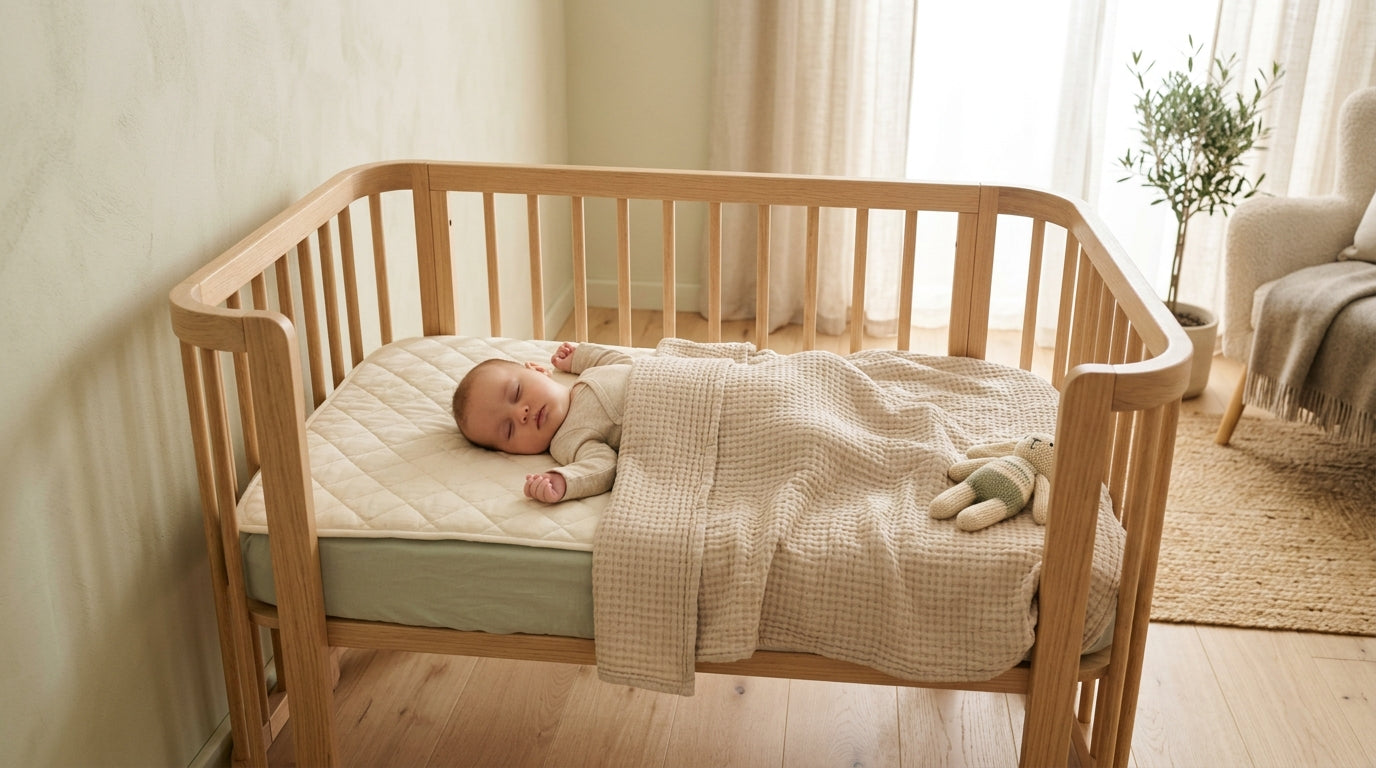
The doctor gave us the "ABCs" of safe sleep—Alone, Back, Crib. It sounds simple until the grandparents arrive. My mother brought over this massive, incredibly complex knitted blanket that weighed about five pounds. She tried to tuck it into the crib "so he wouldn't be chilly." I had to physically intercept her like a secret service agent. I must have sounded completely unhinged trying to explain that any loose object in a baby bed is basically malware that could block his airway, because apparently babies don't inherently know how to clear things off their faces.
This brings me to my biggest rant: crib bumpers. How are people still trying to buy these things? The federal government literally banned them in the US with the Safe Sleep for Babies Act in 2022, but you still see them in aesthetic Instagram nursery photos. It makes zero sense. People buy these fluffy, suffocation-hazard death traps because they're terrified their baby might bump a knee on a wooden slat. Newsflash: a bumped knee is a localized error. Restricted airflow is a fatal system crash. You want the mattress flat, firm, and completely empty except for a fitted sheet. If it looks like a depressing little baby prison, you've configured it correctly.
Drop-side cribs were banned back in 2011, so just don't buy a used one from a garage sale and you'll be fine.
Since we couldn't put blankets in the crib, we had to figure out how to handle daytime temperatures versus nighttime drops. For daytime operations, when I'm actively monitoring him, I actually found something that works perfectly. I highly suggest the Plain Bamboo Baby Blanket in terracotta. I didn't think I'd care about blanket materials, but this thing is legitimately my favorite piece of gear. When our HVAC system went offline for two days in October, this blanket naturally regulated his temperature while we hung out on the living room floor. It somehow gets softer every time we run it through the washing machine, which defies my understanding of material degradation. But remember: it stays strictly in the living room or the stroller. It never crosses the threshold into the night-time baby bed.
The great mattress off-gassing panic
You're going to spend three weeks researching crib frames, admiring the sustainable wood finishes, and then completely forget about the mattress until the last minute. Don't do that.

Sarah sent me down a massive internet rabbit hole about volatile organic compounds (VOCs) and mattress off-gassing. I ended up reading chemical engineering whitepapers at 4 AM. We finally settled on a mattress made of natural coconut coir and organic cotton, verified by GREENGUARD Gold certification. I still don't totally understand the chemical extraction processes, but apparently, standard foam mattresses can emit gases that you really don't want trapped in a baby's sleep environment.
The physical fit of the mattress is another strict parameter. I read about the "two-finger rule"—if you can fit more than two fingers between the mattress edge and the crib frame, the gap is too big and poses an entrapment hazard. I tested our setup with my fingers, Sarah's fingers, and a digital caliper just to be absolutely certain the tolerances were tight. Buy the mattress new, even if you inherit the crib frame from your brother. You want maximum structural integrity.
If you're already starting to realize how many organic layers you need to source for this kid, you might want to take a breather and browse some organic baby essentials before your partner starts texting you links to $400 wool sleep sacks.
Hardware transitions and daytime debugging
Around month five, the baby received a firmware update that allowed him to roll over. This immediately deprecated the bassinet. We had to migrate him to the primary data center: the standard crib.
This transition was rough. He was used to the small, enclosed space of his bedside setup, and suddenly he was in a massive wooden rectangle. We tried everything to make the room more soothing. We monitored the humidity. We adjusted the blackout curtains to eliminate literally any photon of light from entering the room.
During this transition phase, he also started teething, which completely wrecked our sleep analytics. We picked up the Baby Panda Teether hoping it would help. Honestly? It's just okay. It's made of food-grade silicone and it definitely helped his inflamed gums during the day, but from a hardware design perspective, it's too bouncy. He would chew on it, drop it, and it would immediately ricochet under the couch, requiring me to fetch it and sanitize it twelve times an hour. It's a decent daytime tool, but again, nothing goes in the crib with him at night.
For daytime walks to burn off his nervous energy, we started using the Bear in Forest Bamboo Baby Blanket. The grid texture is great, and he likes staring at the little bears. It's breathable enough that I don't panic when I drape it over his legs in the stroller, but it's just another reminder of how strictly we segment daytime accessories from nighttime bare-metal sleep rules.
Pre-flight checklist for the big migration
Looking back, I made building out the baby bed infrastructure way more stressful than it needed to be. I treated every sleep regression like a critical server failure instead of just a standard biological process.

If I could hand you a patch note for the next 11 months, it would be this: lock down the safety parameters, invest in breathable, non-toxic materials, and then stop hovering over the baby monitor waiting for anomalies. The hardware isn't going to fail if you set it up right the first time. You're going to transition from the bassinet to the crib, and eventually, you'll have to figure out how to convert that crib into a toddler bed when he learns how to scale the walls like a tiny ninja.
Before you get back to wrestling with that Allen wrench, make sure your deployment environment is fully stocked with the right gear. Check out Kianao's collection of sustainable baby blankets for your daytime ops, and trust the bare metal process for the night.
Troubleshooting the sleep infrastructure
Why can't I use a dock or sleep nest inside the baby bed?
Because they're basically a catastrophic failure waiting to happen. I thought those little padded nests looked incredibly cozy, but Dr. Aris explicitly warned us that if a baby turns their head into the soft padded side of a sleep nest, they can re-breathe their own carbon dioxide. The crib needs to be completely flat and firm. Save the cozy nests for supervised awake time on the living room floor while you're drinking your third coffee.
How long do we really have to room-share?
The official docs (pediatric guidelines) say ideally six months to a year. We made it to exactly five and a half months before we couldn't take it anymore. Every time the baby sighed, I woke up in a panic. Every time my knee popped when I rolled over, the baby woke up crying. We moved his crib to his own room just shy of the six-month mark and kept the baby monitor volume on high. It was a calculated risk that drastically improved our household's overall uptime.
What's the deal with breathable mattresses? Do they prevent SIDS?
This one drove me crazy. I kept seeing ads for $300 "breathable" mattresses claiming to eliminate sleep risks. From what I gathered cross-referencing medical sites, breathable materials are great for temperature regulation so your kid doesn't wake up in a pool of sweat, but they don't medically prevent SIDS. Only placing them on their back does that. Don't let marketing algorithms exploit your parental anxiety into buying features you don't need.
When do we lower the crib mattress?
You have to drop the mattress level the absolute second your baby figures out how to sit up or pull themselves up on the rails. For us, this happened overnight at around seven months. I walked in and he was standing there gripping the top rail like a tiny prison warden. I had to disassemble half the crib hardware right then and there to lower the base plate so he wouldn't pitch himself over the side.
Is buying a second-hand baby bed honestly dangerous?
It really depends on the version history. If it was manufactured after 2013, it likely meets the current safety compliance standards (no drop sides, correct slat spacing). But honestly, the structural integrity degrades if it's been assembled and disassembled a bunch of times by tired parents. If you do get a used frame, you absolutely must buy a brand new, firm mattress. You don't want your kid sleeping on a degraded foam block that's molded to another baby's shape.




Share:
Dear Past Me: Surviving a Baby Bed Bug Nursery Infestation
Why Your Outdoor Baby Bee Sting Panic Is Statistically Flawed