

It was 4:17 PM on a rainy Tuesday when I found Molly wedged firmly beneath the living room radiator, her lower half encased in a brightly coloured plastic UFO that was loudly playing a tinny electronic version of "Old MacDonald." She couldn't move forward, she refused to move backward, and she was expressing her displeasure at a volume that threatened to shatter our windows. Meanwhile, her twin sister Sophie had figured out that if she rammed her own identical plastic contraption into the skirting board hard enough, it made a satisfying banging noise that sent our cat fleeing for his life.
This was the exact moment I realised that the traditional baby walker—the kind where you dangle your child in a fabric seat surrounded by a massive plastic bumper on swivel wheels—was probably invented by someone who actively hates parents. I had brought these things into our cramped London flat thinking they would buy me ten minutes to drink a cup of tea, but instead, I had inadvertently militarised my infants.
The plastic doughnut of death
If you've never experienced a sit-in walker in a confined space, let me attempt to describe the specific brand of chaos they bring into your home. You think you've a cute, slightly immobile nine-month-old who just wants to look around. You place them into the crotch-harness of this wheeled saucer. For three minutes, they stare blankly at the plastic buttons on the tray. Then, their tiny toes make contact with the floorboards, and suddenly you've a Dalek on speed tearing through your hallway.
The speed a highly motivated infant can generate in one of these things is genuinely terrifying. Because they're supported by the seat, they don't have to worry about trivial things like balance or gravity. They just push off with their big toes and launch themselves blindly towards whatever looks most dangerous. In our house, this meant an endless series of collisions with doorframes, coffee tables, and my shins. It was like living in a bumper car arena where the drivers are drunk, crying, and covered in their own drool.
The worst part is the false sense of security they give you. You think your baby is contained, but actually, you've just elevated them an extra six inches off the ground and given them wheels, which means they can suddenly reach the edge of the dining table where you foolishly left your hot coffee. I spent more time chasing them down and extracting them from tight corners than I ever did when they were just crawling.
Stationary activity tables, by contrast, are just brightly coloured holding pens that make you feel guilty while you try to boil the kettle, but at least they don't cause property damage.
What Brenda the health visitor actually said
My suspicions that these plastic saucers were a terrible idea were confirmed during a routine check-in with our NHS health visitor, a lovely, no-nonsense woman named Brenda. She came round to weigh the girls, took one look at Molly doing burnouts in the hallway, and raised an eyebrow in a way that made me feel like I was back in primary school getting told off.

She offhandedly mentioned that the sit-in things are actually pretty heavily frowned upon by the medical crowd these days. Apparently, hanging them in a sling makes them push off exclusively with their tiptoes. Our GP vaguely suggested something similar later on, saying it can shorten some tendon in their ankle—the Achilles, maybe?—and makes their upper leg muscles lazy. I might have completely misunderstood the exact anatomy because Sophie was trying to eat a receipt from my wallet at the time, but the general gist was that sit-in walkers can really delay independent walking rather than encourage it.
Brenda highly recommended we just let them figure it out on the floor, barefoot if possible, so they could feel the ground and build up the muscles in their feet naturally. It sounded like brilliant, rustic, earthy advice right up until the temperature dropped in November and our Victorian floor tiles turned into ice rinks.
The late-night Google rabbit hole
Once I consigned the plastic sit-in walkers to the recycling bin, I needed an alternative. The girls were desperate to be upright, constantly pulling themselves up on the sofa, the TV stand, and the curtains (which didn't hold their weight, leading to a very dramatic Tuesday morning). I knew we needed to transition to a push walker baby phase—those sturdy carts they can stand behind and push.
I remember sitting on the sofa at 2 AM, trying to find a lightweight, breezy contraption for the warmer months that were approaching. I typed in some variation of "summer walker baby" hoping to find something with breathable mesh or whatever. Instead, I ended up utterly confused by a flood of articles and forums talking about a "summer walker baby daddy."
I spent an embarrassing twenty minutes reading through these threads, trying to figure out if "baby daddy" was some weird industry slang for a specific brand of parental steering handle. It turns out, after significantly more sleep-deprived reading than I care to admit, that Summer Walker is a very famous American R&B singer, and the internet was heavily invested in her personal life. It had absolutely nothing to do with keeping infants cool while they learn to handle the living room. Feeling entirely disconnected from modern pop culture, I closed the tab and just bought a heavy wooden cart instead.
If you're currently trying to childproof your house against highly mobile toddlers and finding yourself tumbling down similar internet black holes, you might want to browse the Kianao baby gear collection before you lose your mind entirely.
Moving onto the heavy wooden push-along things
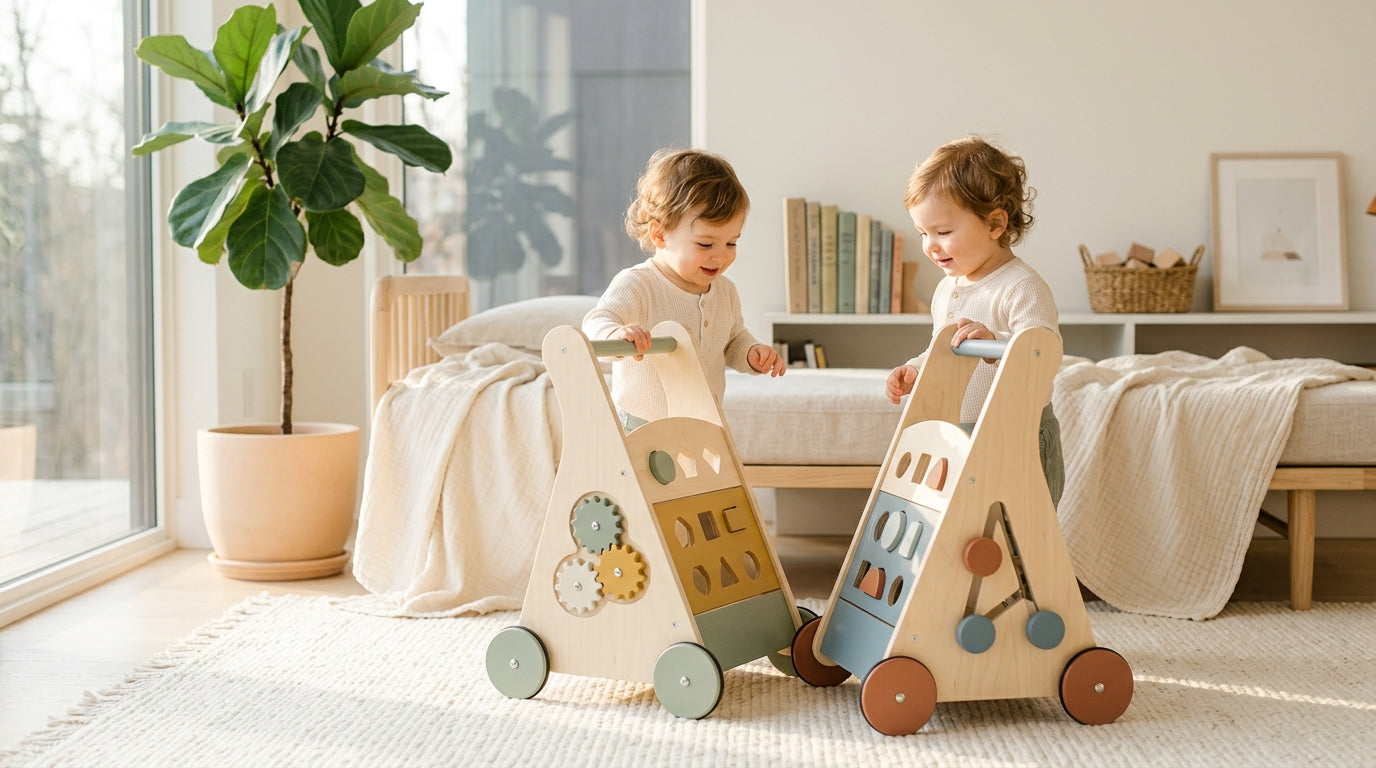
The transition from a sit-in walker to a push walker is a massive reality check for a baby. With the wooden push carts, they suddenly realise they really have to hold their own body weight up. There's no crotch-harness to save them. If they let go, they sit down heavily on their nappy.
The first few days with the wooden push walker were nerve-wracking. Sophie would pull herself up on the handlebar, and because she hadn't quite grasped the physics of wheels, she would immediately push it too far forward and end up doing an inadvertent yoga downward dog before collapsing onto the rug.
The trick, I eventually learned, is that you've to find a push walker where you can tighten the wheels. You want it to offer resistance. If the wheels spin freely, your kid is going to face-plant into the floorboards at mach three. We tightened the screws on the wheels so the cart barely moved, turning it into more of a mobile leaning post. Slowly, as they got stronger, we loosened the wheels a fraction of a millimetre at a time.
Shoes, slippery floors, and hoarding
The whole "barefoot is best" advice from the health visitor was all well and good until Molly started trying to push the heavy wooden cart across our kitchen. We have those old, aggressively slippery tiles. She would get her grip on the handle, push forward, and her bare feet would just slide backwards like she was doing a terrible Michael Jackson impression. She was getting incredibly frustrated, screaming at the cart as if it had personally insulted her.

We clearly needed something with grip, but putting stiff, clunky shoes on a baby who's just learning to walk seemed counterproductive. Eventually, we tried the Baby Sneakers Non-Slip Soft Sole First Shoes 0-18 Months from Kianao. I honestly really like these. Most baby shoes either look like orthopaedic medical devices or those ridiculous miniature adult trainers that weigh more than the baby's actual foot. These ones just look like classic little boat shoes, but the sole is completely soft and flexible.
When I put the green ones on Molly, she didn't do the weird high-stepping march that babies usually do when you put shoes on them. Because the soles are so pliable, she could still feel the floor and use her toes for balance, but the rubbery grip on the bottom stopped her feet from sliding out from under her on the kitchen tiles. She practically lived in them for three months, dragging her wooden cart from the kitchen to the hallway and back again until the shoes were covered in a questionable layer of mashed banana and dust.
Once they figured out the mechanics of pushing the cart without falling over, a new, entirely separate problem emerged: the hoarding.
The tray of a push walker is, in the mind of a one-year-old, a mobile cargo hold. Sophie became obsessed with transporting items around the flat. She would load up the cart with anything she could find—my keys, a rogue sock, a half-eaten rice cake, the TV remote. We tried to lean into this by getting the Gentle Baby Building Block Set.
They're fine, as far as toys go. The main appeal for me is that they're made of soft rubber, meaning that when Sophie inevitably leaves one lying in the middle of the dark hallway at 3 AM, stepping on it doesn't pierce my heel and send me into a blinding rage like a traditional plastic brick does. But honestly, the girls don't really build anything with them. They just aggressively chew on the textured edges and use them as payload in their wooden cart, ferrying the blocks from the living room to the bedroom and then throwing them at the cat. They're okay if you want something that won't scratch your floors when thrown, but don't expect your kid to start constructing architectural marvels.
The sheer sweat factor of learning to walk
One thing nobody tells you about the push walker phase is how physically exhausting it's for the babies. Watching Molly and Sophie do circuits around the living island was like watching tiny, drunk cross-fitters. They would be breathing heavily, faces red, determined to push that heavy wooden box over the lip of the rug.
I found I was constantly having to strip them down because they were sweating so much from the exertion. Thick jumpers were out of the question indoors. I ended up keeping Sophie mostly in her Organic Cotton Baby Bodysuit Sleeveless Infant Onesie. It's just simple, breathable cotton with a tiny bit of elastane so it stretches when she bends double to pick up a dropped block. I prefer it over the cheaper synthetic ones we were gifted, mostly because when she inevitably overheated during her pushing marathons, the organic cotton didn't give her those weird, red, prickly heat rashes on her chest.
It's funny how quickly the phases change. You spend months wishing they would just sit still, then months trying to help them stand up, and then you spend the next two years running after them trying to stop them from touching the oven. The push walker phase was chaotic, mostly because trying to referee two wobbly toddlers armed with heavy wooden carts in a small flat is a logistical nightmare. They would inevitably crash into each other, get their wheels locked together, and scream until I came to untangle them.
But eventually, almost without me noticing, the day came when Molly just let go of the handle and took three staggering, Frankenstein-esque steps toward the sofa. A week later, she didn't need the cart at all. The wheeled menace era was over, replaced immediately by the entirely new terror of independent running.
Before you accidentally buy another plastic musical toy that will haunt your nightmares and ruin your skirting boards, check out the Kianao new arrivals to find something that genuinely looks nice in your living room and won't make you want to pull your hair out.
Some slightly unhelpful answers to your questions
-
Do sit-in walkers genuinely teach them to walk?
Not in my experience. They mostly just teach them how to glide across the room using only their big toes, whilst severely compromising the safety of your shins and any pets in the vicinity. Our health visitor was pretty clear that they honestly make the leg muscles lazy because the seat takes all their weight. -
When should we introduce a push walker?
I wouldn't bother until they're already pulling themselves up to stand on the furniture. If they can't bear their own weight while holding onto the sofa, a push cart is just going to slide out from under them and result in tears. For my twins, it was around the 10-month mark, but honestly, every baby does things on their own wildly unpredictable schedule. -
Will a wooden push walker ruin my walls?
Probably, yes. We have several very distinct dents in the plasterboard where Molly failed to hit the brakes. You can try sticking some felt pads on the front corners of the cart, which softens the blow a bit, but accept that your house is going to take some damage during this phase. -
How do I keep them from slipping on hardwood floors while pushing?
Bare feet are usually best if your house is warm enough, but if you've slippery tiles or it's winter, you need something with grip. Just don't put them in heavy, stiff shoes. We used the soft-soled Kianao sneakers because they genuinely let the foot bend naturally, which stops them doing the weird robotic march. -
How do you stop the push walker rolling away too fast?
Most decent wooden ones have a screw on the wheel hub. You tighten it to create friction so the wheels barely turn when they're just starting out. As they get less wobbly and more confident, you slightly loosen the screws. If yours doesn't have adjustable wheels, you're basically handing them a skateboard and hoping for the best.




Share:
Was Ed Gein A Babysitter? True Crime Myths & Real Childcare Fears
The Real Deal on Vitamin D for Babies (And Why It's So Messy)