

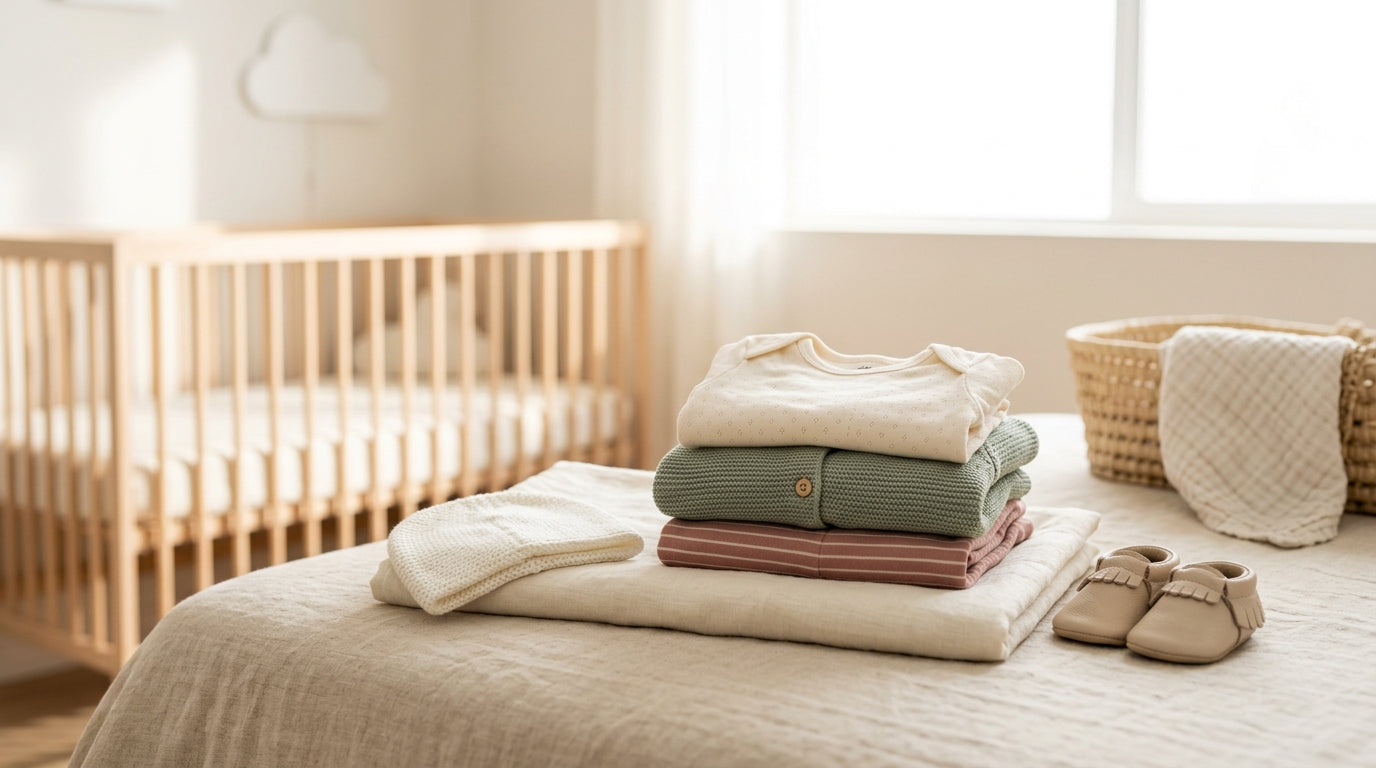
I’m currently staring at a mountain of beige ribbed leggings that have somehow survived three kids, while desperately trying to stretch the neck hole of a brand new so-called sustainable bodysuit that my youngest just got his giant head stuck in. I'm just gonna be real with you—building a wardrobe for a tiny human who doubles in size every six weeks and violently soils themselves on the regular is an extreme sport. When I had my oldest (my absolute guinea pig, bless his heart), I thought I had cracked the code. I waddled my extremely pregnant self into the mall, bought the entire h&m baby section because it looked like a minimalist Scandinavian dream, and patted myself on the back for being a frugal genius. I thought I had the whole infant apparel thing completely figured out.
Spoiler alert: I knew absolutely nothing. Now, with three kids under five, a laundry pile that rivals the Texas hill country, and an Etsy shop to run, my strategy for dressing these kids has completely flipped upside down. What I believed then and what I know now are two entirely different things, especially with fast fashion versus investing in things that actually touch your kid's skin for twenty hours a day.
That weird European sizing nobody warned me about
Let's just address the elephant in the room right now because if you've ever bought anything from H&M for an infant, you already know the trauma. The sizing is completely unhinged. When my oldest was exactly six months old, I pulled out a fresh stack of "6-9 months" long-sleeve shirts I had bought on sale. I put one on him, and I kid you not, it fit like a maternity dress. The sleeves hung past his hands like a Victorian ghost child, and the neckline dipped past his collarbone.
I guess because it's a Swedish company, their clothes are actually based on the baby's length in centimeters rather than our arbitrary American age brackets, which my sleep-deprived brain simply couldn't process. My grandma used to just wave her hand and say "oh, he'll grow into it," which is great in theory, but when your kid is practically swimming in a garment, it bunches up under their chin when they sleep and creates this massive tripping hazard once they start crawling. You end up rolling the sleeves up four times just so they can grab a Cheerio. I've learned that you basically have to ignore the month label entirely and just look at the centimeter height on the tag if you want any hope of the outfit fitting before their first birthday, while also dodging those weird seasonal mismatches where they finally fit into a heavy knit sweater in the dead of July.
And honestly, don't even get me started on their infant shoes, which are basically just cardboard torture devices that slip off in three seconds flat.
What touches the skin actually matters
Here's the part where my firstborn really took one for the team. About four months in, he developed this awful, angry red rash all over his torso and the backs of his knees. I was panicking, changing laundry detergents, cutting dairy out of my diet, doing all the frantic late-night Google spirals. Finally, I dragged him to the pediatrician, who took one look at his cheap, fast-fashion polyester-blend outfit and sighed.

My pediatrician basically told me that thin, cheap synthetic blends trap heat and moisture against the body like a tiny greenhouse. I guess it messes with their delicate skin barrier or something, especially down here in the South where the humidity is thick enough to drink. Babies can't keep stable their body temperature well anyway, so when you wrap them in plastic-derived fabrics, their sweat just sits there and breeds irritation. She casually mentioned that I should probably look into breathable, natural fabrics like organic cotton to keep his skin from losing its mind.
That was a huge wake-up call for me. I realized that while saving a few bucks on a five-pack of bodysuits felt good at the register, paying for prescription eczema creams and dealing with a screaming, itchy baby at 2 AM was a terrible trade-off. This is why I started hunting for better base layers.
The high low wardrobe trick
So how do we survive without going completely broke? Because I run a small business, I'm aggressively budget-conscious. My mom always swore by ironing all her babies' outfits, which is hilarious because I barely have time to move things from the washer to the dryer before they mildew. But she did have one piece of advice I genuinely kept: "Don't put a silk dress on a pig in mud." Basically, dress them for the mess.
I use a high-low strategy now. I still buy cheap multi-packs of basic leggings for daycare days or when we're doing messy sensory play, because if a blowout ruins a three-dollar pair of pants, I'll literally just throw them straight into the outdoor trash can without a second thought. But for the pieces that sit directly against their skin all day—the bodysuits, the sleepwear, the base layers—I invest in the good stuff.
My absolute favorite workhorse piece for this is the Long Sleeve Organic Cotton Baby Bodysuit from Kianao. I'm obsessed with this thing. It has 95% organic cotton and 5% elastane, which doesn't sound like a big deal until you're trying to wrestle a screaming, wet infant into clean clothes at 3 AM. That little bit of stretch means I can pull the lap shoulders down over his torso instead of over his head when there's a diaper disaster, and the fabric doesn't warp into a weird bell shape afterward. The cotton is buttery soft, undyed, and it honestly absorbs moisture instead of trapping it. My youngest sleeps in this almost every single night, and his skin has been completely clear.
If you're trying to figure out how to balance your budget while still keeping your kid comfortable, honestly, just browse some of the organic baby clothes out there and pick a few solid base layers to rotate. You don't need a massive closet.
Now, I’ll be totally honest, I also bought the Kianao Flutter Sleeve Organic Cotton Baby Bodysuit for my daughter because I'm a sucker for anything with a ruffle. It’s undeniably gorgeous and the fabric is just as amazing, but I’m just gonna be real with you—those little flutter sleeves are an absolute magnet for mashed sweet potatoes. Every time she wore it to eat, I spent twenty minutes trying to scrub orange stains out of the delicate folds. It’s perfect for church or going to see my mother-in-law, but it's strictly banned from the high chair in my house.
The great fast fashion deception
Running a small Etsy shop has really opened my eyes to how things are made, and it’s made me a lot more critical of giant retailers. When you look at the tags on standard h&m baby apparel, it's a wild mix of materials. Even their "conscious" collections that brag about sustainability often feel like a bit of a marketing gimmick.

The problem is the sheer volume of it all. You buy these incredibly cheap, thin shirts, and after three trips through my heavy-duty wash cycle (because kids are gross), the side seams start twisting. You know what I mean? Like the seam that's supposed to be under the armpit somehow slowly migrates to the middle of their belly. The snaps get misaligned or the fabric around the crotch just rips right out. Retail analysts call this stuff "functional, not heirloom," which is just a polite way of saying it's destined for a landfill in six months.
When you're trying to dress multiple kids over a few years, constantly replacing cheap things that fall apart really ends up costing you more money and sanity. I learned the hard way that an organic cotton bodysuit that survives fifty washes and can be handed down to the next kid is vastly superior to a cheap polyester one that pills and twists after a week.
Finding the middle ground
Texas weather is famously bipolar, which makes dressing a baby even more complicated. It’ll be freezing when my husband leaves for work at 6 AM, and by noon we’re all sweating on the porch. Layering is the only way we survive.
For those weird transitional months, I lean heavily on the Kianao Organic Baby Romper Long Sleeve Henley Winter Bodysuit. The little three-button neckline is ridiculously cute, but more importantly, it makes it so easy to get over a giant baby head. I use it as a standalone outfit when we're inside the air conditioning, and then throw a chunky knit sweater over it if a cold front blows through. The organic cotton is thick enough to feel substantial, but breathable enough that he doesn't wake up from his nap with a damp, sweaty back.
Ultimately, parenting is just one long string of compromises, and figuring out baby clothes is no different. You don't have to choose between going broke on pure organic luxury for every single item and dressing your kid in scratchy plastic fast fashion. If you can just learn to let the cheap stuff absorb the permanent markers and spaghetti sauce while saving your actual money for the high-quality organic base layers that keep their skin happy, your laundry routine and your peace of mind will be so much better.
Ready to upgrade the pieces that seriously matter? Check out the full line of gentle, organic essentials over at Kianao and give your baby's skin a break.
Questions I constantly get asked about baby clothes
Should I just size down when buying H&M baby clothes?
Honestly, yes, almost always. Unless you've a kid in the 99th percentile for height, their stuff runs massive. I usually buy at least one size down from what my kids wear in American brands like Carter's, and even then, I usually have to roll the cuffs. Just look at the centimeter height on the tag instead of the months.
Are organic cotton baby clothes really worth the money?
If you had asked me with my first kid, I'd have laughed and said no. But after dealing with full-body rashes and eczema flare-ups, I'm a total convert. It’s absolutely worth it for the base layers—the bodysuits and pajamas that touch their skin all day and night. You don't need organic winter coats or fancy organic jeans, but for the bottom layer, it makes a huge difference in how comfortable they're.
How do I wash organic cotton without ruining it?
I'm not a delicate laundry person, but organic cotton is seriously pretty tough. I just wash ours on cold or warm (around 40°C) with a free-and-clear detergent. The main thing is to skip the fabric softeners, because they coat the natural fibers in a weird film that makes them less breathable. I dry them on low heat, and they usually shrink a tiny bit the first time but then hold their shape forever.
Can I mix and match premium brands with fast fashion?
This is exactly what you should be doing! Don't put your kid in a thirty-dollar organic outfit to eat a blueberry pouch. Put them in the cheap multipack pants from the mall for daycare and the playground, and save the nice, breathable Kianao bodysuits for under their clothes, for sleep, and for when you need them to seriously be comfortable and not screaming from itchy seams.
Why do the snaps on my baby's clothes keep ripping?
Because babies are incredibly strong when they're angry, and cheap fast fashion fabrics are too thin to support the metal hardware. When you yank open a cheap bodysuit during a frantic diaper change, the thin cotton-poly blend just gives up. Brands that use slightly thicker organic cotton or a tiny bit of elastane reinforce that area better so you aren't constantly ripping holes in the crotch.




Share:
The Truth About Ugly Baby Gear and Why I Stopped Caring
The Halle Bailey Baby Guide to Setting Firm Internet Boundaries