

It was August, the kind of oppressive, sticky London August where the pavement smells vaguely of roasted bins and the air in our second-floor flat had achieved the exact consistency of soup. The twins were four months old. They were stripped down to their nappies, glistening like two tiny, furious rotisserie chickens, and crying a sort of dry, raspy cry that pierced straight through my skull.
I was standing in the kitchen, staring at the Brita filter jug with wild, sleep-deprived eyes. Every instinct I possessed—every adult survival mechanism honed over thirty-odd years of existing on earth—was screaming at me to pour a few drops of gloriously cold water into their bottles. They were hot. I was hot. The cat had melted into a puddle of fur under the sofa. Surely, just a tiny sip to cool them down couldn't hurt?
To my eternal shame, I actually reached for my phone and typed "can 4 month old have water" into the search bar, plunging immediately into a chaotic 3am parenting forum where one panicked mother had frantically posted about her babi drinking bathwater, and another replied that her babie absolutely loved sucking on ice cubes at three weeks old (a comment which sent my anxiety so high I thought I might actually pass out next to the toaster).
I didn't give them the water. Instead, I called our NHS health visitor, who audibly sighed over the phone and gave me a terrifying, caffeine-fueled lecture about infant anatomy that I'll now attempt to pass on to you, entirely filtered through my own lingering dread.
An anatomy lesson from my exhausted health visitor
When you look at babies, they just look like small, squishy adults, which is incredibly deceptive because inside, nothing works properly yet. My health visitor explained that an infant's stomach is utterly pathetic in terms of capacity. When they're born, it's roughly the size of a cherry, and by four months, it’s maybe the size of an egg. It's premium, fiercely guarded real estate.
Water, she reminded me in a tone that suggested I should already know this, has zero calories. If you put water into an egg-sized stomach, it takes up space that should be occupied by breastmilk or formula. They get full on literal nothingness, their tiny bodies are tricked into thinking they've had a meal, and they miss out on the fats and proteins they desperately need to prevent them from dropping off the growth charts (and earning you a very stern letter from the paediatrician).
But the lack of calories isn't even the scary bit. The scary bit is the kidneys.
Apparently, an infant's kidneys are roughly the size of grapes, and they're spectacularly inefficient. If you give a baby under six months old a bottle of water, their little grape-kidneys just sort of panic. They can't process the fluid fast enough, so the excess water gets dumped straight into the bloodstream, diluting the sodium levels in their body. My GP later told me this leads to a very real, very terrifying medical emergency called hyponatremia—or water intoxication—where the blood gets so watered down that the brain cells actually start to swell.
I think she mentioned something about electrolytes and cellular osmosis, but I was too busy staring in horror at the Brita jug, treating it like it was an unexploded bomb I had almost fed to my children.
The great formula dilution temptation
If you happen to be breastfeeding, your babies are getting all their hydration from you anyway, so you can smugly skip this next bit.

For the rest of us, there's a very specific, dark temptation that creeps in around day three before payday, when you're staring at the bottom of a twenty-quid tin of formula powder. You know you're supposed to use exactly one flat scoop of powder per fluid ounce of water. The tin says it. The midwife said it. The aggressively cheerful woman on the YouTube tutorial said it. But when you only have three scoops left, and two screaming infants who each want a four-ounce bottle, the devil whispers in your ear.
Just add a little extra water, the voice says. Stretch it out. It's basically a milkshake anyway, who cares if it's a bit thin?
I care. The health visitor cares. The grapes care. Deliberately diluting infant formula to save money or make it last longer is basically a fast-track ticket to exactly that water intoxication we just panicked about, because you're forcing them to ingest excess water without the corresponding sodium and nutrients that their bodies require to process it safely.
I know formula costs as much as printer ink and requires a small mortgage to maintain, but you absolutely can't mess with the ratios. If they're sweating profusely in a heatwave, you just have to keep feeding them the properly mixed milk, even if the idea of drinking warm milk in a 35-degree room makes your own stomach churn.
Surviving the heat without the tap
So how do you keep them from evaporating in the summer without water? You just ride it out in the most undignified way possible.

Instead of trying to hack their hydration by pouring Evian into a bottle and hoping their kidneys magically mature overnight, you just have to strip them down to their nappies, keep the milk flowing around the clock, close all the curtains like a vampire, and accept that your electric bill from running the fan continuously is going to financially ruin you.
You also have to violently audit everything that touches their skin. During that awful August, we realised that the lovely, thick, synthetic blanket we'd been gifted at a baby shower was basically turning the pram into a mobile greenhouse. We ended up switching entirely to a bamboo baby blanket from Kianao, which I'm bringing up solely because it might have saved my sanity. Bamboo fabric is strangely brilliant at regulating temperature—it feels cool to the touch and genuinely lets the air flow through, meaning the twins could be shaded from the sun without waking up drenched in their own sweat and screaming for a drink they weren't legally allowed to have.
We also tried distracting them from their thirst with dummies. I had bought these incredibly aesthetic wooden and silicone pacifier clips to keep them from dropping their dummies onto the filthy London pavements. I’ll be completely honest with you: they look beautiful, and they worked flawlessly for Twin B, who happily chewed on the wooden beads to soothe her teething gums. Twin A, however, is a tiny, destructive Houdini who figured out how to forcefully unclip the metal clasp from her onesie in about four days. So, 50% success rate in our house, but your mileage may vary depending on how diabolical your child is.
Crossing the six-month finish line
Eventually, autumn arrived, the heatwave broke, and the girls hit six months old. Suddenly, the medical establishment flips a switch.
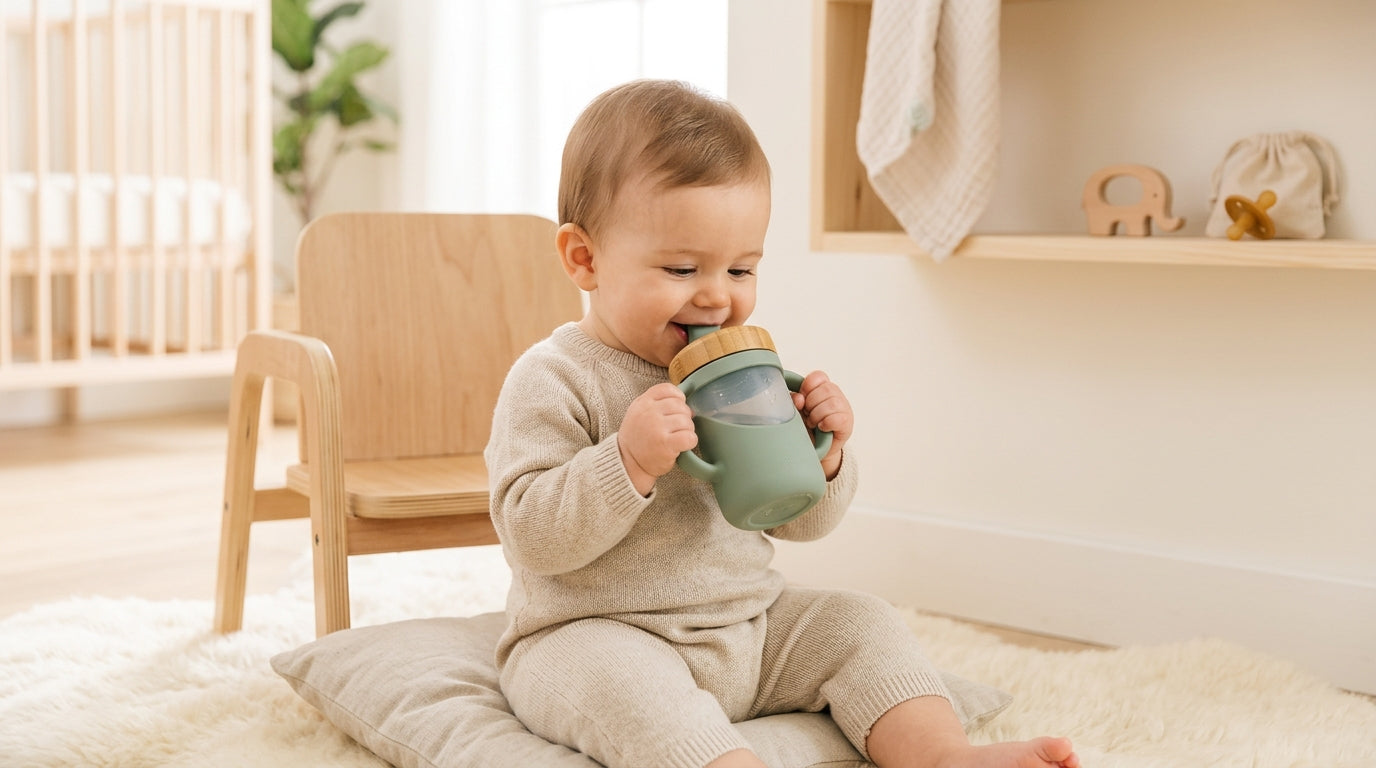
Overnight, the terrifying poison known as "tap water" is reclassified as a necessary developmental tool. The guidance shifts: you're suddenly supposed to offer them small sips of water with their solid meals, not for hydration (they still get that from milk), but just to teach them the mechanical skill of drinking from an open cup.
Let me tell you about the reality of a six-month-old learning to drink from an open cup. It's not a hydration exercise. It's a water sports event. You pour two ounces of water into a tiny silicone cup, hold it to their mouth, and they violently enthusiastically smash their face into it, sending water down their chin, into their neck folds, and all over your trousers.
This is where mealtime gear really matters. We started using the Kianao waterproof silicone bibs during these early water-tasting sessions, and it was genuinely the only thing standing between us and having to mop the kitchen floor three times a day. The bib has this massive, rigid catch-all pocket at the bottom. By the end of lunch, between the spit-up water, the drool, and the mashed peas, the pocket essentially becomes a small, murky birdbath. But you can just detach it, dump the contents into the sink, and wipe it down. It’s brilliant.
You cap their water intake at a few ounces a day (my paediatrician suggested treating it like a fun little side-activity rather than a drink), and slowly, agonizingly, they figure out how to swallow without choking.
Parenting is mostly just a series of terrifying rules that apply with absolute life-or-death severity until a specific Tuesday, at which point the rules completely reverse and you’re expected to just adjust without panicking. Keeping water away from babies feels deeply unnatural, especially when they’re hot and miserable. But you hold the line. You mix the formula right. You let them chew on a cold teething ring. You wait for the kidneys to grow.
If you're braving the messy transition to solids and those terrifying first sips of water, you can explore the full feeding collection here to find silicone cups and bibs that will seriously survive the chaos.
Things you're probably still panicking about (FAQs)
What if they accidentally swallow some bathwater?
Unless you're bathing them in a deep-fill swimming pool and they're drinking it by the pint, you don't need to panic. A tiny accidental gulp of soapy bathwater isn't going to trigger hyponatremia. My girls used to treat the baby bath like a soup bowl. Watch out for an upset stomach from the soap, but their kidneys can handle a rogue teaspoon of water.
Can I give them water if they've a fever?
Never do this without a doctor explicitly telling you to. When they've a fever or vomiting bug, you might think water is the answer, but plain water can genuinely flush out the few remaining electrolytes they've left. Our GP always told us to push breastmilk or formula, and if they were really dehydrated, they'd prescribe a specific medical electrolyte solution like Dioralyte or Pedialyte. Plain water is useless here.
Do I need to boil the water once they turn six months?
Ah, the great boiling debate. The NHS officially recommends boiling tap water and letting it cool for babies under six months (if you're making formula). Once they hit six months and are just having practice sips from a cup, normal cold tap water is generally fine in places with safe municipal supplies like the UK. If you've well water or live somewhere with dodgy pipes, use filtered.
Is baby water from the supermarket a scam?
Yeah, absolutely. It's just distilled water with a massive markup and a picture of a smiling infant on the plastic bottle. Save your money for Calpol and endless packets of wet wipes. If your tap water is safe for you, it's safe for a weaning baby.
When can they just drink water whenever they want?
Around their first birthday, the training wheels come off. At 12 months, cow's milk gets introduced (which you've to cap at around a pint a day so they don't get constipated), and water becomes their main free-flowing beverage. They will immediately start demanding water at 4am just to make you walk down the hallway.




Share:
The Gross But Normal Truth About Your Infant's Crusty Flaky Scalp
Why Are Babies So Cute? A Dad's Guide to Infant Hardware