

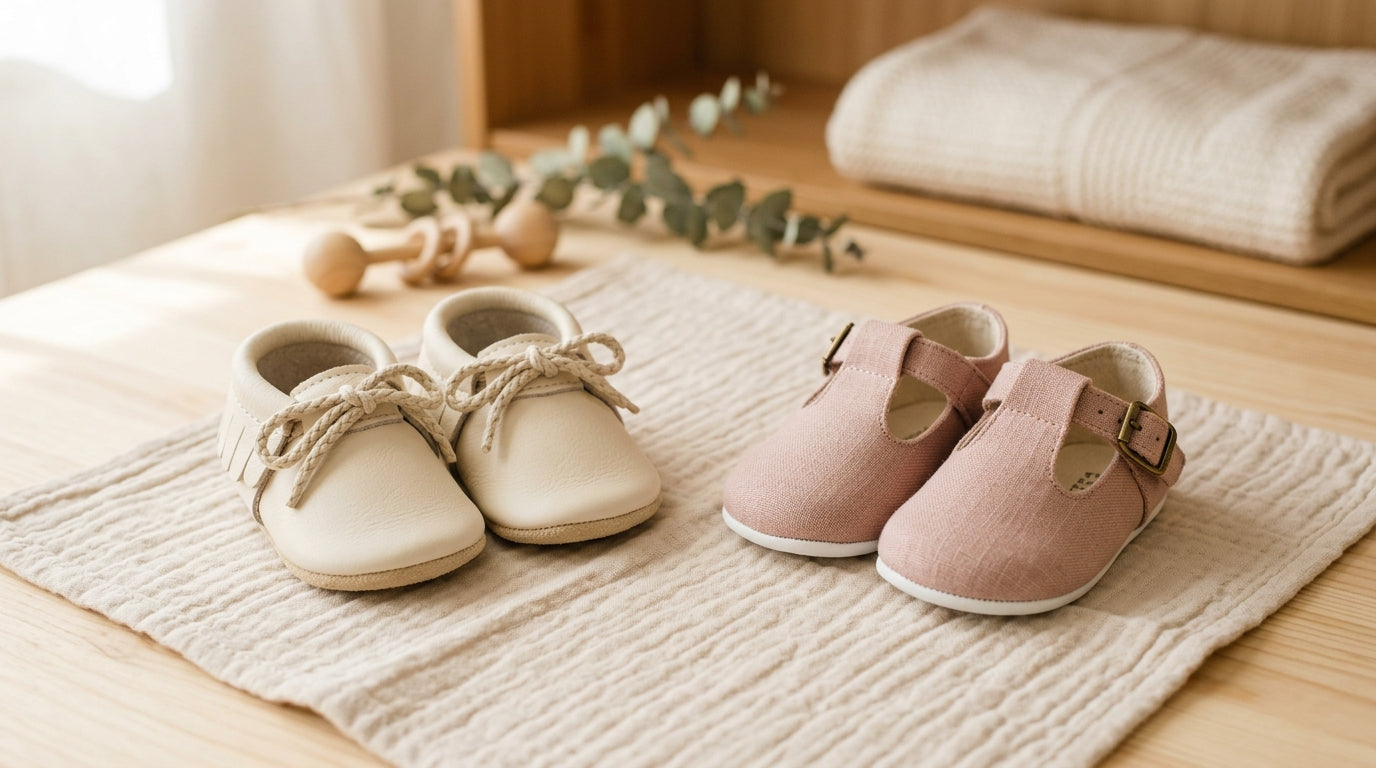
I'm currently staring at six pairs of stiff, leather infant oxfords sitting in my donation pile. Hemingway supposedly wrote a famous six-word tragedy about unworn baby shoes, but honestly, any mom on a local buy-nothing group will tell you it's not a tragedy at all. It's just Tuesday. My mother-in-law bought three of these pairs. I bought two myself because I was highly susceptible to targeted ads at three in the morning while nursing. None of them have ever touched pavement. They're pristine, entirely untouched by the dirt of the outside world. I've created my own little sad literary myth right here in my Chicago apartment, all because I thought my six-month-old needed to look like a tiny corporate banker.
Let me paint you a picture of what happens when you try to shove a squishy, bone-cartilage blob into a rigid mini high-top. It's basically like trying to stuff a very angry, flailing marshmallow into a coin slot. You push the heel down, the toes curl up. You flatten the toes, the heel pops out. I've worked pediatric triage enough times to recognize defeat. I've seen parents bring in kids for mysterious foot bruises that turned out to be from forcing an aesthetic bootie onto a foot that clearly wanted to remain wild and free. We do this to ourselves. We buy the tiny converse, we try them once, sweat through our shirts in the process, and toss them in the back of the closet until the kid inevitably outgrows them three weeks later. That's the actual, unromantic story behind the endless listings you see haunting your neighborhood resale app.
The anatomy of a squirming marshmallow
Listen, forcing an infant into rigid leather while expecting them to hit their gross motor milestones is a fast track to mutual resentment. A newborn foot is not a miniature adult foot. I vaguely remember from my nursing textbooks that babies are born with almost no solid bones in their feet. It's mostly just spongy cartilage and a thick layer of fat padding the arch. That means their little feet are basically radar dishes, meant to feel the floor, the carpet, the temperature, the texture. They need that sensory feedback to figure out where their body ends and the ground begins.
When you wrap that radar dish in a half-inch of stiff, molded rubber, you're essentially blindfolding their feet. My own pediatrician, Dr. Gupta, told me this while watching my daughter aggressively kick off a very expensive pair of suede moccasins I had wrestled onto her in the waiting room. She just looked at me over her glasses and mumbled something about how kids who learn to walk barefoot usually skip that clumsy Frankenstein-walk phase. I nodded like I fully grasped the biomechanics, but really I was just mourning the forty dollars I spent on those moccasins.
Dr. Gupta actually pulled out a plastic anatomical model to prove her point. She showed me where the twenty-six bones and thirty-three joints would eventually form. A baby foot is entirely malleable. If you put a malleable foot into a narrow, rigid toe box, it simply conforms to the shoe. It's a bit like binding. I've seen teenagers in the clinic with bunions and hammertoes, and while genetics certainly play a part, terrible footwear choices in early childhood probably don't help the situation. Your baby needs to splay those toes. They use their big toe like a kickstand to balance. When they're pulling to stand on your coffee table, watch their feet grip the floor and adjust to tiny shifts in weight. The proprioception—that's the medical term for knowing where your body is in space—is entirely dependent on the nerve endings in the soles of their feet communicating with their brain. Putting a heavy sole between their foot and the floor mutes that signal.
The secondhand goldmine of parental regret
This brings us back to the massive pile of unworn footwear currently overtaking my hallway. For a long time, I felt guilty about it. It feels wasteful, yaar. But from a sustainability standpoint, the endless supply of pristine baby kicks on resale sites is actually a brilliant loophole for the eco-conscious parent.

You see, podiatrists generally get very twitchy if you put a kid in actually worn secondhand shoes. Once a toddler wears a shoe for a few weeks, that shoe molds to their specific gait, their unique foot shape, their particular brand of chaos. If you put your kid in a heavily worn hand-me-down, it can apparently mess with their developing arch or cause weird blisters. It's one of those medical warnings that sounds a bit dramatic but is unfortunately grounded in reality.
But the unworn ones? The ones some other tired mom gave up on after one sweaty wrestling match? That's the holy grail. You get to keep materials out of a landfill without compromising your kid's foot development. It's a perfect micro-economy built entirely on collective parental delusion about what babies will seriously tolerate wearing. The fast fashion industry churns out millions of polyurethane mini-shoes that will be worn for maybe two hours, total. They sit in closets, off-gassing whatever cheap chemicals they're made of, until they're eventually thrown in a trash bag. Buying these unworn mistakes off other mothers is honestly the most ethical way to handle the situation if you really need footwear for a wedding or a photo shoot. It bypasses the medical risk of pre-molded insoles, saves you thirty bucks a pop, and keeps plastic out of the dirt.
Growth charts and other fictional timelines
Let me rant about infant foot sizing for a minute. The entire system is a complete scam designed to break your spirit. A baby's foot can grow half a size in eight weeks. Sometimes four weeks. You buy a pair of shoes for an upcoming family event, the kid blinks, and suddenly they need a bigger size. They sell these little plastic foot-measuring devices online that look like mini Brannock devices from a 1990s shoe store. I bought one in a sleep-deprived haze.
Do you know what a ten-month-old does when you ask them to stand still on a piece of cold plastic with a sliding gauge? They go completely rigid, lock their knees, and curl their toes under so tightly you'd think they were trying to grip a tree branch. You try to flatten the toes. They scream. You try to slide the gauge. They kick it across the room. I spent three hours last month trying to measure my toddler's foot with a piece of paper and a pen while she acted like I was amputating her leg. The line I drew was nowhere near her actual toe. I just guessed. We're all just guessing.
Then there are the sizing systems themselves. European sizes, US sizes, UK sizes. Months. Zero to six months is not a shoe size. I've met three-month-olds with feet like tiny flippers and six-month-olds with delicate little bird feet. The month-based sizing is a trap designed by the apparel industry to make you feel like your kid is mathematically incorrect. My kid was in a twelve-to-eighteen month size at nine months. Did I ask a growth chart? Yes. Did I spiral into anxiety about giant feet? Also yes. If someone tells you they know their baby's exact shoe size, they're absolutely lying to you.
The socks just disappear in the wash anyway, so none of this matters.
The gear we really use when barefoot isn't an option
Eventually, my kid did start walking. Sort of. It was more like a drunken stumble towards the nearest breakable object. We needed something to put on her feet when we went to the park because Chicago pavement is unforgiving, and the winters here require actual insulation. The balance between freezing toes and proper foot development is a daily struggle.

I bought a ridiculous amount of options. Most were terrible. But the Baby Sneakers Non-Slip Soft Sole First Shoes were the one exception to my strict anti-shoe crusade. Listen, they're not going to turn your kid into an Olympic sprinter. But the sole is completely bendable. You can fold the entire shoe in half with two fingers. It's basically a thick, non-slip sock pretending to be a boat shoe. I liked that the toe box was wide enough that her toes could still splay out like little frog feet when she stood up.
The inner lining is just soft fabric, which matters because there are no weird seams rubbing against the ankle. Babies can't tell you their shoe is rubbing. They just cry and refuse to put any weight on that leg, which leads to a panicked clinic visit where you think they've a hairline fracture, but no, it's just a blister from a stupid shoe. These soft sneakers don't do that. They have an elastic lace situation that honestly stretches, so you don't have to dislocate their ankle to get the foot inside.
I also got a Panda Teether around the same time. It's fine. It's a piece of silicone shaped like a panda. My daughter mostly used it to throw at my head when she didn't want to get dressed, but it did distract her just enough for me to slip the soft sneakers on her feet without a full meltdown. Take that for what it's worth.
If you're hunting for things that genuinely make sense for a baby's reality rather than an Instagram grid, you can browse our organic baby essentials collection. They focus on natural fibers that breathe and move. I've their Leaves Organic Cotton Blanket, and it has survived roughly four hundred washes without turning into scratchy sandpaper. That's the level of utility I require in my life.
Stop fighting the marshmallow
So here's the messy reality of infant footwear. Give up on the stiff leather wingtips, keep them in socks as long as humanly possible, and when you absolutely must buy footwear for outside, stick to soft-soled options or hunt down the pristine cast-offs of other mothers who learned this lesson the hard way. Your baby's arches will thank you, and your sanity will remain somewhat intact.
If you want to skip the trial and error completely and just get the one pair of shoes that won't make you both cry, grab the soft soles from our collection and move on with your day.
The messy truth about baby feet (FAQ)
When should my baby genuinely wear their first pair of shoes?
Basically, not until they're confidently walking outside. If they're just cruising along the couch or taking wobbly steps on your living room rug, they don't need shoes. Bare feet give them the grip they need. The only exception is if your floors are freezing or you're taking them somewhere gross, in which case, just use a pair of socks with those little rubber sticky things on the bottom.
Are hard-soled shoes better for ankle support?
No, this is a total myth that our parents' generation loved to push. Arre beta, they need support! They don't. High, stiff ankles honestly prevent the baby from using their own muscles to balance. They need their ankles to wobble and adjust so those ligaments get strong. Putting them in a tiny ski boot just weakens the entire structure. Soft and flexible is the only way to go.
Why do babies hate having things on their feet so much?
Because their feet are highly sensitive sensory organs. Imagine wearing thick leather mittens and trying to read braille. That's what it feels like for a baby to wear stiff shoes while trying to learn how to walk. They kick them off because their brain is literally screaming for input from the ground, and the shoe is blocking the signal.
Is it safe to buy secondhand infant footwear?
It depends. If the listing says "never worn" or "worn once for a photo," absolutely buy them. It's the smartest thing you can do. But if the shoes look visibly broken in or the soles are worn down on one side, skip them. A used shoe has already molded to another kid's foot, and forcing your baby's malleable foot into that pre-set mold is a recipe for bad posture and weird gait issues.
What if daycare requires them to wear shoes?
This happens a lot, usually for liability reasons or fire drills. If you're backed into this corner, just buy the absolute softest, thinnest-soled shoe you can find. Look for things made of thin leather or breathable mesh that you can wring out like a wet washcloth. Send them in those, and take them off the second they get in the car to come home.




Share:
The Truth About Long Baby Sherpa-Lined Cotton Coats In Winter
The Truth About Baby Feet: Why Those Tiny Shoes Are a Scam