

I was sweating through my postpartum shirt, trying to fold my three-week-old son's arm into a rigid denim jacket labeled zero-to-three months for a mandatory family photo. His arm was stuck at a strange right angle while he screamed, and I just sat on the nursery floor crying because I thought I had broken my child. I had bought twelve of these highly structured outfits before he was born because the tags explicitly told me they were for newborns. It turns out, stuffing a fragile human infant into arbitrary, age-based clothing is basically an orthopedic hazard, and nobody warns you that most baby sizing is pure fiction.
The European system makes actual sense
Listen, the American way of sizing baby clothes by age is a collective hallucination. A three-month-old could be in the tenth percentile or the ninetieth, making a three-month label about as useful as a horoscope. When my doctor casually mentioned the European sizing model during our two-month checkup, my sleep-deprived brain finally stopped short-circuiting. The whole baby größe concept is just based on your kid's length in centimeters, which is profoundly simple and prevents you from having a breakdown in the Target aisle.
Size 50 is just for kids up to 50 centimeters. Size 56 is for 51 to 56 centimeters, and it just goes up in increments of six, so you hit 62, 68, 74, and so on. You literally just measure the baby on the changing pad. You don't have to guess if your unusually long two-month-old needs a six-month size or if you're doing something wrong. You just look at the measuring tape and buy the number.
Most newborns pop out around 51 centimeters and roughly 3500 grams, assuming the biological math holds up, but they outgrow that size 50 and 56 in about four to six weeks. I see new parents hoarding newborn sizes like they're preparing for an apocalypse, only to realize their baby has outgrown the entire wardrobe by Tuesday. Just buy a couple of newborn pieces, stock up heavily on the 62s and 68s, and accept that you'll be rolling up sleeves for a very long time.
What the growth charts really mean
I've stared at a thousand of these growth charts during my clinic days. Parents always panic when their kid isn't sitting exactly at the fiftieth percentile, as if it's a standardized test score their infant somehow failed. They compare baby größen at mommy groups like it's a competitive sport.
The medical textbooks say a healthy baby might double their birth weight by five months and triple it by a year, but infant growth is violently unpredictable. My own kid decided to get aggressively dense in week eight and then just stayed the same length for a month. Pediatricians only really care if the baby drops off their own established curve, meaning if your kid is riding the tenth percentile and staying there, that's their normal, yaar. Sudden drops or wild spikes are the only things that trigger the triage instinct in a medical setting. Stop buying clothes for the statistically average baby you think you're supposed to have and just dress the one sitting in front of you.
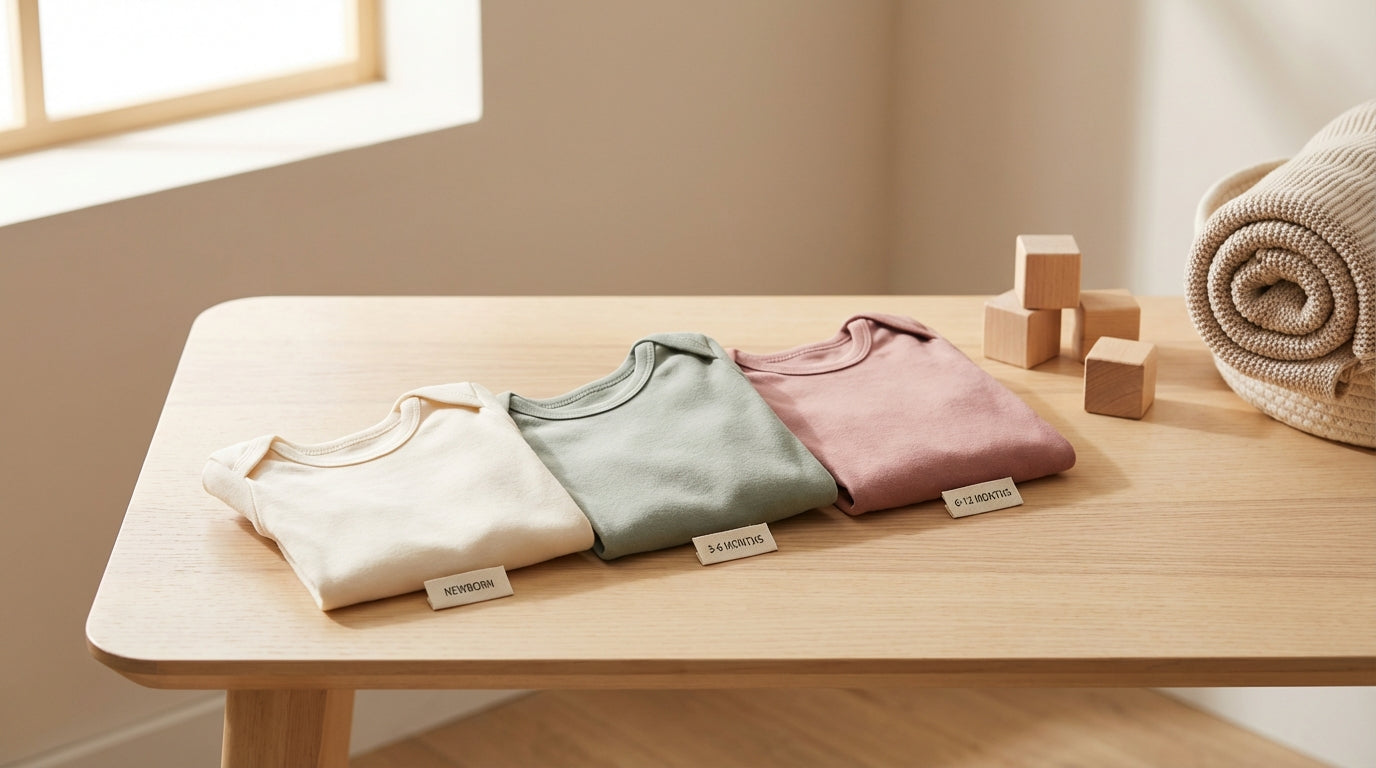
Because they grow roughly an inch a month for the first half-year, buying rigid, non-stretchy fabrics is a financial tragedy. You need things that forgive the growth spurts. My absolute lifeline has been the Organic Cotton Baby Bodysuit. The first time I wrestled him into it, I realized what five percent elastane actually does for your sanity. It stretches over their massive, fragile heads without that horrifying moment where they get stuck in the neck hole and panic. The flat seams don't leave those angry red pressure marks on their skin that always made me think of hospital tourniquets. It actually survives the month, which is the highest compliment I can give a piece of baby clothing.
Sleep sack math is basically triage
Sleeping bags are the one place where sizing is an actual safety hazard rather than just an aesthetic annoyance. I'm not being dramatic here. If you put a newborn in a massive sleep sack so they can grow into it to save twenty bucks, the loose fabric can easily ride up over their face in the middle of the night.

There's a clinical formula for this that takes the guesswork out entirely. You take their body length, subtract their head length, and add ten centimeters for them to frog-kick. That ten centimeters of kicking room is non-negotiable for healthy hip development. But the most critical part is the neck fit. If you can fit more than one adult finger between your baby's neck and the collar of the sleeping bag, take it off them immediately because it's too big and therefore a suffocation risk.
Seasonal layering and the neck test
Winter babies are an entirely different logistical nightmare because the temperature swings from the freezing pavement to the suffocating heat of the doctor's waiting room are brutal. We use the onion principle, which just means layering them in thin, breathable pieces so you can strip them down when the heating in the car turns them into a baked potato. I always size up for outer layers, putting a newborn in a 62 coat, because cramming a baby into a tight winter suit restricts their movement and makes them furious.
You also don't check their temperature by feeling their hands or feet. Baby extremities are always freezing because their circulatory systems are still figuring out how to pump blood efficiently. My old head nurse drilled the neck test into my skull. Just shove two fingers down the back of their neck. If it's warm and dry, leave them alone. If it feels sticky or sweaty, peel a layer off immediately before they overheat, regardless of how cold you think it's outside.
If you're tired of guessing which fabrics breathe and which ones trap heat, you can explore our collection of adaptable organic baby clothes that actually work with your kid's fluctuating body temperature.
The accessories nobody needs
Let me save you some time and money right now. Hard-soled baby shoes are a developmental roadblock. Shoving a tiny, malleable foot into a stiff leather shoe before they're actively walking on pavement just restricts their natural foot development and messes with their balance. Put them in thick wool socks and let them figure out gravity on their own.

Hats are slightly more relevant, but only if you measure their head circumference in centimeters. A baby hat that's too tight will quietly give them a tension headache that manifests as hours of unexplained screaming, while a loose one just becomes a dangerous blindfold.
I feel similarly skeptical about the massive industry of teething accessories. We have the Panda Teether laying around our living room. It's fine. It does the job because it's made of food-grade silicone and I can throw it in the dishwasher when it inevitably hits the floor at the coffee shop, which is the baseline requirement for anything entering my house. It gives him something safe to gnaw on, but it's not going to magically cure the teething phase or give you a full night of sleep.
On the other hand, putting them under a Wooden Baby Gym while they're wearing clothes that genuinely fit their current body length is about the only reliable way you'll get ten uninterrupted minutes to drink your tea before it goes cold.
The reality of the size chart
You're going to look at a baby größentabelle a hundred times in the first year, trying to map out what size they'll be for a wedding six months from now. Just remember that the age labels are marketing suggestions, the growth percentiles are fluid, and your primary job is simply making sure nothing is cutting off their circulation or restricting their breathing.
Instead of stressing over the numbers on the tags, measure their length, buy clothes that stretch, and accept that they'll grow at whatever chaotic pace their genetics dictate. Ready to build a wardrobe that honestly works for the baby you've right now? Find the right fit in our sustainable baby collection before you waste money on another useless, rigid newborn jacket.
Answers to the sizing questions you're too tired to google
Why does my baby fit into size 62 in one brand but swims in it in another?
Because brand sizing is a lawless wasteland. Even in the European centimeter system, some brands cut their clothes for long, string-bean babies while others cut them for the chunky ones with deep thigh rolls. Always look at the fabric composition. If it doesn't have a little elastane or a forgiving knit, it's going to fit weirdly unless your baby perfectly matches their fit model.
Are those clothes that claim to grow with your baby genuinely real?
Mostly yes, if they're designed right. I used to roll my eyes at this, but a bodysuit with an extra row of snaps at the crotch or pants with massive foldable cuffs will seriously buy you an extra month or two. When you realize they're blowing through a new baby größe every few weeks, you start appreciating anything you can unroll to cover their sudden ankle exposure.
How do I buy clothes before the baby is born if I don't know their size?
You don't buy a full wardrobe. You buy three neutral sleep-and-plays in size 50 and five in size 56. That's it. Don't buy the seasonal outfits for six months out, because your kid will inevitably be in a massive growth spurt and that expensive velvet winter overall will only fit them in August.
When should I genuinely start putting shoes on them?
My doctor was blunt about this. No hard shoes until they're confidently walking outside on surfaces that could cut their feet. Inside the house, bare feet or grippy socks are better because they need to feel the floor to develop their arches and balance. Those tiny newborn sneakers are just expensive props that fall off every five minutes anyway.
How tight should the diaper be under their clothes?
If you're seeing deep red elastic marks on their thighs or waist when you take the diaper off, it's too tight or you need to size up. The same goes for the clothes over the diaper. If you've to forcefully stretch the bodysuit to snap it over a full diaper, just move to the next size up, beta. They need room for their stomach to expand after they eat.




Share:
Navigating the Chaos of Buying Tiny Outfits for Premature Babies
Surviving the sticky, panic-inducing reality of baby suncare