

At exactly 3:14 AM on a rainy Tuesday, I found myself holding a slippery, screaming infant who looked alarmingly like a boiled prawn. Florence, who's usually the more reasonable of the twins, was covered neck-to-toe in a furious, sandpaper-like rash. Her sister Matilda was fast asleep in the next room, possessing the skin of a rhinocerous and the ability to sleep through what sounded like a fire at an abattoir, but Florence was in absolute agony.
I had caused this. Or rather, my crippling desire to be a "good, modern parent" had caused this.
You see, earlier that evening, I had bathed her in a wildly expensive, artisanal, "all-natural woodland sprite" cleanser that I bought from a boutique in East London. It cost twenty-eight pounds, came in a glass bottle that terrified me every time my wet hands touched it, and smelled like a Tuscan lemon grove that had been aggressively rubbed with lavender. I thought I was giving my daughter the absolute pinnacle of organic wellness. Instead, I had essentially marinated her delicate, immature epidermis in highly concentrated botanical allergens, triggering a contact dermatitis flare-up so spectacular it looked like she'd been rolling in fiberglass.
The botanical betrayal
There's a massive deception in the baby product industry that preys entirely on sleep-deprived anxiety. We're sold this idea that if something is "natural," it's inherently safe, and if it has chemical-sounding names, it's toxic sludge designed to ruin your child's life. So we actively seek out things packed with key oils, thinking we're doing the right thing.
I spent an hour in the GP's office the next morning, smelling faintly of stale sick and wearing yesterday's t-shirt, while our very patient doctor explained that newborn skin is not the same as adult skin. My admittedly foggy understanding of the science is that a baby's skin barrier is about thirty percent thinner than ours, meaning it loses moisture incredibly quickly through something called transepidermal water loss (which sounds less like biology and more like a plumbing failure in a cheap hotel).
When you take that delicate, poorly sealed barrier and slather it in highly alkaline soaps and fragrant plant extracts, you aren't nourishing them. You're just stripping away whatever pitiful natural oils they managed to produce and replacing them with potential irritants. Lavender is lovely if you're a candle, but apparently, it's a notorious trigger for infantile eczema.
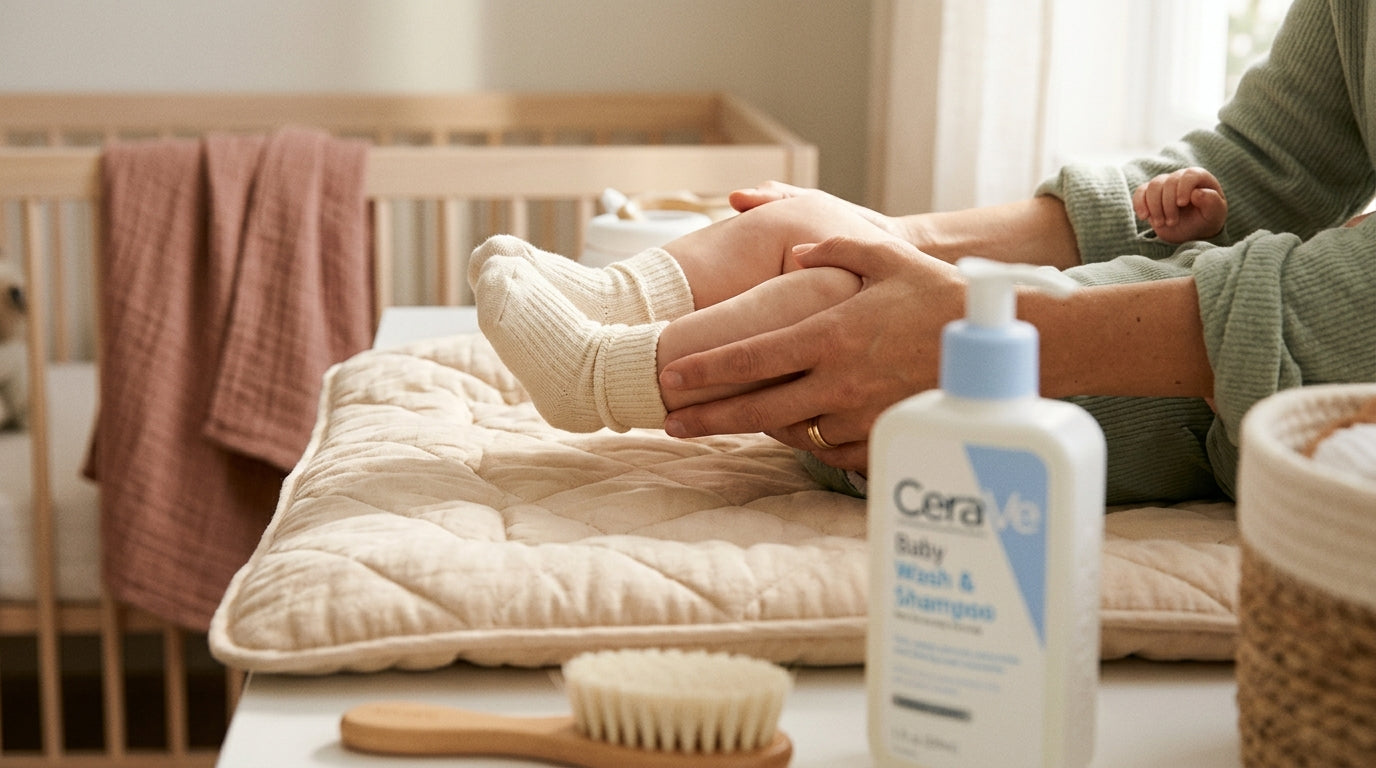
My GP didn't hand me a prescription for some magical, rare ointment. She just told me to go to the high street pharmacy and buy a big, boring, plastic pump bottle of CeraVe baby wash.
Embracing the aesthetic void
I'll admit, bringing the CeraVe baby wash into our bathroom felt like a defeat. It has absolutely zero aesthetic appeal. It doesn't look good on a minimalist shelf. It looks like something you'd find in the supply closet of an NHS hospital. It smells of absolutely nothing—just a vague, clinical absence of scent.
But my god, the sheer functional competence of the stuff is staggering.
The secret, as our pediatrician tried to explain to me while Florence tried to eat a wooden tongue depressor, is ceramides. Ceramides are lipids that naturally make up about half of the skin barrier, holding the cells together like mortar between bricks. Babies with eczema or severe dry skin are basically walking around with missing mortar. CeraVe just shoves a bunch of synthetic ceramides into the cracks, along with hyaluronic acid to hold onto water, and it does so without using harsh sulfates that strip the skin raw.
It doesn't foam up into those magnificent, cinematic bubbles you see in diaper adverts. It just sort of coats them in a slippery, milky film that rinses off easily. But within three days of abandoning the £28 woodland sprite juice for the £10 high street bottle, Florence's skin went from angry boiled prawn back to soft, vaguely sticky baby.
The great vernix cheese debate
If I could go back in time to when the twins were born, I'd drastically alter our entire approach to bathing. When my girls were delivered, the hospital staff whisked them away and gave them a bath almost immediately. At the time, I thought this was great because, quite frankly, newborns emerge looking like they've just survived a shipwreck in a vat of cottage cheese.

But the medical guidance has shifted massively on this. That white, waxy cheese coating is called vernix caseosa, and it's essentially the ultimate, custom-made moisturizer and immune barrier. You're supposed to leave it on for at least twenty-four hours, if not longer, allowing it to soak into the skin naturally.
If they get crusty scalps later on, just rub a bit of plain olive oil into it and forget about the whole thing entirely.
Instead of delaying, we scrubbed the vernix off them and immediately started a routine of daily baths, because that's what you do in the movies, right? It turns out, daily bathing is arguably the worst thing you can do for an infant in London, where the water is so hard it practically comes out of the tap in solid chunks. We were just systematically dehydrating them night after night.
The post bath wrestling match
Of course, finding the right baby wash is only half the battle. The other half is what happens immediately after you pull them out of the water. This involves a technique dermatologists call "soak and seal," which sounds incredibly professional until you actually try to execute it on a wet, thrashing toddler who views the towel as a sworn enemy.
The goal is to sort of desperately pat them with a towel while they try to launch themselves off the changing table, leaving their skin slightly damp, and then smear on a thick layer of ceramide cream before the moisture magically evaporates into the ether.
Then comes the clothing. During Florence's worst eczema days, any synthetic fabric would make her instantly furious. We tried putting her in a polyester-blend sleepsuit once and she screamed with such sustained intensity I thought the neighbors were going to call social services.
We ended up migrating almost entirely to organic cotton, specifically the Organic Cotton Baby Bodysuit from Kianao. Honest opinion: I don't care much about the environmental halo effect when it's 3 AM and someone is crying, but I care deeply about the fact that this bodysuit actually stretches over a wet, angry baby's head without decapitating them. It has flat seams, which meant it wasn't digging into the eczema patches behind her knees, and it breathes. The lack of harsh chemical dyes genuinely made a difference when her skin was at its most reactive.
Distractions in the tub
Because bath time had become connected to stinging and crying, we had to introduce heavy distractions to get Florence back into the water without a meltdown. Matilda, naturally, loved the water and would happily sit in the tub trying to drink the murky bathwater, but Florence needed occupational therapy.

We threw a bunch of toys into the mix. We tried the Panda Teether Silicone Chew Toy, which is perfectly fine as a teether when we're in the living room, but honestly, in the bath, it's just okay. It survives the water well enough, but it sinks, and Matilda immediately figured out how to use it as a projectile to splash me directly in the eye.
What actually worked brilliantly was the Bear Teething Rattle. It has this wooden ring that clanks satisfyingly against the side of the plastic baby tub. I'd hand that to Florence, and while she was fiercely concentrating on trying to gnaw the crochet bear's ears off, I could quickly wipe her down with the CeraVe without her noticing the indignity of it all.
Take a look at Kianao's organic cotton clothing collection if you're battling the endless cycle of mysterious red rashes and need fabrics that won't make things worse.
Escaping the digital anxiety trap
There's this whole modern phenomenon of the perfectly optimized infant—let's call it the "e baby." Parents now have digital bath thermometers that sync to Bluetooth, apps that track the exact duration of the bath, and smart-monitors that alert you if the bathroom humidity drops below fifty percent. We bought into all of it with the first few paychecks.
I spent the first six months of their lives staring at my phone screen, trying to cross-reference Florence's bath temperature with her sleep cycles, convinced that if I just found the perfect data correlation, she would stop crying.
It's all total nonsense.
The anxiety of trying to bio-hack your baby's bath time just makes you tense, which makes the baby tense, which usually results in someone pooping in the tub. You don't need a digital thermometer. You just stick your elbow in the water. If it feels like nothing—neither hot nor cold—it's perfect. You don't need an app to track how long they've been in there. When they start looking slightly wrinkly or they start shivering, you pull them out.
And you definitely don't need a twenty-eight-pound bottle of botanical elixir to get milk out of their neck folds.
Embracing the boring
We're now at the stage where bath time is mostly a chaotic exercise in preventing them from drowning each other while I try to wash Weetabix out of their hair. We bathe them maybe twice a week. The rest of the time, I just wipe their faces and the deeply unglamorous undercarriage areas with water and a cotton pad.
The CeraVe bottle sits proudly on the edge of the tub, ugly and functional. It doesn't promise to align their chakras or make them sleep twelve hours through the magic of chamomile. It just cleans the dirt off without breaking their skin barrier.
Parenting is full of wildly expensive mistakes that you make out of pure love and crippling fear. If I can save you from just one of them, let it be this: skip the fancy skincare. Save that money for Calpol and industrial quantities of coffee for yourself. Your baby just wants to be comfortable, and sometimes, the most comfortable thing in the world is incredibly boring.
Ready to swap the irritating synthetic fabrics for something that genuinely lets your baby's skin breathe? Explore the full range of Kianao organic essentials here before you dive into the FAQs below.
The messy reality of baby baths (FAQs)
How often should I really bathe my newborn?
Honestly, unless they've experienced a catastrophic nappy blowout that defies the laws of physics and gravity, twice a week is plenty. They don't have jobs, they don't go to the gym, they mostly just lie there emitting fluids. A warm sponge bath for the crusty bits is fine for the first month.
Is CeraVe baby wash better than natural or organic washes?
In my extremely traumatized, anecdotal experience—yes. "Natural" usually means packed with plant extracts and key oils, which are massive triggers for infant eczema. CeraVe is heavily processed and completely synthetic, but it's formulated specifically not to destroy the lipids in their fragile skin. Sometimes science is better than a crushed flower.
Can I use adult wash on a baby?
Please don't. Adult soaps are usually highly alkaline to cut through the grease we accumulate as stressed-out humans. If you use it on a baby, it strips their skin barrier completely, leading to dryness, redness, and a lot of crying at 3 AM. Stick to pH-balanced, soap-free cleansers.
What's the soak and seal method my doctor mentioned?
It's a messy race against time. The moment you pull them out of the tub, you lightly pat them with a towel so they're still a bit damp, and within three minutes, you aggressively smear a thick ceramide ointment all over them to trap that water inside the skin before it evaporates. It requires the speed of a Formula 1 pit crew.
Do I need to wash their hair with shampoo every time?
Not at all. For the first few months, their hair (if they even have any) just needs a quick rinse with water. Unless they've managed to rub an entire mashed banana into their scalp, you can mostly skip the shampoo. If they've cradle cap, ignore it or rub a tiny bit of olive oil on it.




Share:
A Letter to Past Me About Baby Skincare and Greasing Up Twins
Spotting Cerebral Palsy in Babies: A Twin Dad’s Messy Story