

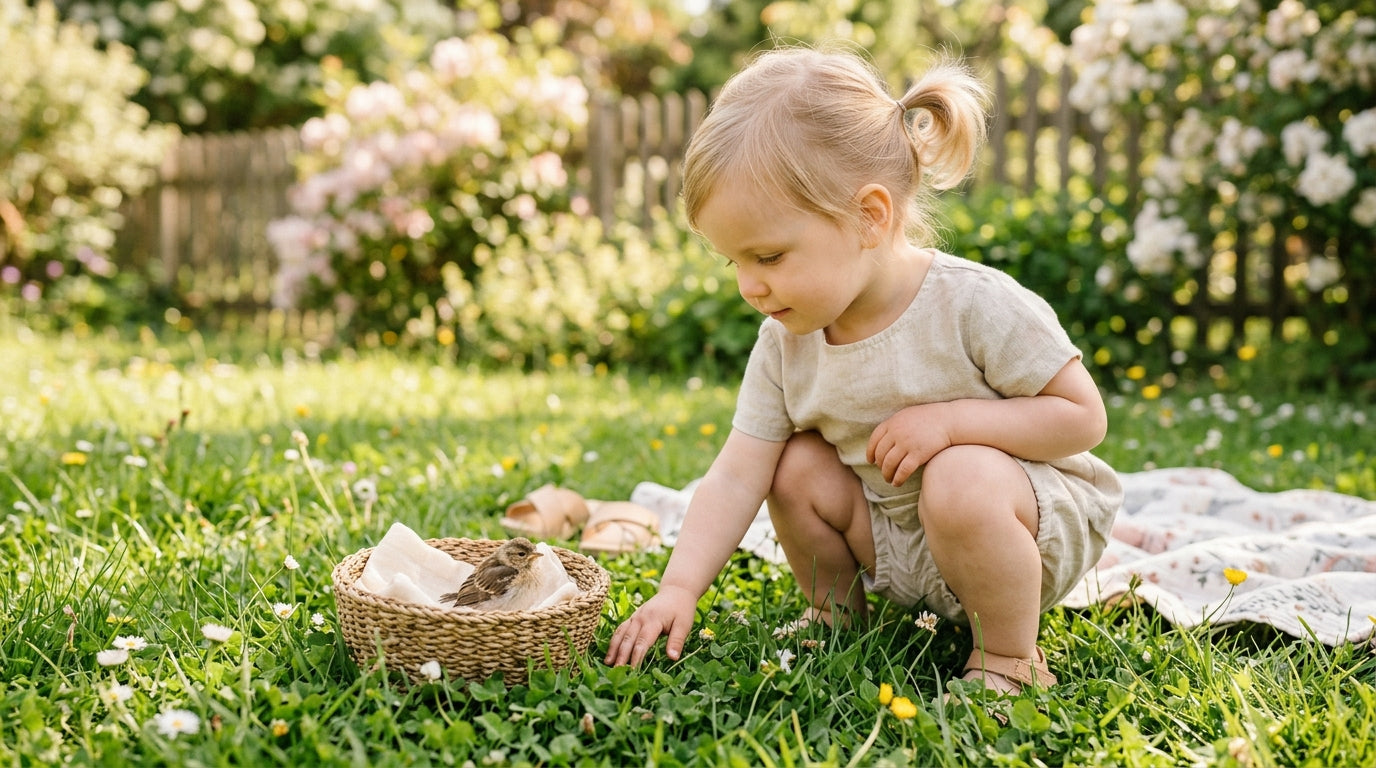
It's 2:14 PM on a Tuesday and I'm staring at what looks like a hairy jellybean on my concrete patio. My 11-month-old daughter is currently operating in her standard 'Roomba mode,' rapidly crawling toward the jellybean with her mouth wide open, fully prepared to execute a taste-test protocol. I intercept her at the last possible millisecond, hoisting her into the air like a sack of potatoes. The jellybean twitches. It has a tiny, microscopic beak. Apparently, a very small infant bird has just plummeted out of the massive oak tree in our Portland backyard, and my brain immediately attempts to boot up a troubleshooting sequence for a scenario I've zero data on.
My daughter is absolutely furious about this interception. She wants the moving jellybean, and her firmware doesn't understand why I'm denying her this fascinating new ground-snack. She starts screaming at a frequency that I'm pretty sure breaks glass. I desperately need to buy myself three minutes to Google what to do with fallen wildlife, so I deploy the Panda Teether from my pocket. We keep this thing in the fridge because the cold silicone seems to be the only thing that temporarily uninstalls her teething rage, and the little textured bamboo shapes on the panda give her gums something to aggressively gnaw on while I try to figure out my next move. It works immediately, buying me just enough silence to hear the tiny, frantic chirps coming from the pavement.
The biggest lie our parents told us
I'm frozen on the patio, holding my happily chewing baby in one arm, staring at the tiny chirping blob, completely paralyzed by a piece of data uploaded to my brain in 1996. My mother told me, with absolute certainty, that if a human ever touches a wild bird, the mother bird will smell the human stench, reject her offspring, and leave it to perish. I've believed this my entire life. I'm convinced that if my shadow even grazes this creature, I'm condemning it to a terrible fate.
I pull out my phone and frantically text my wife, who's usually the one fixing my parenting glitches. She replies three seconds later with a link and a text that just says: Pick it up, idiot, birds don't have a sense of smell. I stare at the screen. Decades of my life, a complete fabrication. It's like finding out the save icon isn't actually a picture of a floppy disk, but just a weird square.
The avian vet I panic-called twenty minutes later essentially confirmed this, though she was much more polite about it. Apparently, most birds have an absolutely terrible sense of smell, or at least that's what the current science insists, meaning you can safely pick up a fallen chick and put it back in its nest without the parents initiating some sort of scent-based rejection protocol.
Debugging the fledgling versus nestling problem
If the bird you find has feathers and is hopping around the grass like a broken wind-up toy, it's just a fledgling learning to fly and you literally just need to lock your cats inside and walk away.
But this creature on my patio was a nestling. It was completely naked, neon pink, and its eyes were fused shut like it hadn't finished rendering yet. You basically have to figure out if it's a feathered fledgling that just needs you to back off, or a naked nestling that requires you to physically scoop it up and awkwardly shove it back into whatever poorly constructed twig bowl it fell out of. I looked up into the branches of our rhododendron bush and spotted a messy clump of dried grass. The hardware belonged in there.
Why you should never try to feed an infant bird
Before I found the nest, my brain went down a terrifying Reddit rabbit hole about what happens if you've to keep one of these things alive yourself. The data I found was horrifying. I thought human newborns were tough, but hand-rearing a tiny wild bird makes the first three months of human parenthood look like a luxury vacation.

According to the internet, emergency hand-feeding requires mixing highly specific avian formula with unflavored electrolytes, heating it to exactly 94 degrees, and sterilizing feeding syringes in a bleach solution every single time. And the feeding intervals? Every forty-five minutes. Around the clock. They don't have a sleep mode. You absolutely must resist the heroic urge to drop tap water in its mouth or feed it soggy breadcrumbs, because apparently they aspirate incredibly easily, and instead you just need to put it in a dark shoebox and immediately call a local wildlife rehabber who actually has the bandwidth for that kind of nightmare.
Securing the perimeter
Before I could attempt to return the tiny bird to its nest, I needed both hands, which meant my daughter needed to be safely contained indoors. I carried her inside and deposited her under our Rainbow Wooden Play Gym. I'm deeply obsessed with this piece of baby hardware. When you're an exhausted parent, you start hating anything that requires batteries, flashes primary colors, or plays tinny electronic music. This gym is just a beautifully stable wooden A-frame with these soft, muted animal shapes hanging from it.
She immediately started kicking at the little fabric elephant and grabbing the wooden rings, completely forgetting about the yard jellybean she was previously ready to eat. The absolute best part about this play gym is the structural integrity—she's learning to pull herself up right now, and unlike the flimsy plastic arches we tried before, this one doesn't collapse on top of her when she tests its weight limits. It reliably buys me exactly twelve minutes of uninterrupted time to go deal with whatever crisis is happening in the house. Or, in this case, the yard.
Returning the hardware to its original packaging
Back outside, I approached the patio. I took a deep breath, gently scooped the tiny, warm, breathing blob into my hands, and stood on my tiptoes to reach the nest in the rhododendron bush. I gently deposited the chick next to two other identical sleeping jellybeans. It felt entirely illegal, like I was trespassing on nature's servers, but as soon as I backed away, a tiny brown bird—which I later identified via a frantic Google Lens search as a House Finch—swooped down and landed on the edge of the nest. It didn't care about my scent. It just started regurgitating food into the chicks' mouths, which seems like a terrible system, but who am I to critique avian biology.

I walked back inside, victorious, feeling like a certified wildlife expert. That feeling lasted exactly until I looked down at my daughter on the living room rug. During her brief stint crawling on the patio, she had completely ruined her outfit. She was wearing the Organic Cotton Sleeveless Bodysuit we bought last week. It's a perfectly fine piece of clothing—very stretchy, incredibly soft, and I appreciate that it doesn't have those scratchy tags that leave red marks on the back of her neck.
But here's the reality: the delicate earth-tones look amazing on Instagram, but they absolutely don't repel Portland patio sludge. The light mustard color had soaked up some sort of mysterious gray grime from the concrete. It's great for indoor lounging, but maybe not the best choice for an impromptu baby-crawling session near a bird rescue operation. If you're looking for sustainable layers, you can browse Kianao's organic baby clothes collection, but maybe stick to the darker colors if your kid is prone to exploring dirty surfaces.
The system runs perfectly without our help
The whole afternoon made me realize how quick we're as parents to intervene and try to fix things we don't understand. I was ready to bring a wild bird into my kitchen and start mixing bleach solutions because I assumed the system was broken. But the nest was right there. The mother bird was watching the whole time. Nature has been running these background processes for millions of years, and usually, the best thing we can do is just put the hardware back where we found it and step away.
I still check the rhododendron bush every morning through the window, tracking the chicks' progress. They have feathers now. They're getting ready to leave the nest. My daughter watches them from the glass, her hands pressed against the pane, safely separated from the wildlife. We're both learning how the world works, one weird backyard glitch at a time.
If you're gearing up for your own backyard adventures with a crawling toddler, make sure you're equipped with gear that actually helps. Check out Kianao's wooden toys collection to keep them safely distracted indoors while you deal with the chaos outside.
Messy questions about finding backyard birds
Will the mother bird attack my face if I put her baby back?
Honestly, I was fully expecting to get dive-bombed like you see in those viral videos of angry geese. But the finch in my yard literally just sat on the fence and watched me with zero aggression. Apparently, most small songbirds won't attack you, they just wait nervously for you to leave so they can get back to vomiting bugs into their kids' mouths. Just do it quickly and get out of there.
What if I look everywhere and there's absolutely no nest?
If you've a naked pink bird and the nest has vanished into thin air (or blew away in a storm), the internet says you can seriously construct a fake nest out of a small Tupperware container with holes poked in the bottom for drainage, lined with dry grass. You nail it or zip-tie it as close to the original spot as possible and put the bird in it. The parents will usually just accept the new housing upgrade and keep feeding it.
Is it okay to give the baby bird water from a tiny dropper?
No. Don't do this. I can't stress enough how aggressively every avian vet website yells about this. Baby birds get all their hydration from the food their parents throw up for them. Their windpipes are apparently right at the base of their tongue, so if you drip water into their mouths, you're basically just flooding their lungs and drowning them. Step away from the eyedropper.
Can my toddler catch some weird disease from crawling near the fallen bird?
My pediatrician basically sighed when I asked this and said that while wild animals obviously carry bacteria, just being near a bird or briefly touching it isn't going to instantly infect your kid with bird flu. Just use basic hygiene. Wash your hands thoroughly with soap after you handle the bird, and definitely wash your kid's hands if they managed to touch it before you stopped them.
Who am I really supposed to call if the bird is bleeding or injured?
Don't call your normal dog-and-cat vet, because they'll usually just tell you they don't treat wildlife. You need to Google "wildlife rehabilitation center near me" or look up your state's department of fish and wildlife website. They usually have a directory of licensed rehabbers who are legally allowed to take in injured wild birds and know how to fix them without making things worse.




Share:
Safe Baby Dice: Why We Banned Regular D&D Sets At Home
Building A Baby Girl Gift Basket That Parents Will Actually Use