

Dear Marcus from six months ago.
You're currently staring at a mesh bag of organic tubers on the kitchen island, sweating right through your gray t-shirt. Your wife just casually mentioned we need to start Baby-Led Weaning next week, and you're holding a single, golf-ball-sized carb, running frantic mental calculations on human windpipe diameters. You're wondering if we can just stick to a liquid diet until he goes to college because the idea of a solid object entering his mouth feels like a critical system error waiting to happen.
I get it. Transitioning an infant to solid food is terrifying. You're exhausted, your brain is running on low battery mode, and the sheer volume of conflicting advice online is enough to make you crash. One night, while functioning on three hours of sleep, I literally googled "can a baby choke on baby po" and then "how to cook baby p" before my brain finally buffered enough to finish typing the word potato. That's the level of cognitive decline we're dealing with here in Portland.
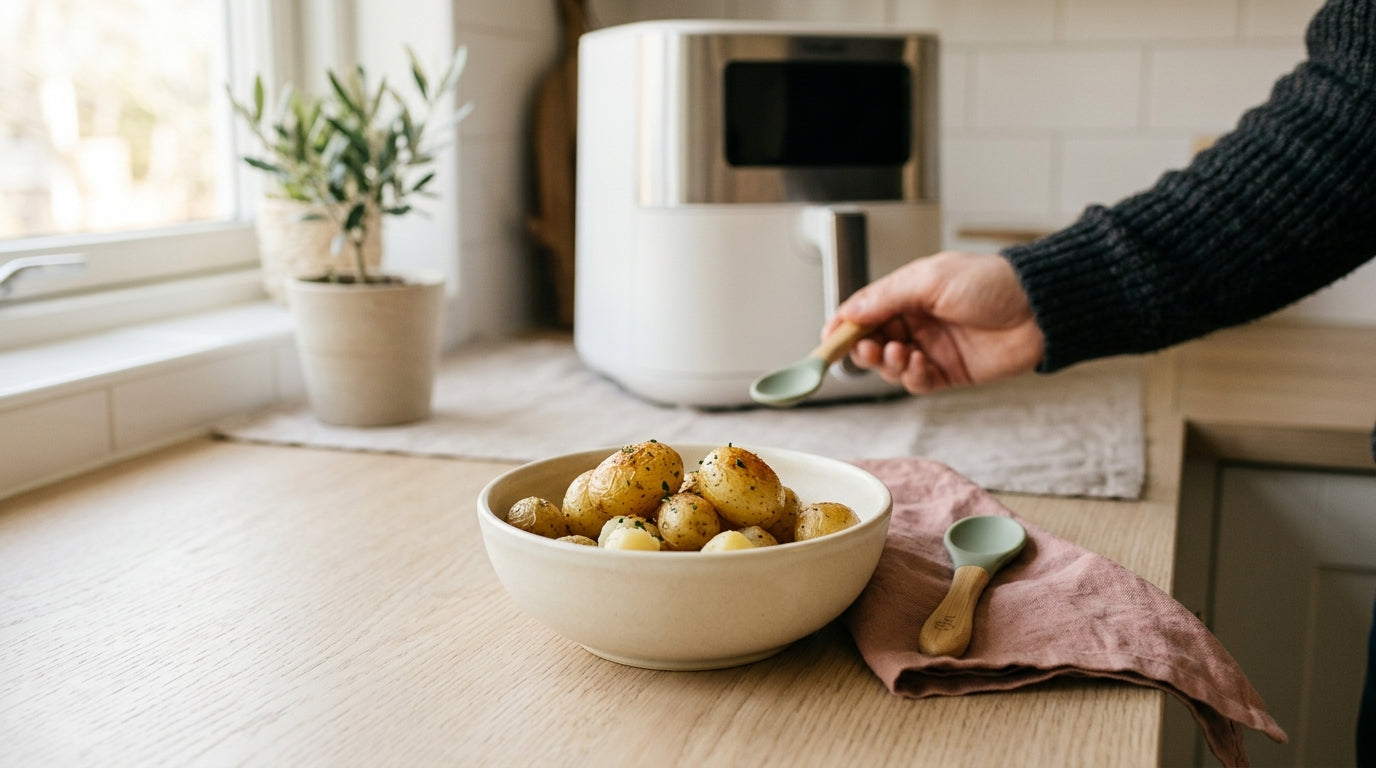
But I'm writing this from the future—well, 11 months into this parenting gig—to tell you that cooking small root vegetables doesn't have to be a nightmare. In fact, throwing a baby potato into the convection basket on your counter is going to become your default troubleshooting step for a hungry, screaming child. Let's debug this process together.
Why spherical starches ruin my sleep architecture
If you're anything like me, you approach risk management by assuming the worst-case scenario. When we went to our doctor, Dr. Aris, she mentioned that round, firm foods are a primary choking hazard. She didn't give me the exact millimeter measurements of a 6-month-old's trachea, which was frustrating for my analytical brain, but she made it clear that a whole, uncut tuber is basically a perfectly designed airway blocker.
Apparently, you can't just toss them in a bowl and hope for the best. You have to alter their physical geometry. Dr. Aris suggested quartering them lengthwise to create little finger-like wedges, which eliminates the spherical danger and gives those tiny, uncoordinated hands something to grip. It makes sense when you think about it like a hardware compatibility issue—the port is small, so you've to reformat the input data to fit.
The firmware update for your kitchen hardware
Culinary blogs will give you a fifty-step recipe with rare herbs, but we don't have time for that. The air-frying device on your counter is basically an un-bricked convection oven running an aggressive heating script, and it's going to save your sanity. Here's the messy, iterative process we actually use to get food on the high chair tray before a meltdown occurs.
- The scrub down: You'll want to wash the dirt off and pat them aggressively dry with a towel because wet skin just steams and turns into a sad, soggy mess instead of crisping up.
- The geometric modification: Slice each baby potato lengthwise into quarters, destroying their dangerous spherical shape and turning them into harmless little wedges.
- The lipid coating: Drench them in avocado oil or olive oil. I read somewhere that high-quality fats are big for developing their neural pathways, and considering my son just tried to eat a dust bunny, he needs all the brain development he can get.
- The execution script: Toss them in the basket at 400 degrees Fahrenheit for about 15 to 20 minutes, shaking it around halfway through whenever you remember.
Managing the extreme thermal output
Here's a fun physics lesson I learned the hard way. The crispy exterior of an air-fried wedge cools down incredibly fast when exposed to ambient room temperature. You touch the outside, think it's perfectly safe, and hand it over. But the dense interior? That's a molten core of geothermal energy.

Always, always break one open and test the inside temperature on your wrist or the back of your hand before serving it. I usually smash them flat on a heavy-duty silicone plate just to vent the steam. It ruins the aesthetic, but it prevents your kid from experiencing a localized thermal event in their mouth.
The structural integrity test
How do you know when they're actually done? You have to perform the smush test. If you pinch a wedge between your thumb and index finger, it should give way with almost zero resistance. If it feels rubbery or fights back, put it back in the heat. Babies without molars are just mashing things with their gums, so the food needs to be structurally compromised before it even enters their mouth.
Also, a quick note about the skins. For older toddlers, the crispy skin is great texture. But for a 6-month-old just starting out, my wife gently reminded me that the skin can stick to the roof of their mouth like a bad piece of adhesive tape. So, in those early weeks, you might find yourself manually peeling tiny roasted wedges while questioning all your life choices.
Stains, messes, and acceptable collateral damage
Let's talk about the physical reality of feeding an infant. My son is 11 months old now and operates like a high-velocity organic matter launcher. He doesn't just eat; he experiments with gravity, trajectory, and abstract art.
We initially tried dressing him nicely for meals. I put him in his Organic Cotton Baby Bodysuit, which I genuinely love because the envelope shoulders stretch easily over his massive head without triggering a wrestling match. It's incredibly soft and breathable. But honestly? Letting him wear pristine, undyed organic cotton while handling greasy, paprika-dusted root vegetables was a spectacular failure in judgment. The fabric is amazing for his sensitive skin, but olive oil stains don't care about GOTS certification. Strip your kid down to a diaper for dinner, or just accept that their wardrobe is going to look like a Jackson Pollock painting.
If you're tired of ruining clothes and want to browse apparel that can at least survive the washing machine, check out Kianao's organic baby clothes designed for actual, messy lives.
Sodium is a systemic threat
Before you instinctively reach for the salt shaker, pause the execution. My doctor made a huge deal about infant kidneys, explaining that they're absolutely terrible at filtering sodium. I don't fully understand the osmotic pressure limits of a tiny human's renal system, but I'm pretty sure their kidneys are the size of grapes and easily overwhelmed.

The World Health Organization apparently agrees, so we strictly ban added salt for his portions. Instead, we heavily season with garlic powder, onion powder, and maybe some dried thyme or rosemary. You pull his bland, herb-covered portion out of the basket first, and then you salt the remaining batch for yourself so you don't feel like you're eating unseasoned hospital food.
Jaw calibration and system prep
One thing that completely surprised me was how much jaw strength is required to gnaw on even a soft piece of food. Long before we gave him his first actual meal, he was chewing on every inanimate object in our living room.
We eventually redirected that destructive energy toward the Bear Teething Rattle Wooden Ring. He treated that untreated beechwood ring like a chew toy, grinding his gums against it for hours. Looking back, I swear he was just running calibration tests on his jaw muscles, building up the bite force he'd eventually need to demolish a plate of roasted carbs. Plus, the little crochet bear face gave him something to stare at while I frantically googled choking protocols.
The aftermath and shutdown sequence
Once the feeding frenzy is over, your kitchen will look like a disaster zone, and your baby will likely be covered in a fine layer of starch and fatigue. This is when the system starts to crash, and you need to initiate the shutdown sequence quickly.
After wiping off the worst of the grime, we usually wrap him up in the Organic Cotton Baby Blanket with Squirrel Print. This is, without a doubt, my favorite piece of baby gear we own. It's absurdly soft right out of the package, and the double-layered cotton actually absorbs the residual moisture from his post-dinner wipe-down. When he's exhausted from throwing food on the floor for twenty minutes, wrapping him in this woodland-themed fabric instantly calms his erratic system. It's like flipping a switch.
Before you run off to slice tiny tubers into geometrically safe wedges, make sure you're equipped for the inevitable chaos of mealtime. Grab some breathable essentials from our baby collection to swaddle your exhausted, carb-loaded child. You're going to need all the help you can get.
The Messy FAQ
Because I know you still have questions, and the internet is full of conflicting data, here are the real answers from a dad who's just trying not to mess this up.
Do I really have to peel the skin off for a baby?
For a 6-month-old just starting out, my wife and I found that peeling the skin off makes life way easier. The air-frying process makes the skin tough and papery, and babies don't have the saliva production or teeth to break it down quickly, so it just gets glued to the roof of their mouth. By 9 or 10 months, we stopped bothering, but early on, peel it to avoid the gagging drama.
How soft does the inside genuinely need to be?
It needs to be structurally defeated. If you pinch the thickest part of the wedge between your thumb and pointer finger, it should collapse into mashed potatoes instantly. If you've to squeeze hard, it needs another 5 minutes in the heat. Babies are just mashing things against their hard palate, so do the heavy lifting for them in the oven.
Can I batch cook these for the whole week?
You can, but the fridge changes the texture. They get weirdly dense and rubbery after a day in the cold. I usually only cook enough for two days at a time. When you reheat them, you've to be super careful because the microwave heats unevenly and creates random hot pockets that will burn your kid's mouth. I usually just smash cold leftovers into some full-fat yogurt.
Why does my kid just squish them and throw them on the floor?
Because they're tiny scientists testing physics, and you're the stressed-out lab assistant cleaning up the mess. Our doctor said playing with the food is part of mapping the sensory data of eating. It drives me crazy when I spend 20 minutes prepping a meal just for it to end up on the dog's head, but apparently, it's a vital developmental milestone. Just nod, smile, and keep a broom nearby.




Share:
The Messy, Exhausting Truth About What It Takes To Adopt A Baby
Aishiteruze Baby And The Massive Lies I Believed About Motherhood