

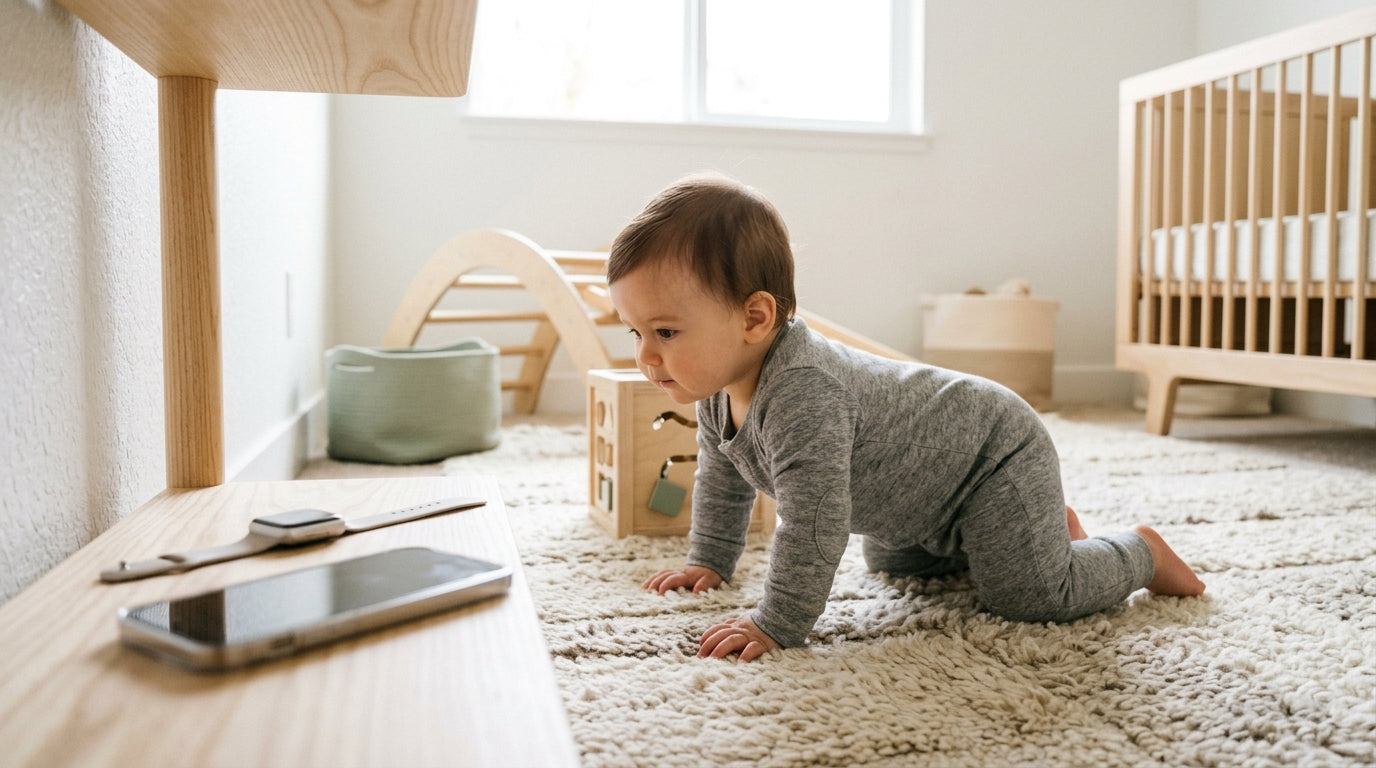
I'm lying flat on the cold oak floor of our Portland living room with a digital laser measure, trying to calculate the exact trajectory of my eleven-month-old daughter. She isn't moving toward me. She's pushing herself violently backward like a reversing dump truck until she gets wedged under the TV stand. I literally searched the exact phrase "at what age do babies start crawling" on my phone while watching her do this, convinced I had missed a key firmware update in her development. I had this whole timeline mapped out in my head before she was born. Six months: sit up. Seven months: crawl. Twelve months: walk. It sounded like a straightforward software release schedule, but apparently, infant mobility is a lot more chaotic than writing code.
My wife frequently points out that I treat our kid like a machine that requires debugging, which is fair. I track everything. I know exactly how many wet diapers she produces, I keep the nursery at precisely 68.5 degrees, and I've spent hours logging her floor time in a spreadsheet. But with mobility, I've had to completely throw my data models out the window.
The timeline I had in my head vs reality
Before she was born, I assumed crawling was a binary state where you wake up one Tuesday and the kid is just executing a flawless hands-and-knees maneuver across the living room rug. I thought the window was tight. If she wasn't moving by seven months, I assumed a critical error had occurred.
Then I took her to our doctor, spiraling about her lack of forward momentum. He looked at my spreadsheet, sighed, and told me that the Centers for Disease Control actually patched their milestone guidelines a couple of years ago and entirely removed crawling from the list. Removed it! I was stunned. He explained that a massive chunk of perfectly healthy babie just skip the whole crawling phase completely and go straight to pulling up on furniture like tiny, wobbly bar patrons. I didn't know you could just skip a prerequisite skill. That's like jumping into advanced calculus without learning basic addition first.
He said the normal window is anywhere from seven to ten months, but even that's just a rough estimate. Every kid is running their own unique operating system, and you just have to wait for them to process the data.
Bugs in the movement software
I really need to talk about the reverse gear, because nobody warned me that babies usually go backward first. It's a fundamental design flaw in the infant anatomy. Apparently, their arms upgrade to the new firmware way faster than their legs do. So they push up, their arms lock, and they just slide backward across the floor like a puck on an air hockey table. I watched my daughter shove herself backward for three straight weeks.
She'd spot a toy she wanted, get highly motivated, push with her arms, and immediately slide farther away from her target. It's both heartbreaking and hilarious. The sheer amount of frustration that builds up in a 9-month-old who's actively moving away from her objective is terrifying to witness. I spent days just plucking her out from under the sofa because she'd reverse herself into a corner and get stuck.
Some kids just drag their bellies across the floor like army snipers, which is fine I guess. Others do this weird bear crawl where they lock their elbows and knees and look like a Halloween decoration. My wife had to gently remind me to stop panicking every time our daughter invented a new, highly inefficient way to drag her body across the carpet. It isn't wrong, it's just an alternative traversal mechanic.
Hardware requirements for traction
Traction is a massive issue I totally overlooked. Hardwood floors are basically ice rinks for a babi in fleece pants. I didn't realize her clothing was acting as a physical barrier until my wife stripped her down to just a diaper one afternoon, and suddenly she had four-wheel drive. Skin provides grip.

I thought she needed protective gear. I was literally about to order miniature tactical knee pads off the internet because I cringed every time I heard her knees thud against the floorboards. My doctor laughed at me and explained that baby kneecaps are mostly soft cartilage right now, not hard bone, so they don't feel the impact like my 34-year-old knees do. They don't need padding, they need friction.
If you want them to get a grip while still keeping them decent, you need super stretchy, non-restrictive stuff that exposes their little feet. You can grab some solid organic baby essentials that actually let them bend their joints without turning them into immobile starfish on the floor.
Baiting the system
So how do you actually get them to move forward? You have to bait them. I've tried everything. The TV remote. My expensive mechanical keyboard. My smartwatch. But teething toys work the absolute best because at this age, they're aggressively trying to chew on every object they encounter anyway.
The absolute highest conversion rate I've seen for forward movement is when I dangle the Llama Teether Silicone Soothing Gum Soother just out of reach. This thing is easily my favorite piece of baby gear right now. It has this little heart-shaped cutout right in the middle, and my daughter is obsessed with hooking her tiny index finger through that hole and carrying it around like a tiny, colorful briefcase. When I place that llama on the floor three feet away, she will completely recompile her movement strategy to drag herself toward it. I love it because it's food-grade silicone, so when she inevitably drops it in a dust bunny, I just toss it in the dishwasher.
We also use the Bubble Tea Teether for bait sometimes. I've a serious boba addiction, so I think it's deeply amusing to see my kid clutching a tiny boba cup while trying to army-crawl. It's got a great textured top that she loves chewing on when her gums are acting up.
On the other hand, the Koala Teething Rattle Wooden Ring is just okay for floor time. Don't get me wrong, the untreated beechwood ring is fantastic, and she loves the sound it makes. But it has this soft crochet koala head on it, and we own a golden retriever. The exact second that crochet material touches our living room rug, it becomes an absolute magnet for dog hair. If you've a pristine, pet-free house, it's probably brilliant. In my house, it requires a lint roller before I can let her chew on it, so we strictly keep that one in the stroller now.
The wiring happening behind the scenes
Even though it isn't an official milestone anymore, pediatricians still really want babies to do floor time. I asked why, and I got a fascinating answer about cross-lateral movement. Moving the right arm and left leg together does some heavy lifting in the brain.

Apparently, this alternating movement fires neurons across the corpus callosum. It helps the left and right hemispheres of the brain talk to each other. The doctor made it sound like laying high-speed fiber optic cable between two servers. This cross-wiring supposedly helps with fine motor skills way down the line, like holding a pencil or figuring out how to zip up a jacket. So even when she was just scooting backward in circles, we kept putting her on her tummy. Just endless, exhausting blocks of tummy time while I sat there cheering her on like a weird sports coach.
The panic protocol of babyproofing
I read an article quoting a doctor from Lurie Children's Hospital saying the biggest mistake parents make is waiting for the kid to become mobile before babyproofing. I can absolutely confirm this is true. The latency between "she can't move at all" and "she's currently trying to lick an exposed electrical outlet" is about 4.2 seconds.
I had to lock down our living room like a secure server room. I bought heavy duty anchors and strapped all our bookshelves to the drywall. I bought a 40-pack of outlet covers and spent an entire Saturday plugging them in while my wife laughed at me for using a tape measure to make sure adequate clearance between the coffee table and the sofa. I basically built a "Yes Space" — a fully enclosed, zero-hazard zone where I don't have to hover over her saying "no" every ten seconds. It's literally the only place in the house where I can drink a cup of coffee without my heart rate spiking.
The reality is, you can't force the hardware to update. Babies crawl when they're ready, or they just figure out how to stand up and completely bypass the crawling phase to mock your meticulous spreadsheets. All you can do is clear the floor, put down some good bait, and wait for the system to boot up.
If you're dealing with a frustrated pre-crawler who just wants to chew on things while they figure out their limbs, check out Kianao's full range of organic teething toys to use as highly good floor bait.
My Troubleshooting FAQ
What's the actual timeline for crawling?
Honestly, it's a massive window. My doctor said most babies start figuring out some form of movement between 7 and 10 months. But a lot of them just skip it entirely and go straight to pulling up. Throw your calendar away, it'll just make you anxious.
Why is my baby only crawling backward?
Because their arms are way stronger than their legs right now! It's super frustrating for them, but it's totally normal. They push up, their arms lock, and they just slide in reverse. It usually lasts a few weeks before they figure out how to put it in drive.
Do I need to buy baby knee pads for my hardwood floors?
No, I almost bought some too, but it's a waste of money. Baby kneecaps are soft cartilage, not hard bone like ours. They don't hurt themselves crawling on hard floors, but they do need bare skin for traction, so take off those slippery fleece pants.
Is it a problem if they do a weird commando army crawl?
Not at all. Bear crawls, belly scoots, crab walks—it's all valid data. As long as they're using both sides of their body to explore their environment, my doctor said I didn't need to stress about the exact form.
How can I get them to finally move forward?
Put something they desperately want just out of reach. For us, it's colorful silicone teethers or whatever electronic device I'm currently trying to use. Just make sure you do it on a surface where they can genuinely get some grip, like a play mat or a rug.




Share:
What Is A Baby Boomer? A Survival Guide to Modern Grandparents
The Truth About Ugly Baby Gear and Why I Stopped Caring