

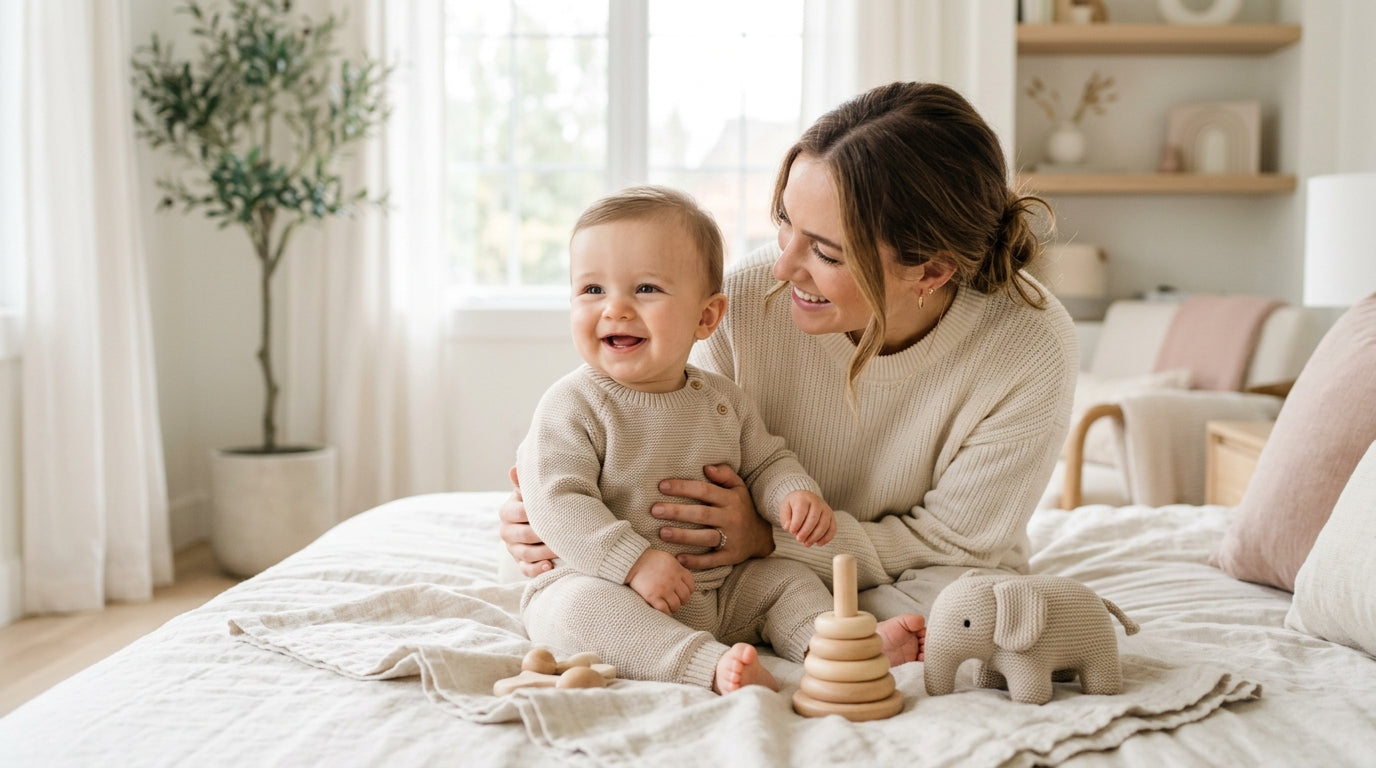
My mother-in-law cornered me by the spinach dip station at my cousin's baby shower when my son Leo was seven months old and confidently declared that because he was currently blowing spit bubbles, he was practically reading. "He's making the 'mmm' sound," she whispered, clutching a celery stick like a magic wand. "He'll be having full conversations by Tuesday." Then, like, twenty minutes later my own mother handed me a lukewarm cup of coffee—which was actually decaf, the ultimate betrayal of my exhausted soul—and told me that I didn't utter a single sound until I was nearly two so I shouldn't hold my breath. Finally, just to round out the trifecta of completely unhinged advice, the random lactation consultant I was still texting at 3 AM for some reason replied to a video of Leo squealing by suggesting that all early vocalizations are usually just disguised acid reflux.
Absolute crap. All of it.
I remember sitting in my car after that shower, wearing a maternity dress I still couldn't zip all the way up, literally typing when do babie talk and babi milestones into my phone with one thumb because I was too tired to even spell check my own late-night panic searches. The internet is a terrifying place when you're sleep-deprived. You'll read one forum that says your kid is a genius and the next one tells you that if they aren't reciting Shakespeare by their first birthday, you've failed as a mother. Anyway, the point is, waiting to figure out exactly when do babies finally say mama is this bizarre waiting game where you're hyper-analyzing every single grunt and burp.
I desperately wanted Leo to validate my existence. I was doing 95 percent of the midnight feedings, dealing with the cracked nipples, washing the endless stream of tiny socks that somehow always lost their mates in the dryer, and I just wanted him to look at my exhausted, unwashed face and acknowledge me. Just one little word.
The great dada betrayal of two thousand eighteen
Let's just talk about the elephant in the room right now because it still burns me up inside. My husband Mark is a great guy, really, but during Leo's first year, Mark’s primary contribution to the household was occasionally taking the trash out and making funny faces while I wrestled a screaming infant into a car seat. So you can imagine my absolute horror when Leo, at around eight months old, looked his father dead in the eye and said, "Da-da."
I cried. I actually went into the bathroom, sat on the edge of the tub, and cried into a damp towel. It felt so incredibly unfair. I was the one keeping this tiny human alive!
But when I brought this up to my pediatrician—Dr. Evans, who always smelled faintly of peppermint and mild judgment—she laughed at me. She told me it's honestly just a mouth mechanics thing, which is my highly unscientific way of explaining what she said about phonetics. Apparently, making a 'd' sound just requires a lazy flick of the tongue against the roof of the mouth, whereas making an 'm' sound means a baby has to figure out how to press their lips together in a very specific, coordinated way. It's just easier to say dada. Plus, Dr. Evans pointed out that because I was the one home with Leo all day, I was constantly pointing at the door saying, "Look, Dada is home!" or "Give that wet piece of toast to Dada!" I was literally programming my own child to say my husband's name first because nobody talks about themselves in the third person unless they're a professional wrestler.
So if your kid says dada first, it isn't because they love your partner more. It's just because their tongue is lazy. And that's a scientific fact, or at least, that's how I choose to interpret the medical literature to protect my own ego.
What my pediatrician actually told me about the timeline
Dr. Evans sort of sketched out this vague timeline for me on the back of a prescription pad, and I kept it stuck to my fridge for like three years. From what I gather, there's this huge difference between a baby just making noise because they realized they've vocal cords, and a baby really using a word to get your attention.

Between six and nine months, babies are just in this loud, chaotic practice phase. Maya, my second kid, would sit in her high chair at seven months old and just yell "ma-ma-ma-ma-ba-ba-pa" at her peas. She wasn't calling me. She was just experimenting with the fact that her lips could make sounds. It's cute, but it's totally meaningless.
The real magic apparently happens somewhere between ten and fourteen months. That's when their little sponge brains figure out that specific sounds equal specific things. Dr. Evans said that for a word to "count" as a real first word, they've to use it in context—like looking right at your face while reaching for you—and they've to do it every time, not just once as a fluke when they sneeze. I guess statistics suggest that most kids will drop their first real, intentional word right around their first birthday, give or take a few months, but honestly, every kid is on their own weird, unpredictable schedule.
How I desperately tried to force the issue
Because I'm a control freak with mild anxiety, I tried to hack my children's language development. Please don't buy those black-and-white flashcards, they're stupid and your baby will just try to eat the cardboard anyway.

Instead of, like, forcing them to stare at your mouth while you aggressively chew sweet potatoes and chant "MAMA" at them until they cry, you just have to sneak the sounds into regular stuff. I found out that mealtime is seriously the best time to practice because they're already using their lips to eat. I'd sit there feeding Maya mashed carrots and just over-exaggerate going "Mmmmmm!" every time she took a bite. I sounded completely deranged.
Speaking of mouths and chewing, something that genuinely weirdly helped with their oral motor skills was keeping them constantly supplied with good things to gnaw on. Both of my kids were aggressive chewers when their teeth started coming in. I bought the Panda Teether Silicone Baby Bamboo Chew Toy for Maya when she was around five months old because I was desperate to stop her from chewing on the television remote. It's honestly one of the few baby products I still suggest to people. It's 100% food-grade silicone, completely non-toxic, and it has these little textured bumps that she would just aggressively mash her gums against. I used to throw it in the fridge for ten minutes while I made my afternoon coffee, and the cold silicone was the only thing that stopped her from screaming during the dreaded 4 PM witching hour. Plus, my sister is a speech pathologist and she mentioned once that chewing on varying textures genuinely helps strengthen the jaw and lip muscles they need to eventually make those hard 'M' and 'P' sounds. So I considered it educational.
On the flip side, Mark insisted we needed to buy this aesthetic wooden activity thing because he read a blog post about sensory development. We got the Wooden Baby Gym | Rainbow Play Gym Set with Animal Toys. Don't get me wrong, it's objectively gorgeous. It's made of responsibly sourced wood, and the little hanging elephant matches the neutral vibe of my living room perfectly. But Maya liked it for exactly five minutes at a time. She would lay under it, bat at the wooden ring twice, and then immediately roll over and try to eat lint off the rug. It looked fantastic in my Instagram photos, and maybe it helped her depth perception or whatever, but it certainly wasn't the magical playtime solution Mark promised it would be. Kids are fickle.
The red flags I obsessed over at two in the morning
I feel like every parenting article on the internet is designed to terrify you. You're just trying to figure out when do babies naturally start doing the thing, and suddenly you're convinced your child is hopelessly behind.
Dr. Evans gave me a pretty grounded rule of thumb that seriously helped me sleep at night. She said to bring them in for an evaluation if they aren't babbling at all by ten months. Like, if they're just completely silent and not even trying to string consonants together. The other thing she mentioned was that if we hit 15 or 16 months and there wasn't a single intentional word—not even a made-up word for a dog or a cup—then we should probably get their hearing checked or see a speech therapist. Sometimes kids just have fluid in their ears from recurrent ear infections that muffles everything like they're underwater. It doesn't mean anything is permanently broken, it just means they might need a little professional nudge.
Anyway, Leo finally said Mama. He was fourteen months old. I was wearing sweatpants with spit-up on the knee, standing in the kitchen trying to aggressively scrub dried oatmeal out of a bowl, and he just waddled in, hugged my leg, looked up, and said it. Clear as day. "Mama."
It was perfect. I picked him up, completely forgetting about the oatmeal, and just held him. To celebrate, I immediately dressed him in his nicest outfit—a little Organic Cotton Baby Bodysuit we had been saving—and we went to the park so I could brag to the other moms. He proceeded to not say it again for three days, but I didn't care. I had won.
If you're in the trenches right now, waiting for that sweet little voice to finally acknowledge your existence, just hang in there. Keep reading the books, keep making those ridiculous "mmm" sounds over your coffee, and let them chew on safe stuff to build those mouth muscles.
Want to see the teething gear that genuinely saved my sanity? Explore our teething toys collection for the non-toxic lifesavers that help with those early oral motor skills.
You're doing great. Even when they call the mailman Dada before they figure out your name.
Ready to upgrade your baby's everyday basics with sustainable, organic materials? Shop our organic baby essentials right here.
Random questions I aggressively googled about baby speech
Does it count if they're crying and screaming ma-ma-ma?
According to my pediatrician, absolutely not. I used to think Leo was begging for me when he was having a meltdown in his crib, but it turns out "ma-ma-ma" is just the easiest sound a baby can make when their mouth is wide open and they're wailing. It's a distress noise, not your name. Sorry to break your heart.
Why does my kid say 'dog' before they say my name?
Because dogs are cooler than we're. Honestly, babies latch onto words that are exciting and highly repetitive in their environment. If the dog is constantly running around and you're constantly yelling "Dog! Look at the dog!" your baby is going to prioritize that over "mama," mostly because you never point at yourself and scream your own name in excitement.
Is my mother-in-law right about late talkers being geniuses?
Look, the whole "Einstein didn't talk until he was four" thing is a total myth that older generations love to repeat at dinner parties. While it's true that late bloomers can be incredibly bright kids, language delays are just language delays. They don't mean your kid is a secret physics prodigy, and they don't mean your kid is struggling either. It's just a developmental timeline variance.
How do I get them to really look at my face when I'm modeling words?
Hold things right next to your eyes. I used to put Maya's favorite silicone teether practically on my nose before handing it to her. If you want them to watch your lips make the 'M' sound, you've to bring the object of their desire up to your face level. It makes you feel ridiculous, but it totally works.
Should I be correcting my baby when they mispronounce things?
God no. If they call a banana a "nana," you don't need to sit there like an English professor correcting them. Just naturally say the right word back in a positive way. "Yes, that's a big banana!" Making them feel bad or pressured about language is the fastest way to get them to stop trying altogether. Keep it messy and fun.




Share:
When Do Babies Start Seeing Color? A Letter to Past Me
When Do Babies Roll From Back to Belly