

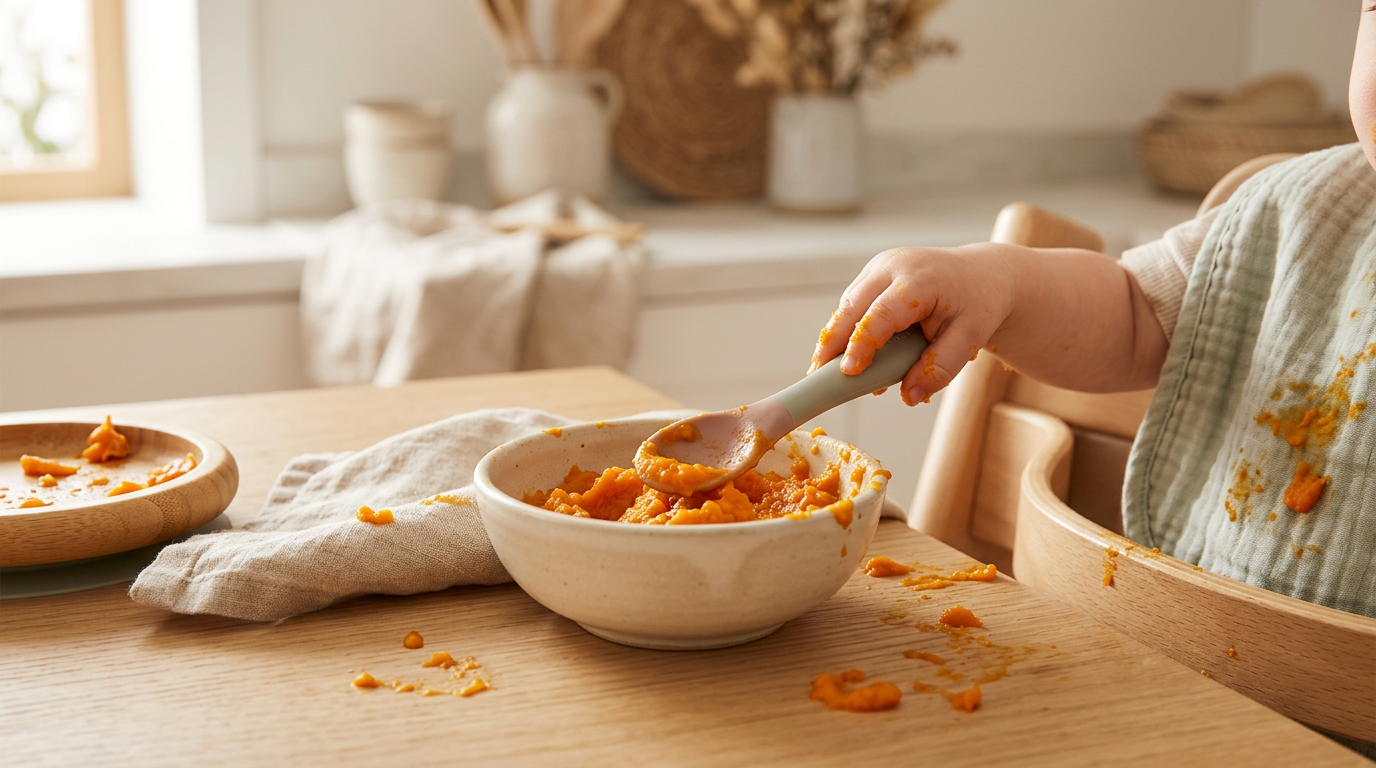
I was wearing a cream-colored sweater, which, let’s be honest, is the first and most obvious mistake I made that day. It was around 5:30 PM, the exact hour when my blood stream is approximately four percent coffee and ninety-six percent pure, unadulterated exhaustion, and I was trying to feed seven-month-old Maya a bowl of homemade sweet potato puree that I had spent an hour steaming and blending because I was in my "I'm going to make all my baby's food from scratch" phase.
Maya wasn't having it.
I was doing that thing where you hold their tiny, flailing arms down with one hand like you’re in some sort of underground wrestling match, while trying to pry their jaw open with a hard plastic spoon using your other hand. She arched her back, managed to wrench her left arm free, and swatted my hand with the force of a tiny, angry ninja.
The spoon acted as a literal catapult. A thick, bright orange glob of sweet potato launched through the air, completely missing my cream sweater (a small mercy) and landing with a wet smack right squarely in the center of my husband Dave’s forehead just as he walked into the kitchen. The dog immediately lunged at Dave’s face.
Maya started screaming. Dave was frozen, dripping orange goop. I just dropped the spoon on the floor and started crying, because feeding your kid is supposed to be this magical, bonding, Instagram-filtered milestone, and instead, my kitchen looked like a crime scene and my baby was looking at me like I was her mortal enemy.
The doctor appointment that made me feel like an absolute idiot
A few days after the Sweet Potato Incident, we had Maya’s checkup, and I sat there on the crinkly paper of the exam table practically in tears, confessing to Dr. Miller that my child hated eating and I was failing at basic mammalian duties.
Dr. Miller, who has this incredibly calming voice that makes you feel both deeply comforted and slightly dumb, asked me to walk her through exactly how I was feeding Maya. I told her about the airplane game, the sneaking the spoon in when she opened her mouth to cry, the holding her hands down. Basically, all the desperate crap you do when you just want them to swallow three ounces of vegetables.
And that’s when my doctor gently blew my mind about something called "responsive feeding."
I guess the old-school way we were all fed—where the parent controls the spoon and jams it in until the bowl is empty—is actually super outdated. My doctor explained that when we force a baby to eat past the point where they're turning their head away or closing their mouth, we're basically overriding their natural fullness cues. She mentioned some studies about how babies who are rigidly spoon-fed without regard for their own signals actually have a higher risk of childhood obesity later on because they never learn how to listen to their own bodies telling them they're full.
I don't completely understand all the science behind it, but the gist was terrifying enough to make me realize I needed to back the hell off. She told me to hold the spoon a few inches from Maya's face and literally just wait. If she leans in and opens up, she gets a bite. If she ignores it or swats it away, the meal is over. It sounded impossible. It sounded like she would starve to death on my watch.
What I fundamentally misunderstood about tiny human hands
thing is no one tells you about baby spoons: we expect these tiny creatures, who literally just figured out they've hands a few months ago, to understand the physics of scooping.

I was trying to use these deep, long-handled rigid spoons that someone bought me off a registry. They were fine for me to hold, but when Maya inevitably demanded to hold the spoon herself around eight months old, it was a disaster. Babies at that age don't hold things with a delicate pencil grip; they use a full-on monkey fist grasp.
They drop it, they gnaw on the wrong end, they bang it on the tray to make noise. They aren't trying to be difficult, they're just exploring the concept of cause and effect, which is apparently a huge developmental milestone even if it makes you want to pull your hair out while you wipe yogurt off the cabinets.
Anyway, the point is, you can't just buy one type of spoon and expect it to work from six months to two years. It's a whole evolution.
The utensils that actually saved my sanity
After the doctor visit, I went down a 3 AM rabbit hole searching for the best baby spoons and ended up overhauling our entire feeding setup. And I've to be completely honest about what worked and what was just okay.
My absolute, holy-grail, buy-it-for-every-baby-shower favorite is the Silicone Baby Spoon and Fork Set. Let me tell you why this specific set changed our lives. When Maya was in that phase where she refused to let me feed her but lacked the coordination to honestly scoop anything herself, these were perfect. Because they're 100% food-grade silicone, she could grab the chunky handle with her little fist and just chew on the thing. I'd dip it into mashed avocado, hand it to her, and she would gnaw the puree off. It didn’t matter if she held it sideways or upside down. It was soft on her teething gums, and if she threw it across the room (which she did, constantly), it didn’t make that nerve-shattering clatter on the hardwood floor.
Now, Dave’s favorite was different. He is very into aesthetics and sustainable materials, so he bought the Bamboo Baby Spoon and Fork Set. They're genuinely beautiful, and I love that they're an eco-friendly alternative to cheap plastics. The silicone tips are great. But I’ll be real with you—these were much better for me to hold during the early parent-led feeding days. The long, smooth bamboo handle was comfortable for my hand, but when Maya was in her chaotic, banging-things-on-the-table phase, the bamboo was a bit too rigid for her to self-feed with. We still use them constantly now that she’s older and has actual motor skills, but for the messy 6-to-9-month window, the all-silicone ones were the undisputed champions.
Oh, and pro tip: half the time Maya was fussing in the highchair, it wasn't because she hated the food, it was because her teeth were coming in and eating hurt. I started keeping a Panda Teether right on the tray next to her bowl. Sometimes I'd even stick it in the fridge before dinner. She would chew on the cold panda for a few minutes to numb her gums, and then she'd honestly be willing to eat. Finding random things to distract them so they don't realize they're eating vegetables is half of parenting, right?
(If you're in the thick of the messy feeding stage, take a deep breath and check out Kianao's Solid Food & Finger Food collection. It seriously helps.)
Why I finally stopped scraping her chin
Okay, I need to rant about this for a second because it's a compulsion that almost every parent has and it drives babies absolutely insane.

You know when they take a bite and half of it squishes out onto their chin, and you immediately use the hard edge of the spoon to scrape it off their face and shove it back into their mouth? Yeah, stop doing that. My doctor (gently, again) told me that babies hate this. Imagine eating dinner and a giant hand keeps coming down to scrape a metal shovel across your face. It's wildly annoying.
If you can just force yourself to suppress the urge to keep them perfectly clean and let the pureed carrots sit on their face while they eat, they genuinely learn to tolerate different sensory inputs and it makes mealtime way less combative.
Seriously, I gave up on keeping her clothes clean and just started dressing her in the Sleeveless Organic Cotton Baby Bodysuit for dinner because it's super stretchy, handles getting washed a million times without falling apart, and doesn't have sleeves for her to drag through her oatmeal. The mess is temporary. The food issues you create by making meals stressful last a lot longer.
The messy strategy that mostly kept us alive
Eventually, we settled into a groove that wasn't perfect but involved significantly less flying food. The biggest game-changer was the two-spoon trick. I'd hand Maya her silicone spoon to hold and wave around and chew on, and while she was distracted trying to master her own utensil, I'd use the bamboo spoon to slip bites into her mouth whenever she leaned forward and opened up.
I also started throwing some extra spoons into her bath time. I read on some mom blog at 2 AM that scooping bathwater builds the exact same hand-eye coordination they need for eating, and since my bathroom was already soaking wet, I figured why not. It genuinely seemed to help her figure out how to rotate her wrist.
It's messy, it's exhausting, and some days you'll just end up giving them puffs for dinner because you can't face the highchair cleanup. And that's fine. They eventually figure it out. Leo is seven now and uses a regular fork like a civilized human being most of the time, so there's light at the end of the pureed tunnel.
If you're staring down the barrel of six months and wondering how you're going to survive the transition to solids without painting your kitchen walls with avocado, do yourself a favor and get tools that really work with your baby's chaotic developmental stage. Explore Kianao's feeding accessories to find the right fit for your little one.
The messy questions you're probably asking yourself
How do I know when my baby is honestly ready for a spoon?
Okay, so everyone rushes this, but my doctor drilled into me that it's usually around 6 months, not 4. They need to be able to hold their giant wobbly head up on their own, sit up without you propping them with pillows, and most importantly, they need to have lost that reflex where their tongue automatically shoves everything out of their mouth. If they keep spitting it out, they probably just aren't ready yet.
Should I let my baby play with the spoon during meals?
Oh god, yes. It will drive your type-A tendencies crazy, but you've to let them bang it and chew on the handle. That's how they learn. If you constantly wrestle the spoon away from them to keep the kitchen clean, they just associate the highchair with frustration and crying. Give them their own spoon to ruin, and keep a second one for seriously feeding them.
Why is silicone better than plastic for baby spoons?
First of all, hard plastic hurts when they violently jam it into their own gums (which they'll do). Silicone is bendy and soft, so it doubles as a teether when their mouth is hurting. Plus, from a totally selfish standpoint, silicone doesn't have all the nasty BPAs and chemicals that sketchy cheap plastic does, and it survives the dishwasher flawlessly.
How do I stop my baby from throwing the spoon on the floor?
You don't. I'm sorry, I wish I had a magic trick for this, but dropping things is how they learn about gravity. It's a phase. You just pick it up, wash it off, and hand it back, or you buy those little silicone tether straps that attach the spoon to the highchair if you're really losing your mind.
Are bamboo spoons safe for babies to chew on?
Yes, the bamboo ones are safe, but they're hard. The Kianao ones have the soft silicone tip which is great for the actual food part, but the handle is solid wood. When Maya was deep in her teething phase, she preferred gnawing on the all-silicone spoons because they had more give. Bamboo is gorgeous and lasts forever, but just watch them so they don't poke the back of their throat with the hard end.




Share:
Dear past Priya: The truth about wooden blocks for your toddler
What No One Tells You About the Stokke Tripp Trapp Baby Set