

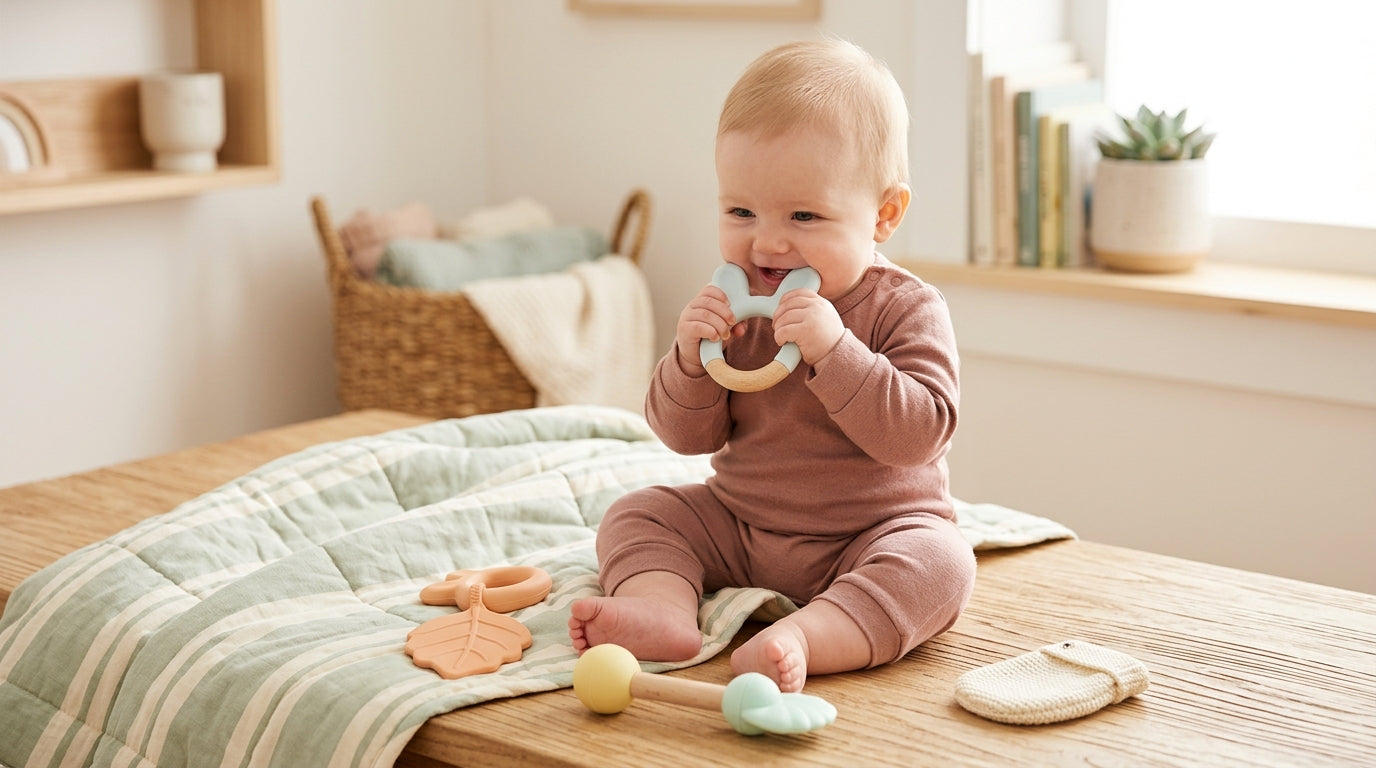
I spent five years in pediatric triage, and if I had a dollar for every time a parent told me their infant's 103-degree fever and explosive diarrhea was just teething, I could pay cash for my kid's future orthodontics. You're sitting there at two in the morning, holding a sweaty, miserable six-month-old, desperately wanting it to be teeth. It's easier to blame a biological milestone than to accept your kid picked up rotavirus at daycare. But let me be entirely clear from the start. Teething doesn't cause high fevers. It just doesn't.
My own pediatrician looked me in the eye at our six-month visit and said that if my son's temperature hit 100.4, it was an infection, not his gums. Teething might raise a basal body temperature slightly, perhaps hovering around 99 degrees on a fussy afternoon. It will definitely make them irritable. It will absolutely soak every single baby tee you own in thick, constant drool that smells vaguely of sour milk. But the systemic illness myth is a leftover wives' tale from before we knew how germs actually worked.
The timeline you can mostly ignore
You can tape a standard baby teething chart to your fridge if it makes you feel like you've control over the situation, but your child will likely ignore it. Biology is messy. Some babies are born with a tooth already sitting there, which is a terrifying surprise for nursing mothers, while others hit their first birthday with a completely gummy smile.
Generally speaking, around six to eight months, the bottom two front teeth show up. These are the lower central incisors. They look like little chiclets pushing through the bottom gum. They usually arrive with minimal drama compared to what comes later, mostly because they're thin and sharp enough to slice through the tissue without too much blunt force.
Then the top two come in around eight to twelve months. These upper central incisors are when they start looking like a tiny, deranged rabbit. You will try to take cute pictures of them smiling, but they'll just try to bite your phone. It's around this time you realize that nursing has become an extreme sport, and you've to start breaking their latch the second they get distracted so you don't lose a piece of yourself.
After that, the laterals drop in on either side of the front teeth. Then come the first molars, and this is where everything usually falls apart.
The absolute worst phase of dental development
The first molars are when you might start questioning your decision to become a parent. These blunt, wide teeth are trying to push through a surface area of gum that frankly seems too small for the job. This typically happens somewhere around 13 to 19 months, right when your toddler is also dealing with sleep regressions and newfound separation anxiety. It's a fantastic combination, yaar.

My son woke up every two hours for three days straight when his first molars cut. I just sat in the rocking chair in the dark, staring at the wall, wishing I could tap out. The pain of a wide tooth slowly bruising its way through the gum tissue is significant, and they don't understand why their mouth hurts constantly.
Eventually, the canines show up to fill the gaps between the incisors and the molars. They're pointy, which helps them erupt a bit easier, but by this point, your kid is probably close to two years old and has the vocal capacity to yell about it.
The garbage they sell desperate parents
Listen, the amount of unregulated trash marketed to sleep-deprived parents is actually criminal. Let me talk about amber teething necklaces for a minute. I've pulled these things off babies in the hospital more times than I can count. The theory sold by internet influencers is that body heat releases succinic acid from the amber, which somehow enters the bloodstream and miraculously reduces soreness.
There's zero clinical evidence this works, and even our loose understanding of skin absorption suggests it's biologically impossible. But even if we pretend it does work, you're wrapping a literal string of choking hazards around the neck of an unpredictable creature who lacks impulse control. It's a strangulation risk and an aspiration risk wrapped into one crunchy, bohemian package. I don't care if your sister-in-law swears by it. Your child is not a crystal shop display. Leave the amber on a shelf.
Also, skip the homeopathic belladonna tablets unless you enjoy the concept of accidental infant poisoning, which the FDA has warned about repeatedly because the dosing of a toxic nightshade plant in unregulated supplements is wildly inconsistent.
What actually numbs the mouth
The entire medical arsenal for gum pain comes down to pressure and cold. You apply counter-pressure to the swollen area, and you use cold temperatures to constrict the blood vessels and reduce the localized soreness. Wash your hands thoroughly and just rub your bare finger firmly along their gums, accepting the fact that they'll probably bite you hard enough to leave a mark.

For cold relief, you can use a damp washcloth chilled in the fridge, but wet cotton against the skin for too long causes its own horrible drool rash on the neck. This is where you need decent, easily washable silicone.
The Panda Teether from Kianao is the one thing I always kept in my bag. It's just heavy food-grade silicone, with no weird liquid inside that can puncture and leak mystery gel into your baby's mouth. I throw it in the fridge for twenty minutes. The textured bamboo part of the panda design is exactly what my son wanted to gnaw on when those upper incisors were making him miserable. More importantly, it goes straight into the dishwasher when it inevitably gets covered in floor dirt.
If you're looking to build a survival kit, you can explore our teething toys collection and wooden play gyms for more organic and sustainable baby products to keep them distracted.
You might see wooden options while looking around, like the Handmade Wood & Silicone Teether Ring. It's beautiful and the beechwood is naturally antibacterial. I own one. It's fine for what it's. My kid liked the silicone beads well enough during the day. But honestly, when it's 3 AM and the molars are coming in hot, you can't put wood in the fridge, and you can't run it through the dishwasher on the sanitize cycle. It's a very good daytime sensory toy, but it's not the heavy artillery you need for nighttime pain.
The Squirrel Teether, on the other hand, is excellent for the later stages. The little acorn detail at the top is the exact right shape to reach the back of the gums when those first molars start threatening to ruin your week. It gives them tap into to apply their own counter-pressure right where it hurts.
Taking care of the teeth once they arrive
Once those baby teeth genuinely break the skin, you've a new chore to add to the endless list. You have to brush them. I know it seems entirely pointless since they just fall out a few years later anyway, but severe decay in primary teeth can honestly rot the adult teeth that are still forming in the jaw bone beneath them.
My pediatric dentist told us to start using real fluoride toothpaste immediately, skipping those useless fruity training pastes. You only use a smear the exact size of a grain of rice. That's such a microscopic amount that even if they swallow all of it, which they absolutely will, it won't cause fluorosis or upset their stomach. You just get an extra-soft infant brush, pin their arms down gently because they'll fight you like a trapped badger, and wipe the bristles across the new teeth twice a day. Eventually, they stop screaming about it and it just becomes part of the routine.
We rely heavily on cold silicone and infant acetaminophen when the pediatrician says the weight-based dose is okay. It's a phase. It ends. Eventually, they've a mouth full of teeth and they just use them to refuse the dinner you cooked.
If you're staring down a long night of drool and tears, grab a silicone teether for the fridge and hang in there.
Answers to the questions you're Googling at 2 AM
Why is my baby biting my shoulder constantly?
Because their mouth hurts and your collarbone provides excellent counter-pressure. They're not trying to be aggressive. Their gums are throbbing, and biting down hard on something solid temporarily restricts blood flow to the inflamed tissue, which numbs it slightly. Give them a dense silicone ring instead of your actual body parts.
Can I just use the numbing gel from the pharmacy?
I'd strongly advise against it. Over-the-counter gels with benzocaine are really dangerous for infants. They can cause a rare condition called methemoglobinemia, which basically drops the oxygen levels in their blood to fatal levels. The FDA has warned against them for years. Stick to cold temperatures to numb the gums.
What if the teeth come out of order?
Nothing happens. The timeline is just an average based on population data. If the lateral incisors show up before the central ones, your kid will look like a tiny vampire for a few months, but it doesn't mean anything is structurally wrong with their jaw. They all get there eventually.
Does teething honestly cause sleep regressions?
Yes and no. The pain of a tooth cutting through the gum can definitely wake a baby up, especially since there are fewer distractions in the dark quiet of their room. But true sleep regressions are usually neurological and tied to major developmental leaps, like learning to pull to stand or walking. We just tend to blame teething because it happens to overlap with every single major motor milestone in the first two years.
When do the second molars arrive so I can prepare myself?
Usually around age two. They're often called the two-year molars. By that point, your kid will probably tell you their mouth hurts, which is slightly easier than dealing with a screaming six-month-old who can't communicate. They're huge teeth, but you'll survive those too.




Share:
When baby tears sims 4 complaints broke me during a 3am twin meltdown
The Search Box Betrayal: Telugu Cinema and My Infant's Brain