

I was thirty-four weeks pregnant, sitting on the floor of our Chicago apartment, staring at a miniature denim jacket. It was roughly the size of a large grapefruit and as stiff as a piece of cardboard. Someone had given it to me at my shower, along with a mountain of tulle skirts, glittery headbands, and smocked dresses covered in tiny, suffocating pearl buttons. I remember holding this tiny rigid jacket in my swollen hands and wondering who exactly puts raw denim on a seven-pound human who lacks neck control.
I worked in a pediatric unit for five years before I had my own kid. I used to stand at the nurses station and watch parents walk out to the elevator carrying their newborns in elaborate three-piece going-home outfits. We would share a look of quiet pity because we knew exactly what was going to happen when that kid had their first massive diaper leak on the Kennedy Expressway. But when it was my turn, the hormone haze wiped my brain clean. I convinced myself that finding the perfect wardrobe for my daughter was somehow tied to my competence as a mother.
Then she actually arrived, and reality hit me like a bag of wet laundry.
The hospital bag delusion
My husband brought our carefully curated duffel bag to the recovery room. I was exhausted, recovering from an emergency c-section, and running on nothing but ice chips and adrenaline. I tried to wrangle my screaming, slippery newborn into a stiff linen romper that had six microscopic buttons down the back.
It was a disaster. Her little limbs were tucked up against her chest like a frog, and she turned purple with rage every time I tried to thread her arm through a non-stretching sleeve. I gave up, cried a little, and put her back in the washed-out hospital-issued wrap shirt. It was ugly, but it worked. That was my first lesson in dressing a baby girl. Nobody cares about the aesthetic when it's three in the morning and everyone is crying.
When we got home, things got worse. My mother-in-law kept calling her baby g and buying her these incredibly synthetic, fuzzy pink sweaters that felt like they were spun from recycled plastic bottles. I put her in one for a family photo. Within two hours, she was sweating profusely and a violent red rash had bloomed across her chest and the delicate folds of her neck.
What happens when the rash appears
Listen, you can read all the books you want, but nothing prepares you for the sheer panic of seeing your baby covered in angry red hives. I rushed her to our doctor, Dr. Gupta, fully prepared for a complex medical diagnosis. She took one look at the rash, then looked at the fuzzy pink polyester monstrosity I had dressed her in, and sighed.
She reminded me of the basic dermatology I had somehow forgotten since leaving the hospital floor. They say an infant's skin barrier is something like thirty percent thinner than ours, which means it's basically non-existent. It absorbs everything it touches. Dr. Gupta told me that synthetic fabrics trap heat and moisture against this fragile skin, creating a perfect greenhouse for eczema and contact dermatitis. Add in the harsh agricultural pesticides used on regular commercial cotton, and you've a recipe for chronic skin issues.
She told me to strip her down, stick to organic cotton or bamboo, and throw the polyester away. You just dump all those cute, stiff outfits in a donation bin and surrender to the reality that your child will live in soft, stretchy basics for the next twelve months.
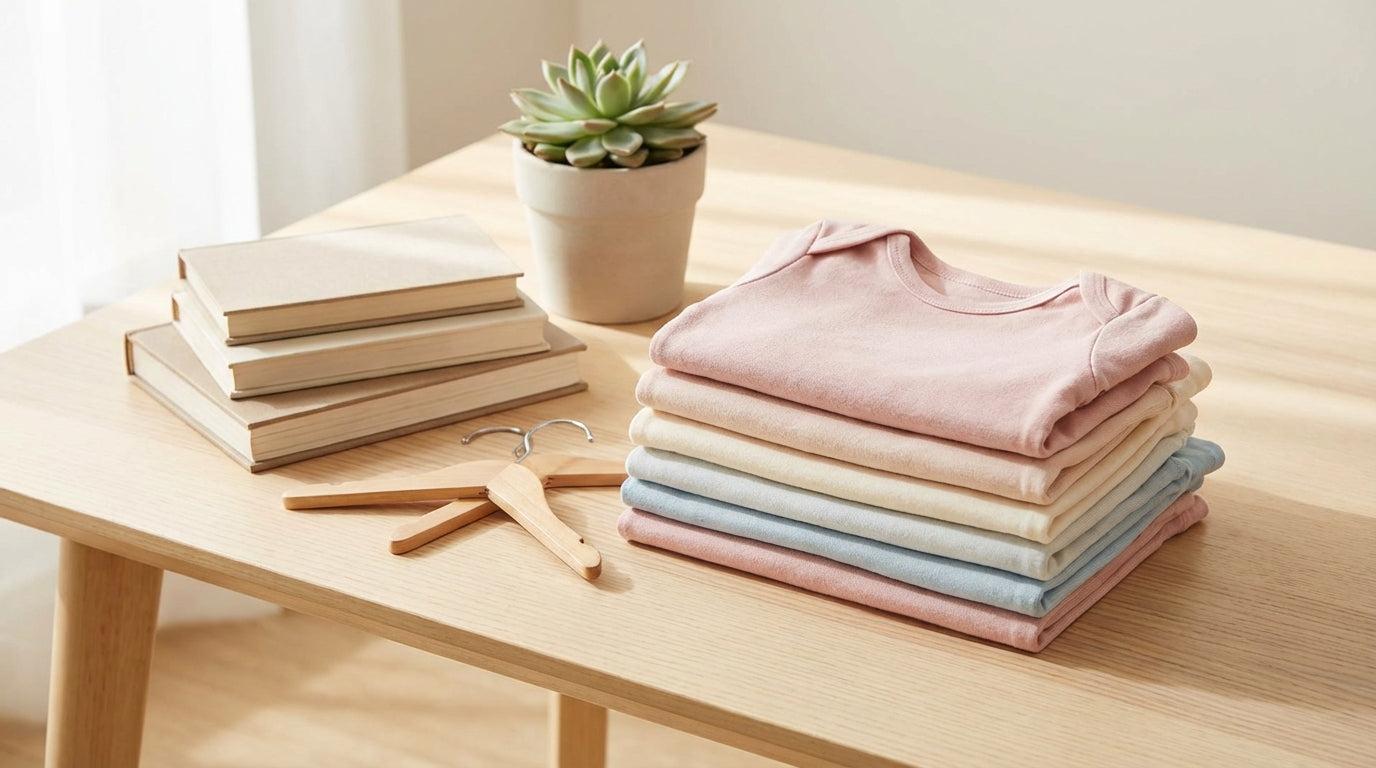
That's when I found the Short Sleeve Organic Cotton Baby Bodysuit from Kianao. I bought one out of desperation, and it quickly became our uniform. It's ribbed, which means it actually stretches over her massive head without trapping her nose, and the envelope shoulders let you pull the whole thing down over her body when the inevitable up-the-back blowout happens. You don't want to pull a soiled onesie over a baby's face, ever. The dark, earth-tone colors hide stains, and the organic cotton actually lets her skin breathe. After three days of wearing these, her neck rash vanished. I went back and bought six more.
A word on sleep and paranoia
The conversation about clothing usually ignores the fact that sleepwear is essentially a medical device during the first year of life. I used to see parents in the ER who were terrified of SIDS, but they were putting their babies to sleep in heavy fleece footies under two layers of cellular blankets.

My doctor hammered this into my head during our two-month checkup. Overheating is supposedly a massive risk factor for sudden infant death. Babies can't keep stable their own temperature well, so if you bundle them like a burrito in synthetic fabrics, their core temp just keeps rising. Dr. Gupta told me to keep the nursery thermostat between 68 and 72 degrees, put her in a single breathable layer, and use a sleep sack instead of loose blankets.
I became completely neurotic about this. I'd wake up at two in the morning just to feel the back of her neck to see if she was sweating. It's exhausting. But switching to purely natural fibers takes a lot of that anxiety away because the fabric really does the temperature regulation for you.
The geometry of snaps and zippers
I need to talk about closures for a minute because clothing designers who use individual crotch snaps have clearly never met a feral, thrashing ten-month-old. Zippers are the only acceptable closure for sleepwear, and two-way zippers are a bare minimum requirement for survival. If I've to align seven metal snaps in the dark while my child practices her alligator death roll on the changing table, I'm going to lose my mind.
Buttons are even worse. They're a choking hazard waiting to happen, they take ten times as long to fasten, and they leave little red indents on a baby's stomach during tummy time.
Avoid any baby girl clothing that prioritizes form over function. Drawstrings around the neck or waist are a strangulation risk. Sequins and loose bows will inevitably end up in their mouth. Keep it flat, keep it stretchy, and make sure you can access the diaper in under thirty seconds.
As for the current trend of dressing baby girls in muted shades of beige and rust instead of bright neon pink, buy whatever color hides sweet potato puree the best and move on with your life.
If you're trying to build a wardrobe that won't make your kid break out in hives, you can browse some genuinely useful pieces in Kianao's organic apparel collection.
Things that really survive the wash
Sustainable parenting is a nice buzzword, but in practice, it just means buying clothes that don't disintegrate after three trips through the washing machine. Babies go through three outfits a day. You're going to be doing laundry constantly.

I've some items that look like dirty dish rags after one month, and others that hold up beautifully. Kianao's Baby Sweater with the Retro Contrast Trim is an interesting case. The organic cotton is heavy and high quality, and it looks adorable on her. But honestly, trying to get a structured sweater over a squirming toddler's head requires the negotiation skills of a hostage taker. The neck hole has some stretch, but it's still a battle. I save it for family dinners where I want her to look presentable, but it's not something I reach for when we're just surviving a Tuesday at home.
What I do reach for every single day is our Colorful Dinosaur Bamboo Baby Blanket. My mother-in-law was quietly appalled that I bought my daughter a blanket covered in turquoise and red dinosaurs instead of something with lace trim. But bamboo is magical. It feels cool to the touch but keeps them warm, and it has survived being dragged across hardwood floors, spit up on, and washed roughly fifty times. The fibers genuinely get softer the more you abuse it.
The sizing conspiracy
Nobody warns you that baby clothing sizes are completely made up. A three-to-six month tag from one brand will fit a newborn, while the same size from another brand will fit a linebacker. You have to ignore the age on the tag and shop purely by weight and height.
I tried to follow that minimalist 8-5-3-2 rule everyone talks about online. Eight tops, five bottoms, three layers, two pairs of shoes. It lasted exactly one week before she got a stomach bug and burned through all eight tops in a single afternoon. You need more than eight tops, yaar. You need at least a dozen onesies that you don't care about ruining, a few reliable layers, and zero pairs of shoes because babies don't walk.
The only accessory you seriously need is a reliable tether for the things they constantly throw on the floor. I once watched my daughter casually drop her pacifier onto the sticky floor of the Blue Line train, look me dead in the eye, and start screaming for it back. I bought the Wood & Silicone Pacifier Clip the next day. The wooden beads give her something safe to gnaw on when she's teething, the metal clip doesn't tear her clothes, and I no longer have to contemplate sanitizing a train-floor pacifier with my own saliva.
You will figure out what works for your kid. Just ignore the tulle, check the fabric labels, and embrace the plain organic basics. Your baby's skin will thank you, and you might really get some sleep.
Ready to strip the synthetic fabrics out of your nursery? Start with the basics and explore Kianao's organic baby clothes to find things that really work in the real world.
Questions I get asked in the doctor's waiting room
Is organic cotton seriously necessary or is it just a marketing scam?
I used to think it was just a tax on anxious parents until my kid's eczema flared up. Regular cotton is heavily sprayed with pesticides and treated with harsh chemical dyes. When you've a baby with a raw, weeping rash on their chest, you realize that spending a few extra dollars on untreated, breathable organic fibers is cheaper than buying tubes of prescription steroid cream.
How many outfits do I realistically need for a newborn?
The internet will tell you five to seven. The internet doesn't do your laundry. If you don't want to run your washer every single day, you need about ten to twelve simple, stretchy bodysuits or footed sleepers. Skip the pants entirely for the first two months. Just focus on things that zip or snap quickly from the bottom.
What should she sleep in during the winter?
My doctor was very clear on this. Put them in a cotton bodysuit, a cotton footed sleeper, and a wearable sleep sack. Don't use fleece pajamas and a heavy blanket. If you feel the back of her neck and it's hot or sweaty, she has too many layers on. Cold hands are normal, sweaty necks are dangerous.
How do I get breastmilk and blowout stains out of organic clothes?
You don't use bleach, because that ruins the natural fibers and irritates their skin later. You just run it under cold water immediately, scrub a paste of baking soda and a tiny bit of dish soap into the stain, and let it sit. Wash it on cold. If you put a stained item in the dryer, that stain is legally part of the garment forever.
Are headbands and bows safe for baby girls?
Honestly, I hate them. I've seen too many babies pull those stretchy nylon headbands down over their eyes or mouths while in the car seat. If you're going to use them for a quick photo, fine, but take them off the second you stop actively staring at your child. They're a strangulation risk and they leave red marks on their fragile skulls anyway.




Share:
The Truth About Why Your Baby Ignores Their Expensive Playthings
Letter to My Past Self: The Cold Truth About Toddler Wooden Blocks