

It was 3:14 AM. The blue glow of my phone was illuminating Twin A's aggressively gripping fist, which was currently tangled in my collarbone. I was scrolling blindly with my free thumb, desperate to keep my brain awake while the rest of my body begged for death, when I realized my entire social media feed had been overtaken by that P Diddy baby oil meme.
You know the one. In fact, unless you’ve been living in a subterranean bunker without Wi-Fi, you’ve probably seen the viral P Diddy baby oil picture by now—the one referencing the sheer, incomprehensible volume of the stuff seized from the music mogul's properties.
I spent the next forty-five minutes in the dark, entirely ignoring the actual horrific true-crime elements of the federal indictment (which is frankly something for the authorities and podcast hosts to unpack), and obsessing over the sheer logistics of the stockpile. A thousand bottles. How does one even acquire a thousand bottles of baby oil? Do you clear out the shelves at Superdrug? Do you've a wholesale account? I complain for three business days when my wife buys a bulk box of water wipes because it blocks the hallway to the bathroom. Imagine stepping over a thousand bottles of a severe slipping hazard just to get to the kitchen.
My mate Dave, who works in A&E, casually mentioned over a pint last week that adults misusing mineral oil for recreational purposes is an absolute medical nightmare anyway. Apparently, if you use it with latex, it degrades the condom into useless confetti in under sixty seconds. Worse still, if you accidentally inhale it, your lungs just sort of politely hoard the oil forever, coating your alveoli in an immovable slick that leads to a rather grim condition called lipoid pneumonia. My sleep-addled brain filed this under "terrifying things to never think about again."
Staring down the pink bottle on the changing table
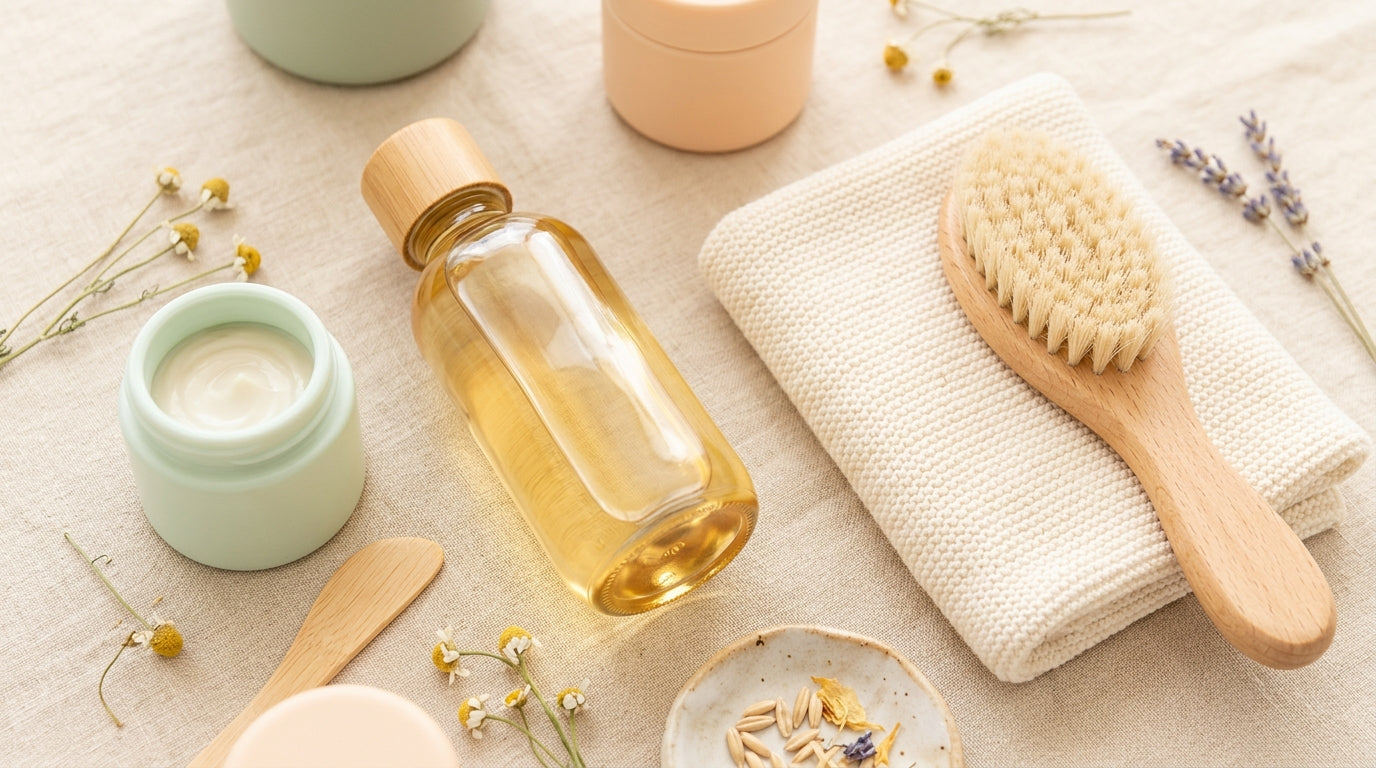
But the whole bizarre news cycle did make me look at the solitary, dusty pink bottle of baby oil sitting on our twins' changing table with big suspicion. What actually is this stuff, and why are we all blindly rubbing it onto the most fragile humans on earth?
Our NHS health visitor had made some cryptic, slightly disappointed noise about it months ago when she saw it next to the nappies, mumbling something about petroleum byproducts before changing the subject to my own mental health. From what I can gather through frantic dawn Googling, traditional baby oil is basically just highly refined liquid cling-film. It's a mineral oil that doesn't actually sink in to deliver moisture to the tissues. It just slaps a waterproof barricade over the skin, locking in whatever dryness is already there and preventing the skin from breathing in any meaningful way.
This revelation came precisely at the wrong time, because Twin B had just developed a scalp that looked like a stale croissant. Cradle cap.
Accidentally feeding the scalp fungus
If you've never dealt with cradle cap, it looks like a severe case of yellow dandruff that's glued to your child's head. It doesn't seem to bother them, but it deeply bothers everyone who looks at them. Naturally, I turned to the internet for a natural remedy, which confidently and universally screamed at me to use extra virgin olive oil.

I raided the kitchen pantry. I gently massaged the expensive, cold-pressed olive oil into Twin B's sparse hair. For two days, my daughter smelled exactly like a lovely Mediterranean focaccia. I kept waiting for the crust to magically dissolve.
It got worse. Much worse.
As it turns out (and I'm translating this from the bewildered sigh of a very tired pediatrician), cradle cap is closely linked to a specific type of yeast that lives on the skin. And apparently, the oleic acid found in olive oil is basically a Michelin-starred tasting menu for this exact fungus. By rubbing olive oil onto her scalp, we hadn't treated the problem; we had enthusiastically fertilized it. If you can somehow resist the urge to marinate your infant like a salad and just dab on a bit of cold-pressed coconut oil instead, you'll save yourself a week of escalating yellow crust.
The geometry of keeping a greased piglet still
Coconut oil, as I quickly learned, actually possesses some mild antibacterial properties and doesn't act as a buffet for yeast. The catch is that you've to let it sit on their scalp for about ten to fifteen minutes before you gently brush the flakes away.
Have you ever tried to keep a heavily oiled ten-month-old completely still for fifteen minutes? It's an extreme sport. They instantly sense that they're slippery and use it to their tactical advantage, wriggling out of your grasp like a greased salmon trying to make it back to the ocean.
Our saving grace during this deeply messy phase was sliding them underneath the Wooden Animals Play Gym Set. In a sea of absolute plastic neon chaos that currently fills our living room, this thing is surprisingly calming. It’s just a beautifully simple wooden A-frame with a little carved elephant and bird dangling down. Honestly, Twin A mostly just stares at the wooden elephant with deep, unblinking suspicion, as if waiting for it to make a sudden move. But that intense suspicion buys me exactly twelve minutes of her lying perfectly flat while the coconut oil sinks in. I'll take it.
Looking for ways to keep your little one distracted without overwhelming their senses? Explore Kianao's collection of minimalist wooden play gyms here.
Teething while slippery
Of course, because the universe is inherently cruel, the great Cradle Cap Incident of last month perfectly coincided with the emergence of their front teeth. So now we had oiled scalps, extreme crabbiness, and rivers of drool pooling in their neck folds.

We tried a few different things to keep their hands busy so they wouldn't aggressively rub their oiled heads and then stick their shiny fingers into their own eyes. We had this Llama silicone teether which was totally fine. It’s made of food-grade silicone and safely soothes their gums, but for whatever reason, Twin B decided it was her sworn enemy and usually lobbed it under the sofa in favor of trying to chew on the television remote.
The actual hero of the hour was the Malaysian Tapir Teether. I don't know who at Kianao looked at a tapir and thought, "Yes, that endangered mammal is exactly what a teething child requires," but they're a genius. The bizarre, elongated snout of the tapir perfectly reaches all the way back to those nightmare rear gums that nothing else can seem to hit. Plus, the high-contrast black and white pattern genuinely fascinated Twin B enough to keep her hands out of her hair while the scalp treatment worked its magic.
The one thing the pink bottle is seriously good for
So, where does this leave us with the meme-worthy bottles of traditional, petroleum-based baby oil? Am I throwing our solitary bottle into the Thames?
No. Because it turns out it possesses one singular, magical property that justifies its existence in a household with toddlers.
It dissolves the glue on a plaster.
Trying to peel a sticky Peppa Pig plaster off the fine hair of a toddler's shin is an exercise in psychological warfare. They look at you with such big betrayal, like you've just told them Bluey isn't real. But if you take a cotton pad, drench it in cheap mineral baby oil, and just rub it over the outside of the plaster for thirty seconds, the chemistry does something magical. It completely breaks down the synthetic adhesive. The plaster just slides off like a wet leaf. No pulling, no screaming, no betrayal.
It also works wonders on removing temporary tattoos and getting sticker residue off the hardwood floors when your kids inevitably discover that the dining room table looks better covered in Paw Patrol decals.
So yes, keep a bottle in the cupboard for dissolving industrial adhesives. Just don't stockpile a thousand of them in your hallway, and maybe keep the olive oil strictly in the kitchen where it belongs.
Ready to ditch the plastic and upgrade to baby essentials that honestly look good in your living room? Shop Kianao’s full collection of sustainable, natural baby gear before the next parenting crisis hits.
The messy realities of baby skincare (FAQ)
What do you really use traditional baby oil for if not for babies?
Honestly, it's just a household solvent masquerading as skincare. Aside from sliding plasters off hairy toddler legs without causing a meltdown, it's brilliant for getting sticky price tags off picture frames, polishing stainless steel sinks, and apparently—if you read the news—making an absolute mess of federal evidence lockers.
Does coconut oil ruin their clothes?
Yes and no. If you slather them like a Christmas turkey and immediately put them in a pristine white babygrow, it'll absolutely leave grease stains that no amount of eco-friendly detergent will shift. The trick is to use about a quarter of the amount you think you need, let it absorb, and maybe put them in that one ugly onesie your great-aunt gifted you until bath time.
How do you keep them still during skincare routines?
Bribery, mostly. Or the element of surprise. Practically speaking, putting them on their backs under something heavily distracting (like a wooden play gym) and handing them a chilled silicone teether straight from the fridge usually buys me the three to four minutes required to wipe a face, apply an eczema balm, and apologize to them for being so annoying.
Is cradle cap honestly bothersome to the baby?
Not really. My health visitor repeatedly assured me that the crusty scalp bothered me infinitely more than it bothered the twins. They don't seem to notice it at all. We only treated it because my mother-in-law kept staring at Twin B's head with a look of big pity, and I couldn't handle the silent judgment.
Why avoid the olive oil again?
Because cradle cap is linked to a yeast called Malassezia, and that yeast thinks the oleic acid in olive oil is absolutely delicious. You're essentially pouring a protein shake onto a fungus. Stick to mineral-free, safe alternatives like a tiny bit of coconut oil, or just use a gentle baby brush in the bath and accept that they'll look slightly scaly for a few weeks.




Share:
3 AM Server Logs and Unexpected Pediatric Data from Paris Hilton
Oh Baby, A Triple: Surviving the Rule of Threes in Parenting