

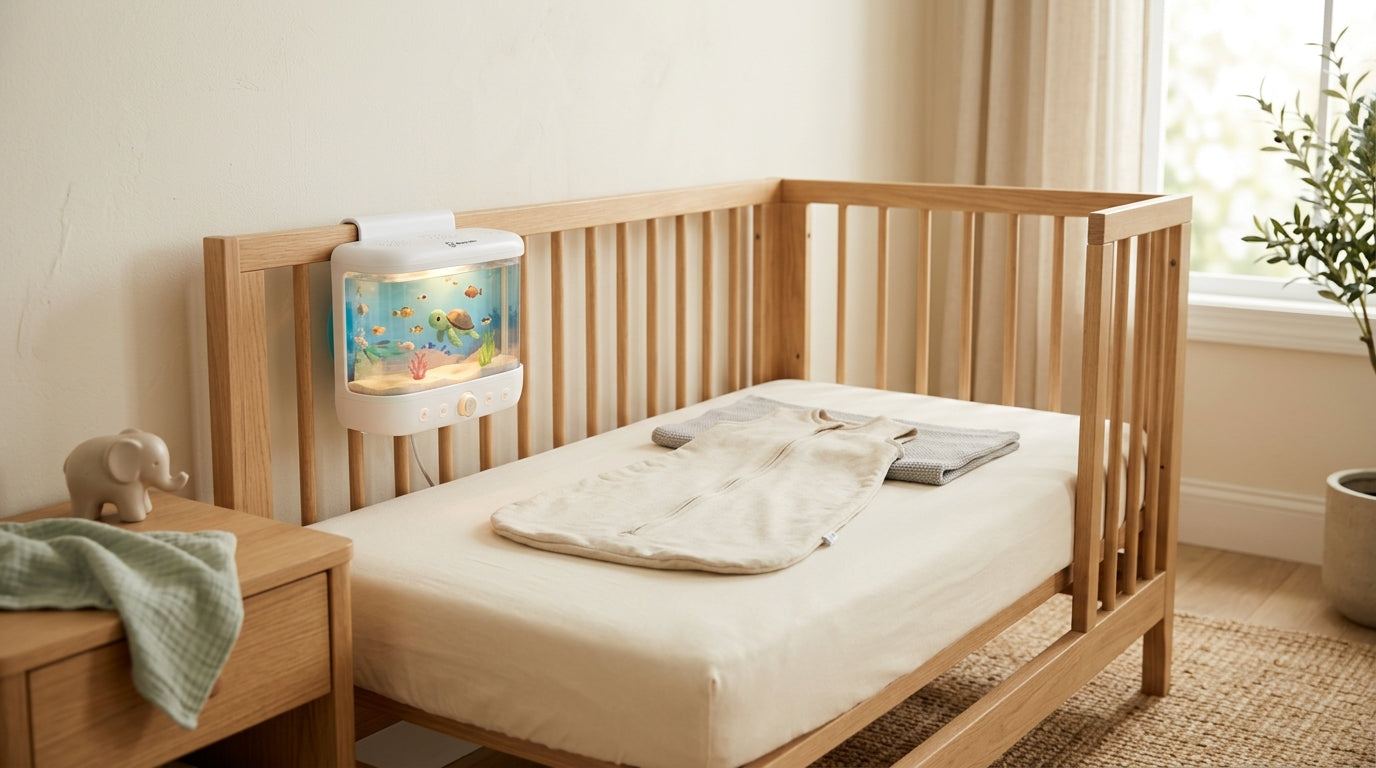
My mother-in-law sat at my kitchen island and told me those glowing plastic fish were the only reason my husband ever slept through the night in the early nineties. My doctor looked at my meticulously tracked sleep logs, sighed, and suggested I throw the whole unit into Lake Michigan. My best friend, who hasn't slept a full eight hours since the pandemic began, swore this same device was a magical portal to unbroken rest. When three people you trust give you completely contradictory advice about the exact same piece of plastic, you know you're dealing with a cult item.
The item in question is the baby einstein aquarium, officially known on the internet as the Sea Dreams Soother. If you've a baby, you've probably seen it. It's a heavy plastic box you strap to the side of a crib. You press a button, and it lights up, playing classical music while a fake turtle and a plastic octopus slowly scroll across a glowing blue background. It looks like a miniature television from 1998.
I bought one at 3 AM during a particularly brutal sleep regression. My mom was texting me from two time zones away, her messages lighting up my phone with beta, just buy the fish toy, he's crying so much. I gave in. But as a former pediatric nurse, watching my child stare blankly at a glowing screen in a dark room felt deeply wrong, even if it bought me twenty minutes of silence.
Anatomy of a plastic sleep prop
Before we get into the medical side of things, we need to talk about the sheer physical reality of owning this device. The baby einstein aquarium is notorious for one specific reason, and it has nothing to do with infant development. It's a battery vampire.
It runs on C batteries. Nobody just has C batteries sitting in a drawer. You have AAs for the remote and maybe some AAAs for a thermometer. When you own this aquarium, your life becomes a constant, low-level hunt for a very specific, slightly obsolete power source. If your baby uses this thing for every nap and overnight sleep, you'll be changing those batteries weekly. The financial drain is absurd, but it's the psychological toll of realizing the fish have stopped moving at 4 AM that really breaks you.
Here's the typical lifecycle of the aquarium's hardware failure, as experienced by myself and half my bumper group.
- First, the lights start to dim. You think it's a feature to help the baby sleep, but no, the power is just fading.
- Then, the music distorts. Beethoven's Ode to Joy starts sounding like a slow, terrifying dirge playing in an empty shopping mall.
- Finally, the motor that drags the plastic turtle across the screen begins to degrade, creating this rhythmic, mechanical grinding noise that completely overpowers the gentle ocean sounds.
Despite all this, parents hunt for it. It goes out of stock at major retailers constantly. You will see people on local neighborhood groups offering absurd amounts of cash for a used one because their original broke and their toddler refuses to sleep without it. I understand the desperation, but the supply chain issues just add to the chaos of relying on a machine to parent for you.
What my doctor actually thinks about the glowing ocean
Listen, I've seen a thousand overstimulated babies in triage. Usually, they're screaming because they've a fever and the ER is bright and loud, but sometimes they're just completely wired from their environment. When you bring a baby into a dark room to sleep, the goal is to lower their heart rate and signal to their brain that it's time to shut down. You don't calm a patient down by shining a blue light in their eyes while playing a tinny symphony.

My doctor was pretty blunt about it. She explained that the artificial light, especially the blue hues of an underwater scene, can mess with melatonin production. Melatonin is the hormone that builds up in the dark and tells the brain to sleep. If a baby is staring at a glowing box, their brain might be getting confused signals about whether it's day or night. I'm not a neurologist, and frankly, I don't know exactly how many lumens of light it takes to derail a sleep cycle, but her logic made sense.
There's also the screen time debate. The AAP says no screens before 18 months. Is a plastic scrolling octopus a screen. It isn't an iPad, but it's definitely a highly stimulating visual display designed to keep a child's attention fixed on one spot. We can debate the semantics of digital pixels versus backlit plastic, but the effect on a tired brain is probably similar.
I ignore most of the rigid sleep consultant rules floating around the internet, but here's what the experts universally agree on with healthy sleep habits.
- The room should be pitch black, not illuminated by a soothing seascape.
- White noise should be continuous and mechanical, not classical music that fades out after 25 minutes.
- The crib should be completely bare, which technically means a heavy plastic box strapped to the slats is pushing the boundaries of safe sleep guidelines.
They claim the classical music builds neural pathways, but honestly, Mozart isn't going to make your kid a genius if they're chronically overtired from waking up every time the music stops.
The crib transition trap
The main reason parents buy the baby einstein aquarium is to survive the crib transition. Moving a baby from a cozy bassinet next to your bed into a massive, empty crib in their own room is terrifying for everyone involved. The aquarium is a distraction. You put them down drowsy but awake, they lock eyes with the glowing turtle, and they forget to cry while you army-crawl out of the nursery.

It works. It really does work for those first few weeks. But then you hit a wall.
Infants sleep in cycles. Every 45 minutes or so, they wake up slightly, check their environment to make sure everything is exactly as it was when they fell asleep, and then drift back off. If they fell asleep looking at a glowing, moving ocean, they're going to expect that ocean to be there when they wake up. If the aquarium has turned off, they'll scream until you come in and press the button again. You have just replaced rocking your baby to sleep with pressing a plastic button for your baby.
Eventually, they get old enough to reach through the crib slats and press the button themselves. People frame this as toddler independence. I frame it as my toddler throwing a private rave in his bedroom at 3 AM. He would wake up, hit the button, and sit there watching the fish for an hour instead of going back to sleep.
I realized we had to get rid of it. But taking away a sleep prop means you need daytime distractions to tire them out, especially when teething hits at the exact same time as a sleep regression. When we went cold turkey on the aquarium, his gums started bothering him, making the nights a nightmare. I needed something he could independently manage in his crib that didn't involve a battery or a screen.
That's when I found the Bubble Tea Teether from Kianao. This thing is shaped like a little boba cup and it saved my sanity. When he would wake up fussy, instead of mashing a button to turn on a light, he would find this in the corner of his crib. It's 100 percent food-grade silicone, totally safe to leave with him, and has these textured little boba pearls that he would gnaw on for twenty minutes before putting himself back to sleep. The silicone is soft enough that it doesn't hurt if he rolls onto it, but firm enough to actually do something for his swollen gums. I used to keep it in the fridge during the day, and the cold would last just long enough to settle him down at bedtime. It's practical, easy to wash, and doesn't require a midnight trip to Walgreens for batteries.
On the flip side, we also tried the Gentle Baby Building Block Set. They're fine. They're soft rubber, which means nobody gets a bruised forehead when a tower collapses, but my son mostly just threw them under the couch. They're much better as bath toys since they float, but as an everyday floor toy, they didn't hold his attention nearly as well as chewing on his boba cup did.
Explore our full collection of baby toys and teethers for daytime play.
Surviving without the electronic ocean
Listen, if you're trying to get rid of this thing, don't just rip it off the crib and expect miracles while simultaneously trying to introduce a new sound machine, drop a nap, and change their sleep sack. You have to be strategic.
I used the fade-out method. The device actually has dimmer settings and a remote control. For the first few nights, I just turned the volume down. Then I switched it from the music and motion setting to just the motion setting. A week later, I turned off the motion and just left the dim light. By the time I really unsnapped the straps and removed it from the crib, he barely noticed it was gone. We replaced the audio with a basic, continuous white noise machine placed across the room, far away from his sleep space.
It's okay if you bought the aquarium. We're all just trying to survive those first twelve months. You haven't ruined your child's sleep architecture forever because you let them watch a plastic turtle for a few months. Just know that eventually, the batteries will die, the motor will break, and you'll have to teach them how to sleep in the dark anyway. You might as well do it before they figure out how to demand a battery change.
Shop our collection of silicone teethers for a natural way to soothe your baby at night.
Common questions about the aquarium and baby sleep
Is the baby einstein aquarium safe for newborns?
Technically it straps to the outside of the crib, so it doesn't violate the strict bare crib rules of having loose items inside the sleep space. But honestly, newborns can barely see past your face. Blasting them with blue light and mechanical ocean noises when they're a week old is just unnecessary sensory overload. They need your smell, a tight swaddle, and darkness, not a light show.
Does the blue light really keep babies awake?
My doctor believes it does, and standard adult sleep hygiene says blue light inhibits melatonin. From what I saw in my own house, it kept my son in a state of light, distracted arousal rather than letting him sink into deep sleep. He would stare at it until he passed out from pure exhaustion, which isn't the same thing as restful sleep.
How long do the batteries last?
If you run it for every nap and every night waking, you'll be buying C batteries once a week. The manual says they last longer, but the manual is lying. The motor that moves the heavy plastic overlay drains power incredibly fast. If you're going to keep it, invest in rechargeable ones immediately or you'll go broke.
When should I take it out of the crib?
The second your baby can pull themselves up to a standing position, this thing becomes a hazard. It's a very sturdy plastic ledge. Toddlers are completely feral and will absolutely use it as a step stool to launch themselves over the crib rail. Take it down by eight or nine months at the latest.
What's a better alternative for sleep training?
A pitch black room and a basic sound machine that runs all night without shutting off. If they need something to fiddle with to self-soothe once they're over a year old, a small, safe, unweighted lovey works. If they're teething, a safe silicone teether left in the corner of the crib gives them something to do with their mouth that doesn't involve screaming for you to turn a TV on.




Share:
When Your Baby's Face is Red and Peeling: My Eczema Survival Story
Twins and the absurd reality of baby elephant weight