

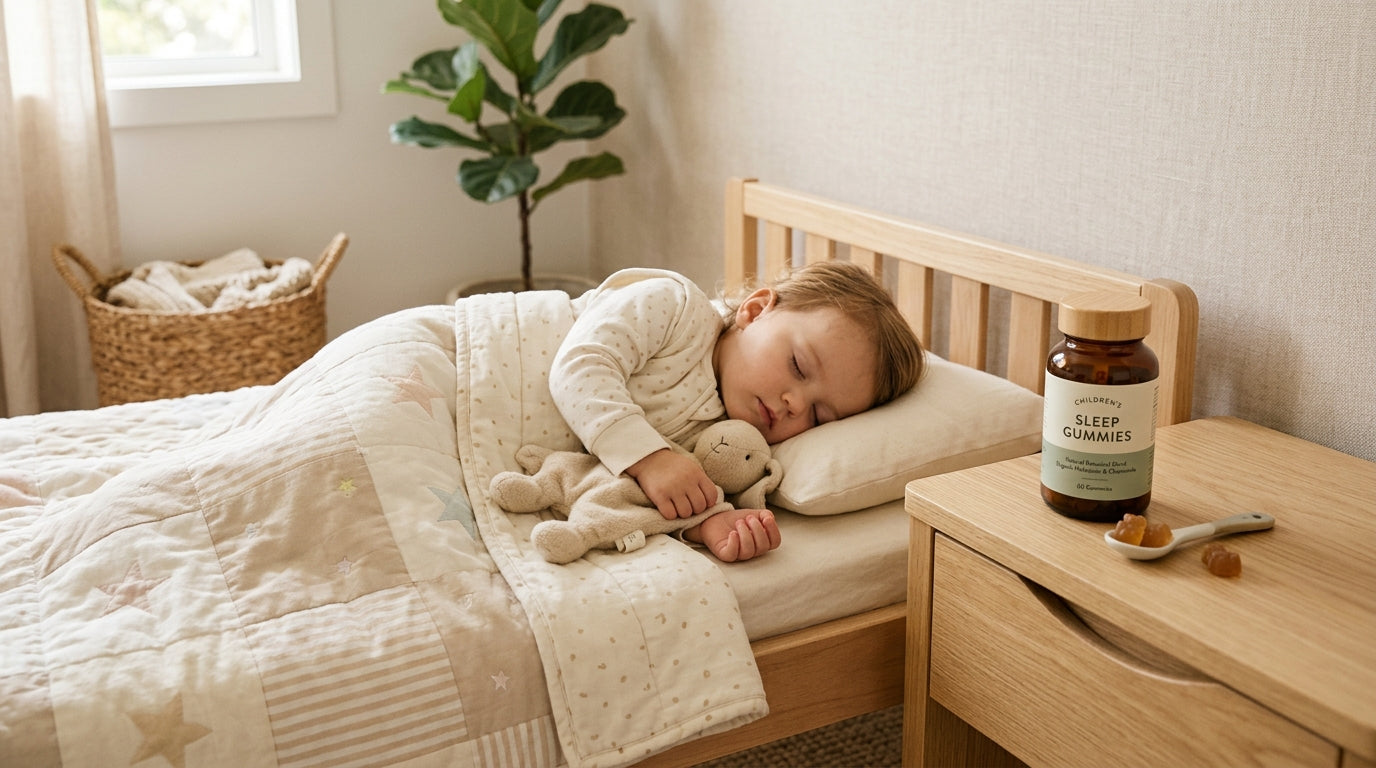
The glow of the smartphone screen is harsh at 4 AM when you're holding a thrashing infant while reading an influencer's post about a miracle gummy that cures night wakings. I've been in that exact chair, yaar. It feels like a hostage negotiation where the terrorist only speaks in shrieks. I remember staring at a late-night forum post titled "safe drops for my babie" and seriously considering taking medical advice from a user named MamaBear99. Listen, before you add a bottle of synthetic sleep to your digital cart, we need to talk about what's actually inside those cute little bear-shaped supplements.
I used to do triage at a pediatric hospital here in Chicago. I've seen a thousand of these cases. A panicked, exhausted parent comes into the ER because their toddler managed to climb the dresser and eat a handful of what looked and tasted exactly like strawberry candy. We have normalized these supplements so much that we forget what we're actually handing our kids.
The gummy bear illusion
The biggest lie the wellness industry sells desperate mothers is that a fruit-flavored chewable is just a natural, gentle way to fix a biologically normal sleep regression. It's not an herb. It's not a soothing root extract. Melatonin is literally a hormone produced by the pineal gland in the brain.
Because the FDA classifies it as a dietary supplement in the US, the industry is a largely unregulated free-for-all. Nobody is checking the homework of the companies bottling this stuff. The American Academy of Sleep Medicine tested a bunch of these products and the results were a joke. You might buy a bottle that has eighty percent less of the hormone than the label claims, or you might hit the jackpot and get four hundred percent more. Some of the gummies they tested even had trace amounts of serotonin mixed in.
Between 2012 and 2021, poison control centers saw a 530 percent spike in children ingesting these sleep supplements. Over a ten-year stretch, roughly four thousand kids ended up hospitalized because of accidental or intentional overdoses. Most of these were kids under five. Whoever decided to make heavy hormone supplements taste like a dessert is probably a billionaire by now, but they certainly never had to monitor a lethargic toddler in a hospital bed.
White noise machines are fine, just keep them at a low volume on the other side of the room.
How a tiny brain actually wires itself
Nobody entirely understands how a developing brain builds its capacity for rest. Science is mostly just making educated guesses about a messy soup of neurotransmitters. What we do generally accept is that a newborn has absolutely zero natural circadian rhythm when they arrive.
They're born with their days and nights completely flipped, which is a cruel biological joke on the mother. They only start to figure out how to produce their own sleep hormones and keep stable their cycles between six and eighteen weeks of age. Dropping a synthetic, lab-made hormone into that delicate, developing process is like throwing a heavy wrench into a delicate watch mechanism just to see if it makes the hands spin faster.
What my doctor told me behind closed doors
When my own toddler hit the eight-month regression and was waking up every forty-five minutes, I was practically hallucinating from sleep deprivation. At our well-visit, I asked Dr. Gupta about giving sleep hormones to an infant. He gave me that specific, tired look pediatricians reserve for internet trends.

He told me flat out that for any child under three years old, it's a hard no. The medical consensus is just not there. Their brains are too busy building the foundational architecture of sleep, and intervening chemically can cause more harm than good. For older kids, maybe a tiny dose under strict medical supervision for a short period, but it's never a cure-all. He warned me that the side effects aren't just a little daytime grogginess. Kids experience vivid night terrors, headaches, dizziness, and sudden bedwetting.
My aunt still calls him her sweet little babi when she FaceTimes from Mumbai, but even she knows that you can't drug a baby into submission. You just have to endure the developmental leaps.
The environmental triage
So if we can't use the magic gummies, we're left with the unglamorous work of sleep hygiene. This means you essentially have to plunge your entire house into a dark cave two hours before bedtime while running a lukewarm bath and hoping the ambient sound of a fan masks your own heavy sighs.
A massive part of infant sleep disruptions is just physical discomfort. When my son was cutting his first molars, the pain was so bad he would wake up thrashing. I didn't reach for a supplement, I reached for the Panda Teether. It's honestly one of my favorite things we own. I kept it in the back of the fridge, and when he woke up screaming at 2 AM, I'd just hand it to him in the dark. The cold food-grade silicone gave his swollen gums enough relief that he would stop crying for ten minutes, which was exactly enough time for me to rock him back down. It's safe, it doesn't have any small parts, and you can just throw it in the dishwasher when it gets gross.
If you're looking to overhaul your nursery without relying on pharmaceuticals, you can check out Kianao's baby sleep collection for organic bedding and swaddles.
Temperature control is another huge factor in the nighttime triage. Babies are terrible at regulating their body heat. I bought the Organic Cotton Baby Bodysuit for him to sleep in. Let's be real, it's just a nice shirt. It won't magically make your kid sleep twelve hours straight, but the organic cotton breathes well enough that he stopped waking up in a pool of his own sweat. It has good stretch and doesn't irritate his eczema, which is one less reason for him to wake up complaining.
Draining the battery
The cruelest truth about infant sleep is that you've to exhaust them during the day to get peace at night. You can't just expect a baby who stared at the ceiling all afternoon to suddenly feel tired at eight o'clock.

We started doing heavy floor time in the late afternoons. We used the Rainbow Wooden Play Gym because it required him to actively reach, grasp, and figure out spatial awareness. The mental energy it takes for a six-month-old to bat at a wooden elephant is equivalent to you running a half marathon. It drains their battery naturally. Plus, the neutral wood design doesn't make my living room look like a primary-colored plastic explosion.
Parenting in the dark hours is mostly just survival. You find the natural tools that work, you establish a boring routine, and you accept that some nights are going to be a total loss. But you don't need to risk their developing brains on a poorly regulated supplement just to catch a nap.
Ready to try some physical comfort solutions instead of gambling on the supplement aisle? Grab the teether and build a safer sleep environment for your peace of mind.
The messy truth about infant sleep
Can I just give half a gummy to my one-year-old if they really can't settle?
No. Cutting a gummy in half doesn't change the fact that you're introducing an unregulated synthetic hormone into a brain that's still trying to map out its own sleep cycles. Plus, because these supplements are mixed so inconsistently, that half gummy might contain triple the dose you think it does. Just stick to rocking and crying it out together.
Why does the internet make it seem like every parent is using these?
Because people only post the highlight reels and the quick fixes. Admitting that you spent three hours bouncing on a yoga ball in a dark room doesn't get as many likes as a neat little hack. The wellness industry thrives on our exhaustion, packaging shortcuts that doctors actively warn against.
What do I do when teething completely destroys our schedule?
You triage the pain. Keep the room dark, keep the temperature cool, and offer physical relief. A cold silicone teether or a damp washcloth from the fridge does wonders. You will probably lose a week of good sleep, but once the tooth cuts through, their natural rhythm usually resets itself.
Are blackout curtains really doing anything?
They're probably the only thing saving your sanity in the summer. Darkness is the biological trigger that tells the pineal gland to start making its own natural sleep hormones. If there's a streetlight shining through the blinds, your baby's brain thinks it's time to party. Tape black construction paper to the glass if you've to.
How long do these sleep regressions genuinely last?
Dr. Gupta told me a true regression lasts anywhere from two to six weeks. It feels like a decade when you're in it, but it's just a phase of rapid brain development. Their hardware is upgrading. Ride it out with coffee for yourself and patience for them.




Share:
Melanie Martinez Cry Baby: My Late Night Parenting Heart Attack
Minka Kelly's Memoir and the Parenting Bugs We Can't Fix