

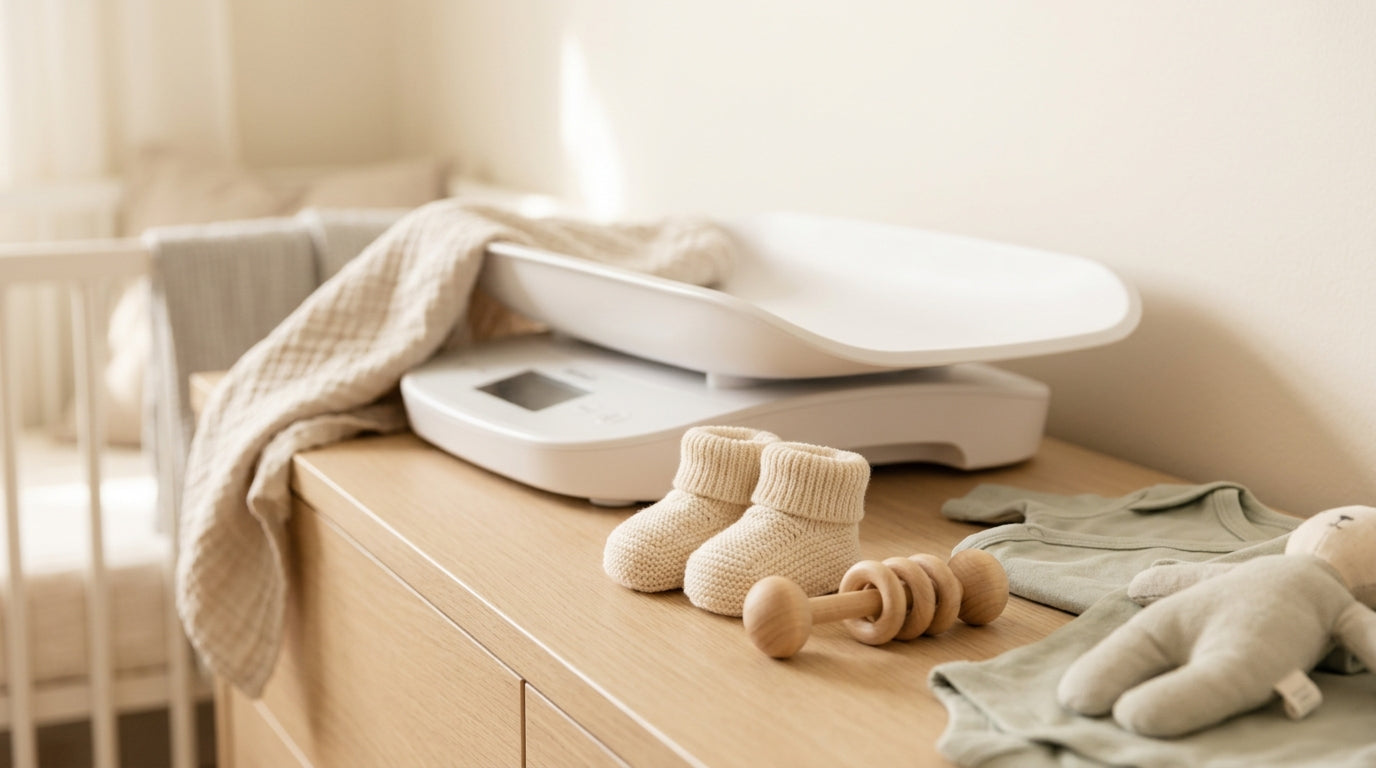
It's 4:12 AM on a Tuesday, and I'm standing in the kitchen illuminated only by the aggressive blue backlight of an LCD screen, trying to calculate the relative density of a soiled nappy. I'm staring at an Excel spreadsheet that tells me Twin A (Freya) has somehow lost 22 grams since Monday afternoon, while Twin B (Florence) has miraculously gained 14. I'm factoring in perspiration, ambient room temperature, and the exact volume of milk I just witnessed them spit up onto my only clean jumper. This is what happens when a sleep-deprived former journalist with a penchant for data gets his hands on a medical-grade infant weighing device.
Before the girls were born, I held a very specific, deeply flawed belief about parenting. I genuinely thought that data equaled safety. If I could just track every single gram, every millimeter of growth, and every milliliter of milk consumed, I could mathematically prove I was keeping them alive. I was convinced that a home baby scale was the ultimate shield against the terrifying vulnerability of having premature twins. It wasn't until months later that I realized the machine I had purchased to give me peace of mind was actually the exact thing destroying it.
The dark days of the anxiety machine
The device itself was a monstrosity. It lived on our dining room table for three solid months, a giant plastic crater that mocked me every time I walked past it to boil the kettle. You don't just gently rest an infant on one of these things and wait for a polite beep. Oh no. The second their bare, fragile skin makes contact with that icy plastic tray, they begin to writhe like tiny, furious eels.
To get an accurate reading, you've to strip them completely naked, which makes them absolutely ballistic. This is precisely why my favorite piece of clothing we own is the Organic Cotton Baby Bodysuit, purely because of those envelope shoulders. When you're trying to quickly undress a screaming child to weigh them before they've a meltdown, you don't want to be pulling things over their head. You can just yank this bodysuit downward over their shoulders and legs in one fluid, slightly desperate motion. It's incredibly soft, which is lovely for their sensitive skin, but more importantly for my sanity, it doesn't shrink when I inevitably have to wash it at 40 degrees after a massive biological event. I honestly bought six of them just so I wouldn't have to fiddle with tiny buttons while under duress.
Once you've stripped them, you place them on the tray. The digital numbers start flickering wildly between 3.2 kilos and 4.1 kilos because the baby is kicking the sides of the device with the strength of a tiny kickboxer. You're hovering over them, whispering sweet nothings in a strained, panicked octave, just begging them to hold still for two seconds so the sensor can lock onto a number.
Don't even get me started on the companion app that synced via Bluetooth, which I promptly deleted after it sent me a push notification congratulating me on my 'weigh-in streak' as if I were playing a deeply depressing video game.
What I thought I knew about infant growth
Here's the reality check that my GP finally delivered when I dragged myself into his office, bleary-eyed and clutching a printout of my twins' weight trajectories. Normal infant growth is incredibly, frustratingly messy.
My understanding of the science is a bit fuzzy, but apparently, it's completely normal for newborns to drop something like 7 to 10 percent of their total birth weight in those first few days of life outside the womb. I still don't quite comprehend how they just evaporate that much mass into the ether (though I suspect it has something to do with the astonishing volume of meconium they produce), but it's supposedly a standard biological process. They usually rebound and regain it by week two or so, assuming everything is ticking along nicely.
But the real kicker is that percentiles aren't a grading system. I used to look at Florence sitting on the 9th percentile and feel a deep sense of failure, as if she were flunking out of being a baby. Meanwhile, Freya was on the 25th, clearly the academic overachiever of the nursery. The health visitor had to explain to me very slowly, using small words, that a baby on the 5th percentile isn't unhealthier than a baby on the 90th. They're just smaller. The only thing doctors actually care about is that the baby follows their own bizarre little curve over time, rather than falling off a cliff entirely.
The great tare function delusion
If you do end up buying a scale for the baby, the manual will undoubtedly boast about the magical 'Tare' function. In theory, this is brilliant. You place a lovely, warm fleece blanket onto the cold plastic tray, press the 'Tare' button to zero out the weight of the blanket, and then place your child gently onto the warm surface.

It's a lie. A beautiful, comforting lie.
What actually happens is that you zero out the blanket, you place the baby down, and the baby immediately grabs a fistful of the fabric and hurls half of it off the side of the tray, pulling the sensor out of alignment. Or they kick the blanket so hard it bunches up under their back, causing the machine to register a completely different distribution of mass and flashing an 'ERR' code that makes you want to throw the entire contraption through a closed window.
During the peak of our weighing obsession, I tried to make the dining table less resembling a clinical triage center by setting up the Rainbow Play Gym Set right next to it. I thought maybe I could distract them with the hanging wooden elephant while I took their measurements. It's a perfectly fine piece of kit, honestly. It doesn't scream 'primary colored plastic' at you, which is a rare mercy for your living room decor, and it's sturdy enough that they couldn't immediately pull it down on their own heads. But let's be real—a tasteful wooden geometric shape is absolutely no match for the deep indignity of a naked weigh-in on a cold Tuesday morning.
If you're currently scrolling through forums at 3 AM trying to decide which medical equipment to buy for your nursery, I highly suggest stepping away from the technology and checking out our collection of comfortable, practical bits and bobs instead. Your blood pressure will thank you.
When tracking the grams really makes sense
Now, I should caveat all of my complaining by admitting that there are times when having this technology at home is genuinely incredibly helpful, and I don't want to sound like I'm completely dismissing it.
Because the girls were born a bit early, we did legitimately need to keep a closer eye on them for the first month. Our doctor told us that for premature babies, or those born with intrauterine growth restriction (IUGR), precision tracking is often necessary to make sure they're honestly thriving and not just burning more calories crying than they're taking in.
There's also this incredibly intense practice called 'weighted feeds' that lactation consultants sometimes suggest if breastfeeding is going poorly. You weigh the infant in a dry nappy, you let them nurse, and then you weigh them again immediately after without changing their clothes or nappy. The difference in grams roughly equals the milliliters of milk they managed to transfer. We did this for about two weeks when Florence was struggling to latch properly. It was utterly exhausting and completely stripped the joy out of feeding my child, but it did give us the hard data we needed to realize we had to supplement with formula. So, in that specific scenario, the machine wasn't a torture device—it was a tool that helped us pivot our feeding strategy so our daughter wouldn't go hungry.
Looking at the babies instead of the numbers
Eventually, around month four, the girls caught whatever standard-issue nursery virus was going around, and they stopped eating as much. I watched the numbers on my spreadsheet plateau and then dip. I spiraled entirely.

My wife, who possesses the kind of stoic common sense that I completely lack, calmly walked over to the dining table, picked up the infant weighing tray, and put it in the loft. She told me we were done.
And you know what? We survived. We started looking at the actual human beings in front of us instead of digital readouts. We noticed that even though they hadn't gained weight that week, they were still producing a staggering amount of wet nappies. They were alert. They were babbling. They were developing perfectly normally, despite the numbers on a screen.
Weight fluctuates for ridiculous reasons. Sometimes they're just gearing up for a growth spurt. Sometimes they're teething so aggressively that they'd rather chew on their own hands than swallow milk. When the girls hit their first major teething phase, their weight dipped slightly because they were just so miserable. We basically survived that month by keeping a Panda Teether on constant rotation. It's brilliant because it's completely flat and easy for them to grip themselves, meaning I didn't have to sit there holding it to their mouths for hours on end. You can toss it in the fridge for ten minutes so it gets nice and cold on their swollen gums (just don't put it in the freezer, apparently that makes it too hard and can damage their mouth tissue, which seems like a cruel biological trap). It saved my knuckles from being gnawed to the bone.
The moral of the story is that unless a medical professional has specifically ordered you to track your child's weight at home, you're probably better off without the machine. It preys on parental anxiety. It turns a natural, messy biological process into a pass/fail test that you use to yourself in the middle of the night.
If you're feeling anxious about your baby's growth, talk to your health visitor. Let them do the weighing at the clinic on their bulky, terrifying machines. At home, just focus on keeping them clothed, fed, and reasonably content.
Take a deep breath, close your spreadsheet, and go explore Kianao's full range of sustainable, sensible baby items that are really designed to make your life easier, not more stressful.
The messy realities of infant weight
Should I weigh my child every single day?
Absolutely not, unless your doctor has specifically looked you in the eye and told you to do so. Weighing them daily is a brilliant way to drive yourself entirely insane because their weight will fluctuate based on whether they've just had a massive wee or haven't pooped in three days. Once a week, or even once a fortnight, is more than enough to see the general upward trend, which is the only thing that genuinely matters.
How accurate are the home digital models anyway?
They're a bit finicky, to be honest. If you don't place them on a completely hard, flat surface like a wooden table or a tile floor, the internal sensors get confused. I once tried to use ours on the living room rug and it told me Freya had gained three kilos overnight, which would have been physically impossible unless she had swallowed a brick. Even when set up perfectly, a wriggling infant shifts their center of gravity so rapidly that the machine struggles to lock in a precise number.
What exactly is a weighted feed and why do people do it?
It's a way to figure out exactly how much breastmilk your baby is really drinking during a single session. You weigh them before they feed, let them eat, and then weigh them again right after. Since one gram of breastmilk roughly equals one milliliter, the difference tells you what they consumed. It's incredibly stressful and I hated every second of doing it, but it's genuinely useful if you suspect they aren't transferring milk efficiently and you need concrete evidence to show your lactation consultant.
My baby's percentile dropped on the chart, should I panic?
I mean, I panicked, but you shouldn't. The health visitor told me that it's quite common for babies to cross percentile lines in the first few months as they settle into their natural genetic curve. A baby born massive might drop down a few percentiles, while a tiny baby might shoot up. They aren't supposed to stay rigidly glued to one single line forever. If they drop dramatically across multiple percentile lines at once, your GP will investigate, but minor fluctuations are just them figuring out how big they're supposed to be.
How do you weigh a wriggly infant without them screaming the house down?
You can't. That's the secret. The moment their bare skin touches that cold surface, they'll inform you of their displeasure at maximum volume. You can try doing it right after a feed when they're slightly milk-drunk and lethargic, or you can try the ill-fated tare function with a blanket, but honestly, the best method is to just be incredibly fast. Strip them, plunk them down, read the number, and scoop them back up into a warm hug before they realize what's happened.




Share:
That time we met a stranded sea sausage on the Norfolk beach
Dear Past Me: A Messy Open Letter About Buying Baby Sandals