

It was 3:14 AM on a Tuesday, and my 11-month-old son felt like a tiny, screaming space heater. I was frantically tearing apart our master bathroom cabinet, tossing aside half-empty bottles of adult cough syrup, stale melatonin gummies, and a tube of hydrocortisone that apparently expired during the Obama administration. My wife was sitting on the floor of the nursery trying to soothe the crying, while I aggressively pushed the button on our adult forehead thermometer, only to realize its batteries were completely corroded. Our incident response protocol was fundamentally broken. We had a house full of drugstore boxes, but absolute zero infrastructure for an infant hardware failure.
That was the night I realized babies are not just scaled-down humans. You can't simply cut an adult aspirin in half or slap a normal bandage on a tiny leg and call it a day. Their operating systems are completely different, their delicate skin reacts terribly to adult adhesives, and their inability to blow their own noses is a glaring design flaw that requires highly specific peripheral devices to fix.
If you want to survive the inevitable winter respiratory viruses and random mystery rashes without driving to a 24-hour pharmacy in your pajama pants, you just need to throw your scattered medical supplies into a plastic container and pray you remember where you put the tiny dosing syringe.
Adult pharmacy gear is entirely incompatible with infants
Let me talk to you about the absolute absurdity of putting an adult adhesive bandage on a baby. You think you're doing the right thing covering up a tiny scrape from the coffee table, but standard drugstore bandages are basically superglue applied to tissue paper. First of all, the adhesive is way too aggressive for their sensitive, uncalloused skin. When you finally manage to peel it off—usually while long-standing screams that suggest you're actively removing their limb—it leaves a bright red, raised welt that legitimately looks ten times worse than the tiny scratch you were trying to protect in the first place.
Secondly, babies are essentially made of rubber and possess a terrifying level of flexibility. Within roughly four seconds of you applying a bandage to their knee, they'll fold themselves into a pretzel, put their own foot in their mouth, and begin gnawing the bandage off. I watched my son unpeel a "heavy-duty waterproof" strip with just his two bottom teeth faster than I can open a beer.
And that brings us to the third and most panic-inducing phase: the choking hazard. An adult bandage floating around loose in an infant's mouth is a 911 call waiting to happen, which we discovered the hard way when I had to execute a clumsy finger-sweep to retrieve a soggy piece of plastic from his tongue. Just skip the adult adhesives entirely, or better yet, leave minor scratches open to the air unless they're actively bleeding.
What our doctor actually told me to buy
During our two-month checkup, I asked our doctor for a strict, binary list of what I needed to buy to keep this fragile organism alive. I wanted data. I wanted a specific checklist for a proper baby first aid kit. She looked at my heavily caffeinated, panicked expression and calmly explained that my main job was just tracking temperature and keeping his airway clear of snot.
My doctor said that any fever in a baby under three months old requires an immediate call to the emergency line or a trip to the hospital, no exceptions. Apparently, newborn immune systems are running on beta firmware and haven't developed the necessary firewalls to fight off basic infections. That piece of information terrified me so deeply that I checked his temperature hourly for the first month of his life.
She also gave me a rundown of the basic medications. Infant acetaminophen is usually okay after two months for pain or fever, but you can never, ever give infant ibuprofen to a baby under six months old. I Googled why and didn't really understand the renal biology behind it, but my wife wrote "6 MONTHS PLUS" in thick black Sharpie across the ibuprofen box just to make sure my sleep-deprived brain wouldn't make a catastrophic dosing error at 4 AM.
The great thermometer debate of my marriage
Forehead scanners are basically random number generators for infants, so just buy a digital rectal thermometer, get some petroleum jelly, and make your peace with your new glamorous life.

Seriously, I wasted fifty dollars on a fancy infrared thermometer that told me my screaming, flushed child had a temperature of 97.1 degrees. My wife finally handed me the cheap, ten-dollar rectal thermometer the hospital gave us, and sure enough, he was running a 101.3. It's incredibly stressful to use the first time because you feel like you're going to break your baby, but it's the only data point the doctors will actually trust when you call the after-hours nurse line.
When it's not a virus, it's just the teeth
Sometimes you think you need a medical intervention, but it turns out your child's jaw is just aggressively pushing sharp bones through their gums. Right around six months, our son spiked a low-grade temp of 99.something. He was drooling like a faulty faucet and crying constantly. I had the medical kit out, ready to use pain relief, but my wife deduced he was just teething.
This is where hardware swaps save the day. Instead of medication, we handed him the Panda Teether Silicone Baby Bamboo Chew Toy. I genuinely love this specific piece of gear because the textures act like a deep tissue massage for his swollen gums. The best part is that we throw it in the refrigerator for twenty minutes, and the cold silicone basically reboots his crying subroutine. It gave us a natural, non-pharmaceutical way to troubleshoot his pain without immediately reaching for the syringe.
Compiling the actual hardware list
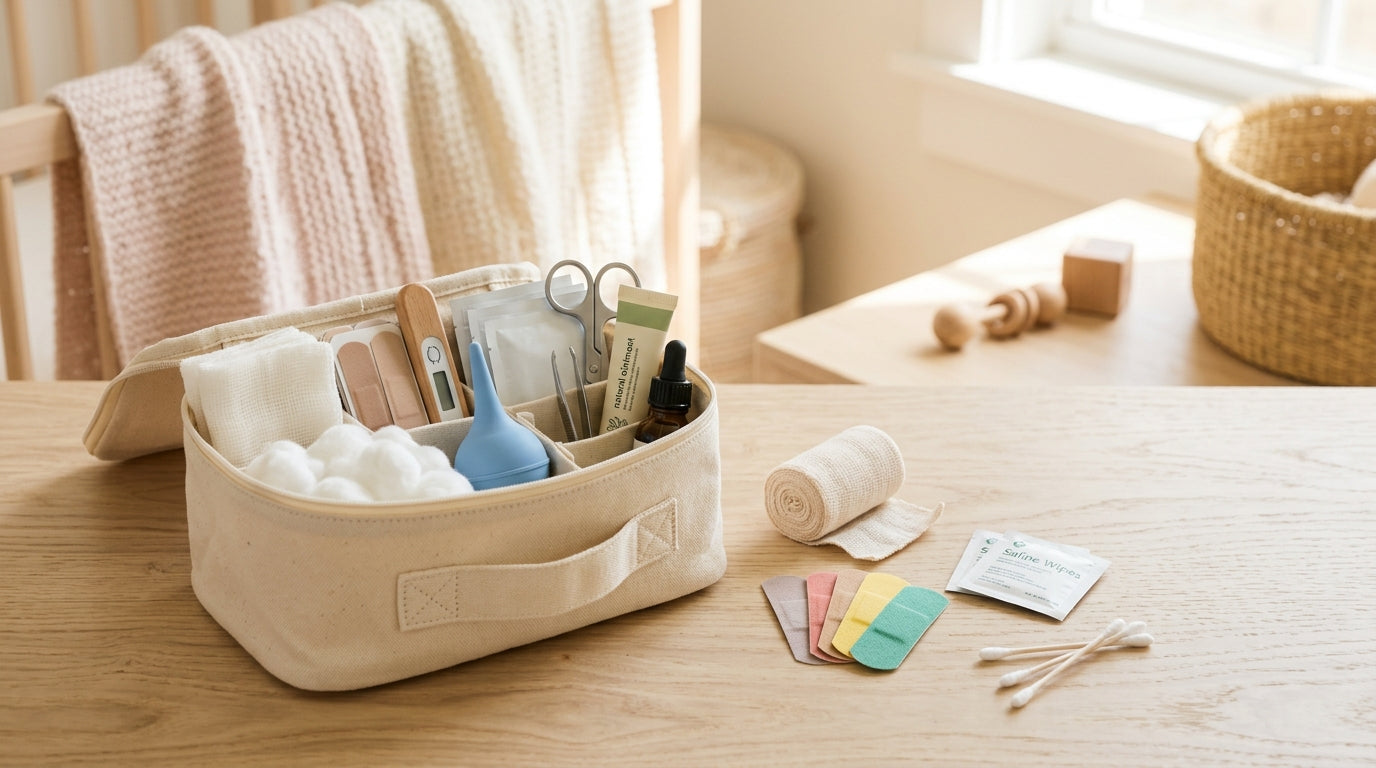
Once we stopped panicking and started organizing, we built a dedicated infant medical stash. We bought a plastic art supply box with little dividers—because my wife correctly pointed out that keeping medicine in the bathroom exposes it to hot shower humidity, which degrades the active ingredients. Now, the box lives on a high shelf in the hallway closet.

Here's what's currently sitting in our plastic box of survival:
- Digital Rectal Thermometer & Petroleum Jelly: The only reliable way to know if we need to panic.
- Nasal Aspirator & Saline Drops: Before I was a dad, if you told me I'd willingly use a tube to suck thick green mucus out of another human's face using my own mouth suction, I'd have dry-heaved. Now? I do it with the precision of a sniper. The saline loosens the data, and the aspirator extracts it.
- Medicine Syringes: Never use the little cups they give you. You need the exact milliliter precision of a syringe because babies spit out exactly 40% of whatever you put in their mouths.
- Baby Nail Clippers: Their nails grow at the speed of light and turn into tiny razor blades that will scratch their own corneas.
- Infant Acetaminophen & Ibuprofen: Clearly labeled with weight-based dosing charts taped directly to the bottles.
If you're looking to upgrade your entire nursery infrastructure with things that actually make sense, take a break from medical prep and browse Kianao's collection of smart, sustainable baby gear that won't make you want to pull your hair out.
Hydration protocols and the clean zone
Around nine months, the stomach bug hit our house. It was a complete systemic failure. After the vomiting stopped, my doctor said we needed to push fluids to prevent dehydration, but only one ounce at a time to keep his stomach from rejecting it.
We used the Silicone Mug Set for this tedious process. Look, it's just a cup. It holds liquid. It's fine. The main reason I'm mentioning it's because when an infant feels terrible, they get angry. When I tried to offer him electrolyte water, he aggressively swatted the cup off his highchair tray like an angry tiny dictator. Because it's silicone, it just bounced off the hardwood floor instead of shattering into a thousand dangerous shards. It does exactly what it needs to do without adding broken glass to my list of problems.
Another weird thing you don't think about until you're in the trenches: where exactly are you doing your medical examinations? When I've to pin down a writhing, congested baby on the living room floor to suck the snot out of his nose, doing it directly on the dog-hair-covered rug feels fundamentally wrong.
We really keep the Organic Cotton Baby Blanket with Squirrel Print folded directly beneath our medical stash. When things go wrong, I throw this blanket on the floor to create an immediate, clean quarantine zone. It’s a soft surface for him to lay on while I check him for weird rashes or use medicine, and because it's high-quality cotton, it survives the heavy-duty hot water wash cycle after we're done with our triage.
Deploying your kit to production
Building this stash isn't just about having the right gear; it's about eliminating friction during a crisis. When your kid wakes up burning hot at 2 AM, your brain will barely be functioning. You don't want to be squinting at expiration dates or trying to remember if a forehead scan of 99.1 is bad.
Put the box together now. Print out the dosage chart your doctor gives you and tape it to the inside of the lid. Stop relying on your adult pharmacy stash, because your infant is running a completely different operating system.
Before you dive into the chaotic world of tracking fevers and managing baby snot, make sure your everyday parenting infrastructure is solid by checking out Kianao’s full lineup of sustainable baby products.
Frequently Asked Questions About Infant Medical Stashes
Should I keep a medical kit in my diaper bag too?
I tried carrying a massive kit everywhere and it just took up space for diapers. Keep it simple for the mobile version. I just throw a few basic bandages, alcohol wipes, and a small tube of rash cream in a ziplock bag. If we experience a catastrophic medical event at the grocery store, we're just going to drive home or to the doctor anyway.
Can I use an ear thermometer instead of a rectal one?
Apparently, infant ear canals are too narrow and twisty for those adult ear thermometers to get an accurate read until they're at least six months old. I tried it once, it read 96 degrees, and I threw it back in the drawer. Stick to the rectal one for the early months, it's gross but it works.
How often do I need to replace the medication in the box?
Liquid baby medications expire surprisingly fast once you open them. I try to audit our plastic box every six months, usually when we change the clocks for daylight saving time. I always end up throwing away crusty bottles of acetaminophen that have turned into sticky syrup rocks.
Is gripe water really a medical necessity?
Our doctor told me gripe water is mostly just highly filtered water with a little bit of chamomile or fennel, and it's not strictly regulated as medicine. We bought it when he was colicky. I honestly don't know if it cured his gas or if the sweet taste just shocked him into being quiet for five minutes, but we kept it in the box anyway for the placebo effect it had on my anxiety.
What's the best way to clean the snot sucker thing?
If you buy the bulb syringe type, just throw it away after a bad cold because you can't see the black mold growing inside it. If you buy the tube style with the mouthpiece (which you should), you've to wash it with hot soapy water immediately after using it. Don't let baby mucus dry inside a plastic tube unless you want to spend an hour trying to clear it with a toothpick later.




Share:
My Bizarre Search for a Baby Firefly Costume and What I Learned
Decoding Baby First Tooth Symptoms: A Late-Night Debugging Guide