

At exactly 4:12 PM on a rainy Tuesday, I realized I had made a terrible, terrible mistake. I was sitting on our battered London flat's living room rug, nursing a desperately lukewarm cup of tea, while my twin daughters, Maya and Lily, were strapped into what I can only describe as twin plastic UFOs. The contraptions were aggressively neon, took up roughly a third of our floor space, and played a tinny, demonic rendition of "Pop Goes the Weasel" every time a baby so much as breathed heavily.

I had bought these massive plastic containment units in a moment of pure, unadulterated desperation. When you've two six-month-olds screaming in stereo and you just want to wipe a kitchen counter without someone rolling under the fridge, a stationary activity center for your baby starts looking less like a toy and more like a holy relic.
But as Maya aggressively bounced herself into a sweat and Lily absentmindedly chewed on a plastic steering wheel that tasted faintly of chemical regret, I found myself going down a terrifying late-night internet rabbit hole. I just wanted to know if these baby activity centers were actually safe, and what I found completely ruined my fleeting moments of hands-free peace.
The terrifying reality of container baby syndrome
Our health visitor, Sarah, is a saint of a woman who possesses the exact right mix of NHS-approved calm and withering disappointment. When she popped round for the girls' check-up, she took one look at my neon space stations and raised a single, devastating eyebrow.
I asked her if spending time in an activity center is actually bad for a baby. I fully expected her to tell me I was doing a great job and to pour myself a gin. Instead, she casually dropped the phrase "container baby syndrome" into our chat, which instantly sent my baseline parental anxiety through the roof.
From what I gathered through my sleep-deprived haze, locking a baby in a bouncy seat for long stretches means they aren't rolling around on the floor building the core strength required to eventually crawl away from you. Apparently, if you rely on the seat to hold them up, their own back muscles just sort of go on holiday. She also mentioned hip dysplasia, something about the way poorly designed seats let their little legs dangle unnaturally, which can put weird stress on their developing joints. By the time she left, I was practically ready to throw the £150 plastic monstrosities straight into the Thames.
The obsession with perfectly flat feet
But the thing that really kept me up at night was the toe-walking warning. Sarah pointed out that if their chubby little feet aren't perfectly flat on the firm baseboard of the contraption, they end up pointing their toes to touch the ground like tiny, uncoordinated ballerinas.
You might think that sounds adorable. It's not adorable. Over time, this constant toe-pointing apparently tightens their Achilles tendons and calf muscles so much that they can become chronic toe-walkers, which sounds like something that requires years of expensive physiotherapy to fix. I spent the next three weeks obsessively adjusting the height of the footboards. Every time Maya grew a millimeter, I was on my hands and knees with a tape measure, sliding the plastic notches up and down, sweating profusely while she screamed because I had interrupted her aggressive bouncing session.
I don't even want to talk about the music features. I duct-taped over the speaker grilles on day three. Just entirely unnecessary.
The physical checklist for containment
If you're wondering when your baby can actually use an activity center without destroying their physical development, it has absolutely nothing to do with what the box says. The box will lie to you.

Our GP told us quite firmly that a baby needs total, unassisted head and neck control before you even think about putting them in one of these things. If their head is lolling about like a drunken sailor, they're not ready. They also need to be able to sit up pretty much by themselves, and they absolutely must be tall enough for the flat-foot rule I just spent three paragraphs complaining about. For my girls, this didn't happen until they were nearly six months old, despite the fact that I bought the things at four months in a blind panic.
Finding something that doesn't assault the senses
Eventually, the sheer visual noise of the plastic UFOs broke my spirit. We needed a way to keep the girls engaged that didn't involve trapping them in a neon bucket or giving me a migraine. This is when we shifted our entire strategy from "containment" to "actual floor play."
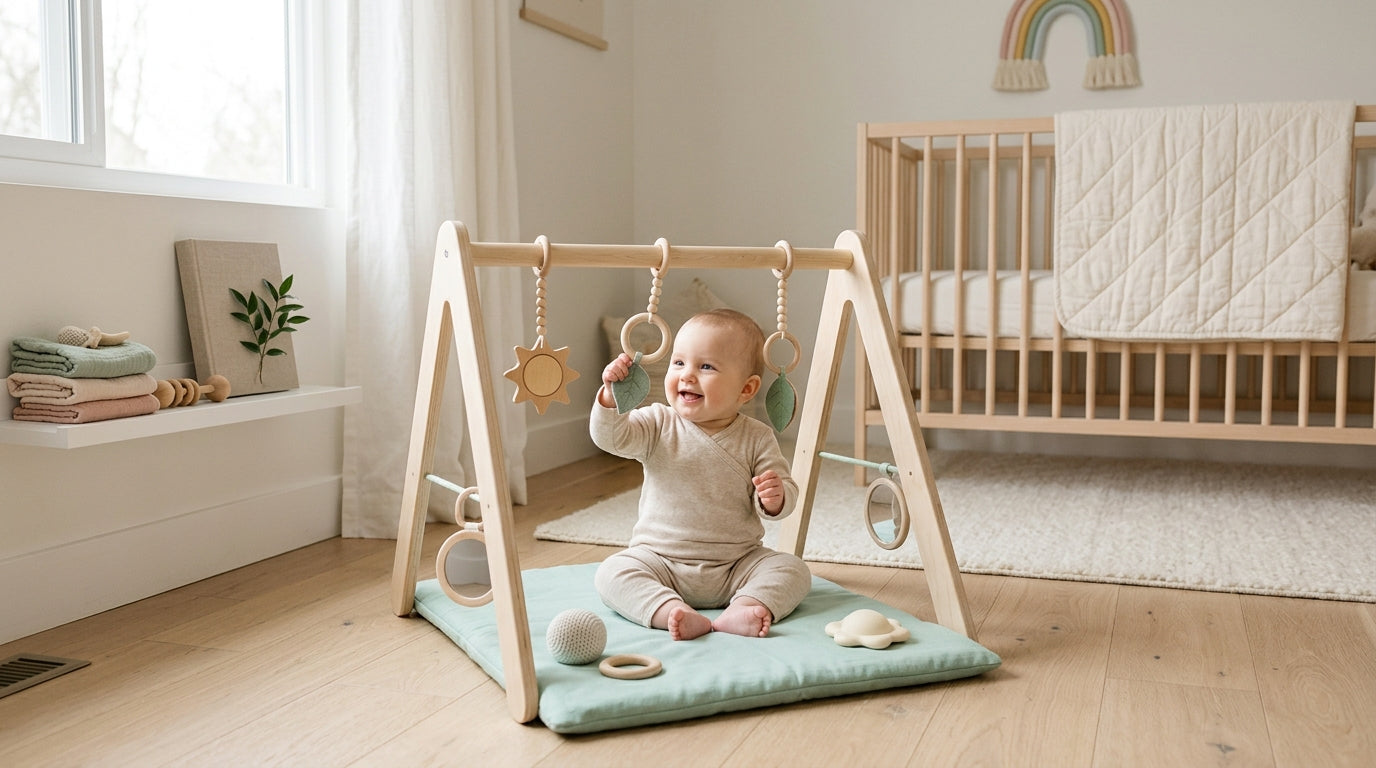
I finally got my hands on Kianao's Wooden Rainbow Play Gym Set, and I honestly wanted to weep with relief. This was easily my favourite baby purchase of the first year. It's an absolutely stunning wooden A-frame with these gorgeous, earthy-toned animal toys hanging down from it. It didn't trap the girls in a seat. I could just lay them on a soft rug underneath it, and they would spend ages batting at the friendly wooden elephant and trying to grasp the textured rings.
Because it's made from sustainably sourced wood and non-toxic materials, I didn't have a panic attack every time Lily inevitably pulled one of the rings into her mouth. It gave me the exact same hands-free time as the plastic spaceship, but they were seriously building their core muscles and practicing reaching without being locked into a weird hip-dangling posture. Plus, it looked lovely in our living room instead of looking like a theme park ride that had crashed through the ceiling.
We also tried the Fishs Play Gym Set, which is another Kianao option. It's perfectly fine—very sleek, very minimalist with just natural wooden rings. Honestly, it was a bit too minimalist for Maya, who demands high drama and bright colors at all times to hold her attention, but we ended up keeping it at my parents' house where it tucks away beautifully behind their sofa when we aren't visiting.
If you're currently drowning in a sea of aggressively loud plastic toys and need a sensory reset, you really should check out Kianao's organic play gym collection before you lose your mind entirely.
The fifteen-minute rule in practice
Even with the beautiful wooden gyms, there were still moments where I had to use the plastic seats just to safely mop up a spilled bottle of Calpol without two infants trying to lick the floor. But the medical advice for stationary centers is brutal: 15 to 20 minutes maximum per day.

Do you know what you can accomplish in 15 minutes with twins? Absolutely nothing. You end up doing this absurd dance of checking their foot alignment while simultaneously staring at the microwave clock to make sure you don't breach the arbitrary window of containment. By the time I had strapped Maya in, realized Lily had soiled her nappy, changed Lily, strapped Lily in, and turned on the kettle, Maya had reached minute 14 and was starting to aggressively demand her release.
And then there's the tummy time tax. For every minute they spent suspended in the plastic donut, I supposedly owed them equal time face-down on the rug to make up for the lost core development. It felt like I was running a highly stressful infant boot camp.
Distractions and sticky bears
To make those precious 15 minutes seriously count, I had to find ways to keep them engaged without turning on the electronic music that made my left eye twitch. I started getting creative with the tray tables.
I ended up taking the Baby Silicone Bear Plate we bought for weaning and suctioning it directly onto the plastic tray of the activity center. It has this ridiculously powerful suction base that outsmarted even Maya's aggressive yanking. I'd put a few safe, dry cereal puffs in the bear's ears, and the girls would spend ten minutes practicing their pincer grasp trying to fish them out. The plate is 100% BPA-free food-grade silicone, completely indestructible, and frankly, looking at that little bear face was vastly preferable to looking at the plastic gears the seat came with.
Parenting is basically just surviving a series of phases you barely understand until they're over. The activity center phase was short, loud, and filled with orthopedic anxiety. If I could do it all again, I'd skip the massive plastic containment units entirely, buy a good wooden play gym from day one, and accept that my kitchen floor is just going to be dirty for a few months.
Ready to swap the chaotic plastic spaceship for something that won't ruin your living room or your baby's hips? Explore Kianao's sustainable play collections and reclaim a tiny slice of your sanity.
Frequently Asked Questions (From a Tired Dad)
Do babies really need an activity center to learn how to stand?
Not at all. In fact, from what my GP explained, it's pretty much the opposite. Hanging out in a sling seat doesn't teach them balance or build the right muscles for standing. They learn to stand by pulling themselves up on your coffee table (and your trousers, and the dog). The center is just a temporary holding pen so you can drink a hot cup of coffee. Don't let anyone convince you it's an educational tool for walking.
How do I know if the activity center is adjusted to the right height?
You'll know it's right when their feet are completely, entirely flat on the bottom surface. If they're on their tiptoes even a little bit, it's too high. If their knees are bunched up near their ears, it's too low. You will spend an absurd amount of time adjusting this as they grow. If you can't get their feet flat, put a sturdy book under them, or better yet, just take them out.
Can I leave my baby in the activity center while I hop in the shower?
Absolutely not. I know the temptation is immense, but these things aren't babysitters. Even though they're stationary, babies can bounce so aggressively that poorly made ones can tip over, or they can pinch their little fingers in the toy attachments. You always need to be in the room, preferably staring at them while wondering how someone so small can create so much drool.
What's a better alternative if I need to put my baby down safely?
A simple, soft playmat with a wooden play gym over it's infinitely better for their development. They get unrestricted movement, they can practice rolling, and they don't have their hips locked in a weird position. Alternatively, a travel cot or a safe, enclosed playpen on the floor gives them room to move without the risk of them finding the one electrical socket you forgot to cover.




Share:
The Data-Driven Dad’s Guide to Using an Online Kids Boutique
An Honest Letter to Past Tom About the Best Baby Shower Gifts