

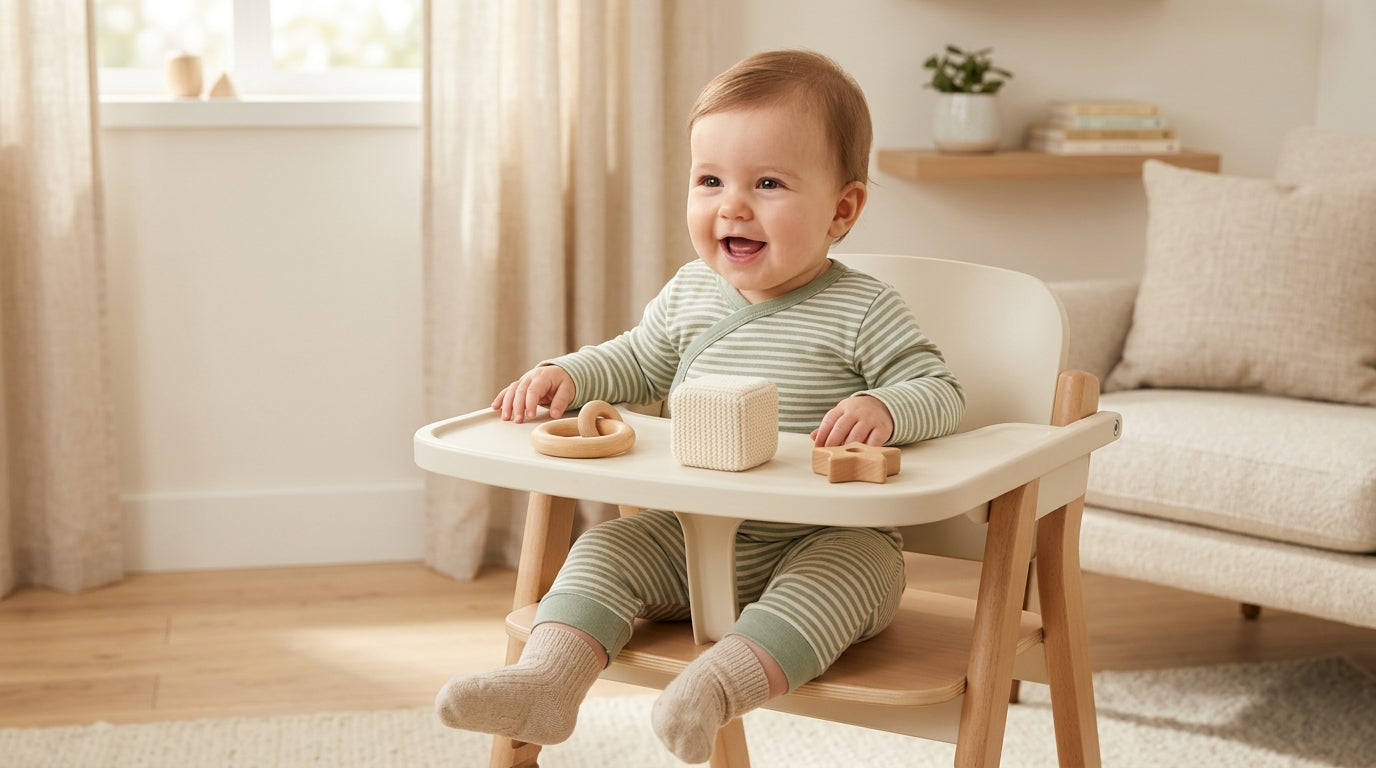
I was sitting on the beige rug in my living room, aggressively holding a wooden block in front of my ten-month-old's face, enunciating the word block like I was teaching a hostage how to defuse a bomb. He just stared at me blankly. Then he blew a wet raspberry, maintaining unbroken eye contact, and threw up a tiny bit of half-digested milk on his collar.
I used to be a pediatric nurse. I've stood in brightly lit clinic rooms and handed out those glossy developmental milestone checklists to hundreds of exhausted parents. I knew exactly what the medical charts said about the timeline of language acquisition. But the second I brought my own kid home to Chicago, all that clinical objectivity evaporated into pure, unfiltered panic.
I wanted the perfect first word. I wanted him to look at me, recognize my soul, and say mama in a clear, resonant voice that proved I was doing a good job. Instead, I got an endless series of grunts, and found myself at 2 a.m. typing frantic variations of 'why is my babie just growling' and 'babi speech delay signs' into search engines.
If you're spending your nights doom-scrolling and wondering about the exact timeline for kids starting to talk, I get it entirely. The gap between what the medical textbooks outline and what actually happens on your sticky living room floor is massive.
The textbook timeline is just a polite suggestion
When you work in triage, you learn that every human body does whatever it wants, whenever it wants. Yet, with infant development, we expect these tiny, chaotic creatures to run on a Swiss train schedule. My own doctor, Dr. Gupta, literally laughed at me when I brought in my heavily highlighted milestone tracker at our nine-month visit.
She reminded me of what I used to tell my own patients. Language doesn't start with a word. It starts in the dark, before they're even born, listening to the muffled rhythm of your voice through amniotic fluid.
From birth to six months, they're basically just taking notes. They communicate by crying, making aggressive eye contact, and eventually doing that throaty cooing thing. Around six to twelve months, they enter the babbling phase, which sounds like they're speaking fluent Swedish. They experiment with consonant sounds like ba and da, mostly because those are easy on the lips.
The textbooks say the first intentional word drops around twelve months. But honestly, that's an average that covers a wildly unpredictable bell curve. Some kids drop a clear word at ten months and then refuse to speak again for a year. Others are silent observers until they're eighteen months old, at which point they demand a cracker in a full sentence.
Throw away the dictionary
The biggest trap I fell into was waiting for a word that sounded like it belonged in a dictionary. We have this weird expectation that an infant's first word will be perfectly articulated. It won't be. If you're waiting for clear diction, you're going to be waiting a very long time.
Pediatric speech pathologists are actually incredibly lenient about what constitutes early language. A word doesn't have to be perfect. It just has to be consistent and intentional.
- Animal noises count. If your kid points at a dog and says ruff every single time, that's a word. You don't need to correct them and demand they say dog.
- Fragments are fine. My son called water wa for six months. He knew what he wanted. I knew what he wanted. Dr. Gupta counted it as a word.
- Exclamations are words. Saying uh-oh when they drop their pacifier out of the stroller for the ninth time is functional communication.
- Sign language is language. If they aggressively sign for more cheerios, that counts as a word in their vocabulary bank. Gestures are the bridge to spoken language.
How to pull the words out of them
Listen, you can't just drill them with flashcards and expect them to become conversationalists. I tried the flashcard thing for about two days before realizing we both hated it and I felt like a drill sergeant. You just have to drag them into your daily narrative, talking to them constantly while you load the dishwasher or fold laundry, instead of trying to schedule dedicated vocabulary time.

- Narrate the mundane. Treat them like a silent podcast guest. Tell them exactly what you're doing. I'm getting the cold milk out of the fridge, pouring it into the blue cup. It feels ridiculous, but it builds their passive vocabulary.
- The hostage negotiation. Don't just anticipate every need and silently hand them their water cup. Hold it for a second. Ask if they want the water. Wait for a grunt, a look, or a point. You have to give them a reason to communicate.
- Add one word. When they eventually do say something like dog, you just bounce it back with an upgrade. Yes, big dog. It's called scaffolding, and it works better than constantly correcting their pronunciation.
Toys that give them something to talk about
As a first-time mom, I bought entirely too much battery-operated plastic junk that sang obnoxious songs. I thought the noise would encourage him to talk. In reality, toys that talk usually just create kids who listen. If the toy is doing all the work, your kid doesn't have to.
I ended up boxing up all the electronic sirens and replacing them with quiet things that required us to interact. If you need a starting point, look at our wooden play gyms or simpler items that require imagination.
My absolute favorite was the Bunny Teething Rattle. It's just untreated beechwood and cotton yarn. There are no batteries. When my kid's gums were inflamed, he would gnaw on the wooden ring like a feral animal. But because it didn't make its own noise, I had to make the noise. I'd shake the little crochet ears and say hop, hop, hop. Eventually, he started holding it up and whispering hop. It's natural, it looks cute sitting on the rug, and it forced us to actually talk to each other instead of staring at flashing lights.
On the flip side, we also had the Squirrel Teether. It's a piece of food-grade silicone shaped like a squirrel. It's fine. It does exactly what it's supposed to do, which is give them something safe to chew on when their molars are coming in. You can throw it in the dishwasher when they inevitably drop it on the floor of a coffee shop. It's a solid, utilitarian object, even if it didn't spark any deep linguistic moments for us.
The bilingual panic
We need to talk about the absolute myth that raising a kid with two languages causes speech delays. My mother speaks Hindi to my son. She calls him beta, asks him if he wants paani, and sings him old Bollywood lullabies. I speak English to him.

When he hit fourteen months and only had about three clear words, the aunties in my community immediately started suggesting that the two languages were confusing his little brain. I even had a well-meaning neighbor tell me I should probably stick to English until he caught up. It made my blood boil.
The clinical data on this is entirely clear, even if the neighborhood gossip is not. Bilingualism doesn't cause delays. A bilingual toddler might know ten words in English and ten words in Hindi. A monolingual kid might know twenty words in English. Both kids have a twenty-word vocabulary. Your doctor will count all of them. The brain is fully capable of sorting it out, so let the grandparents speak their mother tongue.
Oh, and if someone tells you a minor tongue tie is the primary reason your kid isn't quoting Shakespeare at age two, they're probably just trying to sell you an expensive laser procedure.
When the silence seriously means something
Because I've seen the dark side of pediatric health, I always tell parents to trust their gut. There's a difference between a quiet kid and a kid who's struggling to connect.
The timeline might be flexible, but the progression should be steady. If you hit twelve months and there's absolutely no babbling, no consonant sounds, and no attempt to make eye contact or respond to their name, that's worth a conversation with your doctor. If they're fifteen months old and don't point at things they want, or if they suddenly lose language skills they previously had, you pick up the phone.
Early intervention is not a failure on your part. It's just getting them a tutor for a subject they're struggling with. Speech therapy is basically just highly structured play, and the kids usually love it.
Most of the time, though, they're just operating on their own schedule. They're watching you. They're listening. They're just waiting until they've something important to say.
Before you head down another midnight internet rabbit hole, take a deep breath, close the search tabs, and check out our teething toys collection to find something natural that might just distract them long enough to let out a new sound.
Questions you're probably still asking
Does 'uh-oh' genuinely count as a word?
Listen, yes. It completely counts. It has a specific meaning, it's used in context, and it communicates a thought. Whether they drop a spoon or knock over a tower, if they say uh-oh every time, write it down in the baby book. It's a word.
My mother-in-law says boys talk later than girls, is that true?
Clinically speaking, boys do tend to develop expressive language slightly later than girls on average. We're talking about a difference of a month or two, not years. It's a slight statistical trend, not an excuse for a massive delay. But yes, you can tell your mother-in-law she's technically right if it gets her off your back.
Should I correct their pronunciation when they say a word wrong?
No. Don't tell them they're wrong. If they proudly point at a truck and call it a guck, you just say, yes, that's a big green truck. You validate the communication while modeling the correct sound. If you constantly correct them, they're just going to stop trying.
Does background television ruin their speech development?
I'm not going to sit here and tell you I never turn on a cartoon when I need to clip his fingernails. But keeping the TV on constantly as background noise does drown out the organic language of your house. It makes it harder for them to isolate the sounds of your voice. Turn it off when you're not actively watching it.
We use a lot of pacifiers, is that delaying his talking?
It's physically hard to talk with a silicone plug in your mouth. Prolonged pacifier use during the day, especially past age one, can limit their opportunities to babble and practice tongue placement. Keep the pacifier for sleep and high-stress meltdowns, but pull it out when they're just playing so they can honestly use their mouth.




Share:
When do babies start clapping: a letter to my panicked past self
Exactly when do you feel baby kick: A very unscientific timeline