

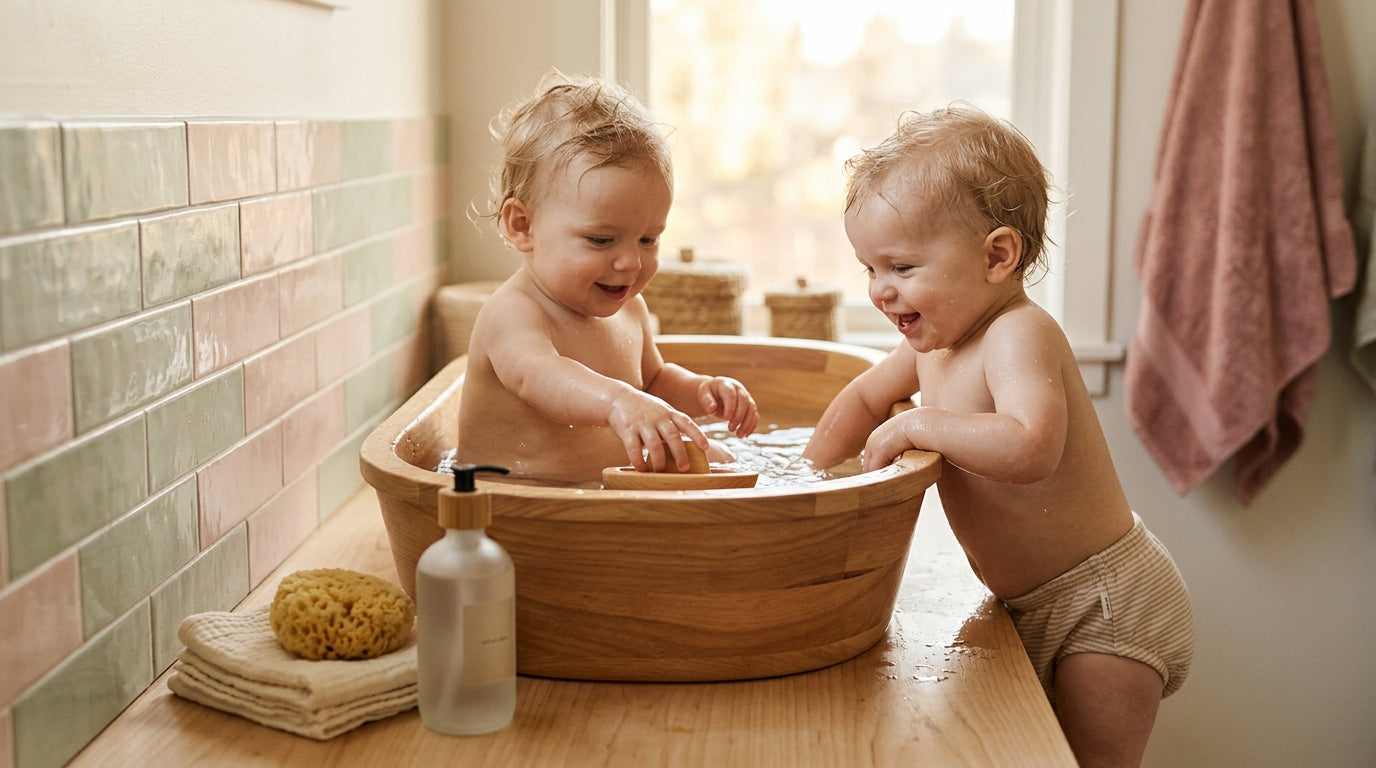
I'm currently holding onto a wet, furious 11-kilo toddler with my left forearm while my right hand desperately attempts to extract lather from a plastic bottle before her sister successfully drinks a pint of lukewarm, slightly soapy bathwater. If you've spent any time on Instagram, you've likely been sold the absolute greatest myth of modern parenting: the serene, lavender-scented evening bath time routine.
You know the imagery I'm talking about. A beaming mother gently sponging a cooing infant in a porcelain sink, soft acoustic music playing in the background, a fluffy hooded towel waiting in the wings. I'm here to demolish that fantasy right now. In our London flat, bathing twin two-year-old girls is less of a bonding experience and more of a hostage negotiation in a slippery porcelain death trap, where any sudden movement results in a minor concussion or a flooded bathroom floor.
So when we talk about a baby wash, we aren't just talking about getting grime off a small human. We're talking about a tactical instrument of survival. And that brings me to the ubiquitous yellow bottle you've probably seen on every pharmacy shelf: the Cetaphil cleanser for babies. I've spent an embarrassing amount of time over the last two years analyzing this specific formulation, mostly because when you're trapped in a steamy bathroom with two screeching children, you tend to read the backs of bottles to maintain a shred of sanity.
The medical advice I didn't want to hear
My lovely NHS GP down at the clinic peered over her glasses when the girls were about three months old, took one look at my exhausted, water-logged face, and told me we were washing them entirely too much. Apparently, human infants aren't supposed to be scrubbed daily like dirty kitchen worktops.
From what I loosely understand of the science she threw at me, newborns are covered in a microscopic armor of natural oils and good bacteria. When we dunk them in a tub every single night out of some misguided attempt to establish a sleep routine, we're basically stripping away the exact barrier they need to survive the absolute cesspool of germs they'll eventually encounter at nursery. My GP suggested that bathing them two or three times a week was plenty, and honestly, the sheer relief of striking that chore off the daily to-do list was the best medical advice I've ever received.
A completely disproportionate rant about packaging
Let's talk about the physical design of this Cetaphil baby product, because I've intensely strong feelings about it. Most shampoos and soaps are designed by people who clearly don't have children, featuring pump action nozzles that require two hands or, worse, screw caps that demand a level of dexterity impossible to achieve while restraining a squirming infant.
But the geniuses behind this particular yellow bottle did something extraordinary: they put the dispensing cap on the bottom. I know this sounds like a trivial detail, but when you're operating on three hours of sleep and your left hand is occupied keeping a slippery infant's head above water, gravity is your only friend. Because the bottle rests on its cap, the liquid is always right there at the opening, ready to be deployed with a one-handed squeeze.
There's no furious shaking, no banging the plastic against the side of the tub, no watching the soap slowly ooze down the inside of the plastic while your child tries to stand up in a wet basin. You just grab, squeeze, and toss it back on the ledge. It's a minor engineering miracle that has legitimately saved me from dropping a child on more than one occasion.
The calendula scent smells a bit like an upscale garden centre, which is fine if you're into that sort of thing.
Decoding the back of the bottle (so you don't have to)
If you're anything like me, you've probably spent late-night hours spiralling down internet rabbit holes trying to figure out if you're accidentally poisoning your child with bath products. The Cetaphil baby formula is heavily marketed as dermatologist-recommended, hypoallergenic, and tear-free, which sounds lovely until you actually look at the ingredient list and realize you need a chemistry degree to understand it.

Here's how my sleep-deprived brain processed the biology. The wash relies heavily on glycerin and panthenol (Vitamin B5), which apparently act like tiny little hydration magnets. Instead of just stripping dirt off, they supposedly draw water into the skin and trap it there. This makes sense to me, because after a bath, the girls feel less like dried-out husks and more like slippery little seals.
Then there's the whole "tear-free" wizardry. For the longest time, I assumed tear-free meant they included some sort of mild numbing agent (which, let's be honest, sounded slightly terrifying). But a pediatric nurse at our health visitor drop-in explained that it's actually just basic pH balancing. The soap is formulated to match the natural pH of a baby's eyeball—somewhere around a 7, I think, though I failed GCSE chemistry quite spectacularly. Because the alkalinity isn't drastically different from their own tears, it doesn't trigger the stinging pain that traditional adult soaps do.
The great eczema gamble
But here's where things get messy, and why I've a love-hate relationship with this particular brand. The bottle proudly slaps the word "hypoallergenic" across the front. Yet, halfway down the ingredient list, you'll spot the word "fragrance" (or parfum, if we're feeling fancy).
One of my twins has skin so sensitive she breaks out in a rash if a wool jumper looks at her aggressively from across the room. Our health visitor warned us that artificial fragrances are basically the mortal enemy of eczema-prone baby skin, acting as a massive trigger for contact dermatitis. So while the calendula extract is supposedly soothing soreness—a trick people have apparently been using since the Middle Ages—the added perfume is actively fighting against it.
We learned the hard way that you must patch-test this stuff. We used it freely for a week, and suddenly twin number one had little red angry patches on her calves. We had to switch her entirely to a completely fragrance-free medical emollient, while her sister, who apparently inherited my wife's invincible genetics, continues to bathe in the fragrant yellow lather without a single blemish.
Surviving the post-bath extraction
Getting them clean is only half the battle. Once I successfully extract them from the tub without sustaining a head injury, the real race against time begins. You have approximately three minutes to lock in whatever moisture the bath provided before the air dries their skin out completely, all while they're screaming because the bathroom is suddenly freezing.

Trying to shove damp, uncooperative, octopus-like limbs into stiff pyjamas is a form of psychological torture. This is exactly why my absolute favorite piece of clothing we own is the Organic Cotton Baby Bodysuit. I'm completely serious when I say this sleeveless wonder has saved my evenings. The lack of sleeves means I can just slide it straight up their squirming bodies without having to bend their little damp arms into unnatural angles. Plus, because we're managing eczema, the fact that it's 95% undyed organic cotton means I'm not immediately suffocating their freshly washed skin in synthetic polyester that traps heat and causes flare-ups. It's incredibly stretchy, holds its shape, and doesn't have those scratchy tags that make my sensitive twin rub her neck against the rug like a bear scratching an itch.
Looking to upgrade your post-bath routine? Take a breather and check out Kianao's full collection of breathable, organic baby apparel that won't make your little one break out in mysterious rashes.
The distraction techniques
Bath time requires immense misdirection. If you aren't actively entertaining them, they'll try to eat the flannel, stand up on the slippery plastic bottom, or fight each other over a solitary plastic cup.
When they're aggressively teething, the tub becomes a giant chew toy. I've caught them gnawing on the edge of the baby bath more times than I can count. To stop them from ingesting soapy plastic, I usually throw a distraction onto the bath mat for them to look forward to when they get out. We have the Bear Teething Rattle, which is... fine. The smooth beechwood ring is genuinely great for their gums, and it looks beautiful in the nursery, but the cute crochet bear gets absolutely manky if they manage to grab it with wet hands and drag it into the actual bathwater. It takes ages to dry. Keep that one strictly on dry land.
If you need them to stay put for five seconds while you towel dry the other one, a floor distraction is important. I'll usually plonk one twin under our Wooden Baby Gym in the hallway. It buys me exactly two minutes of peace. The natural wood and gentle colors aren't violently overstimulating like those plastic monstrosities that play terrible electronic music, and reaching for the little hanging elephant keeps her arms occupied so she isn't trying to pull my glasses off my face while I'm dealing with her sister's nappy.
A word on lather and chemical compromises
If you read the parenting forums at 3am (don't do this, it'll destroy your soul), you'll see massive debates about sulfates. The Cetaphil baby formulation uses Sodium Laureth Sulfate (SLES) to create those satisfying bubbles.
Here's my very tired, decidedly non-expert take: SLES isn't the hyper-aggressive stripping agent that old-school SLS is, but it's still a synthetic surfactant. If you're deeply committed to an ultra-clean, 100% plant-derived, eco-warrior lifestyle, this probably isn't the bottle for you. But if you're a standard, exhausted parent just looking for something that reliably cuts through the layer of mashed banana crusted onto your child's neck without causing major chemical burns, it does exactly what it says on the tin.
Parenting is just an endless series of small compromises. We don't bathe them every night anymore, we slather them in thick fragrance-free cream the second they're dry, and we accept that sometimes, survival is more important than achieving Instagram perfection.
Ready to make your parenting life just a tiny bit less chaotic? Explore Kianao's range of smart, organic essentials designed to actually work in the real world.
The messy, honest FAQs
How often should I really be bathing my newborn?
If you ask my GP, significantly less than you think. Unless they've had a spectacular nappy explosion that defied the laws of physics, two to three times a week is plenty for a newborn. Their skin is incredibly thin and prone to drying out, so skipping the daily scrub seriously helps preserve their natural moisture barrier. On the off days, just wiping down their face, neck rolls, and nappy area with warm water does the trick nicely.
Is tear-free soap really safe for their eyes?
It's safe in the sense that it won't cause them agony, but you still shouldn't be squirting it directly into their retinas. The formula is pH balanced to mimic natural tears, which stops the burning sensation, but it's still a cleansing agent. If some suds slide down their forehead into their eyes during a hair rinse, they won't scream the house down, but you should still wipe it away with a clean, wet flannel as soon as you can.
What's the deal with the fragrance in this brand?
This is my biggest gripe. It contains synthetic perfume alongside natural calendula extract. For babies with normal, robust skin, it leaves them smelling lovely and fresh. But if your kid has active eczema or contact dermatitis, that fragrance is a massive red flag. Always do a patch test on a small area of their leg 24 hours before you commit to a full-body lather.
How do I stop them from slipping under the water?
You don't, really—you just have to hover over them like an anxious hawk. I highly suggest using a baby wash that has a one-handed dispensing mechanism (like the bottom-up cap) so you never have to let go of your child to get the soap out. Keep the water shallow, put a non-slip mat in the big tub once they outgrow the baby basin, and accept that your own sleeves are going to get absolutely soaked.
Why do they scream bloody murder the second I take them out?
Because going from a warm, cozy 38-degree bath into a drafty hallway is an objectively terrible experience. Their tiny bodies lose heat incredibly fast. The trick is to have the towel fully open and resting on your shoulder before you even initiate the lift, so you can wrap them like a burrito the millisecond they clear the water. Pat them dry gently—rubbing just aggravates the skin—and slap on their lotion while they're still slightly damp to lock the moisture in.




Share:
Spotting Cerebral Palsy in Babies: A Twin Dad’s Messy Story
The Uncanny Valley of the CGI Baby in Squid Game