

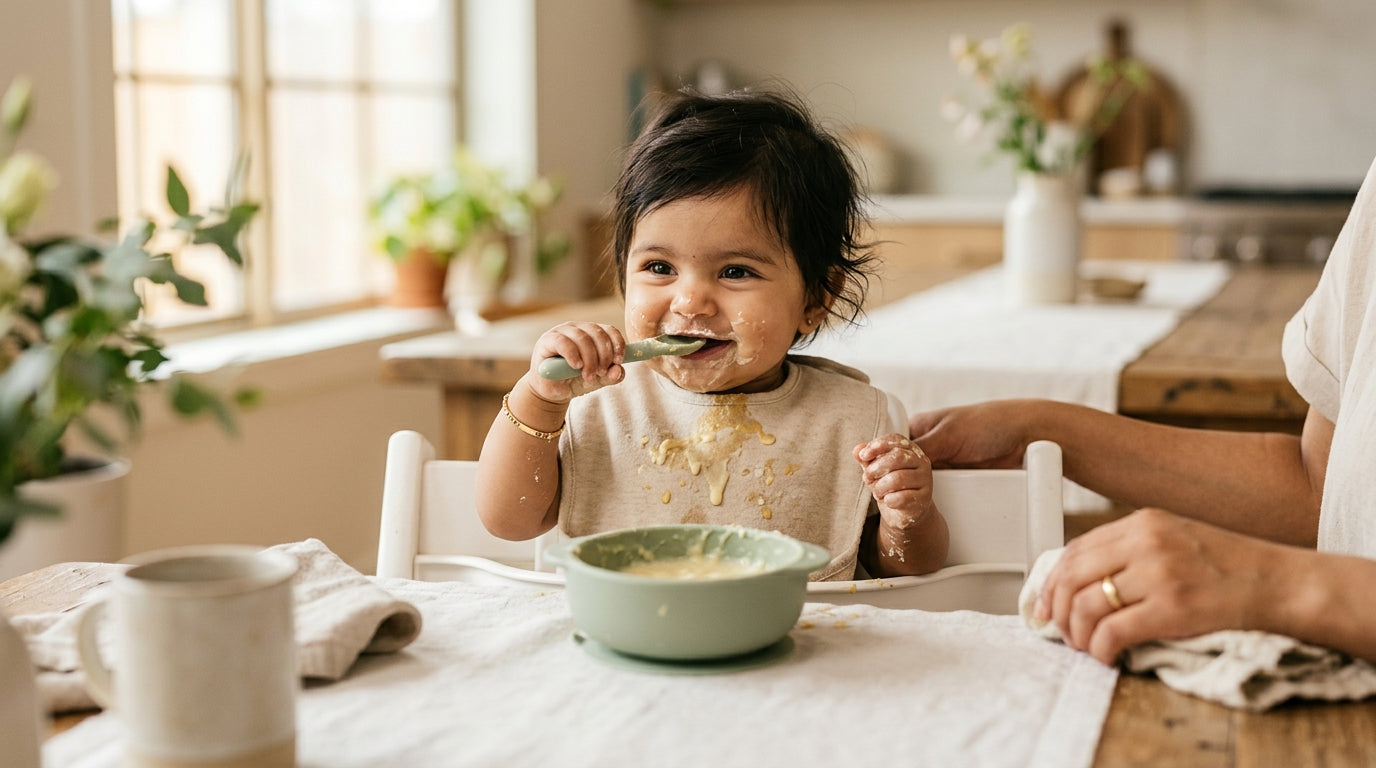
Listen. You're currently standing in the dairy aisle at Patel Brothers, staring at the cartons of cultured buttermilk and traditional chaas, having a mild internal crisis. Your mom has been asking for weeks when her precious granddaughter can finally have some yogurt or chaas, and your nurse brain is battling your exhausted new-mom brain over the exact right way to introduce dairy. You're overthinking it, yaar.
I'm writing this to you from six months in the future. The high chair is permanently sticky, there's a suspicious white crust on the kitchen baseboards, and we survived the whole buttermilk baby phase. I know you're staring at your phone, trying to cross-reference pediatric guidelines with traditional Indian weaning practices. You should probably just take a breath, put the full-fat milk down, and let me tell you how this actually goes.
The cultural pressure cooker and the dairy aisle
thing is about being an Indian-American mom trying to feed a baby. On one side, you've got Western medical advice treating cow's milk like it's radioactive before the first birthday. On the other side, you've got every aunty in your zip code telling you that a little buttermilk will settle the baby's stomach and make her strong. It's enough to make you want to just feed her plain avocados until she's in preschool.
My pediatrician vaguely mentioned that yes, babies can have buttermilk starting around six months, but only as an ingredient, never as a drink. That distinction is going to be your lifeline. You're going to treat feeding like hospital triage, deciding which nutrient takes priority. For the first year, breast milk and formula are the VIPs holding the trauma bay. Everything else, including buttermilk, is just waiting in the lobby.
The problem is that buttermilk is mostly water and milk solids. If you fill her tiny, walnut-sized stomach with it, she won't have room for the nutrient-dense stuff she actually needs to grow. So you're going to use it like a secret weapon in cooking, not as a beverage. And please, for the love of everything, make sure you're buying the pasteurized stuff. Medical organizations are pretty universally against raw dairy for infants, and I've seen enough weird bacterial infections in the pediatric ward to know you don't mess around with unpasteurized anything.
The great iron blockade and the fat deficit
This is the part that's going to annoy you the most. Dairy is an iron blocker. I think it has something to do with the calcium binding to the iron, or maybe they just compete for the same receptors in the gut. My sleep-deprived brain doesn't remember the exact cellular mechanism from nursing school anymore, but the result is the same. Babies need a ton of iron, and pouring buttermilk over their iron-fortified cereal basically cancels out the benefits.

You'll end up playing this ridiculous game of culinary chess. You'll serve the buttermilk-infused purees at lunch, completely separate from the iron-heavy lentils at dinner. Or you'll try to game the system by throwing a handful of mashed strawberries into the buttermilk oatmeal, because vitamin C is supposed to boost iron absorption. It sounds exhausting, and it's, but you'll get used to it.
Then there's the fat issue. Commercial buttermilk in the US is almost always cultured skim milk. It's tangy and great for baking, but it has zero fat. Babies need dietary fat to build their rapidly developing brains. So you're going to find yourself doing deeply weird things, like drizzling extra virgin olive oil over a bowl of buttermilk and sweet potato puree. It smells completely bizarre, but trust me, she'll inhale it.
Gear that actually survives the mess
Let's talk about the laundry. Introducing dairy is messy, and cultured milk smells exactly like vomit when it dries on fabric. You're going to ruin a lot of cute clothes before you figure out a system.
Do yourself a favor and stock up on the Organic Cotton Baby Bodysuit Sleeveless Infant Onesie. This became my absolute favorite piece of clothing during the messy weaning phase. When the inevitable dairy spit-up happens, the envelope shoulders mean you can pull the whole thing down over her body instead of dragging a sour-milk-soaked collar over her face. I've seen a thousand diaper blowouts, but nothing prepared me for the sheer volume of a milk-heavy spit-up. The fabric on this bodysuit really washes clean without holding onto that awful spoiled milk smell, and it's stretchy enough that I wasn't wrestling her into it while she was covered in dried porridge.
On the flip side, you can probably pack away the Flutter Sleeve Organic Cotton Baby Bodysuit Ruffled Infant Romper for a while. Don't get me wrong, it's incredibly soft and looks beautiful for family photos. But those little flutter sleeves act like giant nets for flying spoons of buttermilk oatmeal. It looks cute for exactly three seconds until she aggressively rubs her face and then grabs her shoulder. Save the ruffles for when she genuinely knows how to use a spoon.
Also, cooking these elaborate baby-safe buttermilk pancakes takes time, and she's going to be screaming at your ankles while you do it. Her teeth are coming in, and she's miserable. I usually hate aesthetic baby gear, but the Panda Teether Silicone Baby Bamboo Chew Toy honestly saved my sanity in the kitchen. I'd just hand her this little silicone panda, and the bamboo-textured edges kept her gums busy long enough for me to flip a pancake without losing my mind. It's dishwasher safe too, which is mandatory because it'll absolutely end up covered in dog hair and floor dirt.
Browse Kianao's organic baby apparel collection if you need a lifeline for your laundry pile. You're going to need more basics than you think.
The allergy wait and watch
Because you're a nurse, you're going to treat her first bite of dairy like a high-stakes clinical trial. Cow's milk is a top allergen. You already know this, but you're still going to sit there staring at her face for two hours, waiting for a hive to appear.

The immediate reactions are one thing. You know what anaphylaxis looks like. But what really kept me up at night was the risk of FPIES. Food Protein-Induced Enterocolitis Syndrome sounds like a complicated diagnosis, but it's basically a delayed allergic reaction in the gut. The baby eats dairy, seems totally fine, and then two or three hours later, turns into a terrifying vomiting fountain. It can lead to severe dehydration so fast.
I'm telling you this not to freak you out, but to validate your anxiety. It's okay that you only gave her half a teaspoon of buttermilk puree on the first day. It's okay that you waited until a Tuesday morning when the pediatrician's office was open, instead of doing it on a Sunday night. You'll introduce it slowly, watch her breathing like a hawk, and eventually, she'll be fine. Just mix a tiny bit into a food she already tolerates, like mashed banana or potato, and wait.
The age-by-age survival timeline
You're probably wondering how this honestly plays out over the next few months. Here's what our reality looked like, stripped of all the aesthetic Instagram mommy-blogger filters.
Between six and nine months, buttermilk was just a minor additive. I'm talking one or two teaspoons mixed into thick purees. The sour, tangy taste was a shock to her system at first. She made that classic baby lemon-face the first time she tried it. I used it mostly to thin out sweet potato mashes when I was too lazy to pump fresh milk for a recipe.
From nine to twelve months, we moved on to baking. This is the sweet spot. You'll start making these dense, sugar-free buttermilk muffins and soft pancakes. The cultured milk makes them fluffy enough that she can practice her pincer grasp without choking on dry crumbles. Just remember to add a healthy fat, like hemp seeds or mashed avocado, into the batter.
Once she hits a year old, everything changes. The pediatrician will finally give you the green light to offer buttermilk as an actual drink. This is when it becomes a secret weapon. Regular water and whole milk flow too fast from an open cup, and she'll just end up wearing it. Buttermilk is thicker. It moves slower. It's the absolute best practice liquid for teaching a toddler how to use an open silicone cup without waterboarding themselves. Plus, the probiotics in it are great when she inevitably catches some mild daycare stomach bug and refuses to eat solid food.
So buy the carton of cultured milk, Beta. Make the messy pancakes. Take the photos of her covered in food. Stop treating the grocery store like a pharmacy, and just trust that you know what you're doing.
If you need gear that really survives this chaotic feeding journey, check out Kianao's sustainable baby essentials before you ruin another nice outfit.
The messy questions you're afraid to ask
Can I just give my 7-month-old a bottle of buttermilk if they refuse formula?
Absolutely not. I know it's tempting when they go on a formula strike and you're desperate to get calories into them, but you can't replace their primary nutrition with cultured dairy. Buttermilk has way too much protein and minerals for their immature kidneys to process in large amounts. It also lacks the specific fat and nutrient profile of breast milk or formula. Keep offering the bottle, and only use the buttermilk as a tiny ingredient in their solid food until they hit twelve months.
What do I do if she gets a rash around her mouth after eating buttermilk pancakes?
You're going to panic, obviously, but try to look at the rash objectively. Sometimes the high acidity and tanginess of cultured milk just irritates their super sensitive skin, especially if it sits there while they eat. If it's just a mild contact rash around the lips that fades after you wipe her face with a wet cloth, it's probably just irritation. But if the hives spread to her chest, or if she starts coughing, vomiting, or swelling, you treat it like an emergency. When in doubt, take a picture and call the pediatrician's triage line.
Is Indian chaas the same as the buttermilk I buy at an American grocery store?
Not exactly, which is why your mom's advice and your doctor's advice feel disconnected. Traditional chaas is the liquid left over after churning butter from cultured yogurt, and it's usually watered down and heavily spiced with salt, roasted cumin, and sometimes green chilies. You definitely shouldn't give salted, spiced chaas to a young baby because their sodium limit is incredibly low. Commercial American buttermilk is just pasteurized skim milk with lactic acid bacteria added. It's safe to bake with for babies, as long as it's plain.
Does cooking the buttermilk destroy the probiotics?
Yeah, it pretty much nukes them. When you bake buttermilk into a muffin or a pancake at 350 degrees, the beneficial bacteria don't survive. But honestly, for a six-month-old, you're mostly just using it to introduce the cow's milk allergen safely and add some calcium and flavor to their diet. Don't stress about the probiotics right now. Once they're over a year old and can safely drink it cold from a cup, they'll get all those gut-health benefits. For now, just focus on surviving mealtime without pulling your hair out.
How long does this stuff even last in the fridge?
Longer than regular milk, but not forever. Because it's cultured and acidic, it holds up pretty well. I usually give it about two weeks after opening, but honestly, your nose is your best tool here. If it starts smelling like old cheese instead of just tangy yogurt, throw it out. You can also freeze leftover buttermilk in silicone ice cube trays and just pop a cube into a warm vegetable puree when you need it. It separates a little when it thaws, but you're mixing it into mush anyway, so the baby won't care.




Share:
The Truth About Burt’s Bees Infant Gear: A Dad's Guide
Troubleshooting the Caden Lane Baby Hype: A Dad's Deep Dive